Negligent servicing is the reason an FSA guarantee can be worth less than its percentage, and the regulation says so in one sentence: the loan guarantee cannot be enforced by the lender, whenever the agency finds out, to the extent the loss results from negligent servicing. That is not a fine and not a haircut — it is the agency declining to pay the part of the loss the lender's own servicing caused, calculated in dollars. For a credit officer or a CFO the practical question is what the specific failures are worth, because the regulation names three of them and they are all failures of timing. Botminds' FSA Guaranteed Loan Servicing exists for that narrow reason: it keeps every 7 CFR 762 date on a board with the rule behind it and prepares each filing before the date arrives, so the servicing history the agency reads after a default is the one the bank meant to have.
The money examples come from a fictional sample bank, Lindmark Valley Bank, as it runs through the solution on sample data; the farms and people are invented. Where this page does arithmetic on those figures it says so. The regulation and the survey data are real and linked.
The FSA guaranteed loan guarantee percentage, and the part it does not cover
Guaranteed farm loans carry a percentage of guarantee written on the loan note guarantee, commonly 90% and in some programmes higher. Most of the time it behaves exactly as expected: the lender takes a loss, the agency pays its share, the bank books the rest. The exception is written into the part's own section on full faith and credit, and it is short enough to read in full.
"The loan guarantee cannot be enforced by the lender, regardless of when the Agency discovers the violation, to the extent that the loss is a result of: (1) Violation of usury laws; (2) Negligent servicing; (3) Failure to obtain the required security; or, (4) Failure to use loan funds for purposes specifically approved by the Agency."
7 CFR § 762.103(b), Lender violations
Three phrases in that sentence do the work. "Cannot be enforced" means the guarantee simply is not available for the affected part, rather than the agency having a discretion to exercise. "Regardless of when the Agency discovers the violation" removes any comfort from the passage of time; a servicing failure from two years ago is live when the claim is read. And "to the extent that" sets the measure: not all or nothing, but a dollar amount matched to the loss that the failure caused.
One important asymmetry sits just below it. The same section says the guarantee and the right to require purchase remain "directly enforceable by the holder" even where it is unenforceable by the lender because of a lender violation. If the guaranteed portion was sold on the secondary market, the holder is still paid; the lender carries the gap. That is worth knowing before a bank treats secondary-market sales as a way of moving the risk.
A sample claim, from the guaranteed share to what is actually paid
The loss, as the claim states it
$225,395
Estimated loss on the sample dairy claim, after both gaps were fixed.
The guaranteed share
90%
The percentage written on this loan note guarantee. It is fixed when the guarantee is issued, not when the loss happens.
What the agency pays, servicing clean
$202,856
90% of $225,395. This is the number a lender has in mind when it says the loan is 90% guaranteed.
Less the loss negligent servicing caused
the agency’s calculation
Not a penalty and not a percentage: the dollar amount of loss the agency attributes to the lender’s own servicing, which can be any size up to the whole of it.
Less interest from an excessive delay
not paid at all
Interest accruing during delays in collection the agency considers excessive is not paid, separately from any other reduction.
What the lender actually receives
the remainder
Which is why the guarantee percentage is the ceiling on a claim, never the floor.
What is negligent servicing? Failing what a reasonably prudent lender would do
The definition is not in part 762 but in the definitions that serve the whole farm loan programme, and it is broader than most lenders assume. Negligent servicing "is servicing that fails to include those actions that are considered normal industry standards of loan management or comply with the lender's agreement or the guarantee", and it "includes failure to act or failure to act in a timely manner consistent with actions of a reasonable lender in loan making, servicing, and collection" (§ 761.2(b)).
Read that definition for what it tests. It is not a test of intent, of competence, or of whether the loan would have gone bad anyway. It has three independent limbs — industry standards, the lender's agreement, and the guarantee itself — and failing any one is enough. And the phrase "failure to act in a timely manner" makes lateness a form of negligence in its own right, which is the limb a servicing calendar either satisfies or does not.
That is why a missed date is a different kind of problem from a bad credit judgement. A lender that took a considered view on a restructure and was wrong is a lender that made a decision. A lender that let the 90-day decision pass undecided has not made a decision at all, and the second is the one the definition names.
Why would FSA reduce a loss claim? Three failures the regulation prices
The reduction rules sit in the loss-claim section, and they are specific about mechanism. The agency "will reduce a final loss claim based on its calculation of the dollar amount of loss caused by the lender's negligent servicing of the account", and the first of the listed grounds names three failures in one sentence:
"A loss claim may be reduced by the amount caused by the lender's failure to secure property after a default, and will be reduced by the amount of interest that accrues when the lender fails to contact the borrower or takes no action to cure the default, once it occurs. Losses incurred as a result of interest accrual during excessive delays in collection, as determined by the Agency, will not be paid."
7 CFR § 762.149(i)(6)(i)
Notice the difference between "may" and "will". Failing to secure property after a default may reduce a claim; failing to contact the borrower, or taking no action to cure the default, will reduce it by the interest that accrues meanwhile. The second is automatic in the regulation's own language, and it is exactly the failure a quiet calendar produces — nobody decided not to contact the borrower, the date simply went by.
The third sentence is separate from both and worth reading alone. Interest accruing during delays in collection that the agency considers excessive "will not be paid", whether or not anything else about the servicing is criticised. A lender that took eight months to start a liquidation it always intended to run has no negligence to admit and still loses the interest.
The three priced failures, what each costs, and the date that prevents it
| The failure, in the regulation’s words | What it costs | The date that would have prevented it |
|---|---|---|
| "Failure to secure property after a default" | The claim may be reduced by the amount the failure caused — typically the difference between what the security was worth at default and what it brought. | The farm visit and collateral check that follow a default, and the lien continuations that keep the position perfected. |
| "Fails to contact the borrower" | The claim will be reduced by the interest that accrues while there is no contact. | The borrower meeting within 15 days of default, which is 45 days after the payment due date on a money default. |
| "Takes no action to cure the default" | Same: the interest that accrues meanwhile is not paid. | The restructure-or-liquidate decision within 90 days of default, and the default status report every 60 days until the default is cured. |
| "Interest accrual during excessive delays in collection" | Not paid at all, as a separate matter from any reduction. | The liquidation plan and estimated loss claim within 150 days of the payment due date. |
| Interest beyond the limit | The agency will not pay interest beyond 210 days from the payment due date; after that it is the bank’s own. | Everything above, early enough that the claim is filed inside the window. |
What the agency will not reduce a claim for
The same section lists what does not count against a lender, and it is as useful as the list that does. Losses "will not be reduced" for "servicing deficiencies that did not contribute materially to the dollar amount of the loss", nor for unaccounted security "as long as the lender's efforts to locate and recover the missing collateral was equal to that which would have been expended in the case of an unguaranteed loan in the lender's portfolio" (§ 762.149(i)(7)).
Both carve-outs reward evidence rather than perfection. A late filing that cost nothing is a deficiency that did not contribute materially — but demonstrating that it cost nothing requires knowing when it was due, when it went, and what happened in between. Collateral that walked off a farm is forgiven if the lender chased it as hard as it would chase its own unguaranteed paper — but "as hard as" is a comparison against the bank's own practice, which someone has to be able to show.
So the defence against a reduction is the same artefact in both cases: a servicing history with dates, filings and the actions taken. That is the real argument for keeping the clocks properly, and it is a different argument from the one about efficiency.
Pricing one missed default status report, end to end
Take a single, ordinary slip and follow the money. A loan with a $1,000,000 balance at 7.00% accrues $191.78 of interest a day (our arithmetic, a 365-day year). Suppose the borrower meeting is held late and the first default status report goes out six weeks after it was due, with no contact in between. The interest accruing across those 42 days is $8,055. Under the sentence quoted above, interest that accrues when the lender fails to contact the borrower will be deducted from the claim — so on a 90% guarantee the bank loses the guaranteed share of it, $7,249, and keeps the unguaranteed remainder as it would anyway.
That is the small, arithmetical part. The larger exposure is the one with no formula: having shown it did not contact a defaulted borrower for six weeks, the lender is arguing about every other servicing step from a weaker position, and the agency's calculation of "the dollar amount of loss caused by" that servicing is not capped at the interest. A sample bank's own look-ahead makes the scale visible rather than the price: moving the board 21 days forward shows 15 clocks running out across 43 filings, with $4.40M of guarantee exposed on 7 loans if nothing were signed in between — and 14 of those filings already prepared and waiting for a signature.
What one look-ahead window showed on the sample book
$4.40M
of guarantee exposed on 7 loans if nothing were signed for three weeks
43filings
falling due across 15 clocks in that window
14of 43
already prepared and waiting for a signature that morning
$96,000
of collateral caught missing from one claim’s recovery before it was filed
The 210-day line, and why day 150 is not the same as day 180
One date on a guaranteed loan behaves differently from all the others, because it is not a filing deadline at all. The regulation requires an estimated loss claim from all lenders "no later than 150 days after the payment due date" unless the account has already been completely liquidated, and then states the consequence that follows the claim: the lender discontinues interest accrual when the agency pays the estimated loss, and "the Agency will not pay interest beyond 210 days from the payment due date" (§ 762.149(d)).
So the 150-day deadline and the 210-day limit are two ends of one window, and the gap between them is the bank's margin for the agency's own processing. A claim filed on day 150 leaves 60 days for it to be read, queried and approved. A claim filed on day 180 leaves 30, and a claim that comes back once for a missing attachment can easily spend that. The interest that falls outside the window does not become a reduction to argue about; it is simply the bank's own, and no servicing history will recover it.
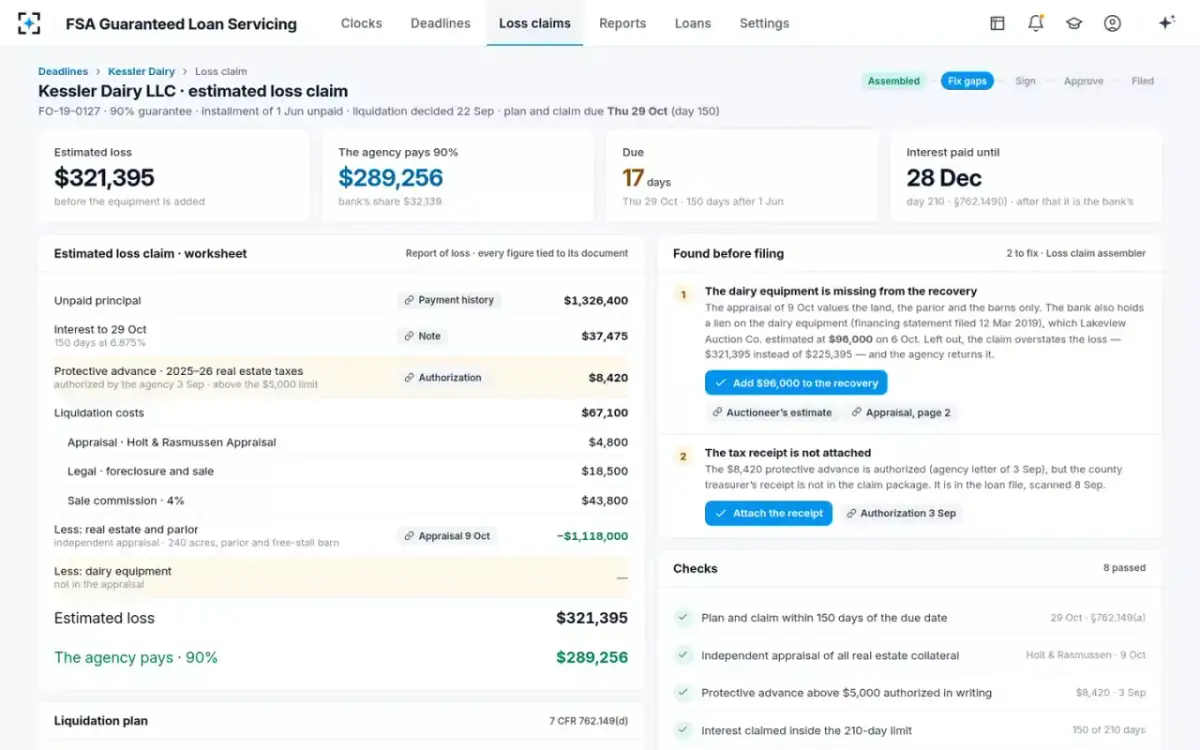
That is the clearest case for preparing a claim early rather than on time. The sample bank's setting prepares each filing ten business days before its date, which on a 150-day claim means the gaps are found at about day 136 — while there is still room to fetch an appraisal that covers all the collateral, or a receipt for an advance. One claim, two gaps and the 150-day deadline follows a sample claim through exactly that window.
What ag credit survey data says about the loans most at risk right now
The exposure is not evenly spread across time, and the regional Federal Reserve surveys are the honest public read on where farm credit sits. The Minneapolis Fed's ag credit survey for the fourth quarter of 2025, published in February 2026, found 64% of agricultural lenders reporting lower farm incomes than a year earlier against 14% reporting higher; 42% reporting increased loan renewal and extension activity; and 56% reporting decreased investment in equipment and buildings against 11% reporting increases. Operating loans in that quarter averaged 7.4% fixed and 7.3% variable (Minneapolis Fed, February 2026).
District ag lenders, fourth quarter 2025: the share reporting each change
Two of those lines matter specifically for guarantee exposure. Renewals and extensions rising means more loans whose terms were changed recently, which is the population where a payment due date — and therefore every date computed from it — most often moves. And lenders expecting a second consecutive quarter of lower incomes is the shape of a year that produces defaults rather than a single bad quarter. A desk whose clocks are kept in a spreadsheet is least reliable exactly when the number of defaulted loans rises, because the spreadsheet's weakness is volume, not difficulty.
Building your own return: hours saved against guarantee preserved
Resist the temptation to build a business case on avoided catastrophe. Nobody can tell you the probability that your next claim gets reduced, and a number built on an invented probability is worth nothing in a credit committee. Build it from two components you can measure and one you can bound.
A return you can defend in a credit committee
Hours released
(clerical hours per defaulted loan − the same hours with the clocks kept) × defaults a year
Measured, not estimated: time a week of your own desk, split between finding the next date and judging the file. Botminds estimates one defaulted loan, from default to a filed claim, at 41 hours by hand and 13.5 with the filings prepared; replace both with your own timings.
From your own timesheet
Interest preserved
daily interest on the average defaulted balance × days of delay removed × guaranteed share
Bounded, not guessed: measure the days your filings were late last year, and price only those. A $1,000,000 balance at 7.00% is $191.78 a day.
From last year’s filing dates
Claims not returned
claims returned last year × average days unpaid × daily interest
Count the claims the agency queried or sent back and what each cost in unpaid days. This is the component most desks have never counted and can.
From the agency correspondence
The cost of the tool
licence + implementation + the time to load the inputs
Put the whole first-year cost in, including the week of a coordinator’s time to load the loan note guarantees and the payment history.
From the proposal
Deliberately missing from that arithmetic is the reduction itself, because it belongs in the risk section rather than the return. State it as the bound it is: the maximum exposure is the guaranteed share of the loans that could default in a year, and the regulation puts no cap on what proportion of a given loss a servicing failure can account for. A committee can weigh that honestly. It cannot weigh a probability someone made up.
A claim with its gaps named before it is filed
Where a clock board helps, and where it does not
Being clear about the limits is the only way the rest of this page is worth anything. Software that keeps dates and prepares filings addresses the timeliness limb of the negligence definition and nothing else. It will not make an unsecured loan secured, will not improve a bad appraisal, and will not turn a weak credit decision into a defensible one. If your claims have been reduced for failure to obtain the required security, this is not the fix.
What it does address is specific. Every date is computed from the loan note guarantee, the payment history and the rules, and re-computed whenever a payment or an event lands, so a re-dated installment moves the chain hanging off it. Each filing is drafted before its date with every line showing its source. A loss claim will not be sent with a missing attachment, an unsupported figure, collateral left out of the recovery or a protective advance above the authorization limit without its written authorization. And every re-dated clock, draft and signature is kept with who and when — which, as the carve-outs above show, is the material the lender needs when the agency asks whether a deficiency contributed materially to anything.
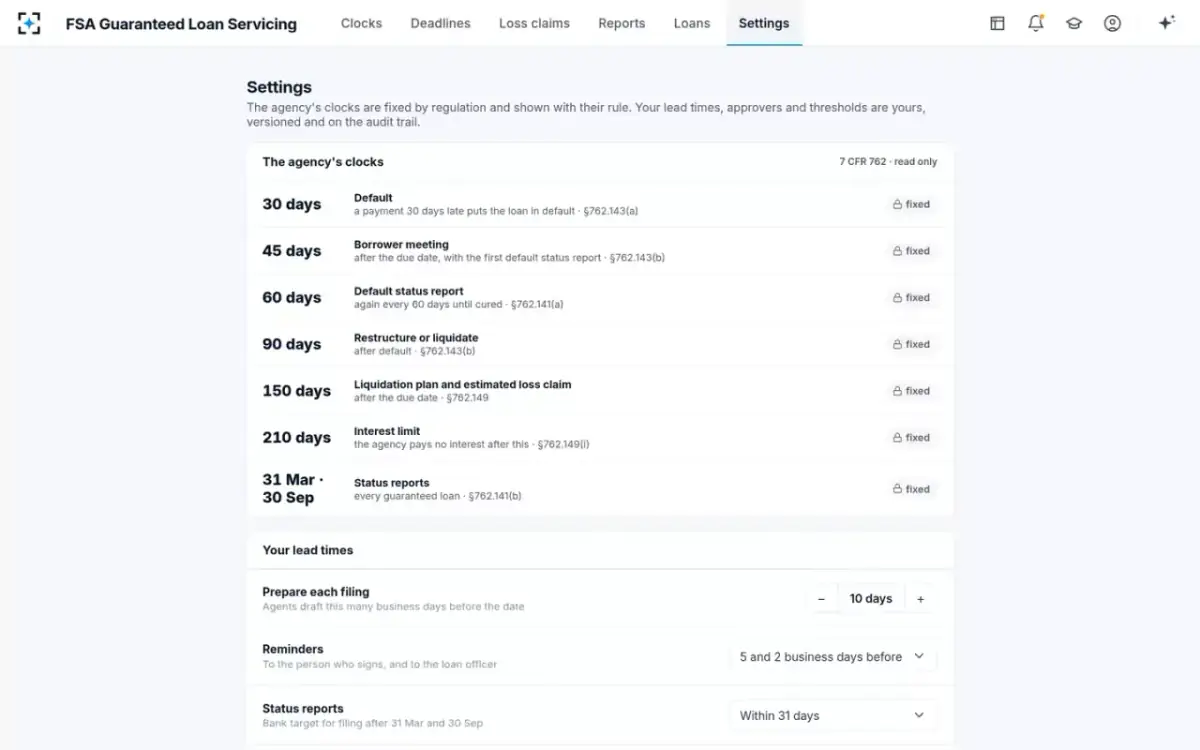
The settings are the other half of the honesty. The agency's dates are shown read-only beside their section and cannot be edited; what a bank chooses is its own lead times — when a filing is prepared, when reminders go to the signer and the loan officer, when an undecided default escalates to the Ag Lending Manager, and the coverage ratio a restructure must reach to count as feasible. What you load before day one goes through those inputs.
Agency clocks fixed, bank lead times editable
If you are pricing this decision, do the measurement first and the proposal second: count last year's late filings and returned claims before anyone demonstrates anything. Spreadsheets, calendars or software compares the three approaches on that evidence, and FSA Guaranteed Loan Servicing shows the clock board, the filings and the claims on a sample book.
Questions people ask
What is negligent servicing on an FSA guaranteed loan?
Servicing that fails to include the actions considered normal industry standards of loan management, or that fails to comply with the lender's agreement or the guarantee — including, in the definition's own words, "failure to act or failure to act in a timely manner consistent with actions of a reasonable lender in loan making, servicing, and collection". Lateness counts on its own; intent is not part of the test.
Why would FSA reduce a loss claim?
Because it calculates that part of the loss was caused by the lender's own servicing. The regulation names specific grounds: failure to secure property after a default, failure to contact the borrower or take action to cure it, unauthorized release of security proceeds, failure to verify ownership of security to be purchased, and failure to inspect collateral as often as required. Interest accruing during delays in collection the agency considers excessive is not paid at all.
How much does FSA guarantee on a farm loan?
A percentage written on the loan note guarantee for that loan, commonly 90%. Treat it as a ceiling rather than a rate: § 762.103(b) makes the guarantee unenforceable by the lender to the extent a loss results from negligent servicing, a usury violation, failure to obtain the required security or use of funds for unapproved purposes — regardless of when the agency discovers it.
What happens if a lender misses an FSA deadline?
Nothing immediately, which is what makes it expensive. The consequence lands when the loan produces a claim and the agency reads the servicing history. A missed borrower contact costs the interest that accrued meanwhile by the regulation's own words; a missed decision or a late claim can push interest past the 210-day limit, after which the agency pays none of it.
Does a late filing always reduce the claim?
No. Losses will not be reduced for "servicing deficiencies that did not contribute materially to the dollar amount of the loss". But the lender has to be able to show that, which means showing when the step was due, when it happened, and what occurred in between — a servicing history, in other words, rather than a recollection.
Can the holder still be paid if the lender's guarantee is unenforceable?
Yes. The same section makes the guarantee and the right to require purchase directly enforceable by the holder even where it is unenforceable by the lender because of a lender violation. A bank that sold the guaranteed portion on the secondary market has not moved this risk; it has kept it while the holder is made whole.