An FSA loss claim is the moment a guaranteed loan's paperwork is finally graded. The lender states what it is owed, what the collateral recovered and what is left, the agency pays its guaranteed share of the difference, and anything the file cannot support comes out of the number. FSA publishes a loss claim checklist of what it will ask for, and most claims that come back come back for something on it. This is one claim, worked through from the missed payment to the signature, with the two gaps that nearly sent it back and how they were found with seventeen days to spare. The claim was assembled in Botminds' FSA Guaranteed Loan Servicing.
The file is fictional sample data, not a customer's result: Kessler Dairy, a borrower of Lindmark Valley Bank in Storm Lake, Iowa. The farm, the bank, the auction house and the people are invented. The deadlines, the arithmetic of an estimated loss and the checklist are real, and the figures below are internally consistent so they can be followed.
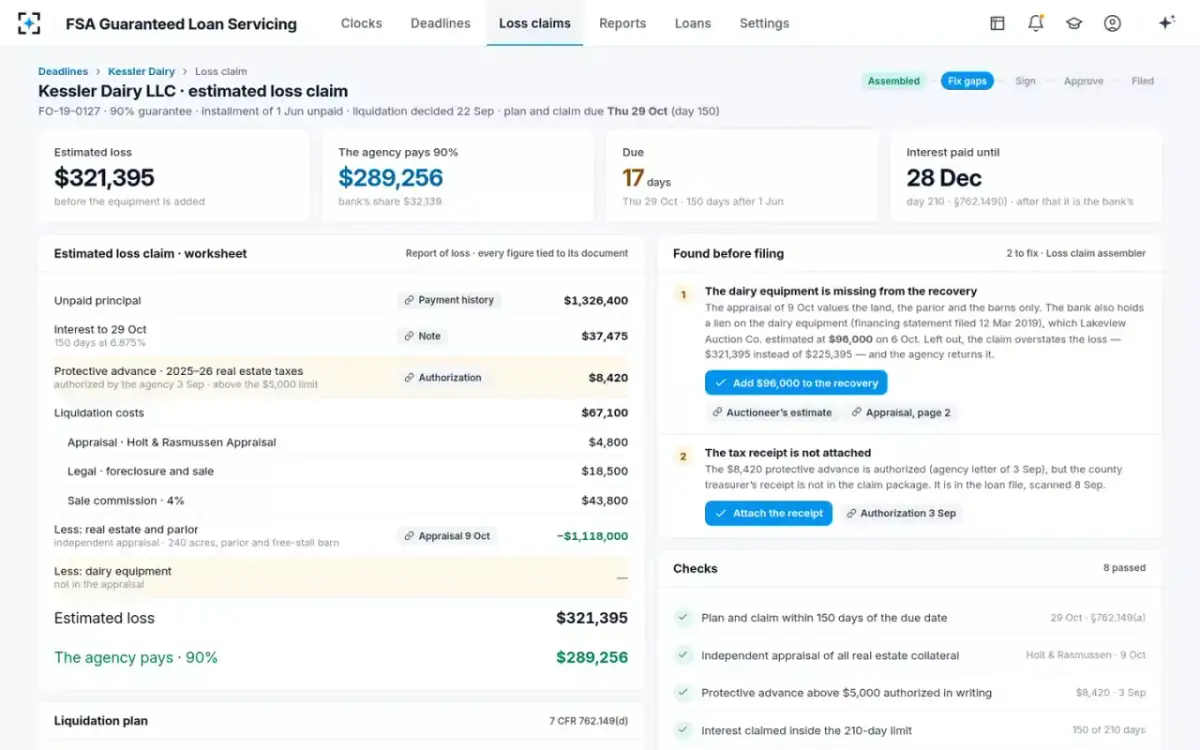
The claim as it stood on Monday 12 October
$96,000
of collateral the appraisal never valued
$8,420
advance with its authorisation on file and its receipt missing
$225,395
estimated loss as filed, against $321,395 as first assembled
17days
left before the 150-day deadline of Thursday 29 October
Day 150 counts from the missed payment, not from default
This is the first thing a desk gets wrong, and it is worth a paragraph on its own. The default on this loan fell on 1 July — thirty days after the installment due on 1 June went unpaid. The liquidation plan and the estimated loss claim are not due 150 days after that default. They are due 150 days after the payment due date, which is Thursday 29 October. Counting from the wrong end gives 28 November and a claim a month late.
The agency's own loss claim checklist states the rule plainly: "Within 150 days after the payment due date, all lenders are required to submit a written liquidation plan and an estimated loss claim unless the account has been completely liquidated and then the final loss claim must be filed. The Agency will not pay interest beyond 210 days from the payment due date." Both clocks start at the same place, and on this file the second one ends on 28 December.
One defaulted dairy loan: where the 150 days went, and what was left
- To default, 1 Jul30 d
- Meeting, reports, liquidation decided73 d
- Assembling the claim30 d
- Left when the gaps were found17 d
- To the estimated loss claimday 150
- Interest the agency will still pay60 d
Building the worksheet line by line
An estimated loss claim is arithmetic with a defined shape. The agency pays the guaranteed percentage of the total outstanding debt, less the net recovery value of the remaining security, less any security that cannot be accounted for. Everything that matters is in those two subtractions: what the collateral is worth after the cost of turning it into money, and whether all of it has been found.
So the worksheet is built from documents, not from the core system's balance. On this file that meant thirty-one lines — principal, accrued interest to the claim date, the protective advance, the appraised values of each class of security, the estimated costs of acquiring and selling it — each one carrying a link back to the page it was read from. That linkage is not neatness. It is what lets a reviewer disagree with a number in thirty seconds instead of re-reading the file, and it is what the eight checks below run against.
The claim worksheet, with two lines flagged before anyone signed
Gap one: a lien the appraisal never valued
The appraisal dated 9 October valued the land, the parlour and the barns. It did not value the dairy equipment, because nobody had asked it to — the instruction had been written around the real estate, as it usually is. But the bank's liens run wider than the appraisal's scope: it also holds a lien on the milking and cooling equipment, which a local auction house puts at $96,000.
That mismatch is a scope error rather than a valuation error, and it is the most common one on a farm loss claim, because farm security is heterogeneous. The regulation is clear that the liquidation plan needs an independent appraisal report on all collateral securing the loan — all of it, not the part that is easiest to appraise. For personal property the appraisal requirements are separate and specific: a current appraisal, meaning not more than 12 months old, valued from public sales of the same or similar property in the market area, by an appraiser with enough experience or training to establish market rather than retail values. Whether a particular estimate meets that standard is the agency's call, since the appraiser's experience is "as determined by the Agency"; an auction house's written estimate built from its own public sale results at least starts from the basis of value the rule names, and it is worth confirming its acceptability with the county office before the claim is due rather than after.
Where the two gaps sat in the file
Gap one · scope
The appraisal of 9 October
Valued: land, parlour, barns
Not valued: milking and cooling equipment the bank holds a lien on
Effect on the claim: the recovery is understated by $96,000, so the loss is overstated by the same amount
Gap two · evidence
The $8,420 tax advance
On file: the written authorisation, dated 14 August
Not on file: the county treasurer’s receipt showing the money was paid
Effect on the claim: the amount is right, but the package is incomplete — and an advance that cannot be evidenced comes out
Gap two: an advance with no receipt attached
The second gap is the opposite shape. A protective advance of $8,420 had been made to pay the county property taxes, which is a textbook use of one: the rule allows a protective advance where the lender can demonstrate it is in the best interest of both the lender and the agency, and unpaid property taxes are a prior claim that erodes the security of both. Because the bank is a Certified Lender, written agency authorisation was required above $5,000, and it had been obtained on 14 August.
What was missing was the proof that the money had actually been paid. The checklist asks for a "justification and explanation of all protective advances made on the loan", and for a copy of every liquidation expense deducted from the sale of the security. An authorisation says the lender was allowed to spend it; a receipt says it was spent, and on what. Without the second, the agency has no basis to include the advance in the claim, and the usual outcome is a request for more information — which costs weeks on a claim that is already being paid late.
Notice that this gap does not change the loss figure at all. The claim as first assembled and the claim as filed both include the $8,420. If the receipt had stayed missing and the advance had been struck out, the loss the bank could claim would have fallen, not risen. Two gaps, two different kinds of damage.
What leaving a gap in does to the number FSA sees
Left in, the first gap would have produced a claim for an estimated loss of $321,395. Corrected, the claim is for $225,395. The whole $96,000 difference is the equipment: because the estimated loss is the debt less the net recovery value of the remaining security, collateral that is not valued simply does not reduce the loss, and the lender ends up asking the agency to pay a share of money the collateral would have covered.
The same dairy claim, as first assembled and as filed
As assembled, with the gap: Land, parlour and barns, from the 9 October appraisal
As filed, corrected: The same, plus $96,000 of dairy equipment at an auction house’s estimate
As assembled, with the gap: $321,395
As filed, corrected: $225,395
As assembled, with the gap: $289,256 asked for
As filed, corrected: $202,856 paid
As assembled, with the gap: Authorisation on file, receipt missing
As filed, corrected: Authorisation and the county treasurer’s receipt both attached
As assembled, with the gap: Two of eight failing
As filed, corrected: Eight of eight passing
As assembled, with the gap: Returned for more information, and paid later
As filed, corrected: Reviewable as filed
It is worth being precise about what the agency does with an overstated claim, because the folklore is harsher than the rule. An overstatement found at review does not void the guarantee. It produces questions, a revised claim and a delay — and the delay is the expensive part, since the lender is carrying the balance while the interest clock runs towards day 210. The harder consequence is reserved for servicing failures: a loss claim "may be reduced by the amount caused by the lender's failure to secure property after a default, and will be reduced by the amount of interest that accrues when the lender fails to contact the borrower or takes no action to cure the default, once it occurs".
The same section contains the sentence lenders should read next to it: losses are not reduced for servicing deficiencies that did not contribute materially to the amount of the loss, nor for unaccounted security where the lender's efforts to locate and recover it matched what it would have spent on an unguaranteed loan. The test is materiality and effort, not perfection. What a servicing failure costs when it is material is set out in what negligent servicing costs a lender.
Eight checks, and what each one catches
The checks below are the ones this claim had to pass before it could be signed. Six of them are arithmetic or date comparisons that a person should never have to do by hand; two are the scope and evidence questions that caught the gaps.
The eight checks run on the claim before signature
| The check | What it found on this file |
|---|---|
| Filed inside 150 days of the payment due date | Due Thu 29 Oct; signed on 12 Oct |
| Interest claimed stops inside the 210-day limit | Accrual claimed to 28 Dec, no further |
| The appraisal covers every item the bank has a lien on | Failed first pass — the dairy equipment was outside its scope |
| Every protective advance has written authorisation on file | The $8,420 tax advance was authorised on 14 Aug |
| Every protective advance has its receipt attached | Failed first pass — the county treasurer’s receipt was not in the package |
| Security proceeds accounted for against the payment history | Reconciled to the cent |
| No default interest, late charges or servicing fees in the claim | None claimed |
| Each figure ties to the document it was read from | 31 of 31 lines linked |
The ordering is deliberate. Date checks are cheap and absolute, so they run first and are never the reason a claim is late. Scope checks — does the appraisal reach every lien, does every advance have both its authorisation and its proof of payment — are the ones that need a human decision afterwards, so they are raised as early as the documents allow rather than on the day the claim is due.
What FSA's own loss claim checklist asks for
The agency publishes what it will look for, which makes assembling a claim a matter of reading rather than guessing. The claim itself goes in on the agency's report of loss form; for the review the agency uses its own estimated and final loss review checklists. Around that sit the supporting documents.
What FSA's published loss claim checklist asks a lender to provide
- A signed report of loss for each loan claimed on
The agency’s own form, one per guaranteed loan in the claim.
- Current signed balance sheets from all liable parties
Or, in bankruptcy, the filing, the schedules and the discharge notice.
- A current credit bureau report
On the borrower, as at the claim.
- Federal and state income tax records with all schedules
Including the depreciation worksheet, which is how equipment is traced.
- The detailed loan history for every guaranteed loan
Advances, principal and interest payments, and interest rate changes.
- The same history for non-guaranteed loans to the borrower
Since the first guaranteed loan closed — so the agency can see whether payments followed lien priority.
- A detailed accounting of the security and its proceeds
Crops and livestock reconciled against the payment history and the tax records; equipment sold at auction reconciled against the settlement statement and the appraisals. In summary: is any collateral unaccounted for?
- Justification and explanation of every protective advance
And a copy of every liquidation expense deducted from the sale of the security.
Read down that list and the dairy equipment appears three times over — in the depreciation worksheet, in the accounting of the security and its proceeds, and in the summary question about collateral unaccounted for. A gap of this kind is not hidden. It is simply spread across documents nobody reads side by side at eleven at night, seventeen days before a deadline.
The loan behind the claim, from the missed installment to day 210
Filed, complete, and inside the 210-day interest limit
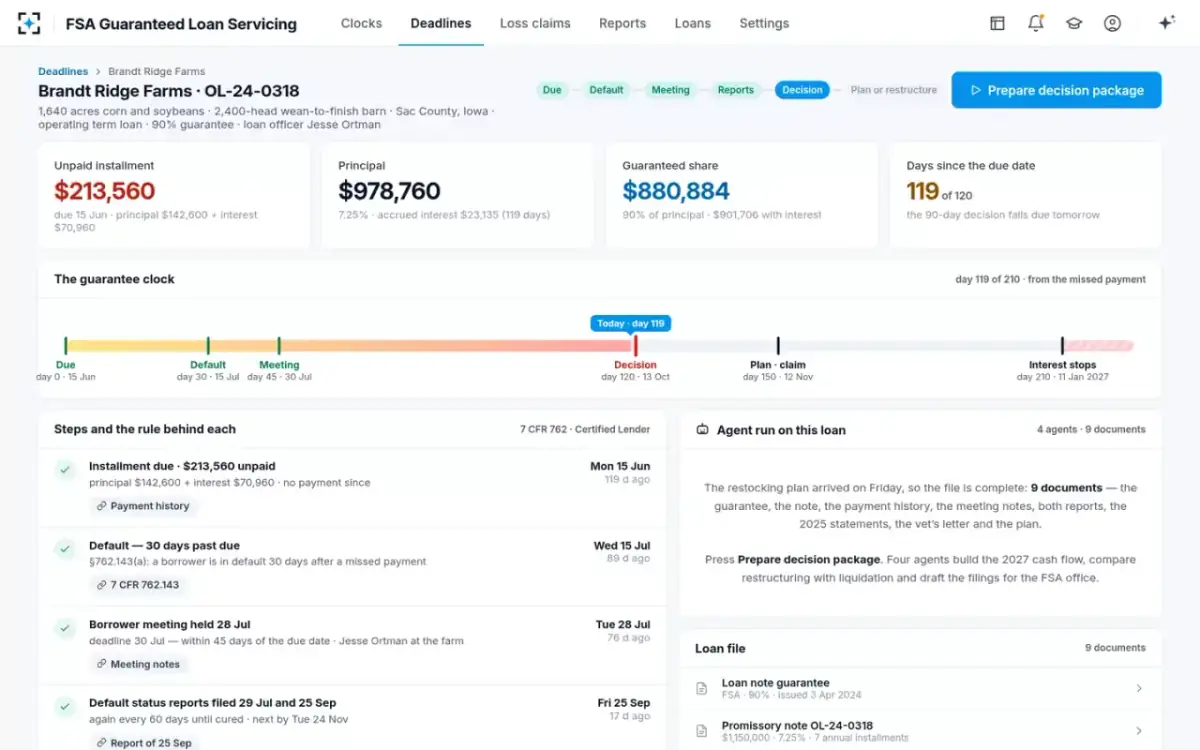
With both gaps closed the claim went out on the loan's own terms: an estimated loss of $225,395, of which the agency's guaranteed share is $202,856, interest claimed only to the point where the 210-day limit bites on 28 December, and every one of the thirty-one lines tied to a document. The coordinator signed it, with the meaning of her signature kept beside it, and the Ag Lending Manager approved it before it left the bank. The agency then has its own clock: on a final loss claim it owes the lender additional interest for every day it takes beyond 40 to approve, reject or query.
A claim the agency can review as filed
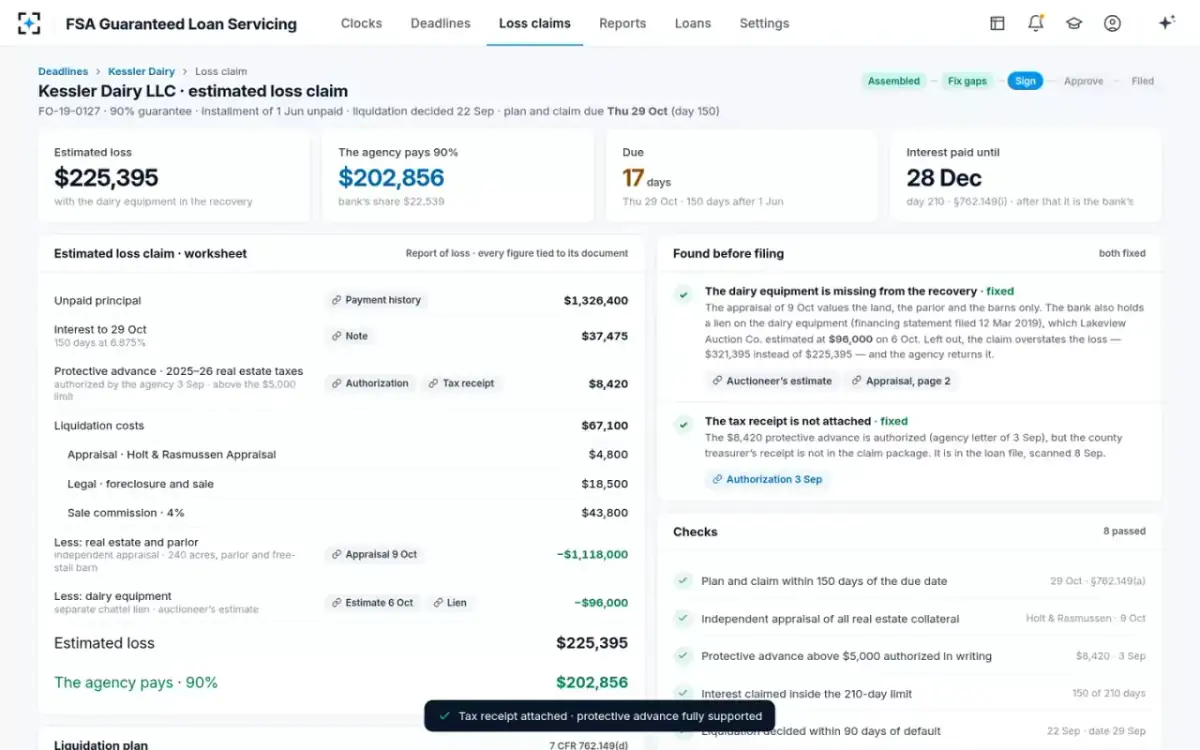
The point of the example is not that an agent found $96,000. It is where in the week the gap was found. A claim assembled on day 148 has no room for an auction house to write an estimate or a county treasurer to reprint a receipt; a claim assembled on day 133 has both. Every date in the sequence that gets to this one is in 7 CFR 762 in plain words.
Questions people ask
What is the FSA estimated loss claim deadline?
An estimated loss claim is due no later than 150 days after the payment due date — not 150 days after default — unless the account has already been completely liquidated, in which case a final loss claim is filed instead. The written liquidation plan falls on the same date. On the sample file an installment due 1 June made the claim due on 29 October.
Why would FSA reduce a loss claim?
Mainly for negligent servicing. The agency reduces a final loss claim by the loss its calculation attributes to the lender's negligence — failing to secure property after default, releasing security proceeds without authority, failing to verify or inspect collateral, or letting interest accrue while nobody contacted the borrower. It also excludes items the guarantee never covered: default interest, late charges, loan servicing fees, and packager or outside consultant fees.
What are the FSA loss claim appraisal requirements?
The liquidation plan needs an independent appraisal of all the collateral securing the loan, from which the net recovery value is computed. Personal property needs a current appraisal, not more than 12 months old, based on public sales of the same or similar property in the market area and made by someone with the experience or training to establish market rather than retail values. The agency may waive the appraisal where a bankruptcy trustee is handling the liquidation, where the proposed method of sale rarely yields less than market value for livestock and used equipment, or where an offer above the debt has already been received.
What happens if an FSA loss claim is incomplete?
It comes back for more information, and the time it costs is the real damage: the lender carries the balance while the 210-day interest limit keeps running from the original payment due date. Being sent back is not the same as being refused — a complete claim can be refiled — but the interest the agency will pay does not reset.
What documents does an FSA loss claim need?
The agency's report of loss form for each loan, current balance sheets from everyone liable, a credit report, income tax records with the depreciation worksheet, detailed loan histories for the guaranteed loans and for the borrower's non-guaranteed loans since the first guaranteed loan closed, an accounting of the security and its proceeds, and the justification for every protective advance and liquidation expense.
When is the final loss claim due, and how is it different?
The final loss claim comes after the security has been liquidated and all proceeds applied — proceeds to principal first, then to accrued interest. Once the last day of the collateral liquidation has passed, the lender has 30 calendar days to submit it. It is the true-up: if the final loss is less than the estimated loss, the lender repays the overpayment with interest at the note rate from the date the estimated loss was paid.