The 7 CFR 762 servicing requirements are a set of dated obligations that fall in a fixed order once a guaranteed farm loan goes 30 days past due, plus reports that fall every year whether anything is wrong or not. Read section by section they are hard to hold in the head, because the regulation groups them by subject — reporting here, distressed accounts there, liquidation somewhere else — rather than by the day they come due. Read as one line, from the 30th day past due to the 210th, they are straightforward, and that is how a servicing desk actually meets them. Botminds' FSA Guaranteed Loan Servicing computes each of those dates for every loan in a book and shows the section of the rule beside it.
What follows is the rule in the order it arrives, with the regulation's own words where the wording decides something, and a fictional sample bank — Lindmark Valley Bank in Storm Lake, Iowa, a Certified Lender with 218 guaranteed loans — to show what the whole set looks like on a real-sized book. The bank and its borrowers are invented; the dates and the sections are not.
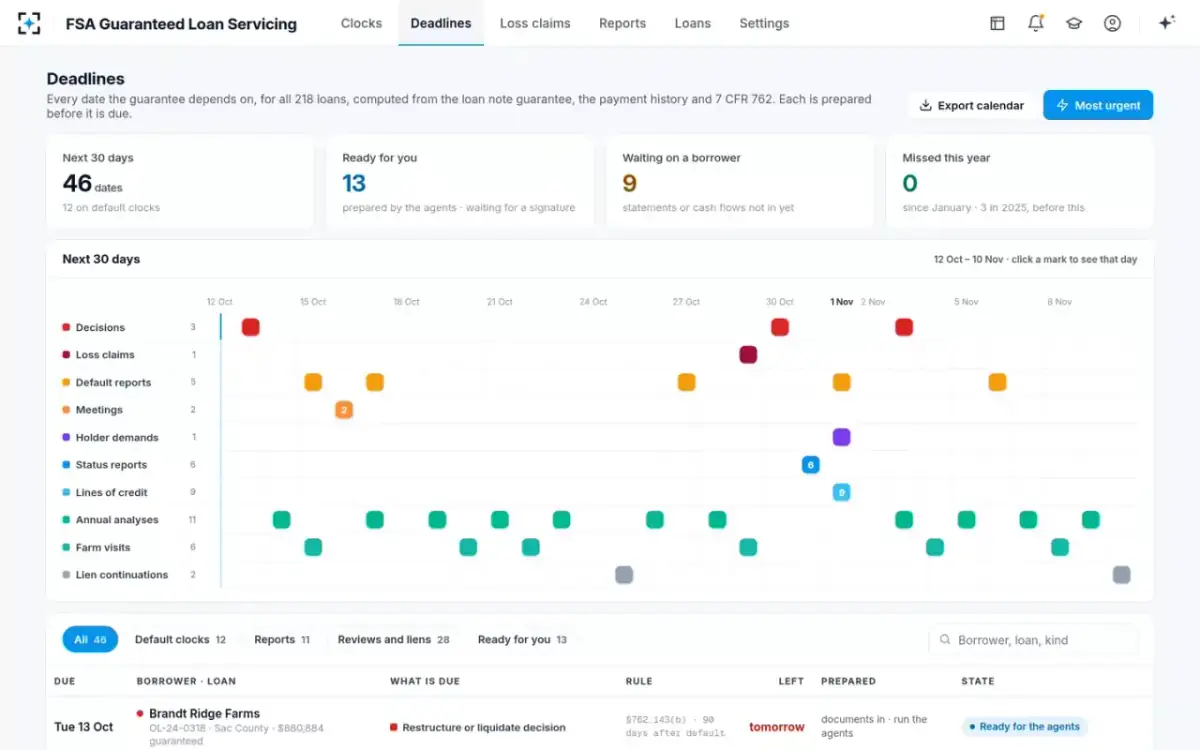
What the rule asks of one sample bank in the next 30 days
46dates
falling in the next 30 days across 218 guaranteed loans
13
already drafted and waiting for a signature
9
waiting on something a borrower has to send
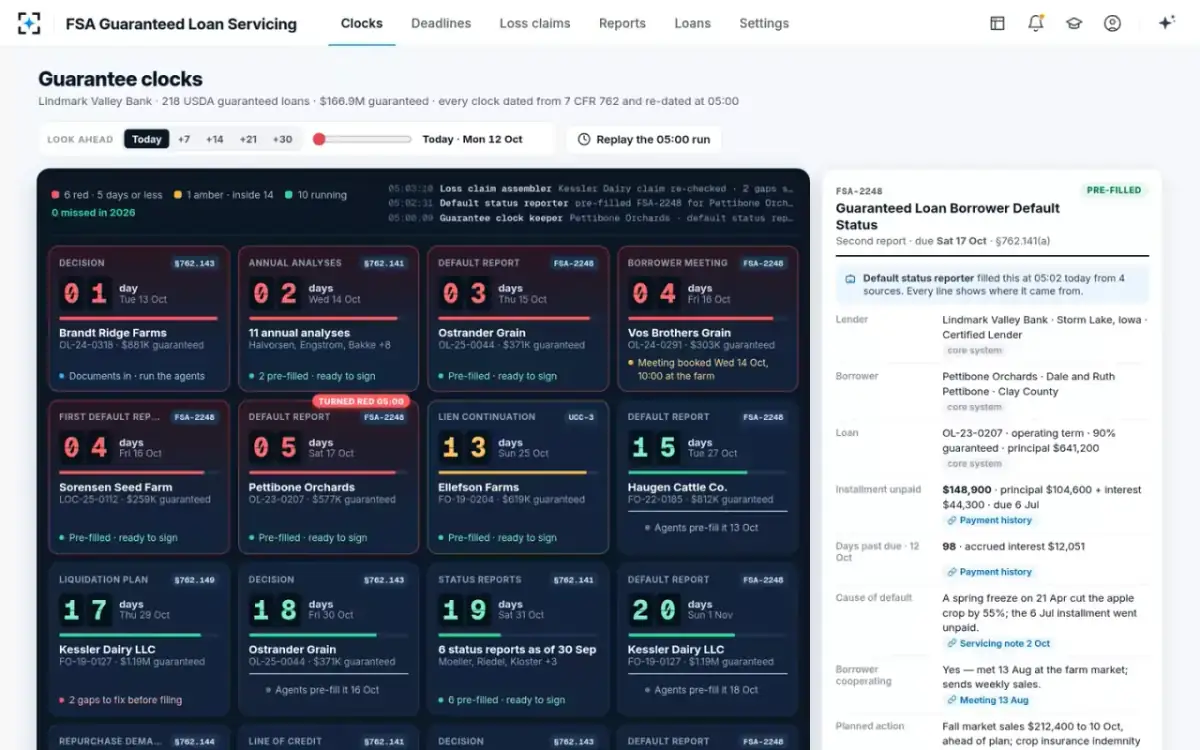
1,284
dates re-computed overnight from the payment history and the rule
Who 7 CFR 762 covers: guaranteed, not direct, farm loans
Part 762 is about guaranteed farm loans — loans a commercial lender makes with its own money, on which the Farm Service Agency guarantees a share of any loss, usually 90%. It is not about direct loans, where the agency is itself the lender and services the account. The practical consequence is that every obligation in this guide belongs to the bank, not to the agency: the bank meets the borrower, the bank decides, the bank files, and the bank is the one whose guarantee shrinks when a step is missed.
Three lender statuses sit inside the part, and they change what the bank has to send rather than what it has to do. A standard eligible lender sends the agency the most. A Certified Lender, or CLP, certifies more and submits less. A Preferred Lender, or PLP, works to its own lender's agreement. The deadlines below are the same for all three.
One sentence governs everything that follows. The lender, the rule says, "cannot enforce the guarantee to the extent that a loss results from a violation of usury laws or negligent servicing". Nothing in part 762 is a formality: every date in it is a date on which a guarantee can start to erode.
The nine obligations of 7 CFR 762, in the order a lender meets them
Day 30
Default
A payment 30 days past due, or any breach of the loan documents
§ 762.143(a)
Day 30 to 45
Report it
Once 30 days past due, and after the meeting or attempts to meet, the default status form goes to the county office
§ 762.141(a)
Day 45
Meet the borrower
Within 15 days of default, with a balance sheet and a cash flow
§ 762.143(b)(3)
Day 45
Summarise the meeting
On the same form, with the course of action agreed
§ 762.143(b)(3)(iii)
Every 60 days
Report again
Until the default is cured by restructuring or liquidation
§ 762.141(a)
Day 90 from default
Decide
Restructure or liquidate, or document an agency-approved extension
§ 762.143(b)(3)(iv)
Day 150
Plan and claim
A written liquidation plan and an estimated loss claim
§ 762.149(b), (d)
Day 210
Interest stops
The agency pays no interest beyond this date
§ 762.149(d)(2)
31 Mar · 30 Sep
Status reports
On every guaranteed loan, in default or not
§ 762.141(b)
Day 30: default, defined
The regulation's definition is one sentence and it is wider than most people expect.
A borrower is in default when 30 days past due on a payment or in violation of provisions of the loan documents.
7 CFR 762.143(a)
Two halves, and the second does the work people forget. A borrower who has paid every installment on time but has sold mortgaged machinery without the bank's consent, let the required insurance lapse or missed the covenant that caps off-farm borrowing is in default under this definition just as surely as one who missed a payment. Non-monetary defaults are handled according to the note and the loan agreements, but they start the same servicing sequence, and the obligations that follow do not care which kind started it.
Day 30 also starts the reporting clock, though the first report follows the meeting rather than the missed day. When the loan becomes 30 days past due, and following the lender's meeting or attempts to meet with the borrower, all lenders submit the appropriate Agency form showing guaranteed loan borrower default status. That is the form the rest of this sequence keeps coming back to.
Day 45: the borrower meeting and the first default status report
Within 15 days of default — which is 45 days after the payment due date on a monetary default — the lender has to arrange a meeting with the borrower, identify the nature of the delinquency, and develop a course of action that will eliminate it and correct the underlying problems. The wording matters in three ways.
It says arrange a meeting, not send a letter. It says develop a course of action, so a meeting that ends in sympathy and no plan has not met the requirement. And it pairs the meeting with preparation: lender and borrower prepare a current balance sheet and a cash flow projection beforehand, and if the borrower will not cooperate, the lender compiles the best financial information available rather than skipping the step.
Either side may ask for an agency official to attend, and if asked, the official will help develop solutions. Afterwards the lender summarises the meeting and the proposed solutions on the same default status form, and indicates on it whether the borrower has been considered for interest assistance alongside a rescheduling.
Every 60 days: the report again, until the default is cured
The default status report is not a one-off. The form, says the reporting section, "will be resubmitted every 60 days until the default is cured either through restructuring or liquidation". The agency's own instructions for the form put the same rule by status code: for ten of the delinquency codes bimonthly reports must continue, and for six others no further reports are required unless the borrower returns to default at a future date.
Two practical points follow. The first is that "cured" has a narrow meaning here: restructured or liquidated, not merely brought current by a late payment, which is why desks that stop reporting the moment money arrives end up with a gap in the file. The second is a counting question the regulation leaves open: it says every 60 days without saying from which date. The sample bank counts from the date the report was due, so a report due on 17 October and sent on the 12th, five days early, leaves the next one due on 16 December. A bank that reads the rule more strictly, counting from the day the report was sent, would put the next one on 11 December; whichever reading a bank adopts belongs in its written procedures.
The next 30 days of one book, laid out by the kind of date
Day 90: the decision the lender must document
Ninety days after default — not after the missed payment — the lender has to decide whether to restructure or liquidate the account, unless it can document circumstances that justify an extension by the agency. On a monetary default that lands 120 days after the payment was due.
This is the only deadline in the sequence that can move, and it moves only with evidence and only with the agency's agreement. It is also the one with the most arithmetic behind it, because a restructuring is allowed only where the borrower can show a feasible plan. The test, the cash flow it needs and what the other path pays are worked through on one file in restructure or liquidate: the 90-day test.
One limit sits just after it. The lender may not start foreclosure until 60 days after the agency has determined whether the borrower is eligible for interest assistance, and the loan cannot be accelerated until that consideration and any mandatory state mediation have concluded. Deciding to liquidate on day 90 and filing on day 91 is not an option the rule leaves open.
Day 150: the liquidation plan and the estimated loss claim
If the default cannot be cured, two documents fall on the same date, 150 days after the payment due date. The first is a written liquidation plan: balance sheets from everyone liable, a proposed method of maximising collection, an independent appraisal of all the collateral with a net recovery value computed from it, an estimate of how long the liquidation will take, and estimates of the liquidation expenses and any protective advances. The second is an estimated loss claim, unless the account has already been liquidated in full, in which case a final loss claim is filed instead.
The agency then has 20 calendar days to approve the liquidation plan or to ask for revisions; if it does neither, the lender may treat the plan as approved. On the final loss claim the agency works to 40 days, and owes the lender extra interest for every day it takes beyond that. What a complete claim actually contains, and the two gaps that most often send one back, are in one FSA loss claim, two gaps, and the 150-day deadline.
From a missed payment to the day interest stops, drawn to scale
- To default30 d
- To the meeting15 d
- To the decision75 d
- To the plan and claim30 d
- To the interest cut-off60 d
- First reportday 45
- Second+60
- Third+60
- Fourth+60 …
Day 210: when FSA stops paying interest on a guaranteed loan
The last date in the sequence is the one with a price on it, and the regulation states it twice in two sentences.
The lender, it says, "will discontinue interest accrual on the defaulted loan at the time the estimated loss claim is paid by the Agency. The Agency will not pay interest beyond 210 days from the payment due date." Where the lender expects no loss at all, an estimated loss of zero is filed and accrual stops on its approval — and never later than day 210 anyway.
There are two narrow exceptions, both involving circumstances outside the lender's control: in a Chapter 7 bankruptcy the agency will pay interest for up to 45 days after discharge on personal-property debt, and up to 90 days on real estate debt, that was estimated as secured but turned out not to be; and it will pay up to 90 days of interest where state redemption rights stopped the lender disposing of acquired property. Neither exception covers a slow file.
Outside those exceptions, interest after day 210 is the bank's own money. On a loan of the sample bank's average size that is not a rounding error, which is why the interest cut-off is the date most worth putting in front of a credit committee.
Every date in the book, dated from the rule rather than from memory
Twice a year, regardless of default: the status reports FSA requires
Two obligations run whether or not anything has gone wrong. All lenders submit the appropriate guaranteed loan status reports as of March 31 and September 30 of each year — every guaranteed loan, performing or not. And every non-PLP lender performs an annual analysis of the borrower's financial condition on all lines of credit, all loans in monetary or non-monetary default, and all term loans where the balances together exceed $500,000.
That analysis has a defined content: for loans secured by real estate only, an analysis of the balance sheet; for loans secured by personal property, a comparison of the borrower's actual income and expenses against plan for the past year; and in every case an account of the whereabouts or disposition of all the collateral. "The annual analysis for non-PLP lenders will be documented in the lender's file" — documented, which means a conversation about a borrower is not one.
The rule’s own obligations, by the day they fall
- Day 30 — default, then the first report
Thirty days past due on a payment, or in violation of the loan documents; the default status form goes to the agency after the meeting or attempts to meet.
- Day 45 — meet the borrower
Within 15 days of default, with a current balance sheet and cash flow prepared, and a course of action written down.
- Every 60 days — report again
Until the default is cured by restructuring or liquidation, not merely by a late payment.
- Day 90 from default — decide
Restructure or liquidate, or hold a documented agency extension.
- Day 150 — plan and claim
A written liquidation plan with an independent appraisal, and an estimated loss claim.
- Day 210 — interest stops
The agency pays no interest beyond this date except in the two narrow bankruptcy and redemption cases.
- 31 March and 30 September — status reports
On every guaranteed loan in the book, in default or not.
- Annually — the analysis
On lines of credit, defaulted loans and term loans over $500,000, documented in the lender’s file.
What a Certified Lender owes beyond the rest
Certified Lender status is a trade: the agency asks for fewer approvals in advance and more certification in return. To hold it, a lender has to qualify as a standard eligible lender, keep its loss rate under the published maximum, show it has submitted substantially complete applications and serviced its guaranteed loans according to the regulations, have made the minimum number of guaranteed loans, be free of regulatory enforcement actions based on financial condition, and name a qualified person in each office who has attended agency training in the past year or will in the next and agrees to attend every year.
In servicing, the status shows up in two places. A CLP lender provides, for every line of credit and every term loan in monetary or non-monetary default, a written summary of its annual analysis describing the borrower's progress and prospects for the coming operating cycle — and for lines of credit, a certification that a cash flow projecting at least a feasible plan has been developed, that the borrower is complying with the line of credit agreement, and that last year's income, loan funds and security proceeds have all been accounted for. And on restructuring, a CLP lender needs the agency's prior written approval only for a debt write-down.
The status is not permanent. It expires within five years unless a new lender's agreement is executed, and the agency may revoke it at any time for cause — violating the lender's agreement, failing to keep the eligibility criteria, or a pattern of deficient servicing.
Renewal of PLP or CLP status is not automatic. A lender must submit a written request for renewal of a lender's agreement with PLP or CLP status.
7 CFR 762.106(f)(2)
What changes with the lender’s status, and what does not
| Standard eligible | Certified (CLP) | Preferred (PLP) | |
|---|---|---|---|
| The deadlines in this guide | All of them | All of them | All of them |
| Restructuring | Prior written agency approval for every action | Certification; prior approval only for a write-down | Under the lender’s agreement |
| Annual analysis | Documented in the lender’s file, with a farm visit or collateral inspection report | Documented, plus a written summary to the agency on defaulted and line of credit loans | Under the lender’s own credit management system |
| Status term | No term | Up to 5 years, renewable on written request | Up to 5 years, renewable on written request |
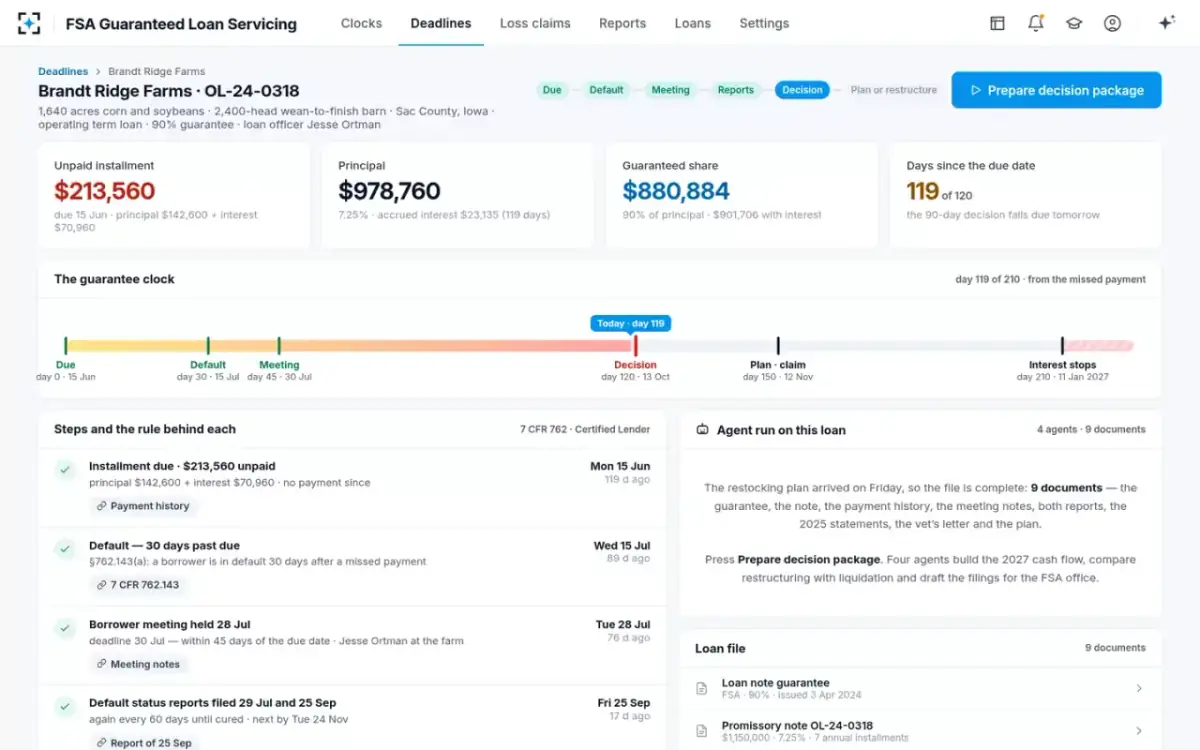
One loan’s whole sequence, each step with the rule that sets it
Questions people ask
What is 7 CFR 762?
It is the part of the Code of Federal Regulations that governs USDA guaranteed farm loans — who may be a lender, how loans are made and secured, how they are serviced, and how a loss is claimed when one goes bad. The servicing sections most lenders live in are 762.140 and 762.141 for general responsibilities and reporting, 762.143 for distressed accounts, 762.145 for restructuring and 762.149 for liquidation and loss claims.
How often does FSA require a default status report?
At default, and then every 60 days until the default is cured by restructuring or liquidation. The agency's form instructions say the same thing by status code: for ten of the delinquency codes bimonthly reports continue, and six codes end the cycle, until the borrower returns to default.
What happens if a lender misses one of these dates?
Nothing happens on the day. The cost arrives with the loss claim, because the agency reduces a claim by the amount of loss caused by negligent servicing, and will reduce it by interest that accrued while the lender failed to contact the borrower or took no action to cure the default. Losses are not reduced for servicing deficiencies that did not contribute materially to the amount of the loss.
Does the 90-day decision run from the missed payment or from default?
From default, which is itself 30 days after the missed payment on a monetary default. The 90-day decision therefore falls 120 days after the payment due date, while the liquidation plan and the estimated loss claim fall 150 days after the payment due date. Mixing the two reference points is the most common way a desk arrives at the right deadline a month late.
Is a line of credit treated differently from a term loan?
In reporting, yes. Every non-PLP lender owes an annual analysis on all lines of credit, whatever the balance, whereas term loans need one only when they are in default or when the balances together exceed $500,000. A CLP lender also certifies, for each line of credit, that a cash flow projecting at least a feasible plan exists and that the previous year's income, loan funds and security proceeds have been accounted for.
Can a lender who is not a Certified Lender still restructure a defaulted loan?
Yes, but it must obtain the agency's prior written approval for every restructuring action rather than certifying its own, and it submits the supporting items with the request. If the agency does not agree with the proposal it notifies the lender in writing within 14 days. The deadline for making the decision is the same 90 days either way.