To measure AI accuracy in loan servicing, stop asking for one accuracy percentage and measure four things separately: how many lines of a drafted filing tie back to a document, how many state something no document supports, how many computed dates match the rule that sets them, and how many facts were true when they were written and are not true now. Each is countable on reports your desk has already sent, which is the only evidence that carries any weight. A drafted FSA default status report is not a prediction, so it cannot be scored like one; its job is to repeat a loan file accurately in the agency's own fields. Botminds' FSA Guaranteed Loan Servicing is built to be measured this way — every line of a drafted report shows the note, payment line or document it came from — but the four measures below belong to the reader, not to the product, and work equally against a tool you already own.
The worked numbers come from a fictional sample bank, Lindmark Valley Bank, as it runs through the solution on sample data. The federal documents are real, and linked where they appear.
How to measure AI accuracy in loan servicing: four measures, not one percentage
The reason a single percentage fails here is that the filing has several different ways of being wrong, and they are not interchangeable. A report that says a borrower's cause of default was drought when the servicing note says a hog disease is wrong in a way a reviewer can catch in seconds. A report whose cause line is correct but whose next-report date was computed from the wrong payment is wrong in a way nobody catches until a clock runs out. Averaging the two into "94% accurate" destroys exactly the information a model-risk reviewer needs.
So split the measure by failure mode. Below are the four, each with the arithmetic and the unit of count. The unit matters: a rate per line flatters a long report, a rate per report flatters a tool that makes one bad line in each. Count both, and publish the per-report figure, because the per-report figure is what the coordinator experiences.
The four measures, and what each one counts
Source-match rate
lines whose cited source actually says it ÷ lines with a cited source
Open the note or payment line the filing points at and check it carries the stated fact. This is the measure that catches a citation attached after the sentence rather than before it.
Sample: a reviewer, on 25 filings
Unsourced-fact rate
lines asserting a borrower fact with no source ÷ all asserted lines
Count every claim about the borrower, the farm or the default that the filing cannot point anywhere for. The target is zero, and anything above zero is a design question, not a tuning question.
Sample: automatic, per filing
Missed-date rate
computed dates that differ from the rule ÷ dates computed
Recompute each date by hand from the payment due date and the section that governs it. A date that is late is a finding; a date that is early is a false alarm with a cost of its own.
Sample: a reviewer, on one quarter
Stale-fact rate
lines true when drafted but false when signed ÷ lines drafted early
The cost of preparing a filing ten days ahead. Measure it on the filings prepared earliest, because that is where it concentrates — a payment that landed after the draft was built is the usual cause.
Sample: a reviewer, at signature
Three of the four need no special tooling and no vendor cooperation. They need a stack of filings you have already sent, the loan files behind them, and someone with the patience to check twenty-five of each kind. That is a week of a reviewer's time, once, and it produces a number that is yours.
Source-match rate: does every line tie to a note or a document?
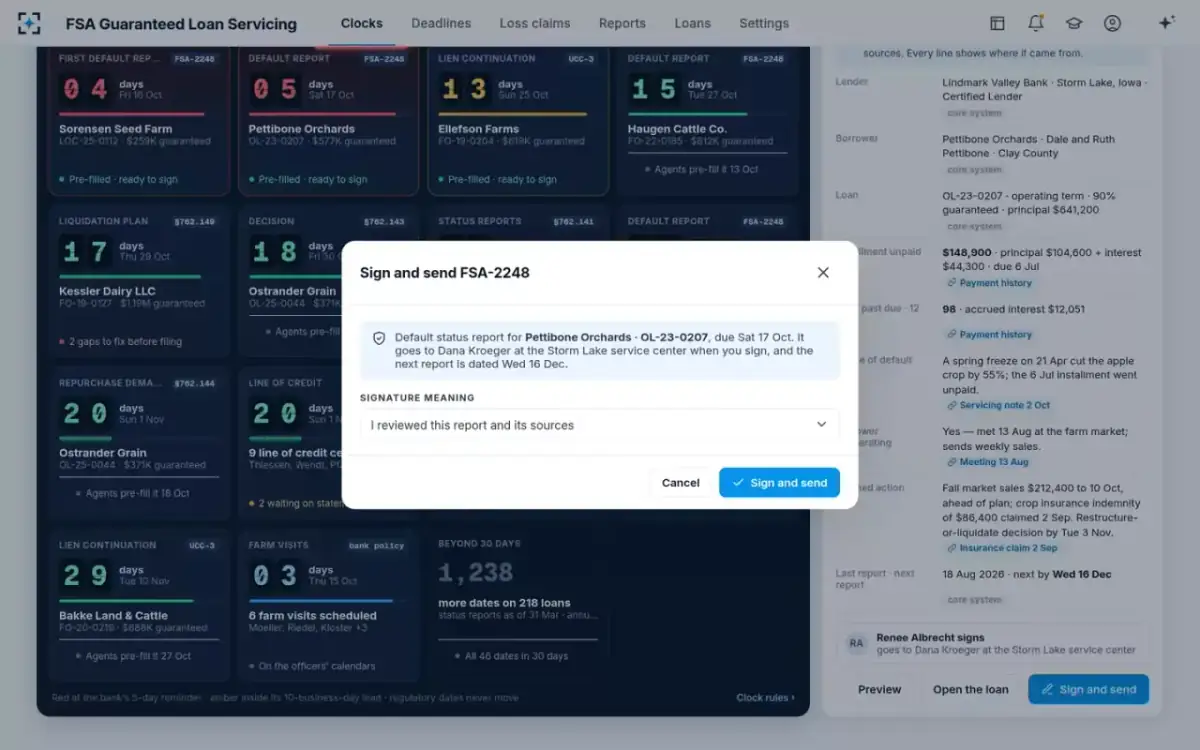
The agency's default status form asks for a specific and checkable set of facts: the date the loan became delinquent, the unpaid principal and accrued interest as of the reporting date, the total past due, a delinquency code, whether interest assistance was considered, and comments on the action taken to correct the default or on the borrower's current position. Each of those resolves to something in the file. The first four come from the payment history; the comments come from the meeting the regulation requires the lender to hold and then "summarize" on that form (§ 762.143(b)(3)).
Source-match asks a narrow question of each line: open what it points at, and does that document carry the stated fact? This is a stricter test than it sounds, because the common failure is not an invented document but a real one that says something adjacent. A meeting note saying the borrower "expects to market grain in the fall" is not a source for "borrower will apply $212,400 of fall sales to the delinquency by 10 October" unless the figure and the date are in the note too.
NIST's generative AI profile puts the same discipline in its own words: assess the accuracy, quality, reliability and authenticity of output "by comparing it to a set of known ground truth data and by using a variety of evaluation methods (e.g., human oversight and automated evaluation …)" and "evaluate claims of model capabilities using empirically validated methods" (NIST AI 600-1). On a servicing desk the known ground truth already exists. It is the loan file.
A drafted report with its sources on the page, before the signature
Unsourced-fact rate: the measure that should be zero by construction
The second measure counts assertions with nowhere to point. It should read zero, and if it does not, the right response is not a better model but a different design: a field that cannot find a source should stay empty and say so, and the reviewer should see the blank. A tool that fills blanks plausibly is optimising for the wrong thing — the coordinator's comfort rather than the agency's reading.
That is the failure NIST's profile names as confabulation, and the part that makes it dangerous for a filing is the citation behaviour rather than the prose: generative outputs "may also include confabulated logic or citations that purport to justify or explain the system's answer". An unsourced fact with a convincing reference attached will pass the eye of a reviewer who is checking that references exist rather than that they say what is claimed. Which is why the unsourced-fact rate and the source-match rate must both be measured: the first catches an empty claim, the second catches a dressed one.
One quarter of drafted reports, measured on sample data
4min
to review a drafted status report, against 35 by hand
0
borrower facts stated without a note or document behind them
1,284dates
re-dated overnight, each recomputable from its own rule
0
guarantee dates missed in the year to date on the sample book
Missed-date rate: did the computed date match the rule?
This measure has a property the other three lack: a ground truth that is free. Every date on a guaranteed loan is arithmetic on a payment due date plus an interval the regulation fixes, so a reviewer with the payment history can recompute it exactly. Take thirty loans, recompute the default date, the meeting date, the first and subsequent default status report dates, the 90-day decision date, the 150-day plan-and-claim date and the 210-day interest limit, and compare. The expected answer is zero differences, and a non-zero answer is worth tracing to its cause rather than averaging into a score.
Two causes recur. The first is a payment that reset a clock: a partial payment, or an installment applied in a different order, moves the due date the chain hangs from. The second is a re-dated event — a meeting moved from the 12th to the 19th moves the first default status report with it. Both are reasons the measure should be run as a replay over a period, not as a spot check: what matters is whether the dates were right at every point in the quarter, not whether they are right this morning.
It is also worth being precise about what kind of thing this part of the software is. The supervisors' 2026 guidance defines a model as "a complex quantitative method, system, or approach that applies statistical, economic, or financial theories to process input data into quantitative estimates", and expressly excludes "simple arithmetic calculations, such as those found within spreadsheets, as well as deterministic rule-based processes and software where there are no statistical, economic, or financial theories underpinning their design or use" (SR 26-2). A date computed by adding 90 days to a default under a rule is a deterministic rule-based process. Measuring it is still worth doing — it is where a quiet error does the most damage — but a reviewer should not let it be bundled into a model validation it does not belong in.
Stale-fact rate: true when drafted, false when signed
The fourth measure exists because preparing filings early is the whole point of a clock board, and early preparation has a cost nobody counts. If the bank's setting is to prepare each filing ten business days before its date, every drafted figure is ten days old at signature. A payment that lands on day three makes the past-due amount wrong; a crop insurance settlement makes the planned action wrong; a farm visit makes the collateral paragraph wrong.
Measure it at the signature, not afterwards: count the lines the coordinator changed between the draft and the signed version, and separate the ones she changed because the draft was wrong from the ones she changed because the world moved. Only the second group is the stale-fact rate, and the remedy for it is not accuracy work at all — it is re-drafting on change, so a payment landing on day three re-opens the figures it touches. A tool that drafts once and waits will show a stale-fact rate that rises with your own lead time, which is a setting you control. The lead times and the other settings are the levers on that number.
Running the measure on filings you have already sent
A person decides
Pick the sampleTwenty-five default status reports already filed, spread across causes and across the quarter, plus the loans behind them. Include at least five that were prepared earliest.
A person decides
Re-draft without the answerHave the tool draft each one from the file as it stood on the original drafting date, with the filed version withheld.
A person decides
Score the linesPer line: cited and correct, cited and unsupported, uncited assertion, or blank. Per filing: any line that would have changed what the agency was told.
A person decides
Recompute the datesIndependently compute every date on those loans from the payment history and the rule, and compare with what the tool had on the day.
A person decides
Trace every differenceEach difference gets a cause, not a tally: a changed payment, a moved meeting, a note that arrived late, a line that should never have been filled.
A person decides
Set the thresholdsWrite down what rate would stop you relying on the tool, before the next run, so the measure can fail.
Why a general hallucination benchmark does not transfer to a sourced filing
Published hallucination research is improving fast, and almost none of it answers the question on this desk. The typical study builds a pipeline for question answering over a public corpus, such as company filings, and reports a reduction in hallucination or a faithfulness score against a baseline model on claims someone else labelled. That design is useful to anyone comparing tools, especially where retrieval is held equal so the comparison is about the generator rather than the search.
It still does not transfer, for three reasons worth stating plainly. The task is different: open-domain question answering is a retrieval problem, while a default status report is a field-filling problem over one loan's own file, where the candidate documents number in the dozens. The population is different: a public corpus is not servicing notes written by a loan officer after a meeting in a yard. And the measure that matters here has no analogue there: a benchmark scores generated claims, while the fields of this form are supposed to be copied from the file rather than generated at all.
NIST makes a related point about benchmarks generally: test datasets commonly used to benchmark or validate models "can contain label errors", and inaccuracies in those labels "can impact the 'stability' or robustness of these benchmarks". A number produced on somebody else's labelled data, however carefully, is evidence about that data. Your filings are the only labelled data that describes your desk.
What a general benchmark measures, and what a servicing desk needs measured
| The question | What a published benchmark answers | What your own replay answers |
|---|---|---|
| Does it invent facts? | On a public corpus of filings, against labels someone else assigned. | On your servicing notes, against the file the coordinator would have read. |
| Does it cite correctly? | As a faithfulness score over regenerated claims. | Line by line: open the note, check the sentence, count the misses. |
| Does it get dates right? | Not addressed — dates are not the task. | Exactly, by recomputing each date from the rule and the payment history. |
| Is it good enough to rely on? | Relative to a baseline model, not to your threshold. | Against a rate you wrote down before you looked at the result. |
| Will it stay good enough? | A point measurement at publication. | A replay you can repeat each quarter on the quarter’s own filings. |
AI model risk management in lending: what a supervisor's letter asks for
SR 26-2, issued in April 2026 by the Federal Reserve, the OCC and the FDIC, is the current statement of what bank supervisors expect of model validation. Three of its ideas apply directly to an AI-drafted filing even though the letter does not cover generative tools. Validation "evaluates whether models perform as expected and includes an assessment of a model's reliability and its limitations", and sound validation "identifies model limitations and errors and clarifies appropriate use and whether corrective actions may be warranted". Validation "generally occurs prior to a model's first use", and where an urgent business need forces use before validation is complete, the letter asks for greater attention to limitations, for stakeholders to be told about them, and for compensating controls such as limits on use or closer monitoring (SR 26-2).
The third idea is the one most often skipped. "Effective challenge" means "the critical analysis conducted by objective experts who evaluate model risk and effect appropriate changes throughout the model lifecycle", performed by people with the expertise to challenge, "sufficient independence to maintain objectivity, as well as the organizational standing and influence to effect any change". On a small ag lending team that last clause is the hard one: the person who knows enough about guaranteed loan servicing to challenge the output is often the person who asked for the tool. Naming a different reviewer — a credit officer, an internal auditor, a second coordinator — is a cheap fix that makes the measure mean something.
Can you trust an AI-drafted default status report? Replay it on filings you have already made
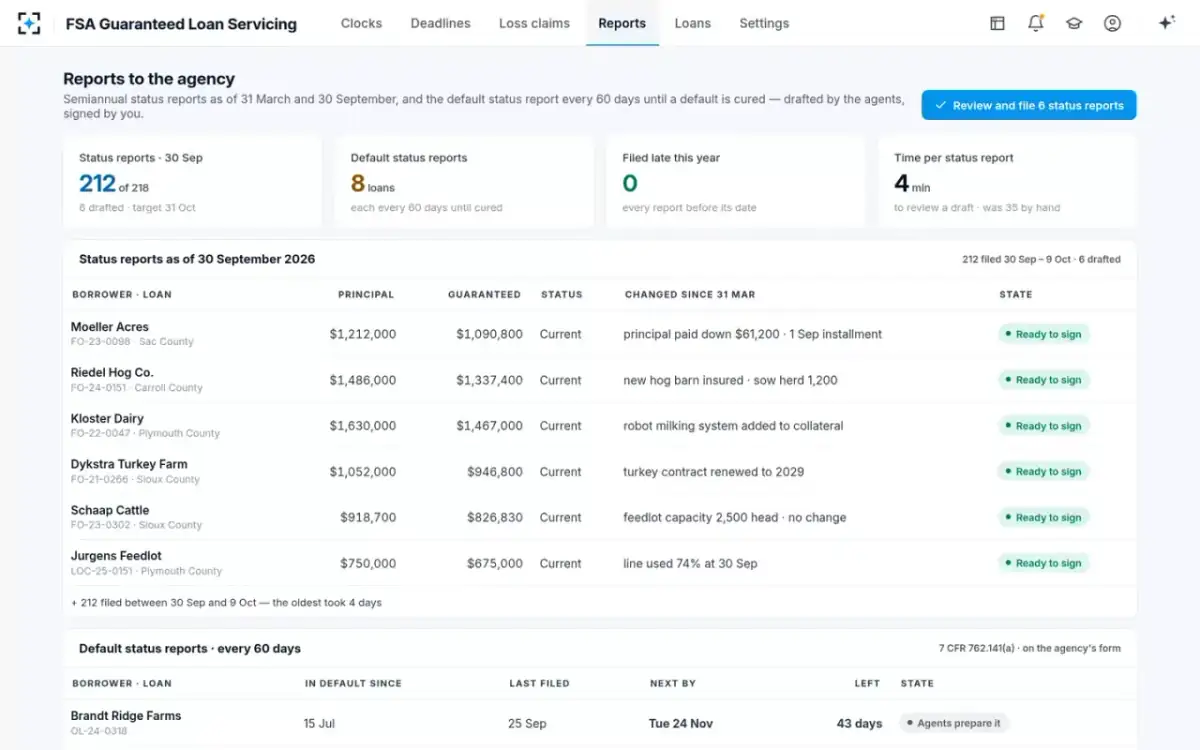
Trust is the wrong frame; replay is the right one. The strength of this particular evaluation is that the answers already exist. Your desk has filed default status reports; the agency has accepted or queried them; the loans went on to be cured, restructured or liquidated. A replay compares what the tool would have written, from the file as it stood, with what was actually written and what actually happened.
A replay also surfaces the disagreements that are worth having. On a sample loan, a drafted report attributed a delinquency to a spring freeze and cited the servicing note; the coordinator, who had been at the meeting, knew the freeze was the trigger but the underlying problem was a second year of thin margins. Both are defensible; only one is in the file. The useful output of the replay is not a score but the list of lines where the file and the person disagreed, because that list tells you what your servicing notes are failing to capture. What each agent may and may not do is the design side of the same question.
The reports the measure is run against
Writing your own standard where the supervisors have not
Because generative and agentic tools sit outside SR 26-2's scope, the thresholds are yours to set, and the useful ones are specific. A workable first standard: zero unsourced borrower facts, with any occurrence treated as a defect rather than a rate; a source-match rate above 98% on a 25-filing sample, with every miss traced; zero missed dates on a 30-loan recomputation, with early dates logged separately; and a stale-fact rate published alongside the lead time that produced it, because the two move together. Add the obligation to re-run after any change to the drafting behaviour, and the obligation to tell the coordinator what the last run found.
Set those numbers before the first measurement, write down what happens if one is missed, and keep the filings the measure ran on. A check that cannot fail is not a check, and a threshold chosen after the result is a description.
What to demand from any vendor before relying on a drafted filing
- A replay mode that drafts from the file as it stood on a past date
Without it you cannot evaluate against filings you have already made, and every other measure becomes a forward-looking promise.
- A source on every line, openable to the document itself
A reference to a document is not a source; the page, the note or the payment line is.
- Blank rather than plausible, when there is no source
Ask to see a filing where the file was incomplete. What the tool does there is the whole design.
- The dates recomputable by hand, with the section shown
If you cannot check a date against the rule yourself, you are trusting the deadline, not keeping it.
- A list of what changed between draft and signature
This is the stale-fact rate, and it is also the fastest route to better servicing notes.
- What happens when the drafting behaviour changes
A model or prompt change invalidates your last measurement. Ask how you will be told, and what the re-run obligation is.
Run honestly, this takes a reviewer about a week to set up and an afternoon a quarter to repeat, and it produces something no vendor can give you: a number about your own book, with the filings behind it. The loss claim is the filing where the same discipline pays most, because a claim the agency sends back costs weeks of unpaid interest. To see the sourced filings and the clock board they come from, start at FSA Guaranteed Loan Servicing.
Questions people ask
How accurate is AI at drafting FSA default status reports?
There is no published figure, and any vendor quoting one is quoting a measurement on data that is not yours. The answerable version is the four measures on this page, run on filings your desk has already sent: source-match rate, unsourced-fact rate, missed-date rate and stale-fact rate. Each is countable in a week of a reviewer's time, and the result describes your own servicing notes as much as the software.
How do you validate AI for loan servicing?
Replay it against history. Have it draft from the file as it stood on a past date, compare line by line with what was filed and what happened, trace every difference to a cause, and set the thresholds before you look. SR 26-2 asks for validation before first use, for limitations to be identified and communicated, and for compensating controls where a tool is used ahead of full validation — all of which applies even though the letter does not cover generative tools.
Does a hallucination benchmark tell me anything about my filings?
Very little. Published benchmarks typically measure question answering over a public corpus, not field-filling over one borrower's servicing file, and NIST notes that benchmark datasets can themselves carry label errors. Use the research for its methods — retrieval-equalized comparison is a good idea — and take your numbers from your own replay.
What is seeded-error testing, and is it worth running?
It is the complement to a replay: put a known error into a copy of a loan file — a payment that was never made, an appraisal missing a piece of collateral — and check whether the tool's own limits catch it. It proves the checks can fail, which a clean replay never does. Run it on the checks you depend on most: the unsourced-fact rule and the completeness checks on a loss claim.
Is an AI-drafted filing a model under bank model risk guidance?
Partly, and the split is useful. SR 26-2 defines a model as a complex quantitative method applying statistical, economic or financial theories, and expressly excludes simple arithmetic and deterministic rule-based processes. Date computation from a regulation is the excluded kind; a drafted narrative is not, though generative and agentic tools are outside the letter's scope altogether. Your own governance has to cover the gap either way.
Who should run the measurement?
Someone who did not choose the tool. The guidance calls this effective challenge and asks for expertise, independence and enough standing to change something. At a small ag lending team that usually means a credit officer, an internal auditor or a second coordinator, with the result going to the person who approves the filings rather than only to the person who prepares them.