A USDA guaranteed farm loan is serviced by the bank, credit union or Farm Credit institution that made it — never by the Farm Service Agency, which guarantees a share of the loss and reviews what the lender files. Inside the lender the work splits across four seats: a guaranteed-loan coordinator who carries every date, an ag loan officer who knows the borrower, an Ag Lending Manager who approves what leaves the building, and a special assets officer who assembles the claim when a loan fails. The rules those seats follow are not hard to read; carrying a few hundred sets of them at once is the job. Botminds' FSA Guaranteed Loan Servicing puts every guaranteed loan's 7 CFR 762 dates on one board, each dated from its own rule, and pre-fills the filing before the date arrives, so each seat spends its week judging files instead of hunting for the next deadline.
The bank on this page is fictional: Lindmark Valley Bank in Storm Lake, Iowa, a Certified Lender with 218 guaranteed loans and $166.9M guaranteed, as it runs through the solution on sample data. Its people are invented too. Everything attributed to a regulation or to a federal wage series is linked where it appears.
One Certified Lender's guaranteed book, and the dates on it
218loans
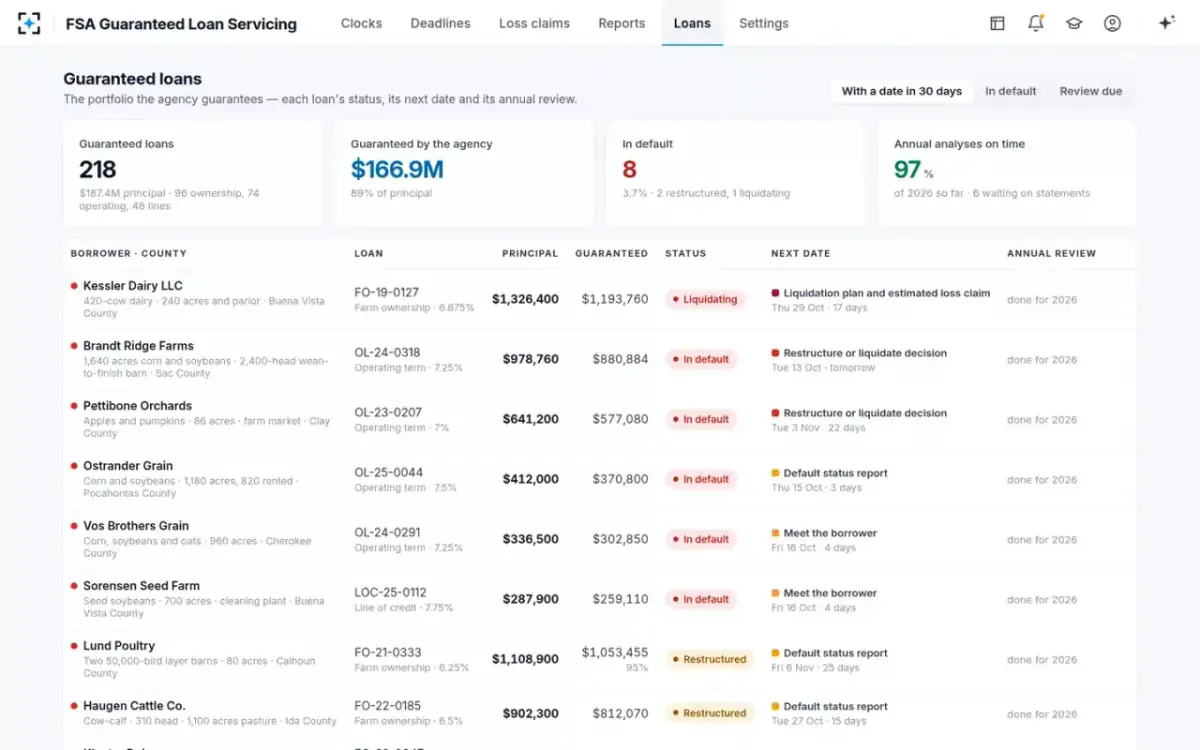
guaranteed, $166.9M of guarantee across them
46dates
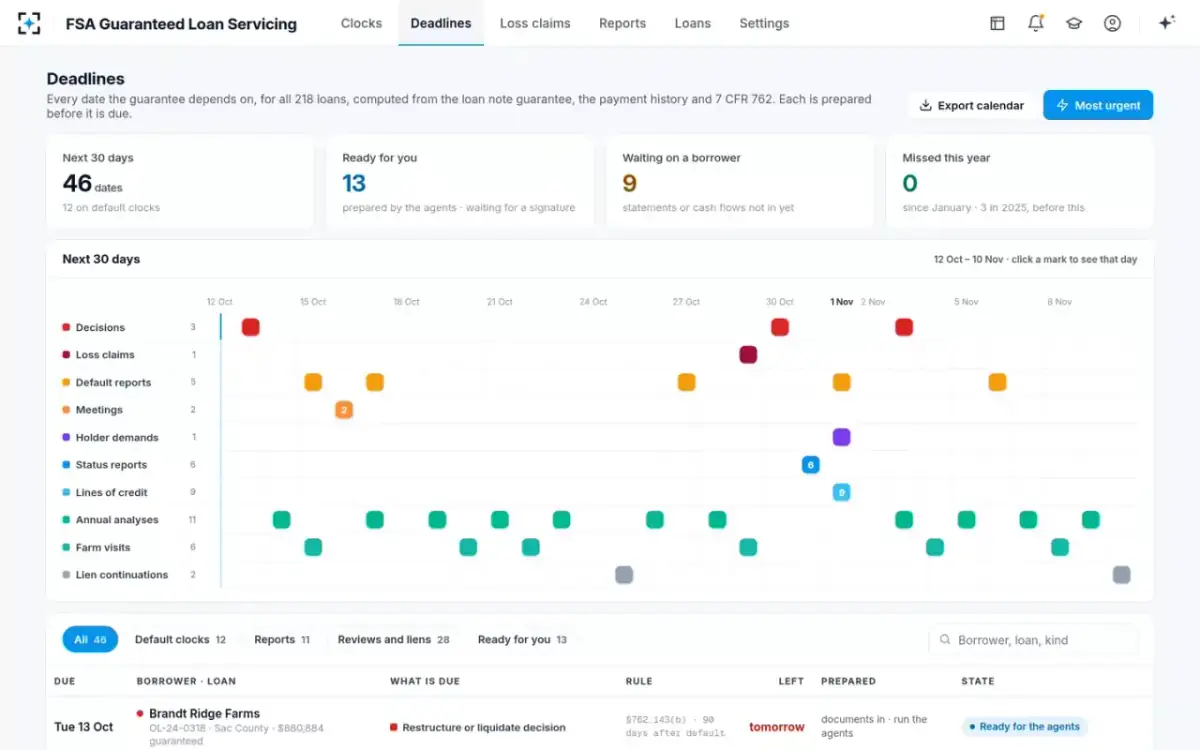
falling in the next 30 days, each dated from its own rule
1,284dates
re-dated overnight from the payment history and the rules
4seats
carrying all of it, with one signature and one approval
Four seats, one guarantee
The division of labour follows the regulation. Part 762 puts the servicing duty squarely on the lender: it must ensure loan funds are not used for unauthorized purposes, ensure the borrower complies with the covenants in the note and the security instruments, report any violation in writing to both the agency and the borrower, receive and apply payments, and perform an annual analysis of the borrower's financial condition "to determine the borrower's progress" (§ 762.140(b)). None of that is the agency's work. The agency's part is to hold the guarantee, review what is filed, and pay — or reduce — a loss claim at the end.
So a guaranteed loan generates two streams of work at the lender. One is ordinary credit work: visit the farm, read the statements, understand the year. The other is a calendar nobody chose, made of dates the agency sets, each one attached to a form. The four seats split the two streams differently at different banks, but the pattern below is the common one, and it is the pattern the sample bank uses.
The same Monday on four seats, before and after the clocks are kept for them
Today
Keeps 218 sets of guarantee dates in a calendar, a spreadsheet and paper loan files, and builds each report by hand from whatever the file holds.
With agents
Starts from a board where every date carries its rule and every filing is already filled in line by line with its source, and signs.
Still theirs: the signature on every filing, and its meaning
Today
Owns the bank’s lender status and knows a missed step can be called negligent servicing when the loss claim is read.
With agents
Gets both options with the cash flow, coverage and collateral side by side, and approves before anything is sent.
Still theirs: the approval on every decision and every claim
Today
Assembles liquidation plans and loss claims, where one missing attachment sends the claim back and costs more unpaid days.
With agents
Gets the claim assembled with every figure tied to its document, and the gaps found before filing rather than by the agency.
Still theirs: the judgement about what the security will really bring
Today
Hears first when a barn breaks or a crop freezes, but the file hears about it weeks later, if at all.
With agents
His meeting notes and the borrower’s own plan feed the cash flow and the default reports the same day.
Still theirs: the relationship, and the farm visit
What does a USDA guaranteed loan coordinator do? 218 loans, a few hundred sets of dates
The coordinator is the seat that exists because of the guarantee. Its job is to know, for every guaranteed loan in the book, which date is next, which rule sets it, which form satisfies it and whether the facts the form needs are in the file yet. On a performing loan that is a light duty: two semiannual status reports, a farm visit, a lien continuation, an annual analysis where one is owed. On a defaulted loan it becomes a dense sequence, and the sequence restarts every time a payment lands or fails to.
The annual analysis is the clearest example of a duty that is easy to read and hard to keep. For every lender that is not a Preferred lender, § 762.140(b)(5) requires an annual analysis on all term loans where the balances together exceed $500,000, on all lines of credit, and on all loans in monetary or non-monetary default; it must be documented in the lender's file, and must include a balance sheet analysis, a comparison of actual against planned income and expenses where personal property is security, and "an account of the whereabouts or disposition of all collateral" (§ 762.140(b)(5)). At the sample bank that is eleven analyses inside one 30-day window. Nothing about any one of them is difficult. Knowing that all eleven are due, and which collateral each has to account for, is the coordinator's whole morning.
The dates one guaranteed loan can carry, and the rule behind each
| The date | When it falls | What satisfies it |
|---|---|---|
| Status report to the agency | As of 31 March and 30 September each year | The guaranteed farm loan status report, updating the loans and the agency’s own figures |
| Default | 30 days past due on a payment, or in violation of the loan documents | Nothing to file: it is the event that starts the rest |
| Borrower meeting | Within 15 days of default, which is 45 days after the payment due date on a money default | A meeting with a current balance sheet and cash flow prepared for it |
| Default status report | After the meeting, then every 60 days while the default lasts | The guaranteed farm loan default status report, summarizing the meeting and the proposed solutions |
| Restructure or liquidate | Within 90 days of default | A documented decision, or circumstances the agency accepts for an extension |
| Liquidation plan and estimated loss claim | Within 150 days of the payment due date | A written liquidation plan, and the report of loss with its attachments |
| Interest stops counting | 210 days from the payment due date | Nothing: after it, accrued interest is the lender’s own |
| Annual analysis | Yearly, where the loan meets the test in § 762.140(b)(5) | The analysis documented in the lender’s file, collateral accounted for |
Read down that table once and it looks orderly. The difficulty is that it is not one table but 218 of them, each at a different point, and that most of the dates are computed rather than given: 45 days after a payment due date that itself depends on which installment was missed, 60 days after a meeting that may have been moved, 150 days after a due date that a partial payment can reset. A spreadsheet holds the arithmetic. It does not re-do the arithmetic when a payment lands on a Friday afternoon. What 7 CFR 762 asks of a guaranteed lender sets the sequence out rule by rule.
What does an Ag Lending Manager do? Approving before anything is sent
The manager's seat carries the consequence. Nothing the coordinator prepares leaves the bank without an approval, for one blunt reason: the guarantee is only as good as the servicing behind it, and the agency reads the servicing at exactly the moment the bank needs the money. A restructure that cannot carry its own cash flow, a loss claim that overstates the loss, a default report that states a cause nobody can evidence — each is cheaper to catch at the manager's desk than at the county office.
The manager also owns the bank's status with the agency, which is a renewable thing rather than a permanent one. Certified Lender status is granted "for a period not to exceed 5 years", expires at the end of that term unless a new lender's agreement is executed, and renewal "is not automatic": the lender must ask in writing, update what it submitted the first time, and address any criteria the agency has added since (§ 762.106(d), (f)). The agency may also revoke the status during the term for cause, and violation of the lender's agreement is one of the listed causes. That is the manager's real exposure: not one loan, but the standing that makes the whole book cheaper to run.
What that means for the week is a queue of approvals that each need the same three things in front of them: the figures, the documents behind the figures, and the rule that set the date. A manager who gets the figures without the documents approves on trust. What negligent servicing costs a lender prices what trust costs when a claim is read.
Special assets officer duties: the claim nobody wants sent back
When a loan is going to end in a loss, it moves to a different seat, because the work changes character. A performing loan is watched; a liquidating loan is assembled. The special assets officer builds the liquidation plan, runs the sale of the security, and files the report of loss — and the regulation is specific about what must travel with it. A final loss claim goes in with an accounting of the use of loan funds, an accounting of the disposition of the security and its proceeds, a copy of the loan ledger showing advances, rate changes, protective advances and the application of payments with a running balance, and whatever documentation the agency asks for on the lender's compliance with the part (§ 762.149(i)(4)).
The incentive to get it right the first time is written into the same section from both directions. The agency will "notify the lender of any discrepancies in the final loss claim or, approve or reject the claim within 40 days", and if it takes longer it pays the lender additional interest for the days over 40. The lender's side of that bargain is a complete claim: a package that comes back for a missing attachment restarts the clock on money the bank has already lost. Special assets is also the seat that knows the uncomfortable part — the agency reduces a claim by the dollar amount of loss its own calculation attributes to negligent servicing, and that calculation reads the servicing history the coordinator kept.
One default status report, across the four seats
Agent
The dates, re-computedOvernight, every guaranteed loan is re-dated from the loan note guarantee, the payment history and the rules. A new default moves a report’s date and turns the tile red.
Never: moves a date the regulation sets
Agent
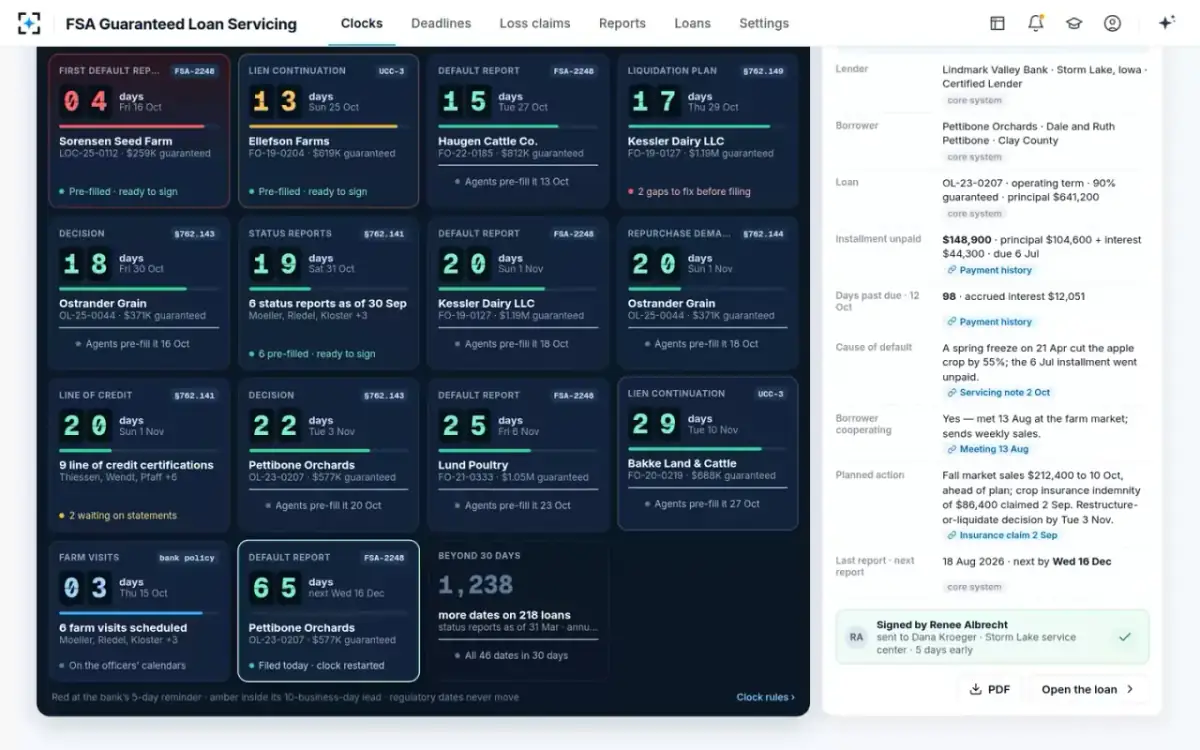
The form, filled inAmount and days past due from the payment history, cause and cooperation from the loan officer’s meeting notes, planned action from the borrower’s own plan — each line showing the document it came from.
Never: states a borrower fact that is not in a note or a document
A person decides
The coordinator signsReads the drafted report against its sources, corrects what the file got wrong, and signs — with the meaning of the signature kept beside it.
A person decides
The manager approvesApproves before anything is sent to the county office, with the figures, the documents behind them and the rule that set the date on one screen.
The loan officer: hearing about trouble first, the file hearing it last
The ag loan officer is the seat with the information and none of the forms. He is at the farm when the hog barn breaks with PRRS in March, or when a spring freeze takes half an apple crop in April. That is exactly the material the agency's default status report asks for, because § 762.143(b)(3) does not ask the lender to describe a delinquency in the abstract: it requires a meeting with the borrower to "identify the nature of the delinquency and develop a course of action that will eliminate the delinquency and correct the underlying problems", with a current balance sheet and cash flow projection prepared for it, and — if the borrower will not cooperate — the best financial information the lender can compile (§ 762.143(b)(3)).
The regulation then says what becomes of the meeting: "The lender will summarize the meeting and proposed solutions on the Agency form for guaranteed loan borrower default status completed after the meeting." The summary is the filing. Which makes the gap between the two seats the most expensive gap on the desk — a conversation in a yard in March, and a form that needs its content in May, with nothing structural connecting them except somebody remembering to ask.
Every date in the next 30 days, laid out by kind and by who owes it
How much does a loan officer make? What a federal wage series tells you, and what it hides
There is no occupational code for "USDA guaranteed-loan coordinator", so the published wage data describes the seats around it rather than the seat itself. Two federal series are the ones to read. For loan officers, the Bureau of Labor Statistics reports a median wage of "$76,690 per year ($36.87 per hour)" for May 2025, 283,000 jobs in 2025, a bachelor's degree as the typical entry-level education, and projected growth of 1% from 2025 to 2035 — slower than average (BLS, Loan Officers). For credit analysts, the occupational wage survey put national employment at 73,200 with a mean annual wage of $94,750 and a median of $79,420, and a spread from $50,060 at the 10th percentile to $164,750 at the 90th (BLS, Credit Analysts, May 2023).
What the federal wage series say about the seats around the coordinator
Those figures do two useful things and hide a third. They tell a team lead what the market pays for the judgement around the guarantee, and the 1% growth projection suggests a bank should not count on hiring its way through a growing guaranteed book. What they hide is the shape of the coordinator's day. A wage series counts seats, not the share of each seat spent on clerical work; nothing in the data distinguishes a loan officer who spends Tuesday at a farm from one who spends it reconciling a spreadsheet of dates against a paper file. That share is the number a bank should measure for itself, because it is the only one a tool can move.
What is the Certified Lender Program, and what it adds to the coordinator's seat
Certified Lender status is the agency's middle tier: more delegated authority than a standard eligible lender, less than a Preferred lender, and a specific set of eligibility criteria the lender must keep meeting. Two of the seven land directly on the coordinator. § 762.106(b)(6) requires the lender to "designate a qualified person or persons to process and service Agency guaranteed loans for each of the lender offices which will process CLP loans", and to be qualified that person must "have attended Agency sponsored training in the past 12 months or will attend training in the next 12 months" and "agree to attend Agency sponsored training each year". § 762.106(b)(7) requires the lender to "use forms acceptable to the Agency for processing, analyzing, securing, and servicing" these loans (§ 762.106(b)).
The Certified Lender criteria, read as duties on named seats
(b)(1)–(2)
What it requiresQualify as a standard eligible lender, and keep the loss rate under the maximum the agency publishes.
Whose seatAg Lending Manager
(b)(3)
What it requiresShow an ability to process and service: applications "substantially complete and correct", and all guaranteed loans "serviced according to Agency regulations".
Whose seatCoordinator, measured by the manager
(b)(4)
What it requiresHave made the minimum number of guaranteed loans the agency publishes.
Whose seatAg Lending Manager
(b)(5)
What it requiresBe under no regulatory enforcement action based on financial condition.
Whose seatThe bank, not the desk
(b)(6)
What it requiresDesignate a qualified person for each office that will process these loans — trained within the past 12 months or booked for the next 12, and agreeing to train every year.
Whose seatThe coordinator, by name
(b)(7)
What it requiresUse forms acceptable to the agency for processing, analyzing, securing and servicing.
Whose seatCoordinator
The effect of (b)(3) is worth sitting with. "Serviced all guaranteed loans according to Agency regulations" is not a one-off test at application; it is the evidence the agency has, which is the servicing history of the book. A coordinator's dates are therefore not only this loan's problem. They are the bank's case for keeping the status that makes every future guaranteed loan cheaper to originate.
Where the week actually goes: chasing dates versus judging a file
Take one guaranteed loan from default to a filed claim and split the hours by what they are for. Botminds' own estimate, with and without the solution, is below; it is an estimate, not a measurement at any bank. The honest reading of it is not that the work halves — it is that the review, signature and approval hours do not move at all, while the hours spent keeping dates, re-typing facts into forms and assembling attachments do.
Hours on one defaulted guaranteed loan, by what the hours are for
| The work | By hand | With the clocks kept and the filings prepared |
|---|---|---|
| Keeping the dates in calendars and loan files | 6 hours | 0.5 hours |
| Default status reports, every 60 days | 4 hours | 1 hour |
| Cash flow and the restructure-or-liquidate analysis | 12 hours | 4 hours |
| Liquidation plan and loss claim with attachments | 16 hours | 5 hours |
| Review, signature and approval | 3 hours | 3 hours |
That last row is the design decision, not an accident of the arithmetic. A desk where the clerical hours fall and the review hours do not is a desk where the four seats spend proportionally more of the week on the questions only they can answer: is this farm's plan credible, will that security really bring what the appraisal says, is a restructure honest or a delay.
The guaranteed book, with the next date beside every loan
What changes on each seat when the next date is already prepared
The change is narrower than "automation" and more useful. Six specialist agents do the reading, the arithmetic and the drafting: one keeps every loan's dates from the guarantee, the payment history and the rules; one drafts the semiannual status reports; one drafts the default status report at default and every 60 days from the servicing notes, the meeting and the payment history; one builds next year's cash flow and lays restructuring beside liquidation; one assembles the liquidation plan and the loss claims with their attachments; one watches statements, farm visits, insurance and lien continuations. What each of the six may and may not do is set out separately, because the limits matter more than the capabilities.
What does not change is who is answerable. The coordinator signs every filing, and the meaning of her signature is kept with it. The Ag Lending Manager approves every decision and every loss claim before anything is sent. The agency's dates are shown read-only beside the section that sets them; only the bank's own lead times, reminders and escalations can be edited. No claim leaves with an open gap — a missing attachment, an unsupported figure, collateral left out of the recovery, or a protective advance above the authorization limit stops it until it is fixed.
Signed five days early, and the next clock already running
If you are staffing this desk for the first time, the order that works is the one the regulation implies: name the coordinator before you take the first guaranteed loan, because (b)(6) asks for a name; give the manager a standing approval slot rather than an inbox; and make sure the loan officer's meeting notes land somewhere the coordinator reads, because the default status report cannot be written without them. What a servicing tool needs loaded before day one covers the inputs side of the same question. To see the board, the filings and the signatures together, start from FSA Guaranteed Loan Servicing.
Questions people ask
Who services a USDA guaranteed farm loan — the lender or the FSA?
The lender. A guaranteed loan is made, held and serviced by a commercial lender; the Farm Service Agency guarantees a share of the loss and supervises by reviewing what the lender reports and files. § 762.140(b) puts borrower supervision on the lender, including the annual analysis of the borrower's financial condition. Direct FSA loans are the other product, and those the agency services itself.
What does a USDA guaranteed loan coordinator do all day?
Three things: knows which date is next on every guaranteed loan and which rule sets it, gathers the facts each filing needs from the payment history and the loan file, and signs the filing that goes to the county office. On a book of a few hundred loans the first of the three consumes most of the day, which is why it is the part worth moving to software.
Is a separate coordinator seat necessary, or can a loan officer do it?
It can be one person at a small book, and often is. But Certified Lender status asks the lender to designate a qualified person for each office that processes these loans, trained within the past 12 months or booked to train within the next 12, and agreeing to train annually. That is a named duty, and a loan officer with a full book of borrowers rarely has the week it needs during harvest.
What is the difference between a standard eligible, Certified and Preferred lender?
How much the agency delegates. A standard eligible lender submits the most to the agency; a Certified Lender meets the § 762.106(b) criteria and gets more delegated authority for up to five years; a Preferred lender meets the Certified criteria plus an approved credit management system and then services defaults according to its own lender's agreement rather than the default rules in § 762.143(b). More delegation means more of the judgement — and the paperwork that proves it — stays in the bank.
Is agricultural lending a good career to go into?
The federal projection for loan officers overall is 1% growth from 2025 to 2035, slower than average, with a median wage of $76,690 for May 2025 — so the honest answer is that the field is not expanding fast and the money is solid rather than remarkable. What the data does not capture is that guaranteed lending is credit work with a rulebook attached, which suits people who like both halves and frustrates people who like only one.
How many guaranteed loans can one coordinator carry?
There is no published figure, and the answer depends almost entirely on how many of the loans are in default: a performing loan carries a handful of dated filings a year, while Botminds estimates one defaulted loan at about 41 hours by hand from default to a filed claim. The useful way to size the seat is to count defaults rather than loans, and to measure what share of the hours is clerical before deciding whether the answer is a hire or a tool.