FSA guaranteed loan servicing software has a short list of requirements, and the list is shorter than most coordinators expect: the loan note guarantee, the payment history, the servicing notes, the agency's own clocks and your bank's lead times. Four of the five you already hold — in a core loan system, a paper file and a loan officer's notebook — and the fifth is a conversation rather than a document. The honest framing of an implementation is therefore not "how long does it take to install" but "how long does it take to get the loan note guarantees and payment history into one place". Botminds' FSA Guaranteed Loan Servicing arrives with the 7 CFR 762 clocks loaded and read-only; everything else on this page is what a lender brings to it, and most of it is what any tool in this category will ask for.
The worked examples come from a fictional sample bank, Lindmark Valley Bank, a Certified Lender with 218 guaranteed loans, as it runs through the solution on sample data. The agency's form instructions and the regulation are real and linked where they appear.
FSA guaranteed loan servicing software requirements: five inputs, one date
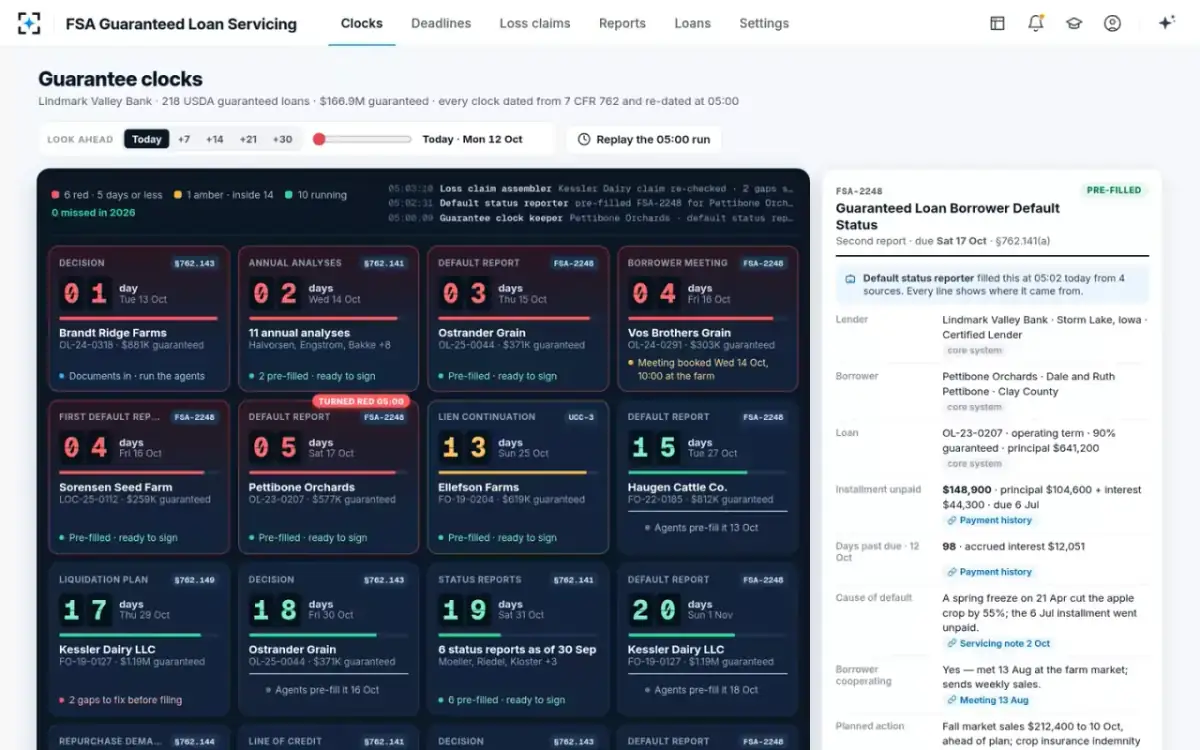
Work backwards from the thing you want on the screen. "Brandt Ridge Farms: restructure-or-liquidate decision due Tuesday 13 October, under § 762.143(b)" is one date on one loan. To produce it, a tool needs to know which installment was missed and when it was due (payment history), that the loan is guaranteed and under which terms (the loan note guarantee), that a payment 30 days past due is a default and the decision falls 90 days after that (the agency's clocks), that a meeting was held on a particular day (servicing notes), and how many days before the 13th your bank wants the paperwork ready (your lead time). Five inputs, one date. Remove any one and the date cannot be computed honestly.
The five inputs, what each one is for, and where it usually lives today
The loan note guarantee and its conditions
What it containsThe percent of guarantee, the loan type, the conditions attached and the agency loan number.
What it makes possibleFixes the guaranteed share on every figure the software will ever compute for this loan, and ties it to the agency’s own numbering.
Where it livesThe paper loan file, usually.
Loan payment and status history
What it containsInstallment due dates and amounts, what was paid and when, current principal and accrued interest.
What it makes possibleEvery date on a guaranteed loan is arithmetic on a payment due date. Without the history there is no clock to keep.
Where it livesThe core loan system.
Servicing notes and meeting notes
What it containsFarm visits, calls, the borrower meeting after a default, and the borrower’s own plan.
What it makes possibleThe cause of the delinquency, the borrower’s cooperation and the planned action come from here and nowhere else.
Where it livesScattered: a loan officer’s notes, email, the file.
The agency’s own clocks
What it containsThe intervals in 7 CFR 762 and the forms that satisfy each.
What it makes possibleLoaded once and shown read-only with their section. Nobody at the bank edits these.
Where it livesComes with the software.
Your lead times and thresholds
What it containsWhen filings are prepared, when reminders go, when an undecided default escalates, your lender status and your feasibility ratio.
What it makes possibleThe only numbers a bank sets. They are what makes the same rulebook fit two different banks.
Where it livesA conversation, not a file.
The loan note guarantee, and the percent of guarantee it fixes
Start here, because it is the document that makes the loan a guaranteed loan and the one most often still on paper. What a servicing tool needs from it is small: the agency loan number, the loan type, the percent of guarantee, the date it was issued and any conditions attached. The percentage is the one everything else leans on — every exposure figure, every split of a loss between the agency and the bank, every look-ahead of guarantee at risk is that percentage applied to something else.
Two practical notes from implementations that go badly. First, the agency's loan number is not your loan number, and the mapping between them is the join that makes agency correspondence match your own files; the instructions for the status report point lenders at the previously completed form for exactly this reason. Second, guarantees reissued after a restructure or an assumption supersede the original, and loading the wrong generation sets a wrong percentage on a loan nobody will re-check. Pull the current guarantee, not the first one.
Payment history: the one fact that starts every clock
If you load only one thing properly, load this. A borrower goes into default when a payment is 30 days past due or the loan documents are violated (§ 762.143(a)), and from that moment every other date is arithmetic: the meeting, the first default status report, the report again every 60 days, the 90-day decision, the 150-day plan and claim, the 210-day interest limit. All of it hangs from a payment due date.
What the tool needs is the schedule and the actual events, not a balance: due dates and amounts, what was received and when it was applied, current principal, accrued interest, and the rate. A monthly extract of balances will produce dates that are plausible and wrong. Partial payments are the usual trap, because a payment that cures part of an installment can move the date the chain hangs from, and a system that re-dates nightly will catch that while a spreadsheet will not.
One extract decision is worth making deliberately: history depth. Two years is enough for the clocks, but five makes a replay possible — drafting past filings from the file as it stood — which is how a desk measures the tool rather than trusting it. The four measures a replay produces are worth the extra extract.
Servicing notes: where cause and cooperation come from
This is the input nobody budgets for and the one that decides whether a drafted filing is any good. The agency's default status form asks, in item 15, for comments "on any action taken to correct the default or to provide an update on the status of the borrower" (FSA-2248 instructions). That is where the cause of the delinquency, the borrower's cooperation and the planned action have to come from, and the regulation requires the lender to summarize the borrower meeting on that form after holding it.
No tool can conjure those facts. What it can do is refuse to invent them: a line that cannot find a note or a document stays empty and says so. Which means the quality of your filings after go-live is a direct function of whether your loan officers' meeting notes reach the same place the coordinator works. In practice that is the biggest behaviour change in an implementation, and it is worth starting before the software arrives. A note that records the date, who was present, what the borrower said about the cause, what they committed to and by when is the difference between a filing that drafts itself and one that still needs an afternoon.
The agency's own clocks, loaded once and never edited
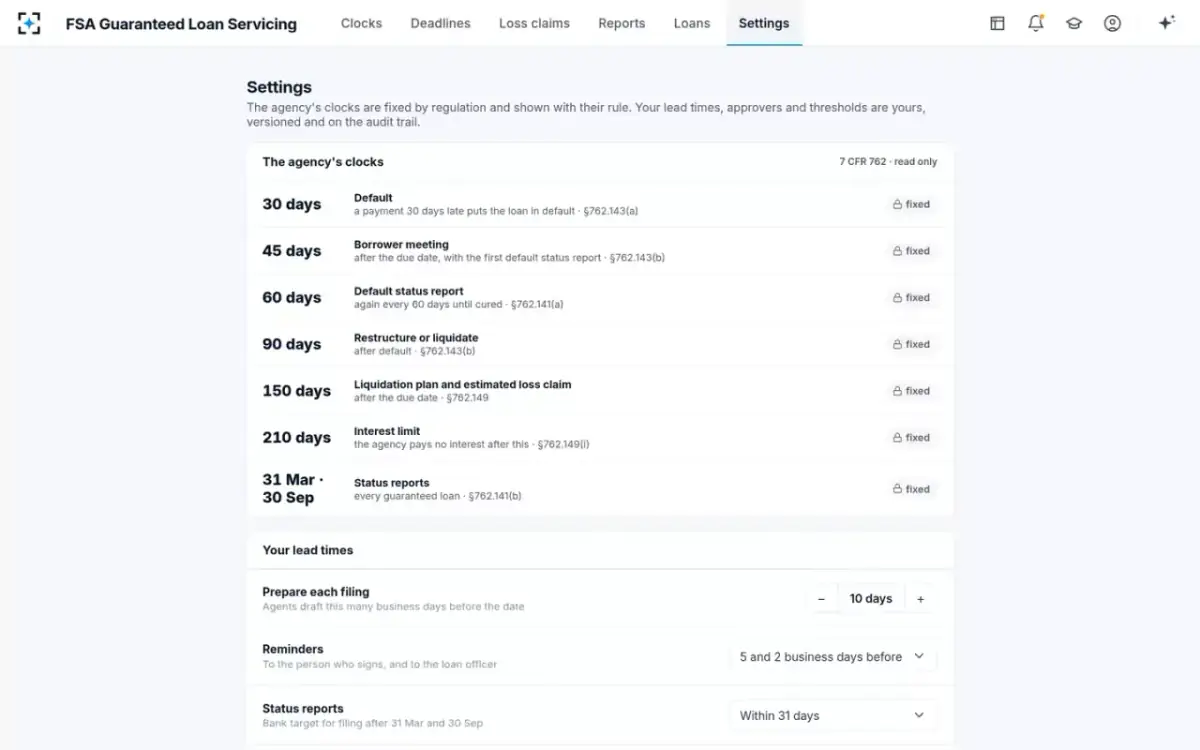
These come with the tool, and the thing to check at selection is not whether they are there but whether they can be changed. In this solution every regulatory date is shown read-only beside the section of 7 CFR 762 that sets it, and nothing in the settings can move one. That is a deliberate restriction rather than a missing feature: a deadline a setting can move is being tracked, not kept.
What you should ask to see is the mapping — each date, the section behind it, and the form that satisfies it — and then check two or three against the regulation yourself. The semiannual status report is a good test case, because the agency's own form instructions state the timing plainly: the guaranteed farm loan status report "is due to FSA from lenders as of March 31, and September 30 of each year" (FSA-2241 instructions). If a tool's calendar says something else, you have learned something important in five minutes.
Your lead times: the only numbers you set
Everything that differs legitimately between two banks is a setting, and there are fewer than a dozen. When each filing is prepared ahead of its date; when reminders go to the signer and the loan officer; the bank's own target for turning around the semiannual status reports; when an undecided default escalates to the Ag Lending Manager; your lender status; the debt coverage a restructure's cash flow must reach to count as feasible; who signs filings; who approves decisions and claims.
Choose the preparation lead time with the stale-fact problem in mind. Ten business days gives comfortable room to chase a missing appraisal; it also means every drafted figure is ten days old at signature, so a payment landing in between has to re-open the figures it touches. Three days is fresher and leaves no room to fix anything. The sample bank's choice is ten, with reminders at five and two, which is a reasonable default to argue with rather than adopt.
What you set, and what you cannot
The FSA-2248 form, item by item: what each field needs from your file
The clearest way to check whether you have the inputs is to walk the agency's own default status form and ask where each answer comes from. The form has sixteen items and the lender completes all of them. The table below maps each to its source in a lender's own systems.
FSA-2248, the guaranteed farm loan default status report: where each answer lives
| The item | Where the answer comes from | What to watch |
|---|---|---|
| Items 1–7: borrower and lender identifiers, the agency loan number | Your core system and the loan note guarantee | The agency loan number is on the status report previously completed for the loan |
| Item 8: the date the loan became delinquent | Payment history | This single date is what every other clock on the loan is computed from |
| Items 9–11: unpaid principal, accrued interest, total past due | Payment history, as of the reporting date | Must all be stated as of the same "as of" date in item 12 |
| Item 13: the delinquency code | Your own classification of the account | The code decides whether reports continue: "If the code is 1-2, 4-7, 9, or 14-15, bimonthly default status reports must be submitted" |
| Item 14: interest assistance considered or requested | The credit decision on the account | Consider it and rule it out, or request it — the form asks which |
| Item 15: comments on action taken, or an update on the borrower | Servicing notes and the borrower meeting | The free-text field that carries cause, cooperation and planned action |
| Item 16: signature, title and date | A named authorized representative | Signed by hand on a printed form, or transmitted with established credentials |
Item 13 deserves the attention. The code you assign decides whether the reporting cycle continues at all: on the agency's instructions, codes in one set mean bimonthly default status reports must keep being submitted, while another set ends them "unless the borrower returns to default status at a future date". A clock board is only as good as the status feeding it, so the handoff between whoever sets the account status in the core system and whoever files the form is a process question worth settling during implementation rather than after.
The FSA-2254 form, and the inputs a loss claim adds
The report of loss asks for a different and larger set, and it is worth reading before you need it, because several of its lines need documents nobody gathers in advance. The form is used to report a loss on a guaranteed loan, with a separate form for each loan, and a report type code that distinguishes an estimated loss from a final loss, a bankruptcy reorganization loss, a debt restructure write-down and several kinds of recovery (FSA-2254 instructions).
Three of its items reach straight back into the inputs above. Accrued interest owed requires the lender to provide, as an attachment, "its calculation of unpaid accrued interest showing advances, payment, periods of time, interest rate and amount" — which is the payment history again, in a presentable form. Collateral and proceeds asks for "the total amount for the real estate and chattel values", with the separate values documented, which is precisely where a claim goes wrong when an appraisal covers the land and buildings but not the equipment a lien also attaches to. And protective advances need their authorizations: prior written authorization from the agency is required for all protective advances above $5,000 for a Certified Lender and $3,000 for a standard eligible lender (§ 762.149(e)(1)).
Three forms, three jobs, three different sets of inputs
FSA-2241
Guaranteed farm loan status report
Due as of 31 March and 30 September each year, to keep the agency's own figures current. Usually pre-filled by the agency from the prior report and checked by the lender.
Needs: balances and status from the core system.
FSA-2248
Guaranteed farm loan default status report
Prepared after the borrower meeting and then on the agency's bimonthly cycle while the default lasts, one per borrower unless loan detail is attached.
Needs: payment history, the delinquency code, and the servicing and meeting notes.
FSA-2254
Guaranteed loan report of loss
One per loan incurring a loss, with a report type code for estimated, final, bankruptcy, write-down and recovery cases.
Needs: the interest calculation as an attachment, real estate and chattel values separately, liquidation costs, prior liens and the advance authorizations.
What a Certified Lender's renewal paperwork adds
If your bank holds Certified Lender status, one more folder belongs in the implementation. The status runs for a fixed term and has to be renewed, and the renewal is a document exercise: a lender must submit a written request for renewal which includes information "updating the material submitted in the initial application" and "addressing any new criteria established by the Agency since the initial application" (§ 762.106(f)(2)).
Two of those materials are things a servicing desk produces rather than finds. The designated person's training is annual and has to be current. And the criterion about having serviced all guaranteed loans according to the agency's regulations is evidenced by the servicing history itself. A desk that can print last year's dates, filings and signatures has written most of its own renewal; a desk that cannot is reconstructing it from memory at the worst possible moment. Which seat carries each criterion sets that out.
A minimum viable set, and what it takes to load it
Loading everything before anything works is how implementations stall. A first clock can run on much less than the full set, and the sequence below gets a real date on a real loan in days rather than months, after which the rest can be back-filled while the board is already useful.
The minimum set to get a first real clock running
- Twenty loans, not two hundred
Pick the defaulted ones and the ones with a date inside 60 days. They are where an error would cost something, and where value shows immediately.
- The current loan note guarantee for each
Agency loan number, loan type, percent of guarantee, date issued. The current generation, not the original, where one has been reissued.
- Two years of payment history
Due dates and amounts, receipts and how they were applied, current principal, accrued interest and the rate. Five years if you want to replay past filings.
- The servicing and meeting notes for the defaulted ones
Dated, with who was present and what the borrower said. This is what the comments field of the default status report draws on.
- Your eight settings, agreed in one meeting
Lead time, reminder points, status-report target, escalation point, lender status, feasibility ratio, who signs, who approves.
- The two names
Who signs filings to the agency and who approves decisions and claims. Both are required before anything can leave the desk.
- The last year of filing dates, for a baseline
Not needed to run, but it is the only way you will be able to say afterwards what changed.
The minimum set against the ideal one
Minimum: a first clock in days: 20, chosen for defaults and near dates.
Ideal: the full book, measurable: The whole guaranteed book, so the look-ahead and the exposure figures mean something.
Minimum: a first clock in days: Two years, extracted once.
Ideal: the full book, measurable: Five years, refreshed nightly, so a partial payment re-dates the chain the same night.
Minimum: a first clock in days: The defaulted loans only, typed up.
Ideal: the full book, measurable: Every farm visit and call, filed as it happens, so cause and cooperation draft themselves.
Minimum: a first clock in days: The loan note guarantees.
Ideal: the full book, measurable: Appraisals, lien filings, insurance and authorization letters too — what a loss claim needs attached.
Minimum: a first clock in days: None; you will be comparing impressions.
Ideal: the full book, measurable: Last year’s filing dates and any claims the agency queried, so the change is measurable.
Minimum: a first clock in days: Real dates on real loans, and the first prepared filing.
Ideal: the full book, measurable: Guarantee exposure across the book, a defensible servicing history, and a replay you can measure.
Where the time actually goes in a first month
- Pull 20 guarantees2 d
- Payment extract2 d
- Notes typed up2 d
- Settings and the two names3 d
- All 218 guarantees7 d
- Nightly payment feed5 d
- Notes routed to one place10 d
- Documents for claims5 d
- Baseline from last year3 d
What the sample bank's board shows once the inputs are in
218loans
with every date computed from its own rule
46dates
in the next 30 days, 13 already prepared for signature
8
settings a bank chooses; the agency’s dates are read-only
0
guarantee dates missed in the year to date
The board the inputs produce
One last expectation to set. Going live is not the same as being trusted: the first month's filings should be reviewed line against source more carefully than later ones, and the four measures of a drafted report are worth running on the first twenty-five before anyone relaxes. What a missed date is actually worth is the reason to be patient about that, and FSA Guaranteed Loan Servicing shows the board, the filings and the claims on a sample book.
Questions people ask
What documents does guaranteed loan servicing software need?
Five classes: the current loan note guarantee for each loan, the payment and status history, the servicing and borrower-meeting notes, the agency's own 7 CFR 762 clocks (which come with the tool and should be read-only) and your bank's lead times and thresholds. For loss claims it will also want appraisals, lien filings, insurance and the written authorizations for protective advances above the agency's limit.
What is the FSA-2248 form?
The guaranteed farm loan default status report. The lender completes its sixteen items for each borrower in default — identifiers, the date the loan became delinquent, unpaid principal and interest as of a stated date, the total past due, a delinquency code, whether interest assistance was considered, comments on the action taken, and a signature. The delinquency code decides whether the reporting cycle continues.
What is the FSA-2254 form?
The guaranteed loan report of loss, filed one per loan incurring a loss, with a report type code distinguishing an estimated loss, a final loss, a bankruptcy reorganization loss, a debt restructure write-down and recovery cases. It needs the interest calculation attached, real estate and chattel values documented separately, liquidation costs and prior liens, and the authorizations for protective advances.
How long does it take to implement loan servicing software?
The honest answer depends on one thing: how quickly you can extract payment history. With twenty loans, their guarantees and two years of history, a first real clock is a week or two of work. The full book with a nightly payment feed and a measurable baseline is more like a month, and the part that slips is never the data — it is routing loan officers' notes to where the coordinator works.
Can we keep using our spreadsheet during the change?
Yes, and for the first month you should. Run both on the same twenty loans and compare the dates each produces; a difference is either an extract problem or a spreadsheet error, and both are worth knowing about before the whole book moves. Keep the spreadsheet until the computed dates have matched for a full reporting cycle.
What does Certified Lender renewal need from the desk?
Evidence rather than paperwork. Renewal is not automatic: the lender submits a written request updating the material from the initial application and addressing any criteria the agency has added since. The designated person's annual training has to be current, and the criterion about having serviced guaranteed loans according to the regulations is evidenced by your own servicing history — dates, filings and signatures.