When a USDA guaranteed farm loan goes into default, the lender has 90 days to decide whether to restructure or liquidate it. The decision looks like judgement and is mostly arithmetic: a restructured loan has to leave the borrower what the regulation calls a feasible plan — enough cash coming in to pay everything going out — and a cash flow either reaches that bar or it does not. What makes it hard is that the bar has to be proved from documents the borrower has not finished sending, on a clock that started the day a payment went 30 days late. Botminds' FSA Guaranteed Loan Servicing dates that clock from the rule, builds next year's cash flow from the file as it arrives, and lays both paths side by side for the people who sign.
The worked example below is a fictional sample file as it runs through the solution: Brandt Ridge Farms, a borrower of Lindmark Valley Bank in Storm Lake, Iowa. The bank, the farm and the people are invented, and every figure describing them is sample data. The deadlines and the tests are real.
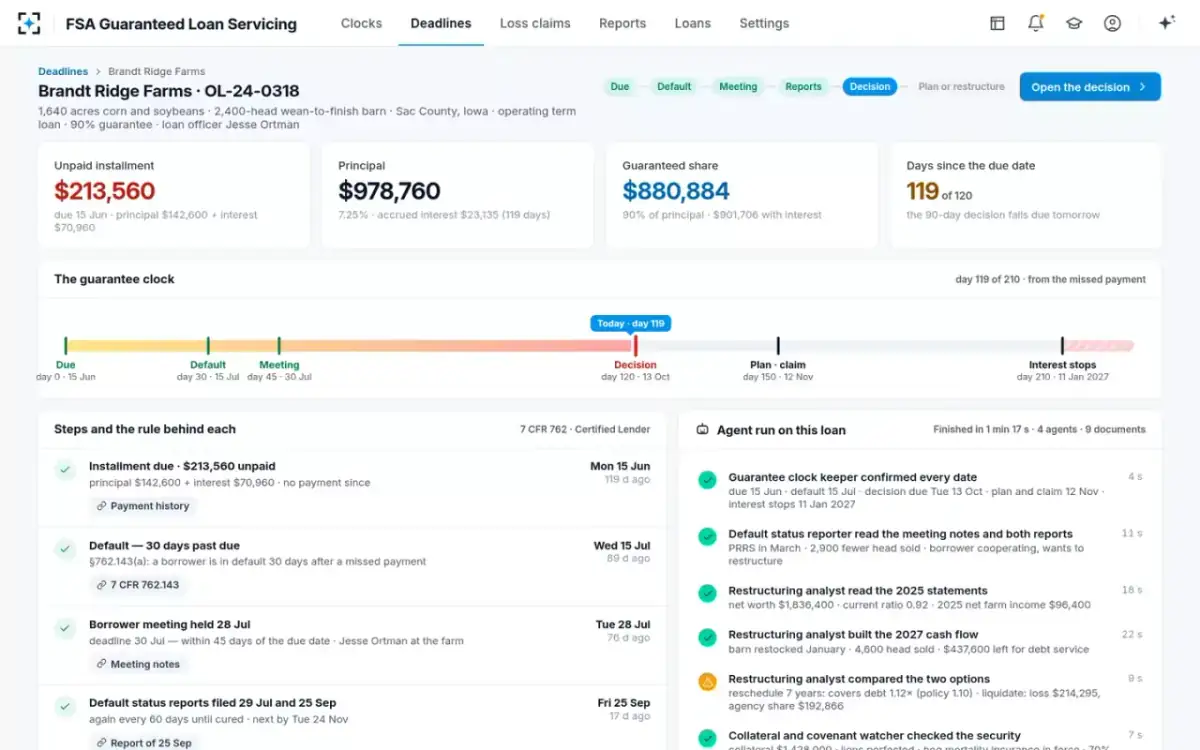
One defaulted farm loan on the morning of Monday 12 October
119days
since the missed installment of 15 June
1day
until the 90-day decision is due, on Tuesday 13 October
$880,884
of guarantee riding on the answer
90% of $978,760 of principal
9docs
in the file, the last of them the borrower’s own plan
The clock: 90 days from default to a decision on a farm loan
The deadline is a sentence long. The lender, says the regulation, "must decide whether to restructure or liquidate the account within 90 days of default, unless the lender can document circumstances that justify an extension by the Agency". Default itself is defined one paragraph earlier, and it is not the day the payment was missed: a borrower is in default 30 days past due, or on any breach of the loan documents.
So there are two clocks, one inside the other, and a desk that confuses them loses a month. On the sample file the installment of $213,560 was due on 15 June. Default fell on 15 July. The borrower meeting had to be held by 30 July, 45 days after the due date, and it was held on 28 July. The decision is due 90 days after default — Tuesday 13 October — and the day this file is being read is Monday 12 October, day 119 of the first clock and day 89 of the second.
Two clocks on one defaulted farm loan, and where the 90 days sit inside them
From the payment due date
15 JunInstallment of $213,560 unpaid
30 JulMeeting due, day 45
12 NovLiquidation plan and estimated loss claim, day 150
11 Jan 2027Agency interest stops, day 210
From default
15 JulDefault: 30 days past due
13 OctRestructure or liquidate, day 90
Nothing about the second clock is advisory. A lender that lets it run out with no documented decision and no agency-approved extension has a servicing failure on the file, and a servicing failure is what the agency looks for first when it later reads a loss claim. The whole sequence of dates is set out in 7 CFR 762 in plain words.
The FSA loan restructuring feasibility test: can the new installment be paid?
A restructuring is allowed when the borrower can show it will work, and "work" has a definition. A feasible plan, the farm loan definitions say, is one where "an applicant or borrower's cash flow budget or farm operating plan indicates that there is sufficient cash inflow to pay all cash outflow". Not a return to profit, not a restored balance sheet: inflow that covers outflow, over a typical production cycle rather than an unusually good or bad one.
That is the whole test, and it is why the restructure-or-liquidate question is answerable rather than arguable. Rescheduling, deferral and write-down are three ways of moving the installment down to where the cash flow can reach it. The regulation takes them in that order, and reaches for the last only when the first two cannot get there: a lender "may only writedown a delinquent guaranteed loan or line of credit in an amount sufficient to permit the borrower to develop a feasible plan", and only after the borrower has been considered for rescheduling and deferral, and after other creditors have been asked to negotiate their own debts.
The lender must decide whether to restructure or liquidate the account within 90 days of default, unless the lender can document circumstances that justify an extension by the Agency.
7 CFR 762.143(b)(3)(iv)
Banks add a second bar of their own. A plan that pays all cash outflow by a dollar is feasible under the rule and reckless under most credit policies, so lenders set a coverage ratio the cash flow has to reach, expressed as a multiple of the year's debt service. The sample bank's is 1.10. That is a setting, not a rule, and the file has to clear both bars.
Building the cash flow the test needs
The test is arithmetic, but the inputs are documents, and that is where the 90 days go. The regulation expects lender and borrower to prepare a current balance sheet and cash flow projection in preparation for the meeting, and if the borrower will not cooperate, the lender compiles the best information available. A restructuring needs more: statements from everyone liable, verification of non-farm income and debts, credit reports, and three years of history behind the projection.
On the sample file that meant nine documents, and the last of them arrived on the Friday before the deadline — the Brandts' own plan for restocking the barn and for the 2027 crop. Until it landed, no honest cash flow could be built, because the single largest line in it was whether and when 2,400 hog spaces come back into production after a PRRS outbreak.
The 2027 cash flow the feasibility test is decided on
| Line | Where the figure comes from | Amount |
|---|---|---|
| Net worth at the last statement | 2025 balance sheet in the loan file | $1,836,400 |
| Current ratio | Current assets over current liabilities, same statement | 0.92 |
| 2025 net farm income | 2025 income statement | $96,400 |
| Cash available for debt service, 2027 | Projection with the barn restocked in January, at the bank’s planning prices | $437,600 |
| Total payments the restructured plan would require | $187,528 on this loan plus the borrower’s other scheduled debt | $392,028 |
| Coverage | $437,600 ÷ $392,028 | 1.12 times |
| The bank’s policy minimum | A setting in the solution, not a rule | 1.10 times |
Two things about that table matter more than the numbers in it. A current ratio of 0.92 and a 2025 net farm income of $96,400 do not, on their own, answer the question: a borrower can look weak on last year's statements and still have a feasible plan next year, and the reverse is true too. And a cash flow whose lines cannot be traced to a statement, a note or the borrower's own plan is an opinion — which is what the agency discounts when it later reviews how a loss was serviced.
Four agents reading nine documents before anyone decides
What liquidation pays, and to whom: net recovery value on the loan
The other path is priced the same way every time, from one definition. Net recovery value of security is "the market value of the security property, assuming that the lender … will acquire the property and sell it for its highest and best use, less the lender's … costs of property acquisition, retention, maintenance, and liquidation". It is not the appraisal. It is the appraisal less everything it costs to turn the collateral into money.
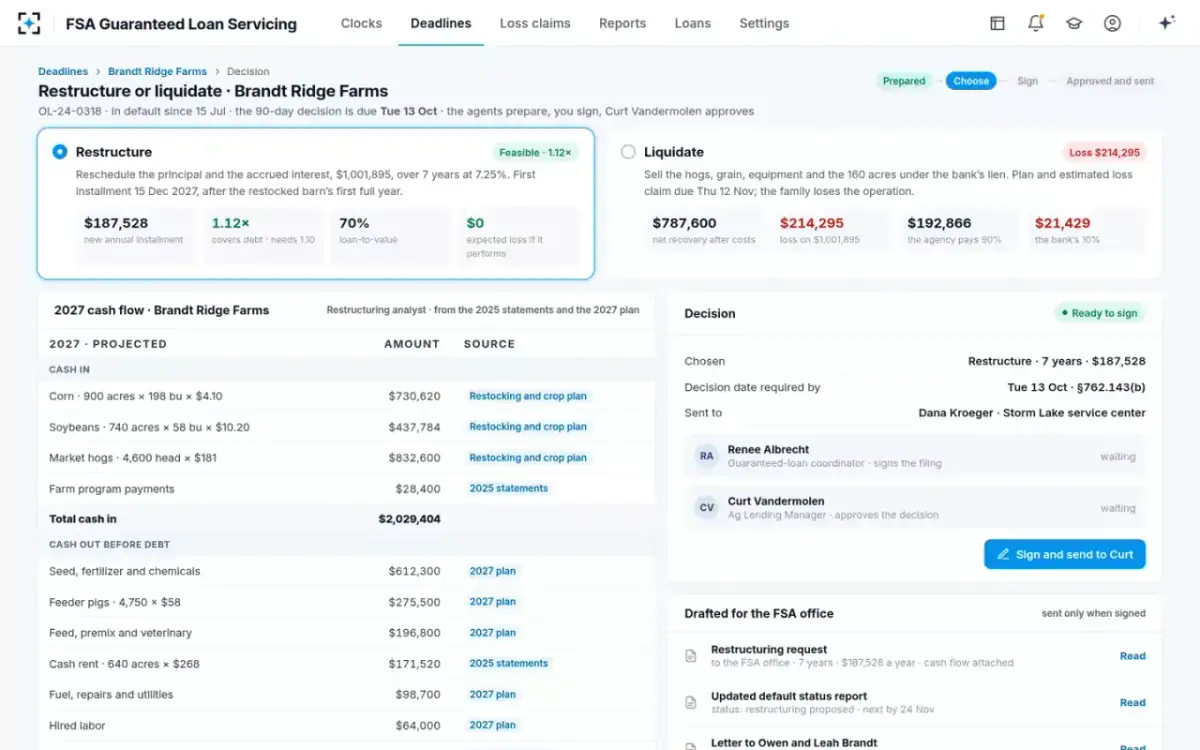
On the sample file the collateral appraises at $1,428,000 and the net recovery value is $787,600. Set against the debt, that leaves a loss of $214,295, of which the agency's 90% share is $192,866 and the bank's own is $21,429. The gap between $1,428,000 and $787,600 is the whole argument for looking hard at a restructuring first: taking a farm's security and selling it is expensive, and the expense lands before the loss is shared.
The same defaulted farm loan, restructured and liquidated, side by side
Restructure: $187,528 a year, first installment 15 Dec 2027
Liquidate: Nothing: the note is accelerated and the collateral sold
Restructure: $1,001,895 rescheduled over 7 years at 7.25%
Liquidate: $978,760 of principal, plus accrued interest and costs
Restructure: $437,600 of cash against $392,028 of payments — 1.12 times
Liquidate: Net recovery value of the security against the debt
Restructure: $1,001,895 against $1,428,000 of collateral — 70%
Liquidate: $787,600 after the costs of taking and selling it
Restructure: No loss claim; the guarantee stays whole
Liquidate: A $214,295 loss — $192,866 to the agency, $21,429 to the bank
Restructure: A Certified Lender certifies; approval only for a write-down
Liquidate: A liquidation plan, approved before the sale begins
Liquidation has its own timetable, and it starts before the decision is cold. Within 150 days after the payment due date, all lenders will prepare a liquidation plan — balance sheets, a method of maximising collection, an independent appraisal of all the collateral, and estimates of the time, the expenses and the protective advances it will take. On this file that is 12 November. A lender that reaches 13 October without an answer has not bought time; it has spent the time the next filing needed.
Collateral, coverage and loan-to-value: the numbers both paths share
Three figures decide both paths, which is why a good decision package computes them once and shows them on both sides.
The appraisal. Everything downstream rests on it, and the rule is specific about its age: a current appraisal of primary personal property security means not more than 12 months old, valued from public sales of similar property in the market area; on larger real estate, not more than 18 months old and by a State Certified General Appraiser. An appraisal that misses part of the security travels on into the loss claim, which is where it is caught — as in one FSA loss claim and the two gaps in it.
Loan-to-value. A restructured loan does not have to be fully secured — the regulation says so explicitly — unless it is restructured with a balloon payment, in which case the lender has to project the loan fully secured at the time the balloon falls due. On the sample file $1,001,895 against $1,428,000 of collateral is 70%, with no balloon, so the question is closed before it is asked.
Coverage. The ratio the bank's policy sets, computed on next year's plan rather than last year's result. At 1.12 times against a 1.10 policy the sample file clears it by a margin that is real but thin — a reason to write down what the plan assumes, here a barn back in production in January, rather than a reason to refuse.
Both options on one screen, with the cash flow behind each number
When an extension is allowed, and what justifies one
The 90 days can move, but only one way: the lender has to be able to document circumstances that justify an extension by the Agency. Three features of that clause are worth reading slowly. It is the agency that grants the extension, not the lender that takes it. The justification has to exist on paper before the date, not be reconstructed after it. And the subject of the sentence is circumstances — a reason outside the lender's control, not a backlog.
In practice the circumstances are usually the borrower's: a bankruptcy filing that stays collection, a mediation under way, an appraisal that cannot be completed because the collateral is a standing crop, a statement promised and not produced. A lender that has chased the missing document in writing, week by week, has a case; one whose only evidence is that nobody opened the file does not, and the difference is visible in the file rather than in the argument. That is the practical reason to draft the filing before the clock turns red: on the sample bank the lead time is ten business days, so the only thing the deadline waits on is a person's judgement.
Who signs the farm loan restructure, and who approves it
Two signatures, in a fixed order, and neither of them belongs to a machine. On the sample bank the USDA guaranteed-loan coordinator signs the restructure and the Ag Lending Manager approves it before anything is sent to the county office — the coordinator because she is the one who certifies to the agency that each requirement of the regulation has been met, the manager because the bank's lender status is his.
What the agency itself requires depends on the lender's status, and this is where banks most often get the sequence wrong. A standard eligible lender must obtain prior written approval for every restructuring action, and the agency has 14 days to refuse in writing. A Certified Lender needs prior approval only for a debt write-down; for rescheduling or a deferral it certifies that each requirement has been met, with a narrative and the calculations. A Preferred Lender restructures under its own lender's agreement. All of them send the agency a copy of the restructured note afterwards.
Who has to approve a restructuring, by the lender’s own status
| Lender status | Rescheduling or deferral | Debt write-down |
|---|---|---|
| Standard eligible lender | Prior written approval from the agency for all restructuring actions; a written refusal within 14 days if the agency disagrees | Prior written approval, with the full calculations |
| Certified Lender (CLP) | A certification that each requirement is met, a narrative on the circumstances, and copies of the calculations | Prior written approval, with the full calculations |
| Preferred Lender (PLP) | As set out in the lender’s agreement | As set out in the lender’s agreement |
What four agents may build, and what only a person may choose
The useful division of labour on this decision is not between fast and slow work; it is between work that has one right answer and work that does not. Reading a meeting note, pulling a figure off a balance sheet, projecting a hog barn's output from a restocking schedule and computing a coverage ratio all have right answers, and a wrong one is visible the moment it is checked against the document. Choosing between a 1.12 coverage ratio and a $214,295 loss does not have a right answer. It has an owner.
The decision package: four agents build it, two people decide it
Agent
Guarantee clock keeperDates the default, the meeting, the 90-day decision, the 150-day plan and the 210-day interest cut-off from the payment history and the regulation.
Never: Never moves a date the regulation sets — only the bank’s own lead times
Agent
Default status reporterDrafts the default status report every 60 days from the servicing notes and the meeting, and afterwards the restructuring request or the notice of liquidation.
Never: Never states a borrower fact that is not in a note or a document
Agent
Restructuring analystBuilds next year’s cash flow from the statements and the borrower’s plan, and sets the rescheduled terms against the net recovery value.
Never: Never chooses restructure or liquidate
Agent
Collateral and covenant watcherConfirms the collateral, the perfected liens and the required insurance, and flags anything the appraisal does not cover.
Never: Never waives a requirement
A person decides
USDA guaranteed-loan coordinatorReads both options with the cash flow behind them, chooses, and signs — with the meaning of the signature kept.
A person decides
Ag Lending ManagerApproves the decision before anything goes to the county office, and owns the bank’s lender status.
That is the question every credit committee asks first. On this file the agents produced a cash flow, a set of rescheduled terms, a net recovery value, a confirmed collateral position and three drafted filings. They did not produce a recommendation. The coordinator signed the restructure and the manager approved it a day before the deadline, both signatures on the file with what they meant.
Questions people ask
Is a restructured guaranteed loan still guaranteed?
Yes, provided the restructuring is done under the regulation: the agency modifies the guarantee when capitalised interest changes the principal, and the lender sends it a copy of the restructured note. What does not survive is negligent servicing — a final loss claim may be reduced, adjusted or rejected for it even after the agency has concurred with a restructuring.
How long can a defaulted farm loan be rescheduled for?
It depends on the loan. An operating loan note may be rescheduled over no more than 15 years from the rescheduling, and an operating line of credit over 7 years from the rescheduling or 10 from the original note, whichever is less. A farm ownership loan cannot mature later than 40 years from the original note. The sample file uses 7 years on an operating note.
What is a debt write-down, and when is it allowed?
A write-down reduces the principal to the point where the borrower can develop a feasible plan, and it is the last option rather than the first. It is available only after rescheduling and deferral have been considered and cannot get there, only when the present value of the written-down loan equals or exceeds the net recovery value of the collateral, and only with the agency's prior written approval. On real estate security the borrower also signs a shared appreciation agreement.
What is net recovery value, and why is it lower than the appraisal?
It is the market value of the security on the assumption that the lender takes the property and sells it for its highest and best use, less the costs of acquiring, holding, maintaining and selling it. Those costs are real and they are the lender's: on the sample file they are the difference between a $1,428,000 appraisal and $787,600 of net recovery. It is the number both the liquidation plan and the loss claim are built on, so an optimistic one is expensive twice.
Can the lender foreclose as soon as the 90 days are up?
No. Foreclosure may not begin until 60 days after the agency has determined whether the borrower is eligible for interest assistance, and the note cannot be accelerated until that consideration and any mandatory state mediation have concluded. Where a state runs a farmer-creditor mediation programme the lender must take part in it; where it does not, the lender considers private mediation.
What if the borrower is current but knows a payment will be missed?
Then the restructuring proposal can be made before the payment comes due, and the regulation says so twice — once in the servicing rules and once in the restructuring rules. It is the cheapest version of this decision for everybody: the loan never goes 30 days past due, no 90-day clock starts, and the lender is working from a complete file rather than from whatever the borrower has had time to assemble after a default.