Agentic AI in loan servicing is usually sold as a list of capabilities, and evaluated as one. The more revealing list is the limits: for each thing the software does on its own, the one action it is built never to take. On a USDA guaranteed farm loan that question is not philosophical. The agency can refuse to pay the share of a loss that the lender's own servicing caused, so an assistant that quietly moved a regulatory date, or stated a borrower fact nobody can evidence, would not be an inconvenience — it would be the thing the agency points at. Botminds' FSA Guaranteed Loan Servicing divides the work across six specialist agents, each with one job and one forbidden action, and puts a named person's signature and a manager's approval after every one of them.
The examples come from a fictional sample bank, Lindmark Valley Bank, as it runs through the solution on sample data: 218 guaranteed loans, $166.9M guaranteed, people and farms invented. The two federal documents quoted below are real and linked where they appear.
Six agents, and the action each one will not take
Agent
Guarantee clock keeperEvery loan’s dates, computed from the guarantee, the payment history and the rules, with the section behind each one.
Never: moves a date the regulation sets
Agent
Status report preparerThe semiannual status reports, drafted from the core loan system with what changed since the last one.
Never: files without the coordinator
Agent
Default status reporterThe default status form at default and every 60 days, each line showing the note or document it came from.
Never: states a borrower fact that is not in a note or a document
Agent
Restructuring analystNext year’s cash flow at the bank’s own planning prices, with rescheduling and liquidation side by side.
Never: chooses restructure or liquidate
Agent
Loss claim assemblerThe liquidation plan and the loss claims, with the appraisal, the interest window and the advances all checked.
Never: files a claim with a missing attachment or an unsupported figure
Agent
Collateral and covenant watcherStatements, farm visits, insurance, lien continuations and holder demands, and the annual analyses prepared.
Never: waives a requirement
A person decides
The coordinator signsReads each drafted filing against its sources and signs it, with the meaning of the signature kept beside it.
A person decides
The manager approvesApproves every restructure-or-liquidate decision and every loss claim before it leaves the bank.
Six agents, six jobs, and why the division is the safety feature
The reason to split the work six ways is not throughput. It is that a narrow agent can be given a narrow prohibition that actually means something. "Do not make things up" is not a rule a system can be held to. "Do not state a borrower fact that is not in a note or a document" is, because the check is mechanical: every line of the drafted filing either resolves to a source or it does not, and the one that does not is visible on the page before anyone signs.
The same logic runs down the list. The clock keeper has one input class — the loan note guarantee, the payment history and the rules — and one output, a date with the section that set it, so "never move a regulatory date" is enforceable by construction: the agency's dates are read-only, and only the bank's own lead times, reminders and escalations can be edited. The restructuring analyst produces two costed options and no recommendation, so the prohibition it carries is simply that the choice field is not its to fill in.
Each agent, its job, and the one action it will not take
Guarantee clock keeper
What it does on its ownComputes every loan’s dates from the guarantee, the payment history and the rules, and re-dates them nightly and whenever a payment or event lands.
What it never doesMove a date the regulation sets. Only the bank’s own lead times, reminders and escalations are editable.
Status report preparer
What it does on its ownDrafts the semiannual status reports as of 31 March and 30 September from the core loan system, noting what changed since the last one.
What it never doesFile anything. The draft waits for the coordinator.
Default status reporter
What it does on its ownDrafts the agency’s default status form at default and every 60 days from the servicing notes, the borrower meeting and the payment history.
What it never doesState a borrower fact that is not in a note or a document.
Restructuring analyst
What it does on its ownReads the balance sheet, the income statement and the borrower’s own plan, builds next year’s cash flow, and sets rescheduling beside liquidation.
What it never doesChoose. The option is picked by a person, and every figure cites its document.
Loss claim assembler
What it does on its ownBuilds the liquidation plan and the estimated and final loss claims with their attachments, checking the appraisal, the interest window and the advances.
What it never doesFile a claim with a missing attachment or an unsupported figure. Gaps are reported before filing.
Collateral and covenant watcher
What it does on its ownWatches statements, farm visits, insurance, lien continuations and holder repurchase demands, and prepares the annual analyses.
What it never doesWaive a requirement, or mark one satisfied without its evidence.
The guarantee clock keeper: never moves a date the regulation sets
The dates on a guaranteed loan are not preferences. A borrower "is in default when 30 days past due on a payment or in violation of provisions of the loan documents"; the meeting with the borrower comes within 15 days of default, which is 45 days after the payment due date on a money default; and the lender "must decide whether to restructure or liquidate the account within 90 days of default, unless the lender can document circumstances that justify an extension by the Agency" (§ 762.143). Each of those is arithmetic on a date in the payment history, and each can move when a partial payment lands or an installment is re-dated.
So the clock keeper's job is recomputation, nightly and on every event, across the whole book. At the sample bank an overnight run re-dated 1,284 dates on 218 loans, and one orchard's second default status report moved from six days out to five and turned red. Its prohibition follows from what makes that useful: a date the software could be talked into moving is not a deadline, it is a suggestion. The agency's dates are shown read-only with their section; the editable numbers are the bank's own — when filings are prepared, when reminders go out, when an undecided default is escalated.
What the overnight run did, and how long a decision package took
1,284dates
re-dated overnight across 218 guaranteed loans
1:17
to read nine documents and build one restructure-or-liquidate package
minutes and seconds
4agents
on that package: notes, both default reports, the statements, the collateral
0
of the six agents that may choose between the two options
The default status reporter: never states a fact that is not in a document
The agency's default status form is not a tick-box. The regulation says the lender "will summarize the meeting and proposed solutions on the Agency form for guaranteed loan borrower default status completed after the meeting" (§ 762.143(b)(3)(iii)). Summarizing a meeting is exactly the kind of work a language model does fluently and, unsupervised, dishonestly: it will produce a plausible cause for a delinquency, a plausible account of what the borrower said, and a plausible plan, whether or not any of the three is in the file.
The reporter is therefore built to fill the form only from what exists — amount and days past due from the payment history, cause and cooperation from the loan officer's meeting notes, planned action from the borrower's own plan — and to show, on every line, the document it came from. A line that cannot find a source stays empty and says so. On one sample loan the cause line reads back to a servicing note of 2 October describing a spring freeze that cut an apple crop by 55%, and the cooperation line to a meeting held at the farm market on 13 August. Those are checkable claims about the file, which is the only kind of claim worth putting a signature under. How to measure whether it is actually doing that sets out four tests you can run on reports you have already filed.
Can AI decide to restructure or liquidate a loan? The analyst builds the choice, never makes it
No — and on a guaranteed loan there is a specific reason beyond the general one. The 90-day decision is the lender's, and it is the decision the agency reads hardest afterwards, because everything about the eventual loss flows from it. A restructure that was never feasible turns into a larger claim; a liquidation that was premature turns into an argument about whether the lender acted as a reasonable lender would.
What the analyst does instead is make the choice decidable in an afternoon rather than a fortnight. On one sample loan it read the meeting notes, both default status reports and the 2025 statements, built the 2027 cash flow with the hog barn restocked in January, and laid the two options beside each other: reschedule $1,001,895 over seven years at 7.25%, an installment of $187,528 covering debt 1.12 times against the bank's 1.10 policy at 70% loan-to-value; or liquidate for a net recovery of $787,600 and a loss of $214,295, of which the agency's share is $192,866 and the bank's $21,429. Every figure on both sides links to the document it came from. The coordinator signed the restructure and the Ag Lending Manager approved it, a day before the deadline.
What the software produces, and what a person still produces
The agents: Both options costed from the file, each figure linked to its source, with the deadline and the section that sets it.
The coordinator and the manager: Picks one, and owns the reasoning if the agency asks later why.
The agents: Every line filled in from a note, a document or the payment history; unsupported lines left empty.
The coordinator and the manager: Reads it against the sources, corrects what the file got wrong, signs.
The agents: Assembled line by line with its attachments, and the gaps named before filing.
The coordinator and the manager: Judges what the security will really bring, and approves the claim.
The agents: Computed from the rule and shown with its section; never edited.
The coordinator and the manager: Sets the bank’s own lead times, reminders and escalation points around it.
The agents: Reports it, and holds the filing until it is resolved.
The coordinator and the manager: Decides what to do about it — including asking the agency.
Both options on one screen, and the field no agent fills
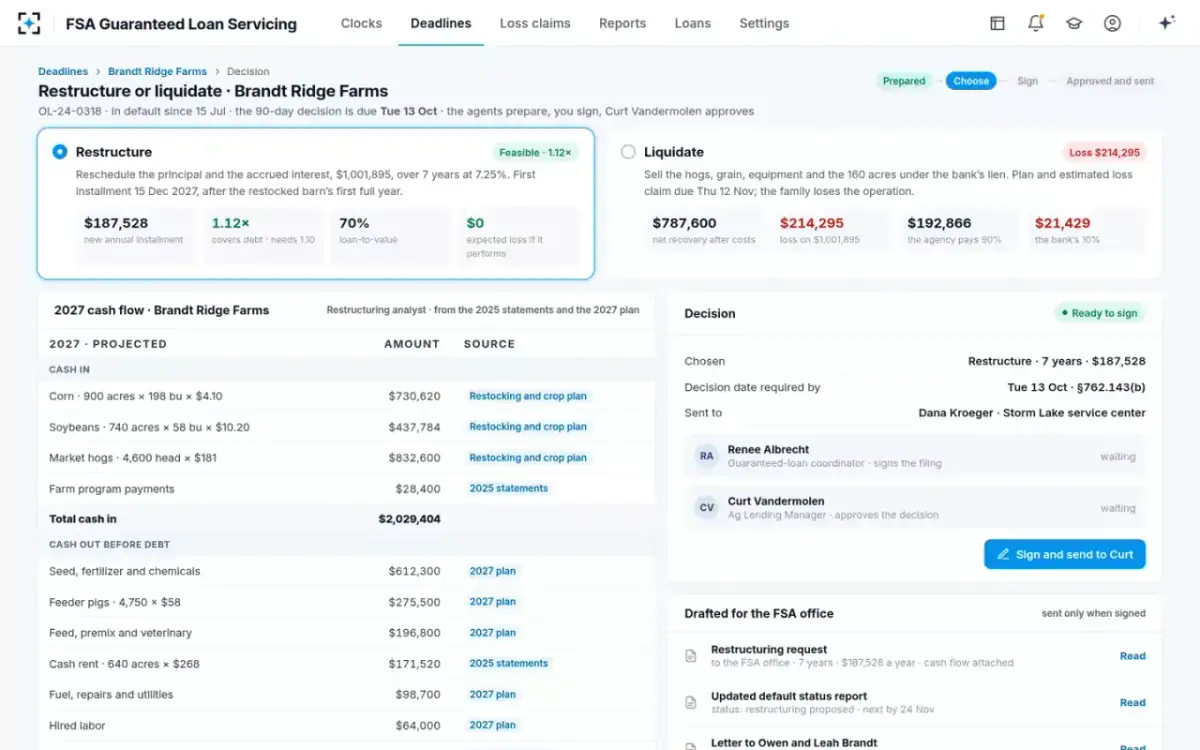
The loss claim assembler: reports a gap, never files past one
A loss claim is the one filing where being helpful is dangerous. The assembler's checks are deliberately the three failure points the regulation prices: that the appraisal covers everything the bank holds a lien on, that the interest claimed stays inside the window the agency will pay, and that protective advances above the authorization limit have their written authorization on file. When one fails, the claim stops.
On one sample claim both checks that fired were about completeness rather than arithmetic. The 9 October appraisal valued the land, parlor and barns, but the bank also held a lien on dairy equipment estimated at $96,000, and the county treasurer's receipt for an $8,420 tax advance was not in the package. Left alone, the claim would have gone in at $321,395 instead of $225,395 — overstating the loss, and coming straight back. The assembler named both gaps and would not file; a person fixed them. That claim, worked through end to end follows both gaps to the filed package.
Note which way the error ran. An overstated loss is not in the bank's favour once the agency reads it, and § 762.103(b) lets the agency decline to pay the part of a loss that negligent servicing caused, whatever the arithmetic says (§ 762.103(b)). An assembler that filed what it was given would have been faster and worse. What that reduction is worth in money is the subject of its own page.
What is AI confabulation? The federal name for the failure that matters here
The National Institute of Standards and Technology gives the failure a precise name in its generative AI profile. Confabulation is "the production of confidently stated but erroneous or false content (known colloquially as 'hallucinations' or 'fabrications') by which users may be misled or deceived" (NIST AI 600-1, July 2024). The profile is blunt about why it happens: confabulations "are a natural result of the way generative models are designed", which approximate the statistical distribution of their training data, and the risk is "particularly relevant when it comes to open-ended prompts for long-form responses and in domains which require highly contextual and/or domain expertise".
A default status report is an open-ended prompt for a long-form response in a domain requiring contextual expertise. It is, almost exactly, the described failure mode. The profile adds the part that should worry a reviewer most: outputs "may also include confabulated logic or citations that purport to justify or explain the system's answer, which may further mislead humans into inappropriately trusting the system's output". A fabricated source is worse than a fabricated fact, because it defeats the check a reviewer would otherwise run.
That is why the sourcing here runs the other way around. The reporter does not produce a sentence and then look for a citation to support it; it fills a field from a document and shows which one, and leaves the field empty when there is none. A reviewer clicks through to the note itself, not to the software's description of the note.
What to ask any agentic servicing tool before you trust a filing it drafted
- Can every line on the filing be opened back to its source?
Not a description of the source — the servicing note, the payment line or the appraisal page itself.
- What happens to a field it cannot source?
The only safe answer is that it stays empty and is flagged. A plausible fill is the failure NIST names.
- Can it move a date the regulation sets?
If any setting, prompt or override can change a statutory deadline, the deadline is not being kept by the software.
- Who chooses between restructure and liquidation?
Ask to see the screen. If the tool arrives with an option already selected, it has made the decision and asked for assent.
- What stops a filing from being sent?
A missing attachment, an unsupported figure and an unauthorized advance should each stop it outright, not raise a warning.
- Can you reconstruct who did what, and when?
Every re-dated clock, every draft and every signature, with who and when, is what an examiner or the agency will actually ask for.
What federal model risk guidance asks before a model is relied on
The bank supervisors rewrote their model risk guidance in 2026. SR 26-2, issued jointly by the Federal Reserve, the OCC and the FDIC, replaced SR 11-7 and its 2021 anti-money-laundering companion, and it is explicit about what validation must include. "Outcomes analysis compares model outputs to corresponding real-world outcomes to assess model performance relative to model objectives and business use," it says, and where the comparison finds material errors or persistent deviations outside the organization's thresholds, "model adjustment, recalibration, or redevelopment may be warranted" (SR 26-2, April 2026).
One sentence in that passage is the useful one for a servicing desk: "When a model's design relies substantially on expert judgment, quantitative outcomes analysis helps to evaluate the quality of that judgment." Drafting a filing from a file is expert judgement expressed in software. The honest way to evaluate it is not to read the vendor's accuracy claim but to replay it over filings you have already made and count where it would have differed.
Is agentic AI covered by bank model risk guidance? Not yet, and that is the point
It is not. SR 26-2 carries a footnote that says so directly: "Generative AI and agentic AI models are novel and rapidly evolving. As such, they are not within the scope of this guidance." It does not leave the matter there — it adds that an organization's own "risk management and governance practices should guide the determination of appropriate governance and controls for any tools, processes, or systems not covered in this document", while the guidance's principles apply to traditional statistical models and to non-generative, non-agentic AI.
Two things follow for an ag lender. First, nobody is going to hand you a checklist for this: the controls are yours to design, and the supervisors have said as much in writing. Second, the guidance's own applicability threshold means most guaranteed lenders were outside it anyway — SR 26-2 "is expected to be most relevant to banking organizations with over $30 billion in total assets", with smaller organizations left to "internal risk management and governance practices appropriate for the size and risk profile". An ag bank well under that threshold therefore gets no ready-made answer from either direction, which makes the per-agent limits above the thing to evaluate rather than a compliance certificate.
Four agents on one file, each step showing what it found
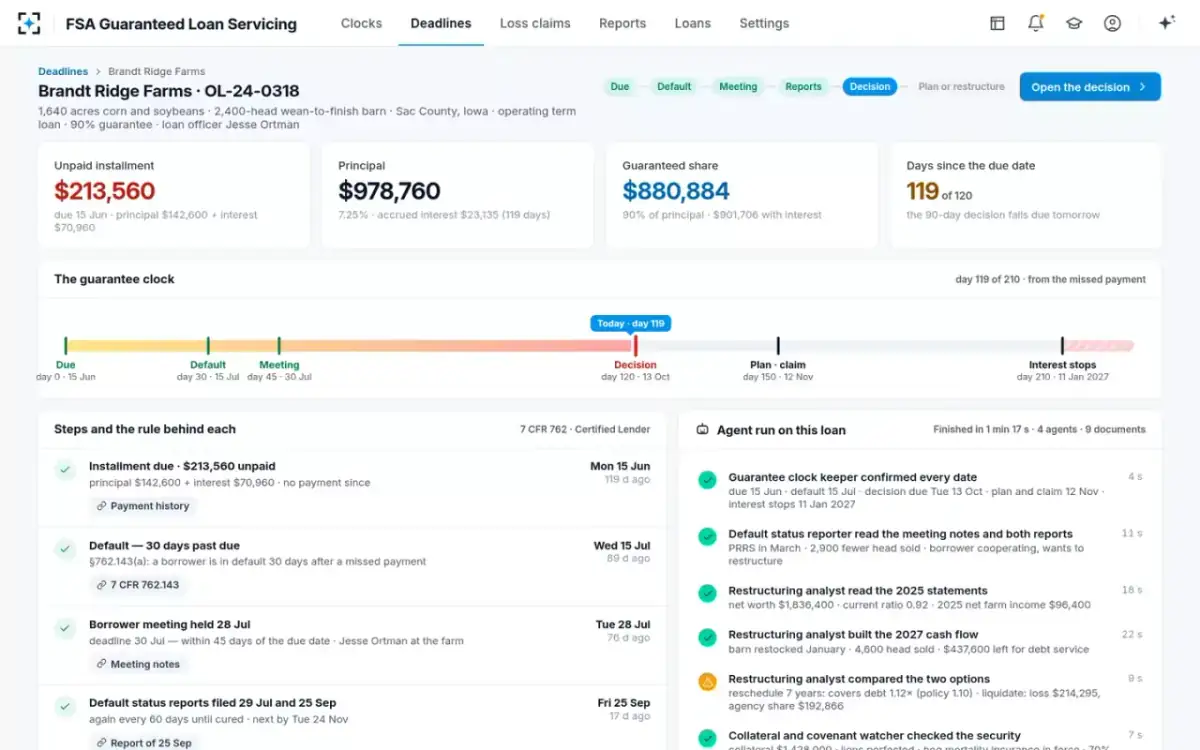
The signature and the approval: what happens after an agent is done
Every path through the six agents ends at the same two places. The coordinator reviews and signs each filing, and the meaning of her signature is kept with it — "I reviewed this report and its sources" — rather than left as an implication. The Ag Lending Manager approves every restructure-or-liquidate decision and every loss claim before anything is sent to the county office. Every re-dated clock, every draft and every signature is kept with who, what and when; lead times, approvers and thresholds are versioned, so a rule that was in force in March can be shown in March's terms.
That is more than good manners. The agency reduces a claim by the dollar amount of loss it attributes to the lender's own servicing, and the evidence for or against is the servicing history. A desk that can show who signed what, against which sources, on which date, is defending itself with the same material the agency is reading.
The board the agents re-date, and the filing already drafted beside it
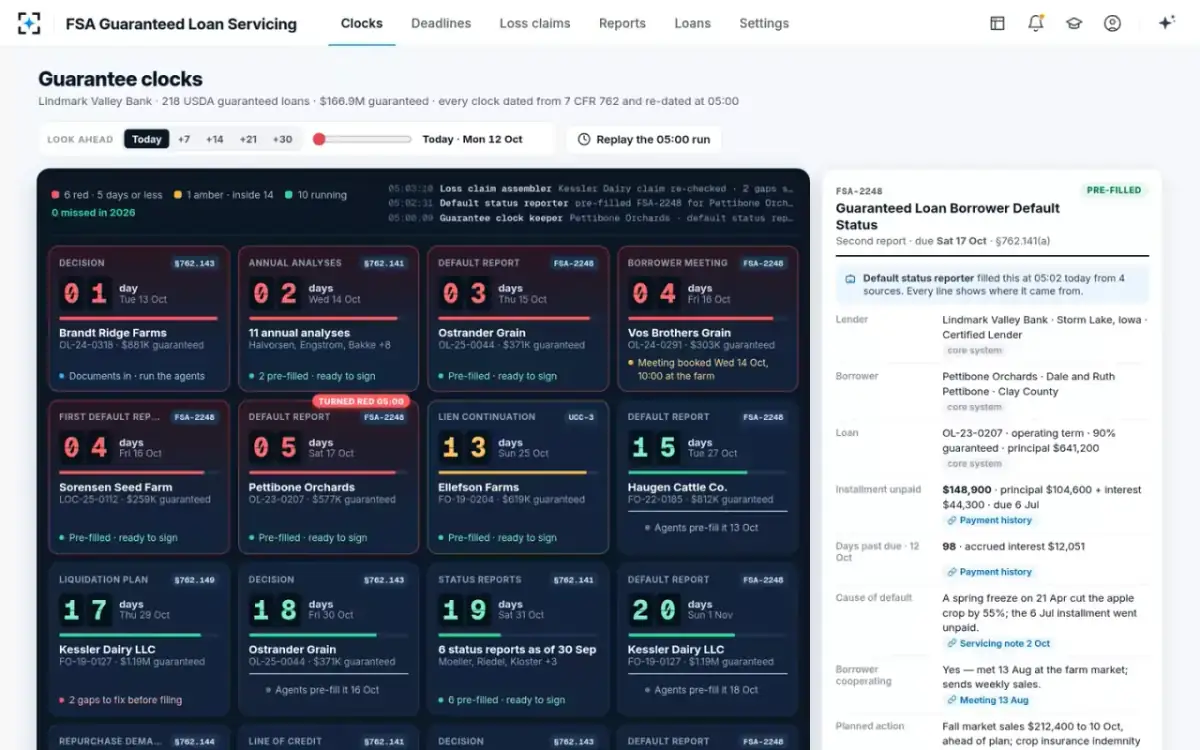
If you are evaluating this class of software, the sequence that works is to read the limits first, ask what happens when each one fires, and only then look at the capabilities. Who sits on the desk and what each seat owns is useful context, and FSA Guaranteed Loan Servicing shows the whole sequence on a sample book.
Questions people ask
How do AI agents service a guaranteed farm loan?
They do the reading, the arithmetic and the drafting, and stop. In this solution six agents compute every loan's dates from the guarantee, the payment history and 7 CFR 762; draft the semiannual and default status reports from the servicing notes and the payment history; build the cash flow and both options for a 90-day decision; assemble the liquidation plan and the loss claims with their attachments; and watch statements, insurance and lien continuations. A person signs every filing and approves every decision.
Can AI decide to restructure or liquidate a loan?
Not here, and the reason is practical rather than ceremonial. The 90-day decision is the one the agency reads hardest after a loss, because everything about the eventual claim follows from it. The analyst costs both options from the file and leaves the choice field empty; the coordinator signs and the Ag Lending Manager approves.
What is AI confabulation, in plain terms?
Confidently stated content that is wrong. NIST's generative AI profile defines it as "the production of confidently stated but erroneous or false content" by which users may be misled, and notes that such outputs can include invented logic or citations that make them look checked. On a default status report the practical defence is to fill fields only from documents and show which, rather than to generate text and attach a reference afterwards.
Is agentic AI covered by bank model risk guidance?
No. SR 26-2, the 2026 interagency revision that replaced SR 11-7, states in a footnote that generative and agentic AI models "are not within the scope of this guidance", while directing banking organizations to apply their own governance to tools it does not cover. Its principles still apply to traditional statistical and non-generative AI models, and the letter itself is aimed mainly at organizations above $30 billion in assets.
Does the software file FSA forms by itself?
No. It prepares them. The default status form, the semiannual status reports, the restructuring request, the liquidation plan and the loss claims are all drafted with their sources shown, and each waits for the coordinator's signature; decisions and claims wait for the manager's approval as well. A claim with a missing attachment or an unsupported figure cannot be sent at all.
What does human-in-the-loop mean on a servicing desk, concretely?
It means two named roles with two different jobs, not an approval button. The coordinator checks each drafted filing against the documents it cites and signs it; the Ag Lending Manager approves the judgement calls — which option, and whether a claim is right — before anything leaves the bank. Both are recorded with the date and the sources in front of them at the time.