Ag loan servicing software, a tickler spreadsheet and a shared calendar are the three ways almost every guaranteed-loan desk tracks its FSA deadlines, and choosing between them is usually argued as a question of effort. It is not. Run the same defaulted loan through all three and the difference that matters is which dates each one knows about at all: a calendar knows the dates someone remembered to enter, a spreadsheet knows the dates someone re-keyed, and a tool that holds the rule derives the dates from the loan itself. This guide compares the three on one loan file, says plainly where each is the right answer, and sets out what to ask a vendor. The third column is Botminds' FSA Guaranteed Loan Servicing, so read it as an interested description and check the questions rather than the conclusion.
The worked figures come from a fictional sample bank — Lindmark Valley Bank, 218 guaranteed loans — running in the solution. They are sample data and Botminds' estimates, not a customer's measured result, and they are labelled where they appear. The regulation, the agency's form and the credit survey are real.
What a guaranteed-loan desk is actually tracking
9
obligations that fall in order once a loan is 30 days past due
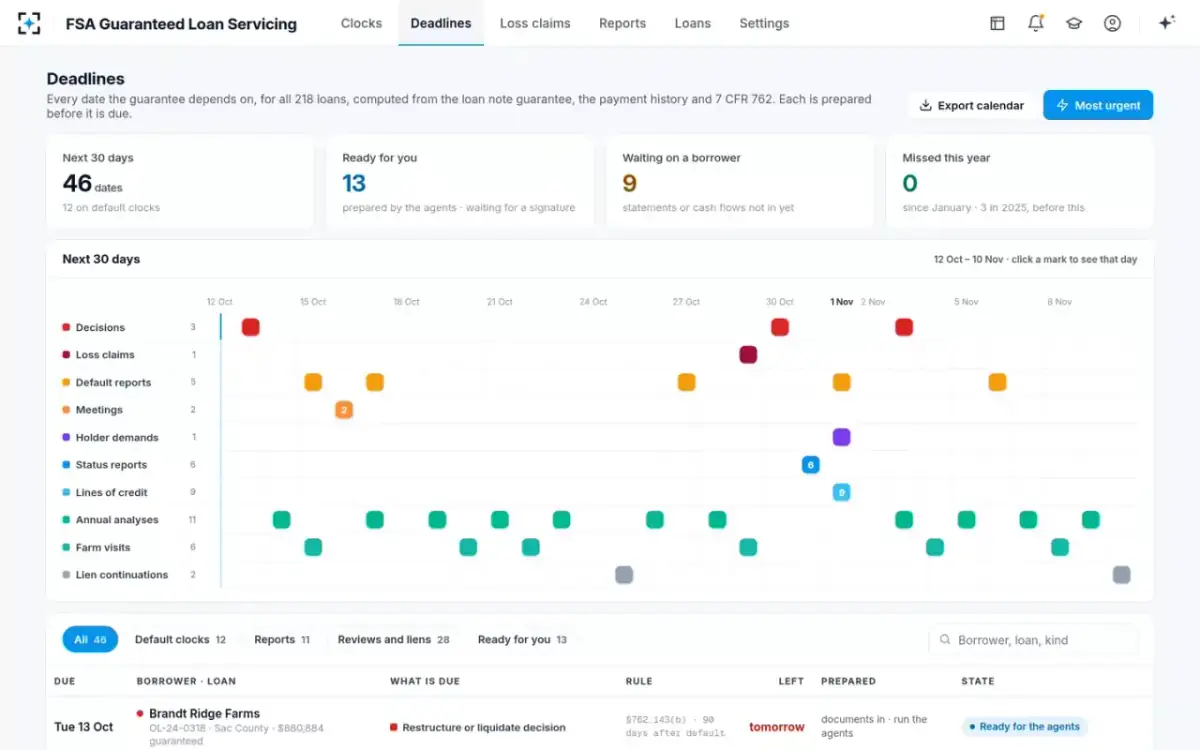
46dates
in the next 30 days on one 218-loan sample book
1,284
dates on that book that move whenever a payment or an event lands
3missed
guarantee dates at the sample bank in the year before it changed method
Ag loan servicing software, spreadsheets and calendars on the same loan
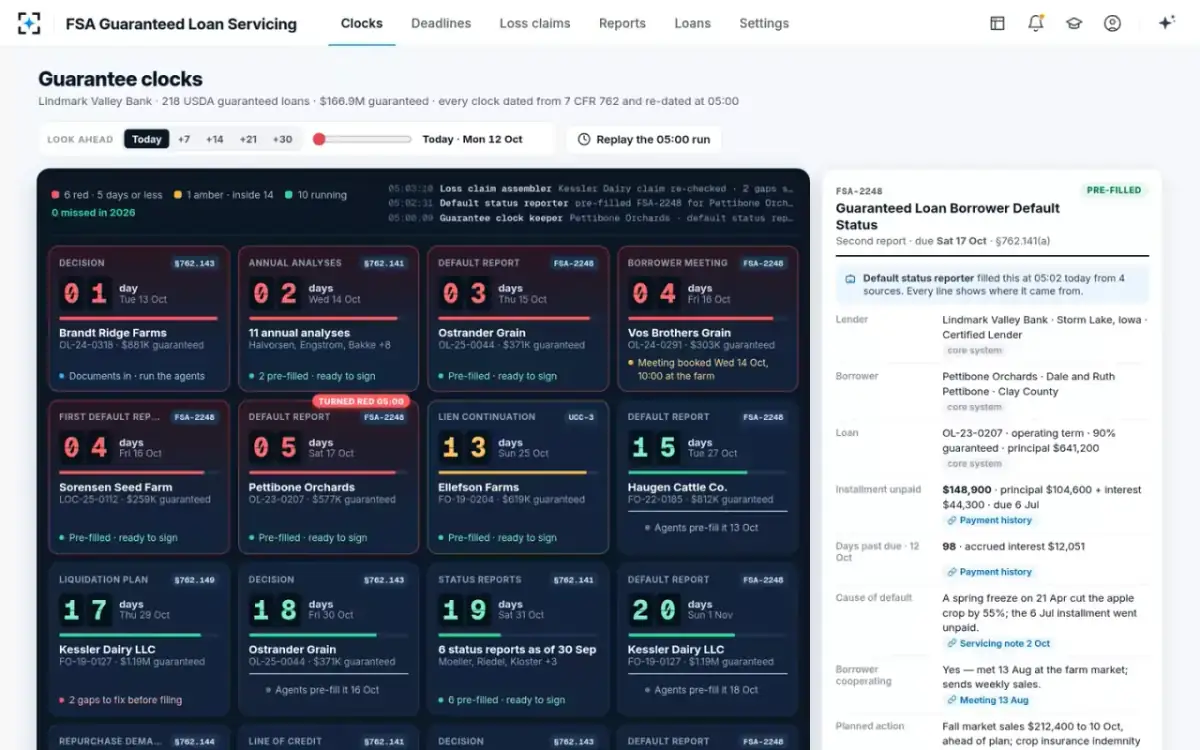
Take one loan. An installment falls due on 6 July and is not paid. Under the rule the loan is in default on 5 August, the borrower meeting and the first default status report are due by 20 August, the report repeats every 60 days until the default is cured, the restructure-or-liquidate decision falls 90 days after default, and the liquidation plan and estimated loss claim fall 150 days after the payment due date. None of those dates is a matter of opinion. Every one of them is arithmetic on a payment date.
That is the test. A method is good to the extent that it produces those dates from the loan without anyone deciding to produce them — and keeps producing the right ones when the inputs move.
The same defaulted guaranteed loan, tracked three ways
A calendar, or a calendar plus a spreadsheet: A person reads the rule, works out the date and enters it
A tool that holds the rule: Computed from the payment history and the section that sets it
A calendar, or a calendar plus a spreadsheet: Every derived date has to be found and re-entered by hand
A tool that holds the rule: Every derived date moves on the next run
A calendar, or a calendar plus a spreadsheet: Has no dates, and looks exactly like a loan with no dates due
A tool that holds the rule: Has the same dates as every other loan in the book
A calendar, or a calendar plus a spreadsheet: A repeating reminder that keeps firing after the default is cured, or stops too early
A tool that holds the rule: Repeats until the default is cured by restructuring or liquidation, then stops
A calendar, or a calendar plus a spreadsheet: In the entry, if the person wrote it there
A tool that holds the rule: The rule’s section, shown beside the date
A calendar, or a calendar plus a spreadsheet: Starts when the reminder fires
A tool that holds the rule: Drafted in advance on the bank’s own lead time, and waits for a signature
A calendar, or a calendar plus a spreadsheet: The sent email, and the file copy if someone saved it
A tool that holds the rule: The signature, its meaning and the versions, kept with the filing
A calendar: catches the date someone remembered to enter
A shared calendar is the most common starting point and it is not a foolish one. It is already deployed, everyone can read it, reminders are free, and for a desk with a handful of guaranteed loans it is genuinely sufficient.
Its weakness is structural rather than a matter of discipline: a calendar has no opinion about what should be in it. If nobody created an entry for the 60-day report on a loan that went into default in August, the calendar is not wrong — it is empty, and an empty calendar looks exactly like a quiet month. Every date in it is also a copy, so when the borrower makes a partial payment and the arrears date moves, the calendar keeps showing the old one until a person edits it. On a book of a few hundred loans, that is a few thousand copies.
A tickler spreadsheet: catches the date someone re-keyed
A spreadsheet is a real improvement, because it can hold the whole book in one view and compute. A column for the payment due date, a formula that adds 30 days for default, another that adds 45 for the meeting, another that adds 150 for the claim, and the arithmetic stops being a per-loan decision. Good ag banks run very good spreadsheets.
Three things limit them, and they are worth naming because they decide when a spreadsheet stops being enough. The first is the re-key: the payment data has to arrive from the core system, and every manual export is a day on which the arithmetic is right and the inputs are stale. The second is the conditional logic — the 60-day cycle that runs until a default is cured, the report that stops on some delinquency codes and not on others. The agency's form instructions are explicit about that: for ten of the delinquency codes bimonthly default status reports must be submitted, and for six others no further reports are required unless the borrower returns to default. That is a rule with state in it, and state is what spreadsheets model worst.
The third is that a spreadsheet tracks dates but does not hold the work. The report still has to be written, the figures still have to be found in the file, and the date in column H turns red whether or not anything has been prepared.
An agentic tool: catches the date the rule itself sets
The third approach inverts the question. Instead of recording the dates a person derived, it derives them: for each loan it reads the guarantee, the payment history and the rule, computes every date the regulation sets, and re-computes them whenever a payment or an event lands. On the sample bank that is 1,284 dates across 218 loans, re-dated overnight, with the section of the rule shown beside each one.
The second half matters as much as the first. If the dates are derived, the filings due on them can be drafted in advance — the default status form filled in from the servicing notes, the meeting summary and the payment history, with each line linked to where it came from, so the coordinator's job is to review and sign rather than to assemble. On the sample data a drafted report takes about four minutes to review; Botminds estimates roughly thirty-five minutes to write the same report by hand. Neither is a customer's result, and the right way to test both is on your own files with your own coordinator holding the clock.
The clock board: every guarantee date in the next 30 days
What each approach does with a changed payment
This is the question to put to any method, because almost nothing on a guaranteed loan stays still. A borrower makes a partial payment. An installment is rescheduled. A non-monetary default is cured. A line of credit advance lands. Each of those moves some or all of the derived dates.
One partial payment, and what each method has to do about it
| Method | What has to happen | What goes wrong when it does not |
|---|---|---|
| Calendar | Someone notices the payment, works out which of the loan’s entries move, and edits each one | The oldest entries survive; the desk works to a date that stopped being true weeks ago |
| Spreadsheet | The payment data is re-exported and pasted in; the formulas do the rest | The arithmetic stays right while the inputs go stale — the most convincing kind of wrong |
| A tool that holds the rule | The payment lands and every derived date is re-computed on the next run | Nothing, unless the payment feed itself breaks — which is why the feed is the thing to monitor |
The regulation does not care which method produced the date. It cares that the meeting happened within 15 days of default, that the report went in and was resubmitted every 60 days until the default was cured, and that the decision was made inside 90 days. A desk that misses one of those because a spreadsheet was a week stale has the same conversation with the agency as a desk that never opened the file.
Thirty days of one book, grouped by the kind of obligation
What ag credit surveys say about who is most exposed right now
The case for spending anything on this is weakest in a good year and strongest in a bad one, so it is worth looking at what lenders themselves are reporting. The Federal Reserve Bank of Minneapolis surveys agricultural lenders across its district each quarter. In the survey for the fourth quarter of 2025, published in February 2026, "While a slight majority of bank contacts said there was no change to loan renewals or extensions, 42 percent reported that renewal activity increased", and 43 percent reported that loan demand had risen from a year earlier.
What agricultural lenders reported, fourth quarter 2025
Read those together and they describe more work rather than less: more renewals and extensions to document, more demand to underwrite, and an expectation that repayment gets worse before it gets better. Renewals and extensions are exactly the events that move a derived date, and a worsening repayment rate is what turns a tracking problem into a loss-claim problem. A desk choosing a method in that environment is not choosing between tidy and untidy; it is choosing how many clocks it can carry when more of them start running.
The other half of the arithmetic is that the desk is unlikely to grow. The US Bureau of Labor Statistics counted 283,000 loan officer jobs in 2025 and projects 1% growth over the decade to 2035, slower than the average across all occupations. Whatever method a bank picks has to work with roughly the staff it already has.
What to look for in loan servicing software, and what to ask a vendor
Most of the useful questions are not about features. They are about where a date comes from and what happens when it is wrong.
Eight questions worth asking before you switch method
- Where does each date come from?
Ask to see a date and the section of the rule it was computed from, on a loan you choose. If a date was typed in by an implementation consultant, it is a calendar with a better interface.
- What happens when a payment lands late in the day?
Ask how often dates are re-computed, what triggers a re-computation, and how a desk finds out that a date moved.
- Can a regulatory date be edited?
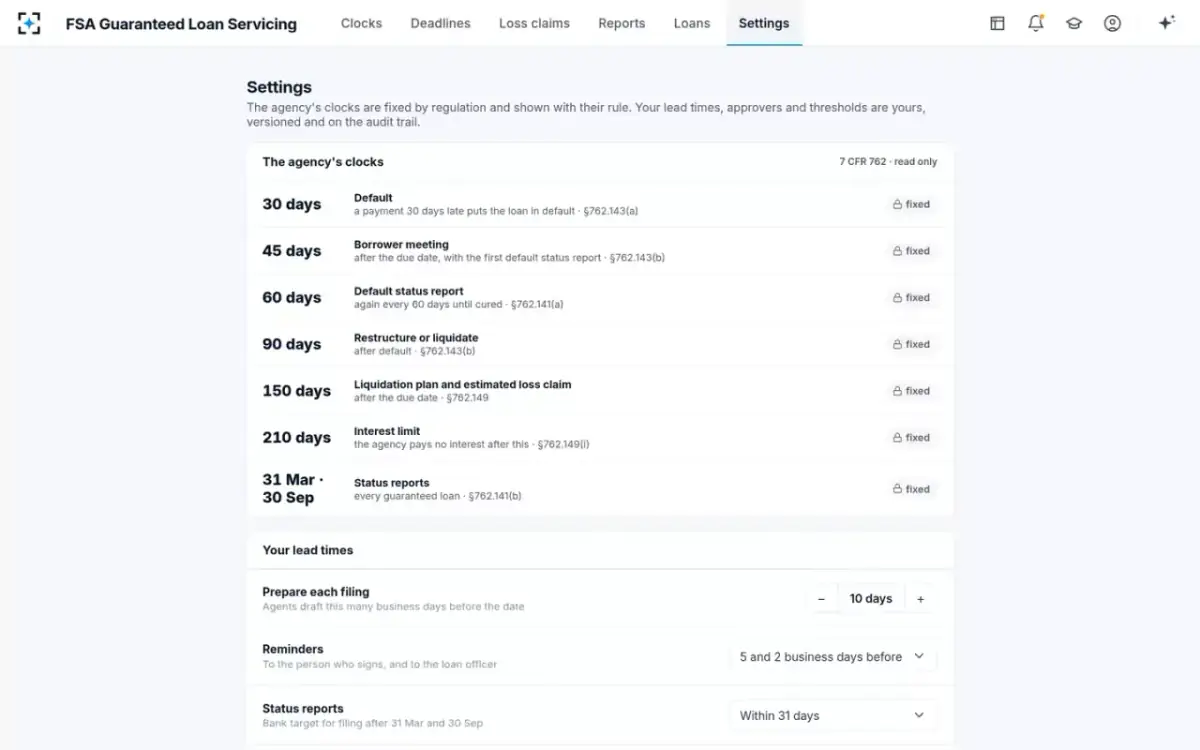
The answer should be no. The bank’s lead times, reminders, escalation points and thresholds should all be editable; the agency’s dates should not.
- What does it do when the payment feed breaks?
A method that silently shows yesterday’s dates is worse than one that refuses to show any. Ask what the screen looks like on a day the feed fails.
- Does it prepare the filing, or only remind you about it?
A reminder moves the work to the deadline. A draft moves the work to whenever the documents arrived.
- Can you see where every figure in a filing came from?
Ask to click a number in a drafted report and land on the note, statement or payment it was read from.
- What can it not do without a person?
Ask for the list in writing. Choosing between restructuring and liquidation, signing a filing and approving a loss claim should all be on it.
- What does it cost to leave?
Ask how the dates, the drafts, the signatures and the history come out, in what format, and who owns them.
Two of those deserve expanding. The read-only question is the one that separates a servicing tool from a task manager: if a user can drag the 90-day decision to a more convenient Friday, the dates in the system are preferences. And the "what can it not do" question is the one a credit committee will ask anyway, so it is better asked early.
The dividing line, as a settings screen
What stays the bank's own decision, whichever you choose
It is worth being blunt about what none of the three methods does, because a buying conversation can drift into implying otherwise. None of them decides whether to restructure or liquidate a loan. None of them signs a filing to the agency. None of them approves a loss claim, waives a requirement or judges whether a borrower's plan is credible. Those are the bank's, and on a guaranteed loan they are also the bank's exposure: the guarantee is not enforceable to the extent a loss results from negligent servicing, and no tool takes that on.
What a method can change is how much of the week is left for them. The mechanical part of this work — deriving dates, filling in a form from documents that already exist, checking that an appraisal covers every lien — has right answers that can be checked. The judgements do not, and they are where a coordinator's twenty years actually earn their keep.
Which also settles the honest version of "when is a spreadsheet still the right answer". With a dozen guaranteed loans and one coordinator who has held them for years, it is. The economics change with the number of clocks, not with the number of loans: a performing book of 300 loans has two dates a year each, and a book with twenty defaults has nine obligations running on each of them at once. Count the clocks before counting the loans.
A rough way to tell which method your book needs
Under 20 clocks
A calendar, kept by one person who knows the rule. The failure mode is absence rather than error — so the control that matters is a second pair of eyes once a quarter.
20 to about 100
A tickler spreadsheet with the arithmetic in formulas, refreshed from the core system on a fixed day. The control that matters is the refresh: date it, and show the date on the sheet.
Over 100, or any defaults
Derived dates, because the re-key is now the job. A single default adds nine obligations and a 60-day cycle that runs until the default is cured.
Whatever method a bank lands on, the obligations themselves do not change, and they are worth knowing cold before evaluating anything that claims to track them: 7 CFR 762 in plain words walks all of them in order. What a missed one costs is in what negligent servicing costs a lender.
Questions people ask
Is there software specifically for USDA guaranteed loans?
There is tooling built around the guaranteed programme's own deadlines and forms, and there is general loan servicing software that can be configured to hold them. The distinction worth testing is not the label but whether the deadlines are derived from 7 CFR 762 and the loan's payment history or entered by a person during implementation. Ask to see the section of the rule beside a date on a loan you pick.
How do you automate FSA default status reports?
The report's inputs already exist in the file: the amount and days past due from the payment history, the cause and the borrower's cooperation from the servicing notes and the meeting summary, the planned action from whatever was agreed. Automating the report means filling those fields from those documents and showing the source on each line, so the coordinator reviews rather than assembles. What cannot be automated is the signature — the agency's form is signed by an authorised representative of the lender, with a title and a date.
Can a spreadsheet be enough for a small guaranteed portfolio?
Yes, and for many banks it is. The question to ask is not how many guaranteed loans are on the book but how many clocks are running at once: a performing loan has two status reports a year, while one in default has nine obligations and a 60-day cycle. A spreadsheet handles the first well and the second badly.
What is the biggest risk when moving off a spreadsheet?
Believing the new dates without checking them. The first thing to do after any switch is to take a sample of loans, work the dates out by hand from the rule and the payment history, and compare. A tool that cannot show you where a date came from makes that check impossible, which is why it is the first question on the list above.
Does the agency require any particular system?
No. The regulation requires lenders to use forms acceptable to the agency and to service loans to the standards in part 762; it does not specify how a lender keeps track. A Certified Lender must designate qualified people trained by the agency, which is a requirement about people rather than systems.
How long does it take to see whether a different method works?
Long enough to include a real event. A tracking method looks identical on a quiet book; it differentiates when a payment lands late, a borrower cures a default or an installment is rescheduled. Evaluate over a period containing at least one of those, on your own loans, and watch what the derived dates do.