The design history file is the medical device industry's name for the collected evidence of how a device was designed: the inputs, the outputs, the reviews, the verification and validation, and the revision at which each was settled. It is the first place a 510(k) gets its facts, and as of 2 February 2026 it is no longer the name the regulation uses. FDA replaced the Quality System regulation with the Quality Management System Regulation, and the paragraphs that defined design controls — and with them the design history file — are marked [Reserved] in 21 CFR part 820, with the requirement now sitting in the design and development clause of the standard the part incorporates. The records did not go anywhere. The vocabulary did, and a submission that quotes the wrong version of a record is a submission that contradicts itself. Botminds' 510(k) eSTAR Submission drafts every section from those documents and cites the page each sentence came from, so the four people who own them can see what the submission says about their work.
This page is about ownership, not about filing: the design history file itself does not go to FDA inside a 510(k). What goes is a set of statements about it, each with an owner who can confirm or deny it.
The worked example is a fictional sample submission inside the solution — Veltara Medical's VLT-Flow 80 infusion set, its four named owners and its test reports are invented, as are the companies. The regulation and guidance are FDA's, linked where they appear.
One Traditional 510(k), counted by what it quotes
22sections
answered in the eSTAR, each from a document somebody else owns
9reports
bench, sterility, biocompatibility, packaging and human factors, each signed by the lab
46attachments
embedded in the submission, each answering one question
1signature
on the statement that all of it is truthful and accurate
What is a design history file?
A design history file is the compilation that shows a finished device was developed in accordance with its design plan and the requirements that governed it: the design inputs, the design outputs, the reviews and their minutes, the verification and validation results, the design transfer to manufacturing, and the changes made along the way with their justification. In practice it is not one document but an index over many, each at a revision, each approved by somebody.
For a 510(k), four kinds of answer come out of it. The device description and its principle of operation. The complete model list and what distinguishes the models from one another. The specifications a claim rests on — dimensions, materials, flow rates, shelf life. And the revision at which each of those was settled, which is the detail teams most often leave behind when they copy an answer out of a previous submission.
Is a design history file still required?
The records are required; the phrase is not. The current text of 21 CFR part 820 contains no occurrence of "design history file", and the subparts that held the old design-control requirements now read "§§ 820.20-820.30 [Reserved]" (21 CFR part 820, eCFR). What replaced them is a cross-reference: "Manufacturers of class II, class III, and those class I devices listed in paragraph (c)(1) of this section and table 1 to paragraph (c)(2) of this section must comply with the requirements in Design and Development, Clause 7.3 and its Subclauses in ISO 13485."
So a class II device — which is what most 510(k)s are about — still has to be designed under a controlled process whose evidence is kept. The obligation now reads out of an international standard incorporated into the regulation rather than out of the regulation's own paragraphs. Teams that say "the DHF" to each other are using a word their quality manual may still define and their regulation no longer does, which is tolerable internally and a problem in a submission that quotes the regulation.
What 21 CFR part 820 contains today, section by section
| Section | Heading | What it does now |
|---|---|---|
| § 820.1 | Scope | In force. Says which manufacturers the part applies to. |
| § 820.3 | Definitions | Rewritten: the definitions in ISO 13485 and Clause 3 of ISO 9000 apply, with a short list of terms the standard does not define. |
| § 820.7 | Incorporation by reference | In force. The clause that pulls ISO 13485 into United States law. |
| § 820.10 | Requirements for a quality management system | Paragraph (c) sends class II and class III manufacturers, and listed class I ones, to Design and Development, Clause 7.3 of ISO 13485. |
| §§ 820.20–820.30 | The old subparts, including Design controls | [Reserved]. The words that defined a design history file are no longer in the part. |
| § 820.35 | Control of records | Complaint and servicing records carry named fields on top of the standard. |
| § 820.45 | Device labeling and packaging controls | Labeling and packaging kept their own section in the regulation. |
What changed in FDA's quality rule in 2026?
The change was published two years before it bit. FDA's own description, carried in the front matter of its Refuse to Accept policy, is the clearest short statement of it: "On February 2, 2024, FDA published the final rule to amend the Quality System (QS) regulation in 21 CFR part 820 (89 FR 7496, effective February 2, 2026). The revised 21 CFR part 820 is now titled the Quality Management System Regulation (QMSR)" (FDA, Refuse to Accept Policy for 510(k)s).
Three things follow for a submission. First, any sentence that cites "21 CFR 820.30" as authority for a design record is citing a reserved paragraph. Second, the definitions a submission leans on have moved: §820.3 now says the definitions in ISO 13485 and in Clause 3 of ISO 9000 apply to the part, except for a short list the standard does not cover. Third, labeling kept a section of its own — §820.45, Device labeling and packaging controls — which matters because the labeling is one of the four desks below.
What did not change is the evidence. The same design reviews, verification and validation results and signed test reports are still what a 510(k) quotes.
The four desks a 510(k) quotes
Look at where a submission's sentences actually come from and four owners appear, with a fifth role — the submission itself — that owns none of the evidence and all of the phrasing.
The four owners of a 510(k)'s evidence, and what the submission asks of each
Today
Owns the design records and the device description, and is asked the same question by every submission: which version did you take that from?
With agents
Every sentence in the submission cites the design records, a test report or the labeling, and one model-number list is used in every section.
Still theirs: The device description, the model list, the specifications and the revision each answer came from
Today
Finds the reports cited at the wrong edition, and reads a submission that says 2007 where the report says 2014.
With agents
Each signed report is the evidence a claim or a difference points to, opened at the passage; the test sections carry a co-approval.
Still theirs: Bench, sterility, biocompatibility, packaging and human factors reports, as signed
Today
Keeps the instructions for use, the pouch and carton labels and the indications form in step with a device description written elsewhere.
With agents
The labeling section and the device description are checked against each other before the file goes, not after FDA asks.
Still theirs: Instructions for use, labels, and the indications for use form
Today
Approves section after section with no single view of what is still open.
With agents
Approves by name, time and meaning with the checks green, and signs the statement that the submission is truthful and accurate.
Still theirs: The approvals and the signature
The regulatory specialist who assembles the eSTAR is the fifth person and owns no evidence at all. Everything in their draft is a quotation. That is the useful way to read a 510(k): not as a document the regulatory team wrote, but as a document the regulatory team assembled from four other people's signed work, and will be held to.
The engineer's records: description, models and the revision each answer came from
FDA's electronic submission guidance quotes the regulation on what the device description has to carry, and the list is longer than most drafts: "a description of the device that is the subject of the premarket notification submission, such as might be found in the labeling or promotional material for the device, including an explanation of how the device functions, the scientific concepts that form the basis for the device, and the significant physical and performance characteristics of the device, such as device design, material used, and physical properties" (FDA, Electronic Submission Template for Medical Device 510(k) Submissions, quoting 21 CFR 807.92(a)(4)).
Every clause of that is an engineer's fact. How the device functions, the scientific concepts, the design, the materials, the physical properties — none of it originates in the regulatory department, and all of it has a revision. The model list is the sharpest case. A family of six models described one way in the device description, another way in the sterility section and a third way in the 510(k) Summary is three statements about the same device, and FDA reads all three.
One sentence in one section, and the three desks behind it
A person decides
Design engineerStates the cannula material and the models it applies to, at a named revision of the design records.
A person decides
Test lab leadSigns the report that tested that material in the finished device, at a stated standard and edition.
A person decides
Labeling ownerCarries the same material and the same model numbers into the instructions for use and the carton label.
Agent
Section drafterWrites the section’s sentence and cites all three by page.
Never: Never writes a claim without a source, and never answers "N/A" without the reason
A person decides
Regulatory affairs directorApproves the section by name, time and meaning.
The lab's reports: what a signed report does and does not say
A test report is the strongest document in the pile and the most often misquoted, because it is precise about something slightly different from what the submission wants to claim. It says what was tested, to what method and edition, against what acceptance criterion, with what result, on what date, signed by whom. It does not say that the device is safe, that the claim in the labeling is supported, or that the method is the one FDA recognises today.
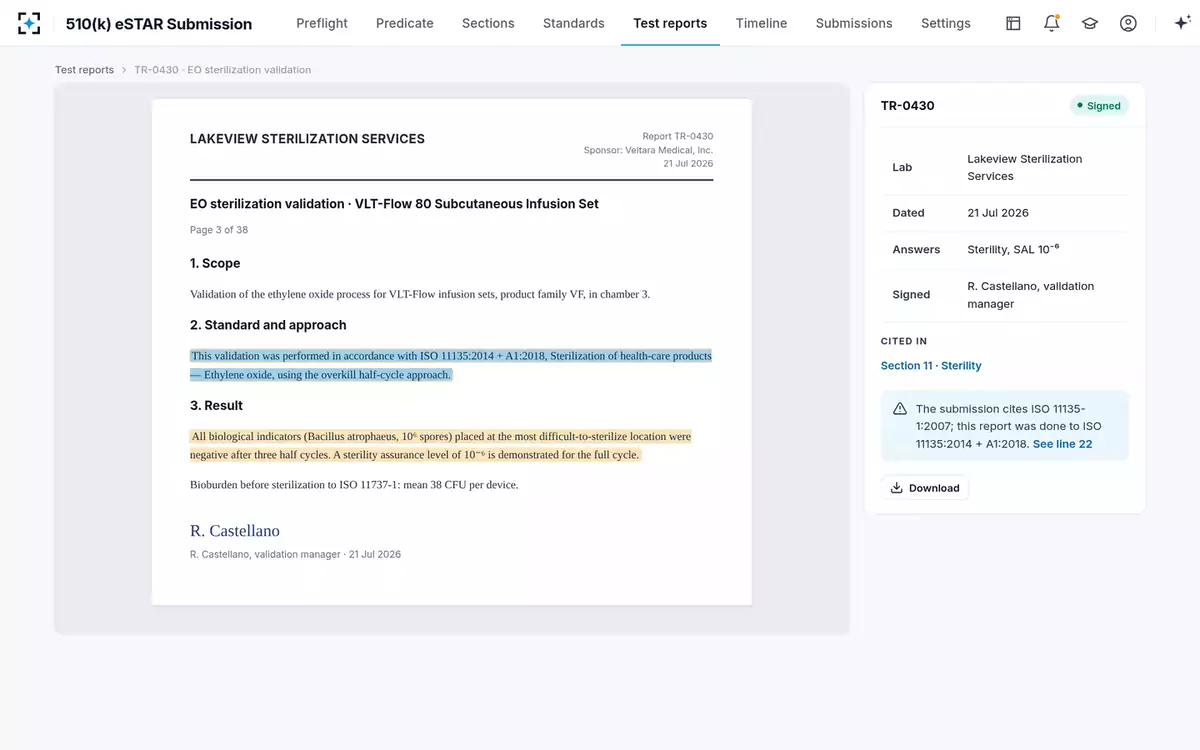
Two failures follow from that gap, and both are visible before a file goes. The first is a claim with no report behind it: in the sample submission a 36-month shelf life was drafted to match the predicate, while the packaging and accelerated aging report supported 24 — so the claim was changed to 24 months in the description, the labels, the shelf-life section and the summary, rather than the report being stretched to fit. The second is the right work cited the wrong way: a sterilization validation performed to the current edition of a standard, quoted in the submission at an edition withdrawn years earlier because the sentence was reused from an older file. The lab's work was never wrong; the submission's sentence about it was. Checking standards against the editions FDA recognises is a job of its own.
A signed test report, opened at the passage a section cites
The labeling: instructions, labels and the indications form
The labeling is evidence too, and the regulation treats it as such.
Proposed labels, labeling, and advertisements sufficient to describe the device, its intended use, and the directions for its use. Where applicable, photographs or engineering drawings should be supplied.
21 CFR 807.87(e)
"Sufficient to describe the device, its intended use, and the directions for its use" sets a bar that the device description and the labeling have to clear together. If the instructions for use say the set may stay in place for 72 hours and the device description says 48, the submission has told FDA two things. If the indications form and the labeling describe the intended use in different words, the difference is not stylistic — intended use is the first thing a substantial equivalence decision turns on, and the comparison table row by row starts there.
Labeling also keeps its own section in the rewritten part 820, at §820.45, which is a small signal worth noticing: while most of the old text was folded into an incorporated standard, labeling and packaging controls — like the extra content required in certain records — kept a section in FDA's own words.
Who signs off a 510(k) submission?
A person does, and the regulation names the thing they are signing. Paragraph (l) of 21 CFR 807.87 requires the submission to carry the submitter's statement, to the best of their knowledge, that all the data and information in the premarket notification are truthful and accurate and that no material fact has been omitted (21 CFR 807.87). It is a statement about the whole file, made by one person, covering four other people's documents.
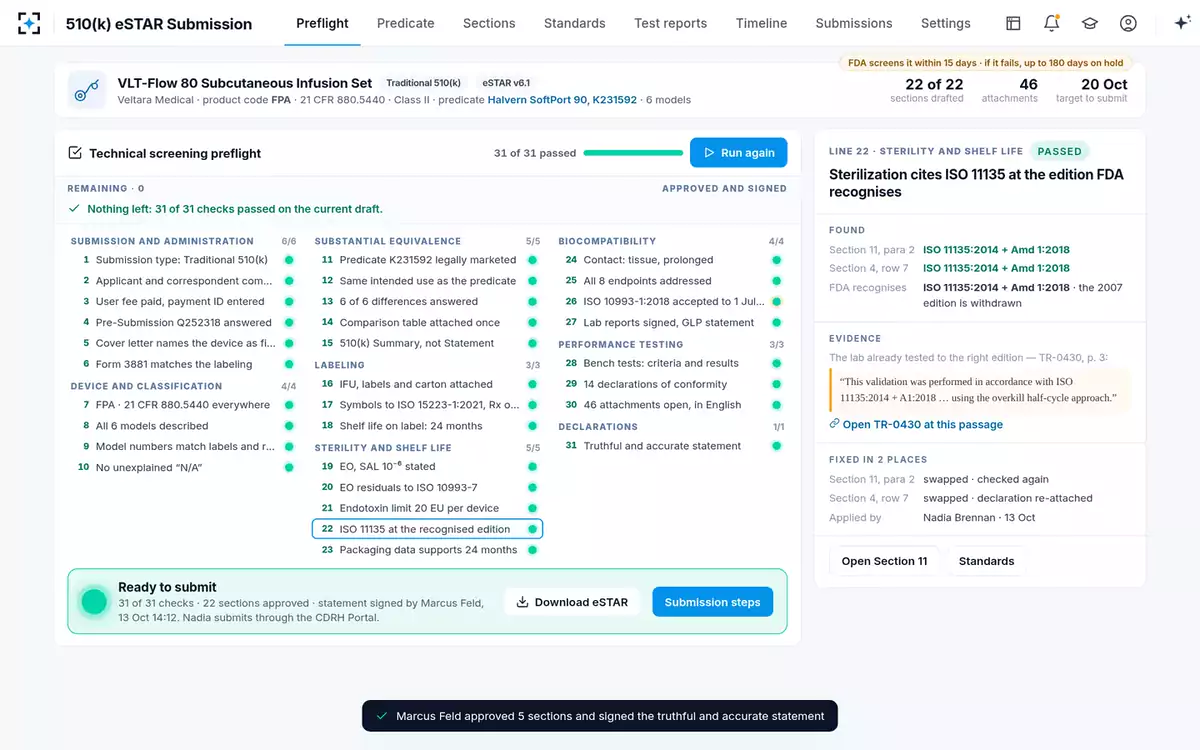
That is why approval has to happen section by section before the signature, and why the test sections are worth a second name. In the sample submission the regulatory affairs director approves every section and signs the statement; the test lab lead co-approves sterility, biocompatibility and performance testing; and the specialist who assembled the file is the one who submits it through FDA's portal. Nobody signs for a section they did not read, and nothing reaches FDA from software.
Approved, signed, and ready to submit
Why versions drift, and the single list that stops it
Drift is structural, not careless. Four owners update four documents on four schedules, and a submission is a snapshot across all of them taken over several weeks. The engineer revises the design records in week two; the lab issues a report in week four; the labeling owner updates the instructions in week five; the section drafted in week one still says what was true in week one.
The repeated facts are where this shows. In the sample submission six model numbers, a product code, a shelf life and the indications appear across 31 documents, and each appearance is an opportunity for two of them to disagree. Three rules keep them together, and none of them is technology: every factual sentence cites the document it came from, one model-number list is used in every section, and a claim that cannot name a report behind it is held rather than written. The first two are drafting discipline; the third is a decision about what the file is allowed to say.
The week a shelf-life claim changed, desk by desk
- Claim copied from the predicate: 36 monthsIn four places
- Packaging and accelerated aging report: 24 monthsOne signed report
- 6 Oct: the gap is raised6 Oct
- The choice: claim 24, or wait for real-time data7–8 Oct
- 9 Oct: changed in the description, labels, shelf-life section and summary9 Oct
Who waits on whom, week by week
Ownership has a schedule as well as a map, and most of a 510(k)'s internal delay is one desk waiting on another.
The four desks, what each one holds up, and what unblocks it
| Owner | What the submission needs from them | What waits on it | What unblocks it early |
|---|---|---|---|
| Design engineer | Description, model list, specifications and the revision each was settled at | Almost every section quotes the description | Freeze the model list and circulate it before drafting starts |
| Test lab lead | Signed reports, with the standard and edition each was performed to | Every difference needing a report, and the test sections | Confirm the edition each report states before sections quote it |
| Labeling owner | Instructions, labels and the indications form, at a known revision | The labeling section and any claim the description repeats | Read the description and the instructions side by side, early |
| Regulatory affairs director | Approval of every section, and the signature on the statement | The submission itself: nothing goes before this | Send sections for approval as they close, not all at the end |
The last row is the one most programmes get wrong. Holding every section for a single approval meeting at the end turns four people's work into one person's queue, and that queue sits directly in front of the submission date. How long a 510(k) takes prices what that costs against FDA's own clocks.
The sections, with the source behind each claim
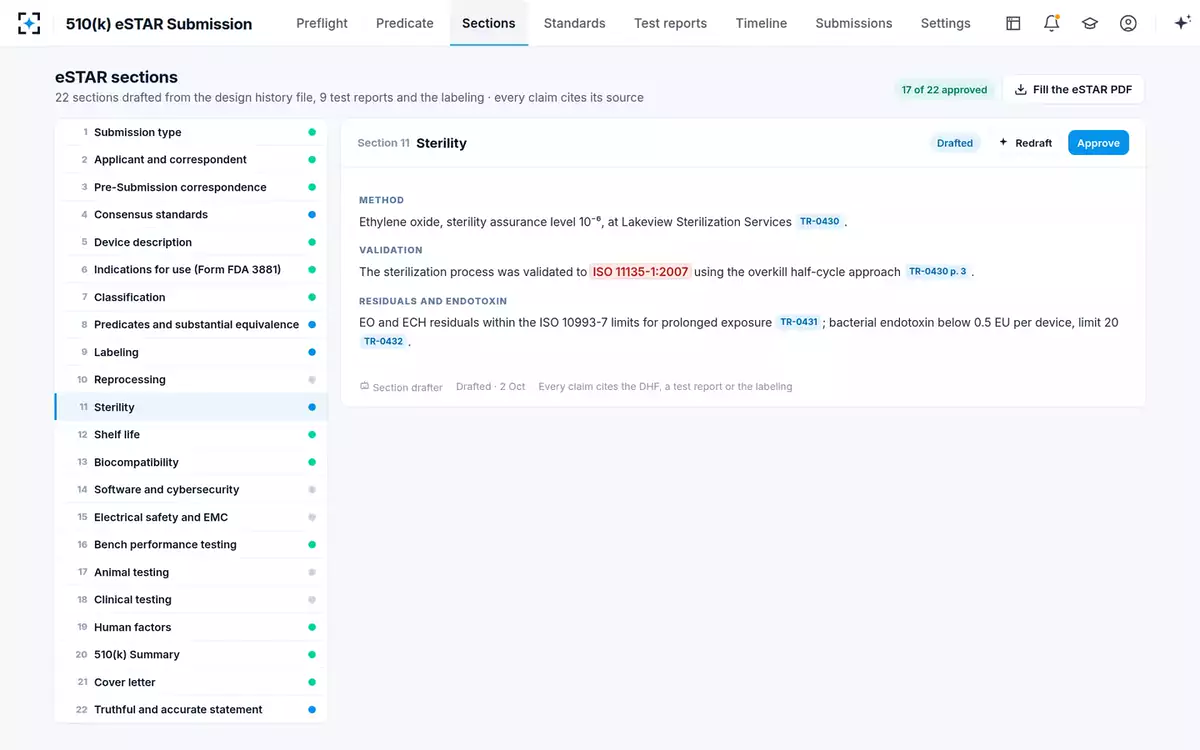
To see the citations, the approvals and the preflight on one of your own devices, start from 510(k) eSTAR Submission.
Questions people ask
Does the design history file go in the 510(k)?
No. A 510(k) carries statements about the device and the evidence behind them — the device description, the specifications, summaries or copies of test reports, the labeling — not the design file itself. The file is what the statements are drawn from, and what an inspection would look at.
What goes in a design history file?
The evidence that the device was developed under a controlled process: design inputs and outputs, design reviews, verification and validation results, design transfer, and the changes made with their justification, each at a revision and approved. Since February 2026 the specific requirements for United States manufacturers of class II and class III devices read out of the design and development clause of ISO 13485, incorporated into 21 CFR part 820.
Who writes the 510(k) device description?
The regulatory specialist drafts it; the design engineer owns the facts in it. The regulation asks for an explanation of how the device functions, the scientific concepts behind it and the significant physical and performance characteristics — design, materials and physical properties — which are all engineering statements at a particular revision.
Who owns test reports in a medical device company?
The testing laboratory that performed and signed them, whether that is an internal lab or an outside one. A report is evidence as signed; a submission may describe it, cite it and quote it, but changing what it says is not available to anyone, which is why a mismatch between a report and a claim is always fixed on the claim's side or by new testing.
Is a design history file still required in 2026?
The records are; the regulation's term is not. The current 21 CFR part 820 does not use the phrase, and §§ 820.20–820.30 are marked [Reserved]. Manufacturers of class II, class III and listed class I devices must comply with the design and development clause of ISO 13485 as incorporated by §820.10(c), so the evidence a design history file held is still required and still has to be kept.
Who signs the truthful and accurate statement?
A named person at the submitter, on their own knowledge. Paragraph (l) of 21 CFR 807.87 requires a statement that the submitter believes all the data and information in the notification are truthful and accurate and that no material fact has been omitted. Because it covers the whole file, the practical defence is per-section approval by the people who own each part before the signature is given.