A 510(k) submission's cost has three lines, and only one of them is published. FDA's standard user fee for a 510(k) in fiscal year 2027 is $28,653, or $7,163 if you qualify as a small business — a number you can put in a budget to the dollar. The second line is the weeks of assembly before the file goes, which no regulator publishes and every programme pays. The third is the cycle you do twice when FDA comes back with a question, which on FDA's own figures is what usually happens. Botminds' 510(k) eSTAR Submission works on the second and third lines: it drafts each eSTAR section from your design records, test reports and labeling, ties every difference from the predicate to the report that answers it, and runs a technical screening preflight before the submission goes.
This page prices each line the way the evidence allows. Fees come from the Federal Register notice that sets them. Cycle rates are computed here from FDA's own performance tables, with the arithmetic shown. Preparation is priced in working days rather than dollars, because a day of a device programme's delay has no published price and inventing one would make the whole calculation untrustworthy.
What FDA charges in fiscal year 2027
$28,653
standard 510(k) premarket notification fee
$7,163
the same submission at the small business rate — 25% of the standard fee
$13,785
annual establishment registration fee, per establishment
$100M
gross receipts or sales ceiling for small business status, including affiliates
How much does a 510(k) cost?
Take the three lines in order of certainty. The user fee is $28,653 at the standard rate for fiscal 2027, or $7,163 at the small business rate, plus $13,785 a year for each registered establishment, which is not a submission cost but lands on the same budget. The preparation is the engineering, laboratory and regulatory time already spent plus the assembly of the submission itself — on a Traditional 510(k), by our estimate, around ten weeks of a specialist's work to produce a file that is ready to go. The second cycle, if there is one, is the response work plus the weeks the submission spends waiting in front of a launch date.
The ratio is what makes the budget conversation go wrong. A finance review that focuses on the only published number is optimising the smallest and most fixed line in the exercise, while the two unpublished ones are both larger and both movable.
Where a 510(k)'s cost actually sits, by the share of effort it consumes
A first-cycle clearance: fee, preparation, no second cycle
- User fee · 14%
- Preparing the submission · 86%
With one additional information request
- User fee · 9%
- Preparing the submission · 57%
- Answering the request and resubmitting · 34%
What is the FDA 510(k) user fee for 2027?
$28,653 at the standard rate. FDA sets the figures each summer in the Federal Register: "This notice establishes the fee rates for FY 2027, which apply from October 1, 2026, through September 30, 2027, and provides information on how the fees for FY 2027 were determined, the payment procedures you should follow, and how you may qualify for reduced small business fees" (Medical Device User Fee Rates for Fiscal Year 2027, 91 FR 48134).
Two practical details follow from the dates. The rate that applies is the one in force when FDA receives the submission, so a file that slips from late September into October crosses a fee year. And the fee is a precondition rather than a review step: FDA's own workload tables count only submissions that have passed the preliminary administrative requirements, the user fee among them. An unpaid fee is not a slow submission; it is a submission that has not started.
How do you qualify as a small business with FDA?
On revenue, and only for a year at a time. The notice states the test plainly: "If your business, including your affiliates, has gross receipts or sales of no more than $100 million for your most recent tax year, you may qualify for reduced small business fees." And the reduction is a fixed proportion: "For all submissions other than a 30-day notice and a 513(g) request for classification information, the small business fee is 25 percent of the standard (full) fee for the submission."
The trap is the expiry. FDA's Small Business Determination programme is explicit that "small business status expires September 30 of the fiscal year it is granted" (FDA, Reduced or Waived Medical Device User Fees). A determination obtained in March does not cover a submission that goes in October; it has to be applied for again in the new fiscal year. A programme that plans a submission for the first weeks of a fiscal year and forgets to renew pays four times the fee it budgeted.
The standard fee and the small business fee on the same 510(k), fiscal year 2027
Standard rate: $28,653
Small business rate: $7,163 — 25% of the standard fee
Standard rate: Everyone who does not qualify as a small business
Small business rate: Gross receipts or sales, including affiliates, of no more than $100 million for the most recent tax year
Standard rate: Not applicable
Small business rate: Expires on 30 September of the fiscal year it is granted, and must be applied for again
Standard rate: $13,785 per establishment
Small business rate: $13,785 — FDA may waive it only for a business with $1 million or less in gross receipts or sales, and only where paying it would be a financial hardship
The fee is the small number: where the rest of the cost sits
Preparation is people, and it is mostly reading rather than deciding. Our estimate for a Traditional 510(k), from the start of drafting to a file that is ready to go, is about fifty working days of a regulatory specialist: twenty on drafting the sections from the design records, nine test reports and the labeling; eight on building the comparison with the predicate and finding the report behind each difference; five on checking standard editions and declarations of conformity; ten on reading the whole file again for facts that disagree and attachments that miss their question; and seven on approvals, the cover letter and the 510(k) Summary.
Three of those five are cross-checking — the same model number, shelf life and standard edition appearing in five places and having to agree in all of them. That work is mechanical, and it is where the solution's design target does its work: about three weeks to a ready eSTAR rather than ten. Both numbers are ours, the ten weeks an estimate of manual effort and the three weeks a design target — neither is a customer's measured result.
What does an additional information request cost?
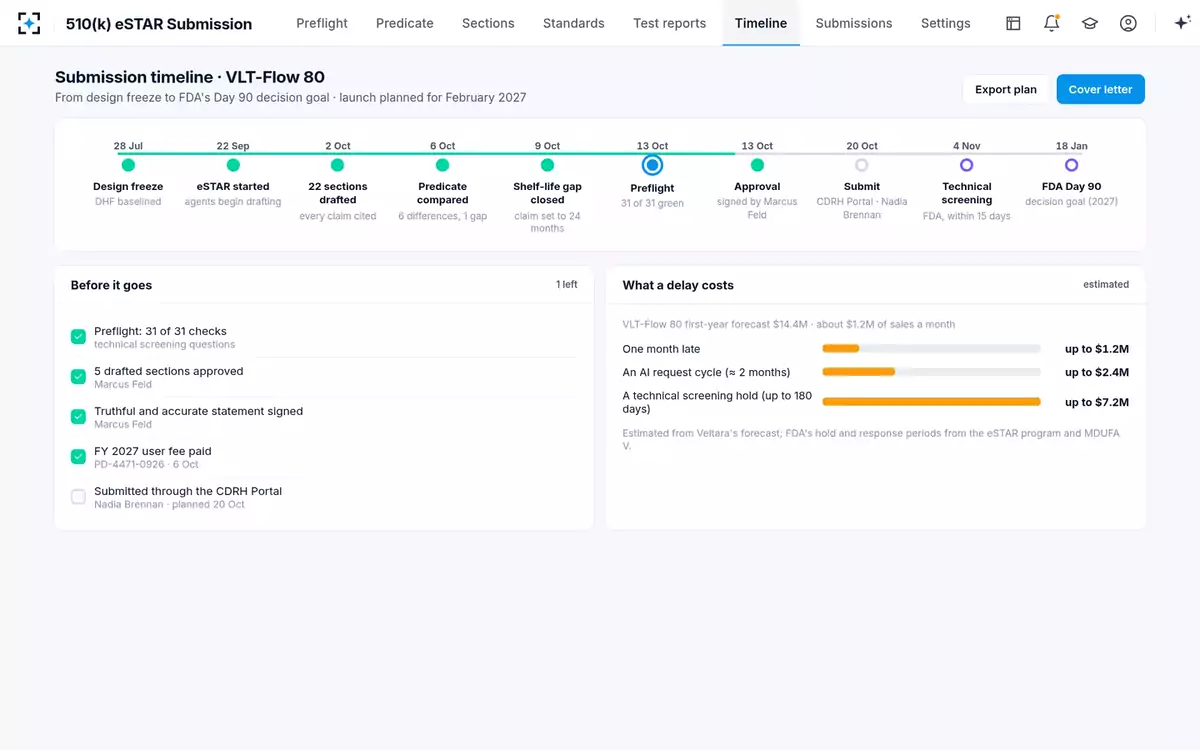
A request for additional information costs a cycle, and a cycle has no published price in dollars. It is priced in days, and there are three kinds. The days spent working out what FDA is asking and assembling the answer, which are yours. The days FDA takes on the second cycle, which are the agency's. And the weeks those two sit in front of, which belong to whatever the submission was blocking — a launch, a tender, a revenue plan.
The cost of a second cycle, written as days rather than dollars
Your response days
Reading the request + any new testing + redrafting the sections it touches + re-approval
Entirely yours, and excluded from FDA’s review-time goals
Regulatory, engineering and the laboratory
FDA's second-cycle days
The remainder of the 90 FDA days after the substantive interaction
Counted by FDA, and not movable by you
FDA
The weeks in front
Whatever the submission was blocking, for as long as both of the above take
Priced by your own plan, because it differs for every device and every launch
The programme
What a first-cycle clearance saves
All three of the above, on a submission that answers its questions before FDA asks them
The only line a preparation decision can actually move
The submission itself
The asymmetry is the argument for spending more before the file goes. A week of extra checking in preparation is a week on a schedule you control. A second cycle is a question answered on FDA's calendar, with your own response days added on top, and the two clocks behind a 510(k)'s timeline shows why those response days never appear in the number FDA reports as its review time.
How often a first cycle ends in a question, by FDA's own count
Often enough that a budget should assume it. FDA's performance report to Congress sets out, for each submission type, the specific action it counts at each goal: for 510(k) premarket notifications at the substantive interaction stage, that action is an "Additional Information Request" (FY 2024 performance report, Table E-1). Table E-2 of the same report gives the counts for the fiscal 2024 cohort, and the share can be computed from them directly.
Working out the first-cycle question rate from FDA's fiscal 2024 figures
| Line | From FDA’s Table E-2 (510(k) substantive interaction) | Figure |
|---|---|---|
| Submissions in the fiscal 2024 cohort | MDUFA cohort [A], non-third-party 510(k)s | 3,197 |
| Completed as of 30 September 2024 | Completed [B] | 2,711 |
| Additional information requests issued | "Major deficiency letters, not approvable letters, denials" [E] — for a 510(k) substantive interaction, an Additional Information Request | 1,834 |
| Share of completed substantive interactions that drew a request | 1,834 ÷ 2,711 | 67.6% |
| Still pending at the year end | Pending [F] | 486 |
Roughly two in three completed first cycles drew a question. That is one cohort, computed one way, and it should be read as the order of magnitude rather than as a forecast — but it is consistent with the longer view. GAO, examining FDA's requests for additional information across all device submission types, found that "from 2001 through 2016, FDA issued letters asking sponsors to provide such information for a majority of the more than 62,000 medical device submissions that it reviewed" (GAO-18-140).
The volume gives the rate its weight: FDA's workload tables put 510(k) premarket notifications at 3,744 in fiscal 2024 against a five-year average of 3,907. This is not a rare event happening to unlucky programmes. It is the ordinary shape of a 510(k), and a plan that assumes one clean cycle is planning for the minority case.
The fee you can lose: a hold, a withdrawal and a new submission
The fee is paid per submission, and a submission can stop being one. FDA's electronic submission guidance sets the outer limit after a failed technical screen: "If a replacement eSTAR is not received within 180 days of the date of technical screening deficiency notification, FDA will consider the 510(k) to be withdrawn and the submission will be closed in the system" (FDA, Electronic Submission Template for Medical Device 510(k) Submissions). A withdrawn submission is not a paused one; the work goes in again as a new submission.
The same shape appears after a request for additional information, where 21 CFR 807.87 provides that a notification is considered withdrawn if the information is not submitted within 30 days of the request. FDA's current policy allows longer — 180 calendar days from the request, after which a 510(k) without a complete response is considered withdrawn (FDA, Effect on FDA Review Clock and Goals) — but the end of the road is the same. Both are avoidable at the cheapest possible stage — before the file goes — which is the whole case for a screening preflight. Why a complete eSTAR still fails technical screening is the detail of the first one.
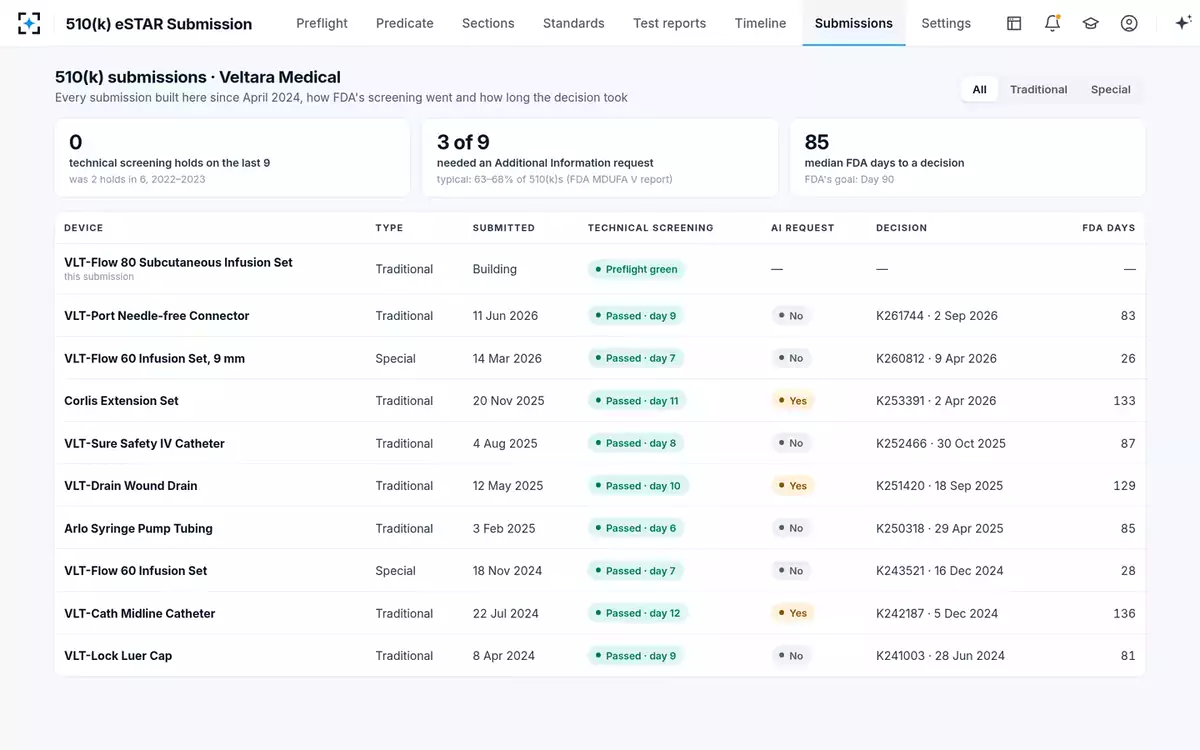
Every submission, how its screening went and the FDA days to a decision
Working out the return without inventing a number
Most return-on-investment cases for submission software fail the same way: they multiply a claimed time saving by an invented cost per day and produce a figure nobody in the room believes. There is a more defensible version that uses only numbers you own.
Count three things across your last ten submissions. How many were held at technical screening, and how long each was held. How many drew a request for additional information on the first cycle. And how many specialist days each submission took from the start of drafting to the file going out. Those are facts in your own files. Then estimate the change you expect in each, state it as an estimate, and let the people who own the launch dates price the days. The honest output is "we expect to lose one fewer cycle in ten and about six weeks of specialist time per submission", not a dollar total.
Five numbers to hold against any claim of time saved
- Measured on how many submissions, and whose?
A target is a design goal and should be called one. An estimate needs to say whose estimate it is and what it assumes.
- Does the saving include the approval steps?
Approval and signature are people’s work and barely move. A figure that assumes they do is measuring something else.
- Measured against what baseline?
Your own last submissions, not an industry average. Device programmes differ too much for an average to mean anything.
- Does it count the cycles, or only the first pass?
A faster first draft that still draws a question on cycle one has saved days and lost months.
- What was the error rate on the checking?
Defects found with evidence, and findings raised that were not real. A count of green lights is not a measurement.
What to measure after the first submission
The first submission prepared a new way is a measurement, if you decide in advance what it is measuring. Four things are worth writing down before it goes, so the comparison afterwards is not an argument.
Four things to record on the first submission, and what each answers afterwards
| What to record | When | What it answers |
|---|---|---|
| Specialist days from the start of drafting to the file being ready | Continuously, while it happens | Whether the preparation line actually moved, against your own previous submissions |
| Whether technical screening was passed first time, and any hold length | At FDA’s screening | Whether the preflight was checking the things FDA checks |
| Whether a request for additional information arrived, and what it asked | At the substantive interaction | Whether the question was one your own file could have answered beforehand |
| The defects the checks caught before it went, with the evidence for each | Before submission | The only direct measure of whether the checking is worth its cost |
The last of those also tells you something the fee never will: which defects are structural in your own process. A team that finds the same disagreement between a test report and a labeling claim on three submissions running has learned something about how its documents are kept, not about its submission software. Who owns the evidence behind a 510(k) is where that usually leads.
What a delay, a question or a hold would cost this submission, in days
To see the preflight, the predicate comparison and the submission history on one of your own cleared devices, start from 510(k) eSTAR Submission.
Questions people ask
Is there a small business 510(k) fee?
Yes. For fiscal year 2027 the small business rate for a 510(k) is $7,163, which is 25% of the $28,653 standard fee — the proportion FDA applies to all submissions other than a 30-day notice and a 513(g) request for classification information. You have to be determined a small business by FDA before the submission, not afterwards.
How do you qualify as a small business with FDA?
By revenue: gross receipts or sales, including those of your affiliates, of no more than $100 million for your most recent tax year. The status is granted for one fiscal year and expires on 30 September of that year, so a determination has to be renewed before a submission that goes in a later fiscal year.
Do you pay the 510(k) fee again if the submission is withdrawn?
A withdrawn submission has to go in again as a new submission. FDA's electronic submission guidance says a 510(k) is considered withdrawn and closed if a replacement eSTAR is not received within 180 days of a technical screening deficiency notification, and FDA considers a 510(k) withdrawn if a complete response to a request for additional information has not arrived within 180 calendar days of the request — its current policy, more generous than the 30 days written into 21 CFR 807.87.
How often do 510(k)s get a question on the first cycle?
In FDA's fiscal 2024 cohort, 1,834 additional information requests were issued against 2,711 completed substantive interactions — 67.6%, computed from Tables E-1 and E-2 of FDA's performance report. The figure is preliminary and covers one cohort, but it is consistent with GAO's finding that FDA requested additional information for a majority of the more than 62,000 device submissions it reviewed from 2001 through 2016.
What does an additional information request cost?
A cycle, measured in days rather than dollars: your days assembling the answer, FDA's remaining days on the second cycle, and the weeks whatever the submission was blocking spends waiting for both. A day of device launch delay has no published price, and its value differs by device and by plan, so the honest unit is days and cycles.
How do you work out the return on 510(k) preparation software?
From your own last submissions, not an industry figure. Count how many were held at technical screening, how many drew a request on the first cycle, and how many specialist days each took to assemble. Estimate the change in each, say that it is an estimate, and let the people who own the launch dates put a value on the days.