How do you prepare a 510(k) submission? The regulation lists what a premarket notification must contain and says nothing about the order in which to build it. This is a sequence: six weeks, with a decision at the end of each, built around an idea that costs almost nothing to try. Start on a 510(k) FDA has already cleared for one of your own devices. Re-source every claim in it to the document it came from, rebuild the comparison with its predicate, check the standards it cited, and tune the checks on a file whose right answer you already know. Then the first submission you send live is the second one you have assembled. Botminds' 510(k) eSTAR Submission is designed to be used exactly this way round.
One honest caveat up front. The six weeks is a design target for a device team with its documents in order, not a measured average, and the plan ends where every submission ends: at a file that goes. What happens after that is FDA's decision, on FDA's evidence, and nothing in a preparation method changes it.
What the rehearsal costs, and what it needs
1device
a 510(k) of your own that FDA has already cleared
6weeks
from the first re-sourced section to a live submission — a design target, not a measured average
2approvers
named: one for every section, one more on the test sections
1submitter
a person with an account on FDA’s portal, who sends it
How do you prepare a 510(k) submission?
In outline: establish what evidence you have and who owns it, choose a predicate and defend the choice on intended use, build the comparison and tie every difference to a report, cite each standard at the edition FDA recognises today, answer every applicable eSTAR section with a citation, check the whole file against itself, have each section approved by a named person, sign the truthful and accurate statement and submit through FDA's portal.
What that outline hides is the order of the risk. Two things that commonly go wrong — a claim with no evidence behind it, and two sections that disagree about the same fact — are both discoverable weeks early, and both are invisible in a plan organised by section rather than by evidence. That is the argument for the rehearsal: it puts the discovery on a file where a mistake costs nothing.
What do you need before week one?
Nine things, and the useful discipline is to name a person against each one before anything is drafted. Seven of the nine already exist in a company that has cleared a device; the last two are administrative and both have lead times.
The nine inputs a start needs, and who holds each one
- A 510(k) of your own that FDA has cleared, with its K number
Regulatory affairs. Ideally one that drew a question on the first cycle, so you know what a reviewer found.
- The design records behind that device
The design engineer: the description, the model list, the specifications and the revision each answer was settled at.
- The test reports it cited, as signed
The test laboratory lead: bench, sterility, biocompatibility, packaging and human factors, with the standard and edition each states.
- The labeling as it was cleared
The labeling owner: instructions for use, pouch and carton labels, and the indications for use form.
- The predicate's 510(k) Summary
Public, from FDA’s own database — the document the original comparison was built from.
- The device you intend to submit next, and what has changed
The programme. This decides whether the live submission is Traditional, Abbreviated or Special.
- A named approver for every section, and a co-approver for the test sections
The regulatory affairs director, with the laboratory lead on sterility, biocompatibility and performance.
- An account on FDA's portal for whoever will submit
Anyone can register for an account in the CDRH Portal and send premarket submissions and Small Business Requests online — so there is no reason to leave it to the last week.
- A small business determination, if you intend to claim the reduced fee
Regulatory or finance. The status is granted for one fiscal year and lapses at the end of it, so check the date before you rely on it.
One more thing is worth settling in week zero, because it is not optional. Every 510(k) now goes to FDA electronically: "A 510(k) submission that is not provided as an electronic submission as described in Section V above, will not be received unless an exemption from the electronic submission requirements or a waiver with respect to that submission applies" (FDA, Electronic Submission Template for Medical Device 510(k) Submissions). Not received, rather than reviewed slowly.
Weeks one and two: one past submission, re-sourced
Take the cleared submission and rebuild it from its evidence rather than from itself. Section by section, for each factual sentence, find the document it came from and cite the page. The output is not a new submission — nothing is going anywhere — but a list of three kinds of finding.
First, sentences whose source you can name immediately: the healthy majority, and the baseline. Second, sentences whose source takes an hour to find, which says more about how the documents are kept than about the submission. Third, sentences with no source at all — a number inherited from a previous device's submission, a claim copied from the predicate because it looked reasonable, a specification nobody can tie to a revision. The third category is what the exercise exists to find, and even a small one is alarming.
The decision at the end of week two: is the proportion of unsourced sentences a drafting problem or a records problem? If the sources exist and were simply never cited, a drafting discipline fixes it. If the sources do not exist, no submission tool helps, and the work is upstream with the people who own the records. Who owns what in a 510(k) is the map of those four desks.
Week three: the predicate comparison, rebuilt
Build the substantial equivalence comparison for the cleared device again, from the predicate's 510(k) Summary and your own design records, without looking at the comparison you filed. Then put the two side by side.
Three questions follow. Are the same rows there — have you missed a characteristic, or included one that was never comparable? Is every difference tied by name to a test report that answers it, or are some answered with an argument? And does the comparison agree with the device description in every number it repeats? A rebuilt comparison that matches the one FDA cleared is a good sign about the method and the original alike; one that does not is worth an hour, because the difference is either an improvement or an error.
The decision at the end of week three: which predicate the live submission will use, and on what grounds. Doing this after the rehearsal rather than before it means the choice is made by people who have just spent a week inside a real comparison. How to choose a predicate device sets out what rules one out.
Week four: standards, editions and declarations of conformity
List every consensus standard the cleared submission cited, with its edition and any amendments, and check each against FDA's recognised list as it stands today — not as it stood when the submission went. Two things are worth looking for on a submission a few years old: a standard recognised at a newer edition since, and a standard in a transition period with an end date you now need to plan around.
This is also where to decide the refresh and the warning window for the live submission: how often the recognised list is re-read, and how far ahead a transition should be flagged. Both are settings, and both are cheap to get right once and expensive to notice late. FDA's recognized consensus standards database, editions and transitions is the detail.
The decision at the end of week four: whether any standard the next device relies on is in a transition that will close before its submission, and therefore whether a test needs repeating to a newer edition. That is a laboratory decision with a lead time, which is exactly why it belongs in week four rather than week six.
Week five: the checks, and who approves what
Now configure the checking, using the cleared submission as the test file. Switch on the checks that matter to your device family, switch off the ones that do not, and add your own in plain words — the IFU revision named in the device description must be the one attached in the labeling section, for instance. Then plant two or three defects you know about and confirm the checks find them and point at the right place.
The approvals are settled in the same week, and they are the part most teams under-specify. Who approves each section, by name. Who co-approves the test sections — sterility, biocompatibility, performance — because a regulatory director signing for a laboratory's work is a weak link. Who signs the truthful and accurate statement. Who submits. Four answers, written down once, and the submission's shape follows from them.
The settings: checks, approvers, who signs and who submits
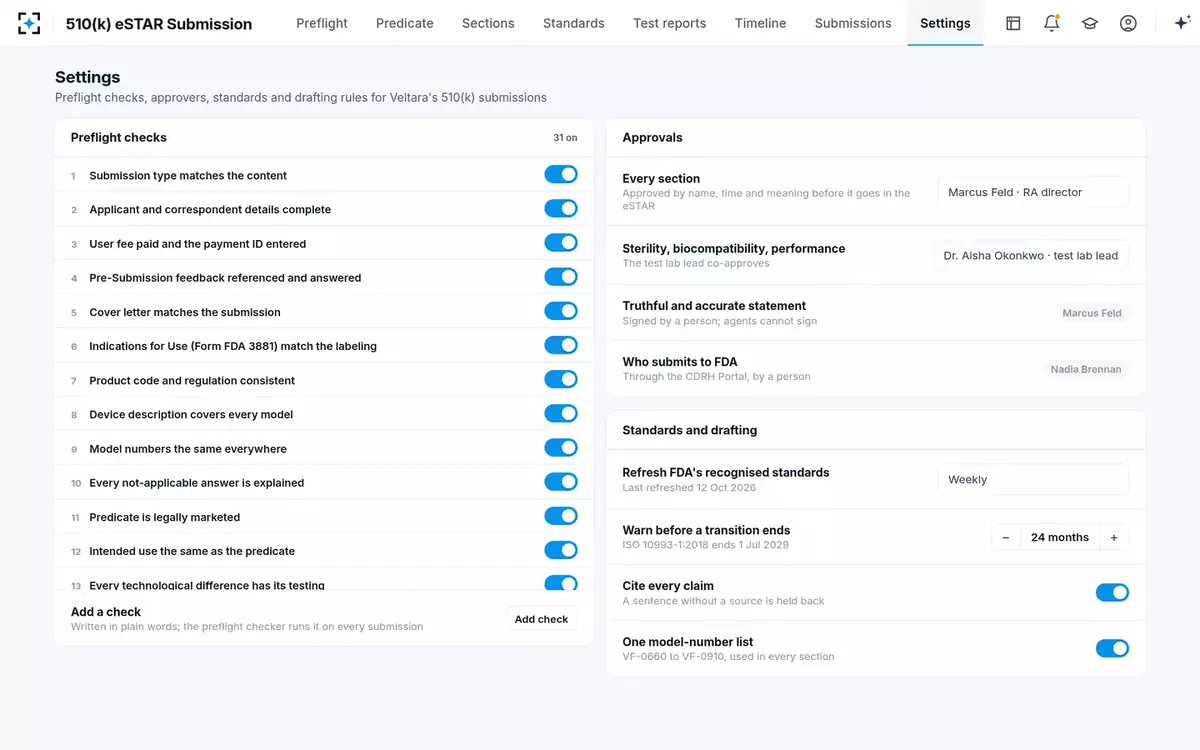
The decision at the end of week five: the list of checks the live submission will be held to, agreed by the people who will have to act on each failure. A check nobody will act on should be switched off rather than tolerated as a warning everyone has learned to ignore.
Week six: a live submission, start to finish
The live submission is now the second file the team has assembled this way, which is the whole point. The sequence is the ordinary one — draft each applicable section from the design records, the reports and the labeling with a citation on every factual sentence; build the comparison and tie each difference to a report; cite each standard at its recognised edition; run the checks; fix what they find; send the sections for approval; sign; submit — but nothing in it is being tried for the first time.
What FDA does next starts with an administrative check rather than a scientific one. FDA's Refuse to Accept policy describes it: "The purpose of the 510(k) acceptance review is to assess whether a submission is administratively complete, in that it includes all of the information necessary for FDA to conduct a substantive review and to reach a determination regarding substantial equivalence under section 513(i) of the Federal Food, Drug, and Cosmetic (FD&C) Act" (FDA, Refuse to Accept Policy for 510(k)s). An eSTAR goes through a technical screen; either way the first thing examined is completeness, which is the thing a preflight can honestly target. Why a complete eSTAR still fails technical screening is what that screen actually looks for.
Six weeks, and the decision at the end of each
- Re-source every factual sentence to its documentWeeks 1–2
- Rebuild the comparison and set it against the one you filedWeek 3
- Every cited standard against the edition recognised todayWeek 4
- Configure checks on the cleared file; name every approverWeek 5
- Draft, compare, check, fix, approve, sign, submitWeek 6
Should you file a pre-submission before a 510(k)?
Only if you have a specific question FDA's answer would change your development or your submission. FDA is precise about what the programme is for, and about what it is not.
A Pre-Sub is appropriate when FDA's feedback on specific questions would help guide product development and/or submission preparation, but is not intended to be a pre-review of an intended submission or a pre-review of data to be provided in a submission.
FDA, Requests for Feedback and Meetings for Medical Device Submissions: The Q-Submission Program, May 2025
"Not a pre-review of an intended submission" rules out the most common hope: that FDA will look over a draft and say whether it will clear. It also has a lead time worth planning around — "If no meeting is requested, written feedback will be provided within 70 calendar days from the review clock start date and will serve as the official record of the Agency's feedback."
Seventy calendar days is most of a quarter, so a pre-submission belongs in the development plan rather than the submission plan. The good questions are narrow and about evidence: whether a test method is acceptable for a particular claim, whether a clinical study is expected for a particular change, whether a predicate is appropriate given a difference in technology. The bad question is "is this ready".
In-house, consultant or third-party review: what each is for
Three different things are often discussed as if they were alternatives, and only two of them are.
In-house, an outside consultant and FDA's Third Party Review Program, on the same submission
| Route | What it is | What it is good at | What it does not change |
|---|---|---|---|
| In-house | Your own team assembles and submits the file | Knowing the device, the records and who owns them; keeping the knowledge afterwards | The attestation: a named person at the submitter signs either way |
| Outside consultant | A specialist prepares or reviews the submission with you | Experience of a device type or review division you have not met, and capacity on a deadline | Responsibility, which does not move, and the records, which stay yours |
| Third Party Review Program | An FDA-accredited organisation reviews eligible 510(k)s and recommends a determination | A different review path — FDA treats third-party 510(k)s as having a decision phase but no substantive interaction phase | FDA still makes the determination, and eligibility is by device type |
One choice in the same family is about the submission type rather than the reviewer. A change to your own cleared device may be eligible for the Special 510(k) programme, which FDA intends to review within 30 days — but not for every change: FDA's guidance rules out, among other cases, changes whose evaluation "generally involve greater than three scientific disciplines (e.g., biocompatibility, sterility, electromagnetic compatibility)" (FDA, The Special 510(k) Program). The rehearsal is a good moment to find out which programme the next change belongs in.
What a rehearsal on a cleared submission proves, and what it cannot
It proves
- Whether every claim in a submission can name the document behind it
- Whether the checks catch a defect you planted, and point at the right place
- How many specialist days the assembly actually takes, on your own documents
- Whether your approvers can work section by section rather than in one meeting
It cannot prove
- That FDA will clear the next device — FDA decides that, on its own evidence
- That a thin evidence package will pass: a missing report is still missing
- What a reviewer will ask about a technology FDA has not seen from you before
- How long FDA will take; its clock is not yours to move
What to measure in the first year
A method that is not measured becomes a habit, and a habit is hard to argue with. Four numbers over the first year's submissions are enough, and all four come out of your own files.
Four numbers worth keeping, and what each one tells you
| Number | Where it comes from | What a bad reading means |
|---|---|---|
| Submissions passing technical screening first time | FDA's notification after receipt | The checks are not modelled on what FDA actually examines |
| First cycles that drew a request for additional information | FDA's substantive interaction | The questions were answerable from your own evidence and were not answered |
| Specialist days from the start of drafting to the file being ready | Your own timesheets, submission by submission | The assembly has not moved, whatever the drafting speed suggests |
| Defects the checks caught before the file went, with the evidence for each | The run before submission | Checks that never fail are not checking; a long list that nobody acts on is noise |
Every submission the team has built, and how each one went
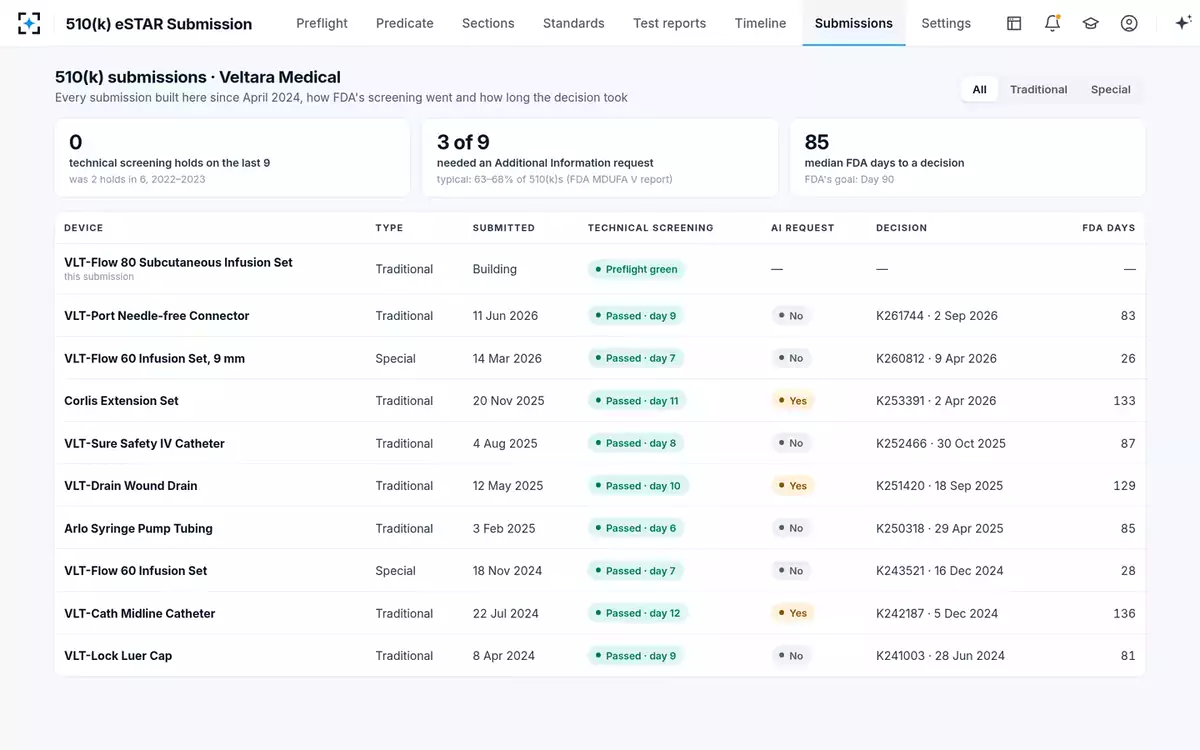
The first reading that matters comes at the end of week six, and it is not a number at all: whether the people who had to approve and sign the live submission did so without asking for a second explanation of where a claim came from. That is the test of whether the citations are doing their job.
A submission with every check green, ready for approval
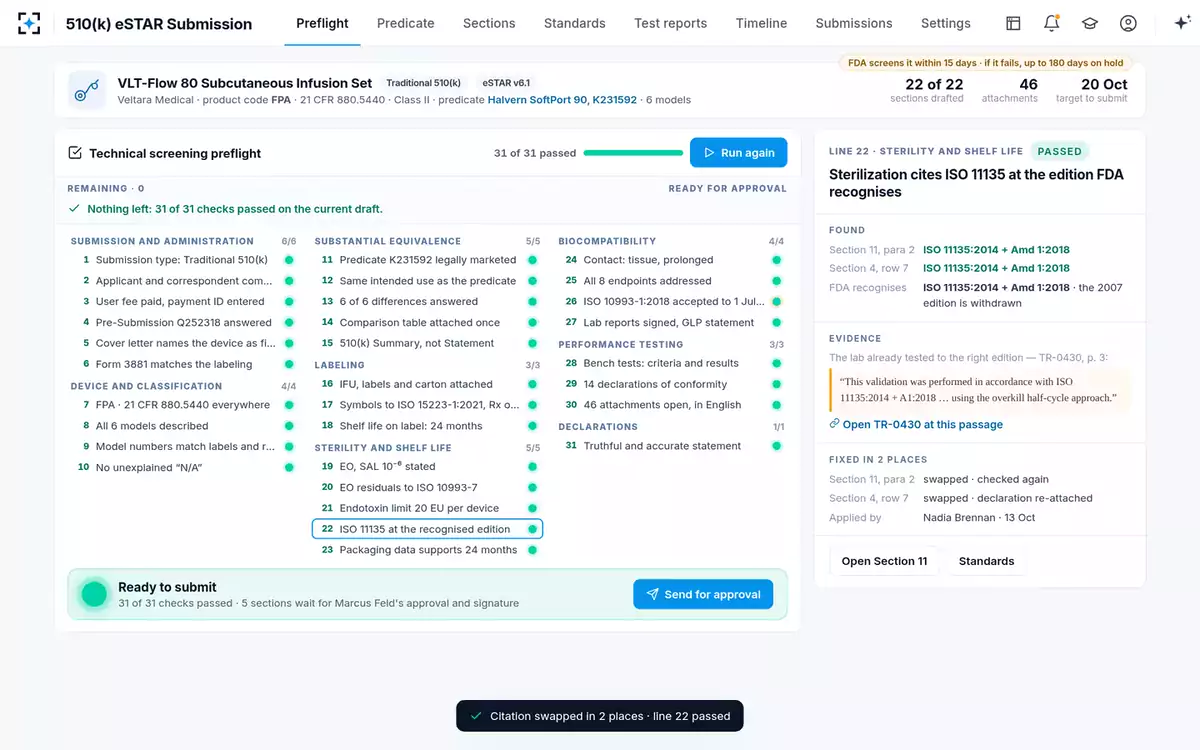
We will run it on one of your own devices first — a 510(k) you have already cleared, with your design records, test reports and labeling — so the first thing you see is your own file rather than ours. Start from 510(k) eSTAR Submission.
Questions people ask
How long does it take to prepare a 510(k)?
For a Traditional 510(k) assembled by hand, our estimate is around ten weeks of a specialist's work from the start of drafting to a file that is ready to go, most of it spent cross-checking facts that repeat across sections. The six-week plan on this page is a design target for a team using the solution with its records in order, not a measured average, and it includes a full rehearsal on a cleared submission.
What is a Pre-Sub and when do you file one?
A Pre-Submission is a request for FDA's feedback on specific questions under the Q-Submission Program. FDA says it is appropriate when feedback would help guide product development or submission preparation, but that it is not intended as a pre-review of an intended submission or of the data in one. Written feedback arrives within 70 calendar days of the review clock start, so it belongs in the development plan rather than the submission plan.
How do you test submission software on a past 510(k)?
Re-source it rather than re-read it. Take a submission FDA has already cleared, rebuild each claim from the document behind it, rebuild the comparison with the predicate without looking at the one you filed, and plant two or three defects you know about to see whether the checks find them and point at the right place. The file's right answer is already known, which is what makes it a measurement.
Should you prepare a 510(k) in-house or use a consultant?
Both routes end at the same place: a named person at the submitter signs the statement that the submission is truthful and accurate, and responsibility does not transfer. A consultant brings experience of a device type or a review division you may not have met and capacity against a deadline; an in-house team keeps the knowledge and owns the records. A third option, FDA's Third Party Review Program, is a different review path for eligible device types rather than a different way to prepare the file.
What does a 510(k) readiness review cover?
Completeness before science. FDA's acceptance review assesses whether a submission is administratively complete — whether it includes the information necessary for FDA to conduct a substantive review and reach a determination on substantial equivalence. A useful internal readiness check targets the same thing: every applicable section answered, every attachment answering its question, no unexplained omission, every difference from the predicate tied to a report, and every standard cited at a recognised edition.
What do you need before you start a 510(k)?
The device's design records, the signed test reports, the labeling, the predicate's 510(k) Summary, a named approver for each section with a co-approver on the test sections, and an account on FDA's portal for whoever will submit — anyone can register for one. If you intend to claim the reduced small business fee, the determination has to be in hand and current for the fiscal year the submission goes in.