To choose a predicate device, start from intended use rather than from technology: FDA may only find a device substantially equivalent to a legally marketed device that has the same intended use, so a candidate whose indications differ is out before its materials are worth looking at. Then take the shortest distance in technological characteristics among the candidates that survive, prefer the one whose published 510(k) Summary describes it in enough detail to compare against, check that nothing in its history disqualifies it — and identify one. Botminds' 510(k) eSTAR Submission is built around that last point: a person chooses the predicate, and the comparer that lays the two devices side by side never does.
This is also the decision that outlives everyone who made it. It shapes the testing, the labeling and the argument; it is read back by a reviewer who was not in the room; and it becomes the thing your own next submission inherits. The worked example below uses a fictional sample submission inside the solution, with invented companies, devices and clearance numbers.
Recalls, and the predicate choices associated with them, in percentage points
How do you choose a predicate device?
The procedure is short, and the order matters more than any single step.
Settle your own intended use and indications first, in the words you will file. Then search FDA's databases for cleared devices with that intended use, usually by product code, and build a candidate list rather than a favourite. For each candidate, read the published 510(k) Summary and ask three questions: are the indications the same, how far is the technology from ours, and does the Summary describe the device in enough detail that a reviewer could compare the two. Check each candidate's history against the disqualifier 21 CFR 807.100(b)(3) names. Then choose one, write down why, and make everything else — the testing plan, the comparison, the labeling — follow from it.
The questions a predicate has to carry are FDA's decision points, and they are the reason a single device is the right answer.
The four questions one predicate must be able to answer
- Is there a predicate device at all?
A legally marketed device as 21 CFR 807.92(a)(3) defines it. Without one, the route is a De Novo request or a premarket approval application, not a 510(k).
- Does the new device have the same intended use?
FDA may only find substantial equivalence where the intended use is the same. Intended use is the general purpose of the device; the indications for use sit inside it.
- Does it have the same technological characteristics?
Materials, design, energy source and other features. A "no" here is ordinary — FDA notes that devices cleared through the programme commonly differ from their predicates.
- If not, do the differences raise different questions of safety and effectiveness?
A question raised by the new device’s technology that was not applicable to the predicate, and that poses a significant safety or effectiveness concern. FDA says it rarely finds a device not substantially equivalent at this point.
How do you find a predicate device on FDA's database?
Three FDA databases do the work, and they are best used in this order. The product classification database turns a device type into a product code, a classification regulation and a class — start here, because the product code is the search term that makes everything else tractable. The 510(k) premarket notification database lists every clearance, searchable by product code, applicant, decision date and device name, with the 510(k) Summary attached where one was filed. The medical device recall database lets you look at what has happened to a candidate since.
Two practical notes. Searching by product code rather than by trade name is what surfaces the devices you have never heard of, which is where a closer technological match often hides. And read the Summary itself, not the clearance record: a decision date tells you nothing about whether the device is described well enough to compare against, and that is the variable that decides how much of your own testing the comparison will need.
Why FDA wants one predicate, not three
The guidance is unambiguous about the preference and clear about why it exists. "While manufacturers may identify more than one predicate device, only one is required. FDA encourages manufacturers to identify a single predicate device to simplify and facilitate the decision-making process. When a manufacturer does identify multiple predicates, the primary predicate refers to the one with indications for use and technological characteristics most similar to the device under review" (FDA, The 510(k) Program).
Multiple predicates are permitted in defined circumstances — combining features from two devices with the same intended use, or seeking more than one indication under the same intended use. Where they are used, FDA asks the manufacturer to identify each device, explain why more than one is necessary and appropriate, and limit the set to the minimum needed.
The argument for restraint is not only regulatory. Each additional predicate is another device whose characteristics you must describe, another set of differences to explain and another history a reviewer can ask about. And the JAMA analysis above found that a one-standard-deviation increase in the number of predicates cited was associated with a 1.25-percentage-point rise in recall probability — about 11% relative to the mean. The association is not a finding of cause, and the authors say so. But it points the same way the guidance does.
What is a split predicate?
A split predicate is the specific mistake of borrowing intended use from one device and technological characteristics from another, and FDA has ruled it out.
Therefore, the use of a "split predicate" is inconsistent with the 510(k) regulatory standard. "Split predicate" refers to a situation in which a manufacturer is attempting to "split" the 510(k) decision making process by demonstrating that a new device has the same intended use as one marketed device while comparing the new device's technological characteristics with a second marketed device that has a different intended use.
FDA, The 510(k) Program: Evaluating Substantial Equivalence (July 28, 2014)
The rule follows from the statute rather than from policy preference: a device is substantially equivalent when it has the same intended use as the predicate and the same technological characteristics, or different ones that do not raise different questions. Both halves attach to the same device. FDA states the operational consequence plainly — to find a device substantially equivalent, it must be able to address Decision Points 1 through 4 using one predicate the manufacturer identified.
The practical tell is a sentence in a draft that begins "for intended use we rely on … and for the technology we rely on …". If the comparison needs two devices to stand up, the honest reading is that the real predicate has not been found yet.
Reference devices: what they can and cannot carry
A reference device is a legally marketed device cited to supply scientific methodology or standard reference values — for example, a device that established the test method for a characteristic your predicate never had. FDA is precise about the limit: "It is important to note that a reference device is not considered a predicate device and it cannot be used to address Decision Points 1 – 4 on the Flowchart."
So a reference device comes in after the equivalence question is already answered, at Decision Point 5a, and only with a scientific rationale justifying its use. FDA also warns that a reference device used in an anatomical location or for a physiological purpose considerably different from the new device's may be of limited use. Reference devices may be cited in the 510(k) Summary, and labelling them correctly in the submission is part of the argument: a reference device presented as a predicate is a split predicate with better manners.
Can you use a recalled device as a predicate?
Usually yes, and the regulation is narrower here than most people expect. Among the criteria FDA applies, 21 CFR 807.100(b)(3) requires that "the predicate device has not been removed from the market at the initiative of the Commissioner of Food and Drugs or has not been determined to be misbranded or adulterated by a judicial order" (21 CFR 807.100). A firm-initiated recall, even a class I one, is not removal at the Commissioner's initiative, and a device that was recalled and corrected generally remains available as a predicate.
The research is where the caution comes from. In the JAMA analysis, applicant devices citing predicates with three or more ongoing class I or class II recalls were associated with a 9.31-percentage-point higher recall probability — an 81.2% increase relative to the mean recall probability in the sample. Those submissions were rare: 93.9% of applicant devices cited predicates with no ongoing recalls, and only 0.8% cited predicates with three or more.
So the honest answer to a programme manager is: it is allowed, it is unusual, and it correlates with an outcome nobody wants. If a candidate has an open recall touching the characteristic you intend to rely on, choosing it is a decision to defend in writing rather than a box to tick.
Three candidates for one fictional sample device, scored the way the decision is actually made
| Candidate | Intended use | Technological characteristics | Evidence and history | Verdict |
|---|---|---|---|---|
| Candidate A — cleared 2023, same product code | Same indications, same wearing time, same patient group. | Closest technology: the same insertion principle, a different cannula material and a shorter tubing option. | A published Summary with usable detail; no recall in the device’s history. | Primary predicate. Four differences, each answerable by a report we already hold. |
| Candidate B — cleared 2015, same product code | Same indications, but the labeling covers a wider patient group than ours. | Identical materials to ours, which would leave almost nothing to explain. | A thin Summary from an era that published less; two field actions since. | Tempting and wrong. The materials match, but an older device’s evidence is harder to compare against and its history invites questions. |
| Candidate C — cleared 2024, adjacent product code | A different intended use: continuous monitoring rather than delivery. | Shares the adhesive and the wear-time testing we care about. | Excellent, recent, detailed testing on exactly the characteristic we must explain. | Not a predicate. It may be a reference device after Decision Point 4, if we justify it. |
Predicate creep, and what the research actually found
Predicate creep is the worry that a chain of small, individually reasonable modifications can carry a device a long way from the device whose evidence justified the original clearance. A 2023 case study in PLoS ONE traced the phenomenon through one robotic surgical device and put the mechanism carefully: "It is possible that, over multiple cycles of small device modifications and subsequent substantial equivalence findings, a new device may be cleared which is significantly dissimilar to the original predicate for which scientific evidence exists" (Lefkovich and Rothenberg, PLoS ONE 2023).
Two things follow for a team choosing a predicate today. The first is that your own last clearance is the easiest predicate to use and the one most likely to be carrying accumulated drift; using it is fine, but it is worth knowing how far the current device has travelled from the one that was actually tested. The second is the JAMA finding that a one-standard-deviation increase in the age of the newest predicate cited was associated with a 0.78-percentage-point decrease in recall probability — a result that cuts against the instinct that newer predicates are safer bets, and a reminder that these are associations in need of explanation rather than rules to apply.
What substantial equivalence does not establish
A finding of substantial equivalence is a comparison, not a verdict on safety and effectiveness in the abstract. The Institute of Medicine's 2011 review of the programme put the structural point in one sentence: "The 510(k) process cannot be transformed into a premarket evaluation of safety and effectiveness as long as the standard for clearance is substantial equivalence to any previously cleared device" (Institute of Medicine, Medical Devices and the Public's Health).
That is worth saying inside a company, not only outside one. A cleared device is a device FDA found equivalent to another device for the same intended use. It is not a device FDA has declared safe, and a team that treats clearance as a safety conclusion will under-invest in the post-market work that actually tests the claim. Choosing a predicate well is the point at which that distinction is cheapest to honour.
The questions to settle before the comparison table exists
The predicate decision is a judgement about law and evidence, and it is the one part of submission preparation that should not be delegated to a tool — a line what AI may and may not do in device regulatory affairs draws in more places than this one. What a tool can do is everything after it: lay the two devices side by side, hold every row to a source, and refuse to call a difference answered when no report answers it.
Where the predicate decision sits, and what never crosses the line
A person decides
The regulatory lead chooses the predicatePicks one device on intended use, technological distance, the detail available in its published Summary and its history, and writes down the reason.
Never: delegated to a tool — this is a legal judgement with a named owner
Agent
Predicate comparerReads the predicate’s 510(k) Summary and the design history file and lays the device beside it row by row — indications, users, technology, materials, performance, sterility, shelf life.
Never: chooses the predicate
Agent
Predicate comparer, on each differenceTies every difference to the test report that answers it, with the acceptance criterion and the result, or opens it as a gap.
Never: calls a difference answered without a report behind it
A person decides
The regulatory lead closes the gapsDecides what to do where no report answers a difference: run the test, narrow the claim, or explain why the difference raises no new question.
Never: left to a default
The device beside its predicate, with the report behind every difference
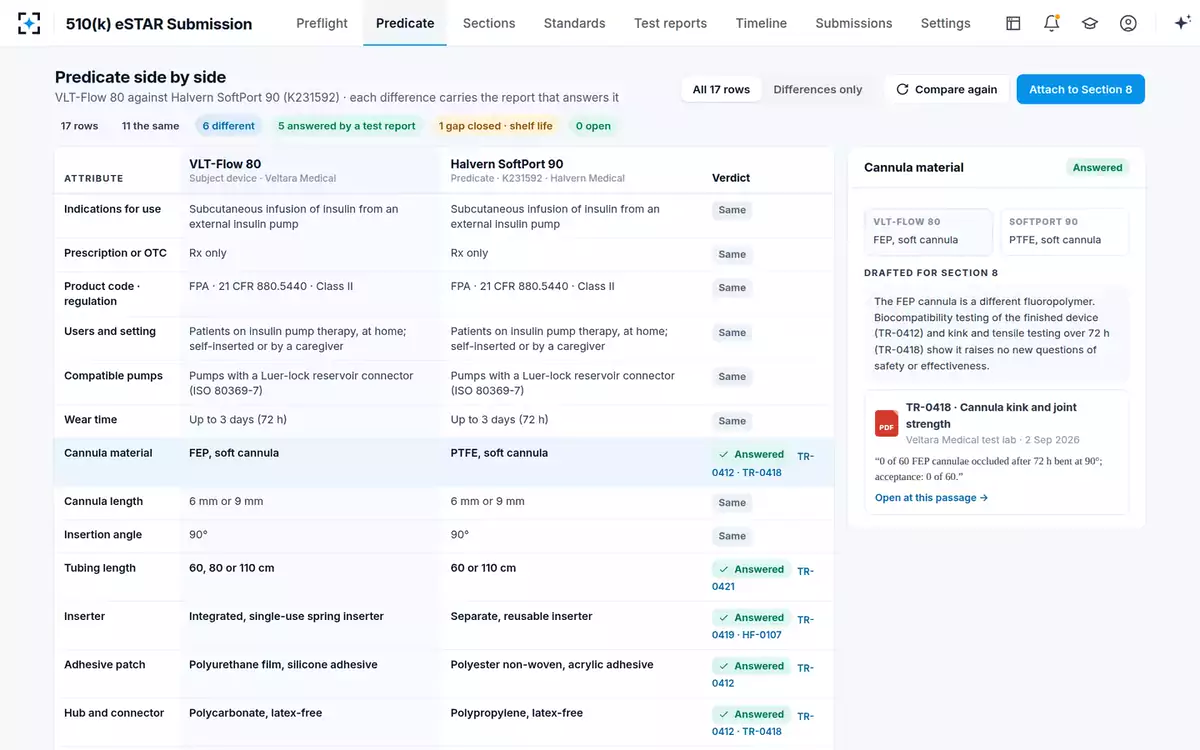
Once the predicate is settled, the work moves to the table itself — which rows belong in it, how a reviewer reads a difference and what counts as answering one. The substantial equivalence comparison table, row by row takes that next, and a predicate named inconsistently across the sections is one of the contradictions FDA's technical screen looks for. The disqualifiers below are worth checking before any of that begins.
Six things that rule a candidate predicate out, and the rule behind each
| What rules it out | The rule or finding behind it | What to do about it |
|---|---|---|
| It is not a legally marketed device | A predicate must be legally marketed as 21 CFR 807.92(a)(3) defines it: marketed before 28 May 1976, reclassified from Class III to Class II or I, or itself found substantially equivalent through the 510(k) process. | Check the clearance exists and that the device type was not later reclassified. |
| It does not have the same intended use | FDA may only find a device substantially equivalent if it has the same intended use as the predicate. About one in ten findings of not substantially equivalent turns on a new intended use. | Compare intended use first, before anybody admires the technology. |
| It was removed from the market by the Commissioner, or found misbranded or adulterated by a court | A named criterion in 21 CFR 807.100(b)(3), and the disqualifier the regulation spells out for a device that was once legally marketed. | Check the device, and the firm, before the comparison table exists. |
| It is carrying only half the comparison | A second device used for technological characteristics while the first carries intended use is a split predicate, which FDA says is inconsistent with the regulatory standard. | If you need two devices to answer Decision Points 1 to 4, you have a problem, not a strategy. |
| It is a reference device wearing a predicate’s name | A reference device supports scientific methodology or standard reference values at Decision Point 5a. It cannot address Decision Points 1 to 4. | Say which it is in the submission, and give the scientific rationale for using it. |
| You cannot see enough of it to compare | Nothing in the regulation requires a rich published Summary, but a predicate you cannot describe is a predicate you cannot be found equivalent to. | Read the Summary before committing. Thin detail means more of your own testing, not less. |
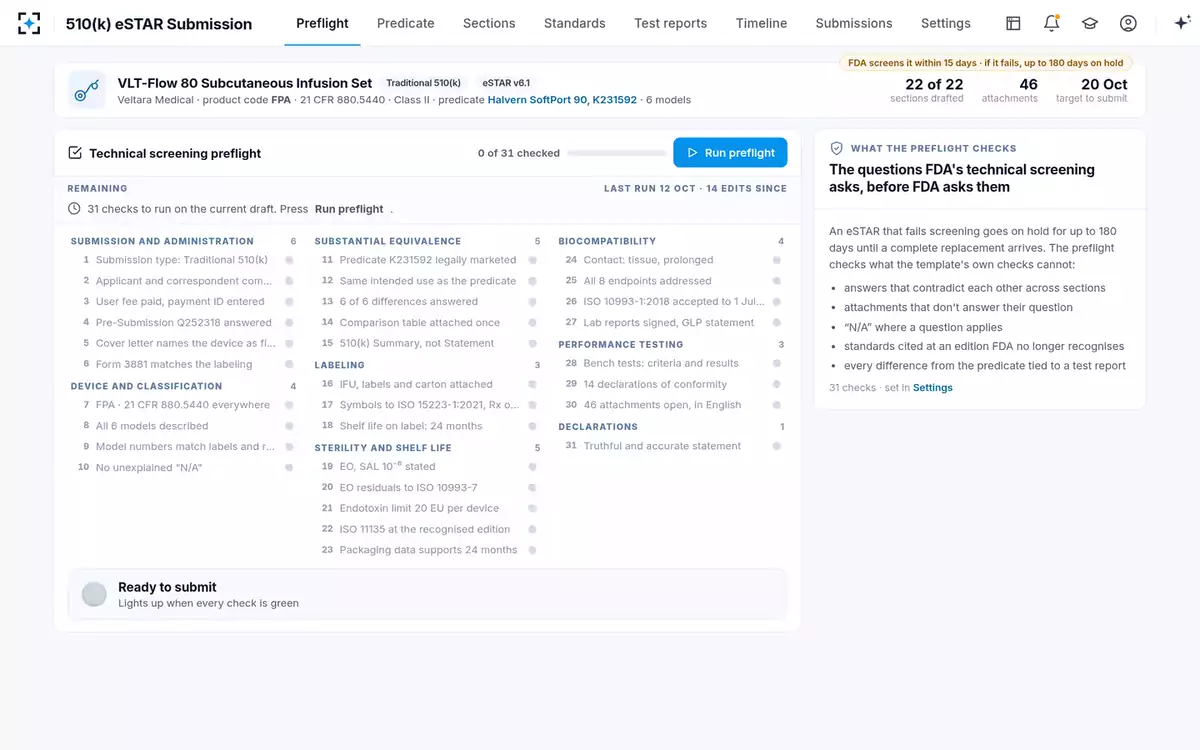
The predicate decision, carried through to every check that depends on it
Questions people ask
Can you use more than one predicate device in a 510(k)?
Yes, in defined circumstances — combining features from two devices with the same intended use, or seeking more than one indication under one intended use. FDA requires only one, encourages a single predicate, and asks that where several are used the manufacturer name a primary predicate, explain why more than one is necessary, and keep the set to the minimum needed.
What is a split predicate?
Taking intended use from one marketed device and comparing technological characteristics with a second device that has a different intended use. FDA states that this is inconsistent with the 510(k) regulatory standard, because the statute attaches both halves of the test to the same predicate. In practice, needing two devices to make the argument work means the predicate has not been found.
What is a reference device in a 510(k)?
A legally marketed device cited to supply scientific methodology or standard reference values, used only after Decision Point 4 and only with a scientific rationale. It is not a predicate and cannot address Decision Points 1 to 4. A reference device in an anatomical location or for a purpose considerably different from the new device's may be of limited use.
Does the predicate have to have the same intended use?
Yes. FDA may only determine substantial equivalence where the new device has the same intended use as the predicate. Intended use is the general purpose of the device, and the indications for use sit within it — which is why a change in indications can create a new intended use. FDA's guidance notes that roughly 10% of findings of not substantially equivalent turn on a new intended use.
Can you use a recalled device as a predicate?
In most cases yes. The regulation disqualifies a predicate removed from the market at the initiative of the Commissioner, or determined misbranded or adulterated by a judicial order; a firm-initiated recall is neither. The research urges caution rather than prohibition: citing predicates with three or more ongoing class I or II recalls was associated with a 9.31-percentage-point higher recall probability in the JAMA analysis.
What does substantial equivalence actually prove?
That a device has the same intended use as a legally marketed one, and either the same technological characteristics or different ones that do not raise different questions of safety and effectiveness. It is a comparison with an existing device, not an independent evaluation of safety and effectiveness — a limit the Institute of Medicine described as inherent in the standard itself.