An FDA technical screening hold is what happens when the agency's first look at a 510(k) eSTAR finds that the answers do not describe the device, or that a question that applies has no relevant attachment behind it. FDA emails the submitter, names the incomplete information, and the submission stays on hold until a complete replacement eSTAR arrives. Nothing about the hold depends on the quality of your evidence: a submission whose science is sound can be held for a model number that disagrees with itself. Botminds' 510(k) eSTAR Submission drafts each section from the design history file, the test reports and the labeling, and then runs a preflight modelled on that screen before the file goes, so the contradictions surface on your side of the fifteen days.
What makes the hold disorienting is that the template does not warn you: eSTAR tells you when it is finished, not when it is right, and those are different claims. The worked screens below come from a fictional sample submission inside the solution; the people, companies, devices and K numbers in it are invented.
The four numbers that govern the first fifteen days
15days
in which FDA anticipates the technical screening will happen
1fee
FDA intends to begin technical screening only where the user fee is paid
180days
from the deficiency notice before a held 510(k) is considered withdrawn
0days
of review clock a held submission earns while it waits
What is FDA technical screening for an eSTAR?
Technical screening is a verification pass, not a review. FDA defines it in the eSTAR guidance as "a process for verifying that eSTAR responses accurately describe the device(s) (e.g., there are, in fact, no tissue contacting components if indicated as such) and that there is at least one relevant attachment per each applicable attachment-type question (e.g., a Software Description attachment is included in response to the Software Description question if software is applicable to the submission)" (FDA eSTAR guidance). Read that twice, because the examples are the whole definition. One is an answer that contradicts the device. The other is a question that applies but has nothing relevant behind it.
The guidance also says FDA "intends to employ a virus scanning and technical screening process for an eSTAR", so the file itself is checked as well as its answers. Everything else about the submission, every judgement a reviewer will eventually make about your evidence, happens later and under a different name.
What the screen tests, and what it leaves to the review that follows
The screen asks
- Do the answers describe this device? FDA gives its own example: a submission that says it has no tissue-contacting components, when it does.
- Is there at least one relevant attachment behind every applicable attachment-type question? FDA’s example again: a Software Description attachment filed against the Software Description question, when software applies.
- Has the user fee been paid? FDA intends to begin technical screening only where it has.
- Does the file scan clean? FDA runs a virus scan as part of the same process.
The screen does not ask
- Whether the predicate you chose is the right one, or whether one predicate carries the whole comparison.
- Whether a test report’s acceptance criterion is appropriate, or whether its result supports the claim made from it.
- Whether the edition of a standard you cited is still the edition FDA recognises.
- Whether your shelf-life, sterility or biocompatibility evidence is adequate — that judgement belongs to the substantive review.
Complete is not correct: FDA's own distinction
The eSTAR PDF reports on itself. FDA's footnote is explicit: "After a submitter completes all necessary sections in their eSTAR file correctly, the status message at the top of the PDF will indicate 'eSTAR Complete' to represent a complete submission." That message is a statement about coverage — every necessary section has been dealt with. It is not a statement about whether what you wrote in them is true of your device.
FDA has drawn that line before, in the Refuse to Accept policy, and the sentence there is as clear a statement of it as FDA has written.
It is critical to distinguish between the completeness of the regulatory submission, and the quality of the data provided and any studies conducted in support of the submission.
FDA, Refuse to Accept Policy for 510(k)s (April 21, 2022)
The RTA policy predates eSTAR and applies that distinction to the acceptance review, which it says is "completed within 15 calendar days of FDA receiving the 510(k) notification". The technical screen sits in the same place in the calendar and asks a narrower version of the same question. In both cases the thing being judged is the submission as an object — are the parts there, do they match — and in both cases the judgement about the evidence comes afterwards.
So "eSTAR Complete" is worth exactly what it says. A team that treats it as a readiness signal has outsourced its own last check to a template that was never asked to perform it.
The fifteen days, and the clock that has not started
FDA writes that "the technical screening process is anticipated to occur within 15 days of FDA receiving the 510(k) eSTAR", and that it "intends to only begin the technical screening for 510(k) electronic submissions where the appropriate user fee has been paid". Both halves matter to a programme plan. The fifteen days are an expectation FDA sets for itself, not a statutory deadline; and they do not start running on the day you press submit if the fee has not cleared.
The sibling guidance for De Novo requests makes the unit explicit, saying "the technical screening process should occur within 15 calendar days of FDA receiving the De Novo eSTAR" (FDA, Electronic Submission Template for Medical Device De Novo Requests). Fifteen calendar days across a holiday period is nine or ten working days. If your submission target is a board commitment, that fortnight belongs in the plan as a fortnight in which nothing can be learned and nothing can be fixed.
Two eSTARs, same receipt date: one passes the screen and one does not
- Screen
- Under substantive reviewclock already running
- Screen
- On hold after the deficiency emailup to 180 days from the notice
What happens if an eSTAR fails technical screening?
FDA's description of the consequence is one sentence and worth knowing by heart: if the eSTAR does not pass, FDA notifies the submitter by email, identifies the incomplete information, and "the 510(k) will be placed and remain on hold until a complete replacement eSTAR is submitted to FDA". Three things follow from the wording.
First, you are told what is wrong. The deficiency email names the incomplete information, so a hold is not a mystery — it is a list. Second, the remedy is a replacement eSTAR, not a patch: you resubmit the whole template, with the problem fixed and everything else unchanged, which is exactly the moment a team discovers whether it knows which of its files produced the version that went. Third, "remain on hold" is passive and open-ended. Nothing restarts because time has passed. The submission sits until you act.
FDA's own eSTAR programme page names the two triggers more bluntly than the guidance does, and uses the phrase a held submitter will see: if the eSTAR does not pass technical screening — the page's examples are an eSTAR "where none of the attachments to a question are relevant to the question, or if an inaccurate response is provided to any question" — "the submission may be put on a technical screening hold for up to 180 days" (FDA, eSTAR Program). The same page warns that the advantages of the template "are dependent on accurate responses and the FDA intends to verify the accuracy of your responses", and that an inaccurate answer to a dropdown can make the template skip questions that should have been asked — a failure mode worth dwelling on, because the submission that results looks finished to everyone who opens it.
A held 510(k) is also a management event: somebody has to tell the programme the launch date has moved, and the reason will sound trivial out loud — a model number, a date, an attachment filed under the wrong question.
Does a technical screening hold stop the 510(k) review clock?
It prevents the clock from being credited at all, which in practice is worse than stopping it. FDA's rule is written for the submission that passes: "For a submission that passes technical screening, the review clock starts on the day the submission was received by FDA." The screening fortnight is therefore free to a submitter who gets through it — those days are counted as review days.
A submission that does not pass gets no such credit. It is on hold, and the clock the agency reports against is attached to the replacement eSTAR, not to the one you sent. A hold does not pause a running clock; it means the clock you were counting on never started. How long a 510(k) takes works through the two clocks in full, including the difference between FDA days and the calendar days your programme actually lives in.
The 180 days: when a held submission is treated as withdrawn
The outer limit is written into the guidance: if a replacement eSTAR is not received within 180 days of the date of the technical screening deficiency notification, FDA will consider the 510(k) to be withdrawn and will close the submission in its system. The count runs from the notification, not from receipt, and it is about delivery of the replacement, not about how long you spend preparing it.
Half a year sounds generous, and for a citation error it is. It stops being generous when the deficiency turns out to be substantive in disguise — a question answered "N/A" because the evidence does not exist yet, or an attachment missing because a test has not been run. Then the 180 days are not administrative slack; they are the schedule for a test campaign, and they are running.
A withdrawn-and-closed submission is not a paused one, and what a second cycle costs — in fee, in hours, in a slipped launch — is worked through in what a 510(k) actually costs.
Is there still an RTA checklist for eSTAR submissions?
FDA's expectation is that eSTARs will not go through one. The guidance says: "Given that an electronic submission properly prepared with an electronic submission template should represent a complete submission, eSTAR submissions are not anticipated to undergo a refuse to accept (RTA) process. The CDRH Portal will automatically verify that the eSTAR is complete, and therefore we do not expect to receive incomplete 510(k) eSTARs."
Notice how carefully that is phrased. "Not anticipated" is a statement of expectation about a system, not a repeal. The Refuse to Accept policy itself remains a current FDA guidance, with its acceptance checklists and its 15-calendar-day acceptance review; FDA simply does not expect to apply it to eSTARs. And since October 1, 2023 an original 510(k) is an eSTAR: "all 510(k) submissions, unless exempted, must be submitted as electronic submissions using eSTAR" (FDA, CDRH Portal), and the exemptions FDA lists in its eSTAR guidance cover only interactive review responses, certain later amendments and withdrawal requests. The screen you should plan for is the technical one.
The practical reading: do not wait for an acceptance checklist to catch anything, and do not read its absence as less scrutiny. The old checklist tested whether the required elements were present; the screen tests whether the answers you gave are about your device.
The answers that contradict each other, and where they hide
"Responses accurately describe the device" is a demanding standard in a document where the same fact is asked for in several places by several different questions. A 510(k) names its models in the device description, in the indications for use, on the labels, in the performance testing summary and in the 510(k) Summary. It names a sterilisation method in the sterility section and again in the labeling. It names a shelf life in the description, on the pouch label, in the shelf-life section and in the Summary. Each of those is typed by a person, often from a different source document, often weeks apart.
Eight facts an eSTAR asks for more than once, and must give the same answer to every time
- The model list
Identical in the device description, the indications for use, the labeling and the Summary. A model dropped from one list is an answer that does not describe the device.
- The product code and classification regulation
One product code, one regulation number, one class — consistent with the predicate you claim equivalence to.
- The indications for use
Word for word the same on Form FDA 3881, in the device description and in the Summary. Paraphrase here is contradiction.
- The shelf life
The claim on the label, the claim in the shelf-life section and the period the aging report supports. Three numbers that are often two.
- The sterilisation method and sterility assurance level
The same in the sterility section, on the label and in the validation report.
- The standard editions
Each standard cited at the edition the test report used — and at the edition FDA recognises today, which is a separate question.
- The instructions-for-use revision
The revision attached under labeling is the revision named everywhere else in the submission.
- The labeling claims
Every performance claim in the instructions for use is one the submission supports with data.
None of these is a hard question on its own. They are hard in aggregate, late at night, three days before a target date, when the person reading is the person who wrote it. That is the structural reason holds happen to competent teams: the error is not in anyone's judgement, it is in the distance between page 14 and page 83.
A preflight built on the same two questions the screen asks
The attachment that does not answer its question
The second half of FDA's definition is the half teams underestimate. An eSTAR question that applies needs "at least one relevant attachment", and relevance is judged against the question, not against the submission as a whole. A biocompatibility report attached under the sterility question is present, readable, signed and in the wrong place — and from the screen's point of view the sterility question has nothing behind it.
Three patterns produce this. The first is the omnibus attachment: one combined test report filed once, against one question, when three questions each needed it. The second is the inherited answer, where a section was copied from an earlier submission along with the attachment it pointed at, and the pointer survived the copy better than the file did. The third is "N/A" used as a shortcut — not because the question is inapplicable, but because the evidence is not ready. The first two are fixable in an afternoon. The third is a programme problem that the screen will surface for you, on FDA's timetable instead of yours.
The defence is unglamorous: walk the applicable questions, not the attachment list, and for each one name the file that answers it and say in a sentence why that file is the answer. The eSTAR template section by section sets out what each section asks for and which document in your own files answers it.
A check modelled on the screen itself
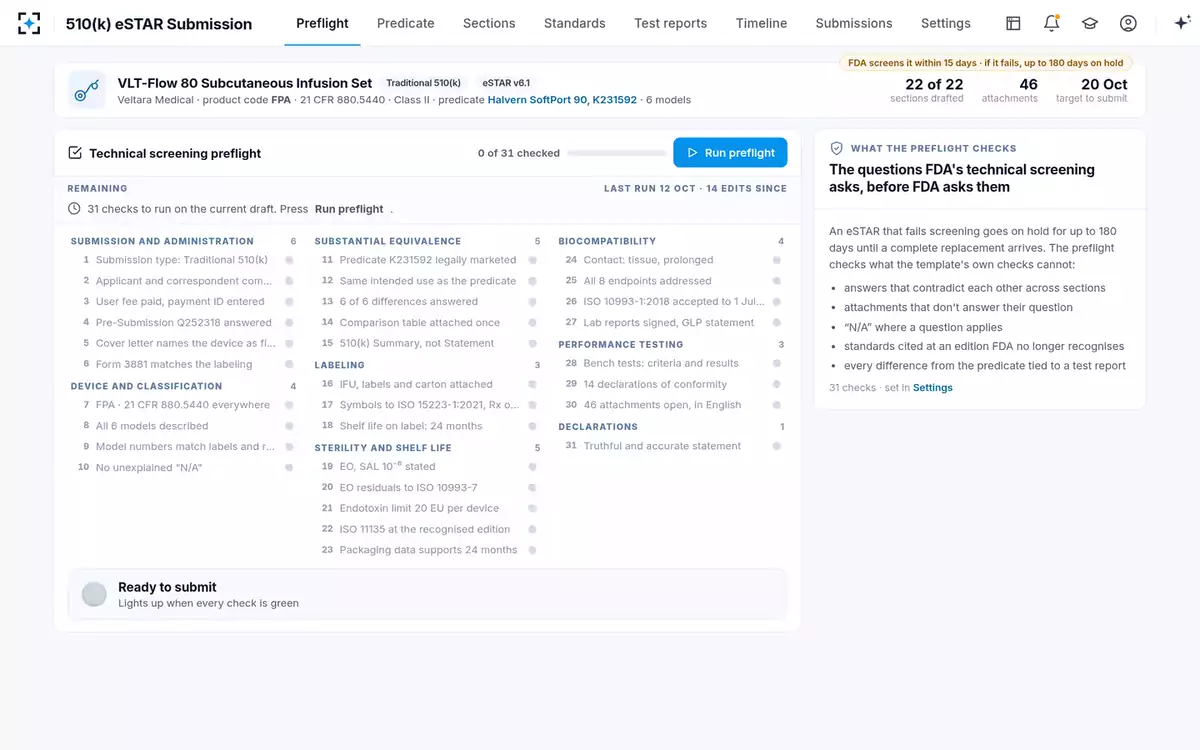
If the screen tests whether the answers describe the device and whether each applicable question has something relevant behind it, then a useful preflight tests the same two things — and the way to test the first is to pull every repeated fact out of the document and compare the copies.
That is how the solution's preflight is built. It reads the drafted sections and their attachments, cross-checks the facts that repeat across them, ties every claimed difference from the predicate to the report that answers it, and matches each cited standard against FDA's recognised editions. Each line shows what was checked, what was found and where, and a failed line carries its fix. The eight groups and the single Ready to submit light at the end are a design choice, not FDA's: the checks are modelled on the screen's two questions, and a count of checks is a product's own number.
One red line, with the evidence and the fix attached to it
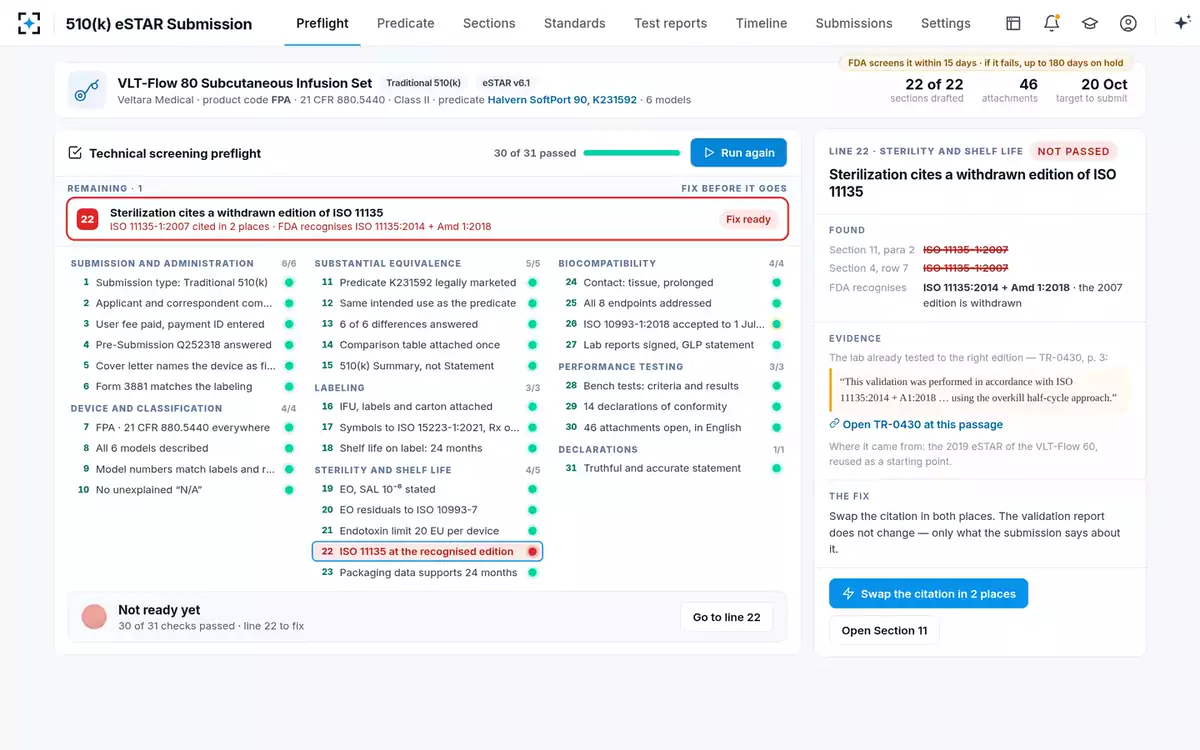
Two limits are worth stating plainly, because a preflight that oversells itself is worse than none. It cannot tell you whether your predicate is the right predicate — choosing a predicate device is a legal judgement a person makes. And it cannot tell you whether a test result is adequate: a difference from the predicate is answered by a named report with an acceptance criterion and a result, and whether that criterion was the right one is a question for the substantive review. What it can do is make sure that the submission says the same thing about your device in every place it says anything at all.
Questions people ask
What is FDA technical screening?
It is the verification FDA performs on a 510(k) eSTAR after receipt, described in FDA's eSTAR guidance as verifying that the template's responses accurately describe the device and that there is at least one relevant attachment for each applicable attachment-type question. It is preceded by a virus scan, and FDA intends to begin it only where the user fee has been paid.
How long does FDA technical screening take?
FDA anticipates it will happen within 15 days of receiving the eSTAR; the parallel De Novo guidance states the same period as 15 calendar days. It is an expectation the agency sets for itself rather than a statutory deadline, and the count does not begin while the user fee is outstanding.
Why was my 510(k) put on hold?
Because the eSTAR did not pass technical screening. FDA notifies the submitter by email and identifies the incomplete information, so the hold always comes with a list. The two things most often behind it are an answer that does not match the device — a model, a date, a method that disagrees with another section — and an applicable question with no relevant attachment filed against it.
Does a technical screening hold stop the review clock?
It means the clock never starts on that submission. FDA's rule is that for a submission which passes screening, the review clock starts on the day the submission was received, so the screening period costs a successful submitter nothing. A held submission earns no review days; the clock attaches to the complete replacement eSTAR when it arrives.
What happens after 180 days on hold?
If a replacement eSTAR has not reached FDA within 180 days of the date of the technical screening deficiency notification, FDA will consider the 510(k) withdrawn and close the submission in its system. The period runs from the notification, and it is about when the replacement is received, not when work on it begins.
Does an eSTAR still go through a Refuse to Accept review?
FDA says eSTAR submissions "are not anticipated to undergo a refuse to accept (RTA) process", on the reasoning that the portal verifies completeness automatically. That is an expectation rather than a repeal: the Refuse to Accept policy remains current guidance with its own 15-calendar-day acceptance review. Since October 1, 2023, though, every original 510(k) has to arrive as an eSTAR, so the technical screen is the one to plan for.