The FDA eSTAR template is an interactive PDF that walks a submitter through building a complete medical device submission, and since October 2023 it is how a 510(k) reaches FDA. FDA describes it as "a collection of questions, text, logic, and prompts within a template that guides a user through construction of a 'complete' 510(k) submission", structured to follow the content of the SMART review memo its own reviewers use. That last detail is the one worth holding on to: the template is shaped like the reviewer's worksheet, which means filling it in well is less a writing task than a sourcing task.
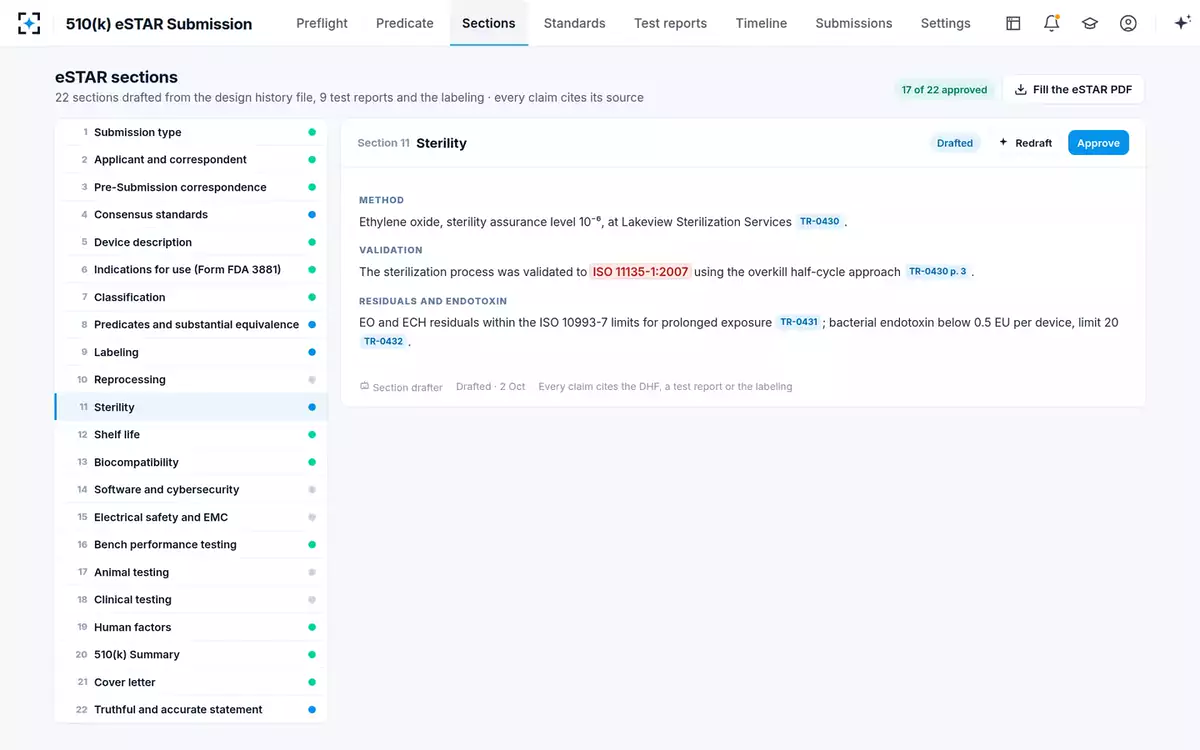
Botminds' 510(k) eSTAR Submission is built on that reading. Its agents draft each section from the design history file, the test reports and the labeling, cite the page behind every factual sentence, and never answer "N/A" without the reason. The figures below use its fictional sample submission — an infusion set from an invented company, with invented models, report numbers and K numbers — to show what that looks like in practice.
The template as an object, before you open it
22rows
in FDA’s own table of the current 510(k) eSTAR structure
21
of them content for an original submission; the twenty-second is where an Additional Information response goes
7.1
the current non-IVD and IVD eSTAR versions published on FDA’s eSTAR programme page
1statement
a person signs: that everything in the submission is truthful and accurate
What is the FDA eSTAR template?
eSTAR stands for electronic Submission Template And Resource. It is a PDF form with logic in it: answer that your device contains software and it asks for software documentation; answer that no component contacts tissue and it stops asking about biocompatibility. FDA's programme page describes it as "an interactive PDF form that guides applicants through the process of preparing a comprehensive medical device submission", and says it "complements the reviewers' internal review templates".
Two consequences follow from the logic. The first is that the template you fill in is not the template anyone else fills in: the questions you see are the ones your answers opened. The second is that a wrong answer early on does not simply sit there being wrong — it silently removes questions. FDA says so on the same page, warning that inaccurate answers to dropdown fields can cause "the eSTAR to omit subsequent questions". That is one way a submission ends up held, and it is worked through in why a complete eSTAR still fails.
Is eSTAR mandatory for a 510(k)?
Yes, with a narrow set of exemptions. FDA's guidance states that "all 510(k) submissions, including original submissions for Traditional, Special, and Abbreviated 510(k)s, and subsequent Supplements and Amendments (amendments include add-to-files and appeals), and any other subsequent submissions to an original submission unless exempted below in Section VI.A of this guidance, are required to be submitted as electronic submissions". A 510(k) that is not provided as an electronic submission will not be received unless an exemption or a waiver applies.
The exemptions are small and specific: interactive review responses, appeals and requests for supervisory review, substantive summary requests, change-in-correspondent amendments, amendments after a final decision, and withdrawal requests. Waivers are another matter — FDA says it "has not identified any particular circumstances appropriate for a waiver" and "does not intend to grant requests for waiver". Treat eSTAR as compulsory and the exemption list as a note about correspondence.
The sections, and the regulation behind each one
Almost every row of the template traces back to a line of 21 CFR 807.87, the regulation that lists what a premarket notification must contain, or to a guidance FDA names in the template itself. Reading the sections against those rules is the fastest way to work out what "enough" means in each one, because the regulation sets the floor and the guidance sets the expectation.
Every row of FDA's eSTAR structure, what it asks for, and where the answer already lives
| eSTAR section | What FDA asks for, and the rule behind it | The document in your own files that answers it |
|---|---|---|
| Submission Type | Key information for FDA’s initial processing, including content from Form FDA 3514, Section A. | The programme’s own decision on which 510(k) route it is taking — Traditional, Special or Abbreviated. |
| Cover Letter / Letters of Reference | The cover letter and any document that refers to another submission. | The regulatory correspondence file, including any letter of authorisation to a master file. |
| Applicant Information | The applicant and correspondent, as in Form FDA 3514 Sections B and C; 21 CFR 807.87(b) asks for the establishment registration number. | Registration and listing data, and the official correspondent. |
| Pre-Submission Correspondence | Prior submissions for the same device: Q-Submission, IDE, PMA, HDE, De Novo, a prior NSE or a withdrawn 510(k). | The regulatory correspondence file — which is why a programme that has not catalogued its own submission numbers starts here at a disadvantage. |
| Consensus Standards | FDA asks for "identification of voluntary consensus standard(s) used, if applicable. This includes both FDA-recognized and non-recognized consensus standards." | The methods sections of your test reports, matched against FDA’s recognised standards database for the edition. |
| Device Description | Materials, design, energy source, the principle of operation, the conditions of use, accessories, and any device-specific guidance or special controls; 21 CFR 807.87(f) and 807.92(a)(4). | The design history file: specification, drawings and released configuration list. |
| Proposed Indications for Use (Form FDA 3881) | The disease or condition the device diagnoses, treats, prevents, cures or mitigates, and the patient population — the definition FDA borrows from 21 CFR 814.20(b)(3)(i). | The approved indications statement, word for word as it reads on the labeling. |
| Classification | The classification regulation number that seems most appropriate; 21 CFR 807.87(c) asks for the device’s class and, if known, its panel. | The classification determination made at the start of the programme. |
| Predicates and Substantial Equivalence | The predicate, a comparison of predicate and subject device, and a discussion of why any differences do not affect safety and effectiveness. | The predicate’s published 510(k) Summary, your design file and the report behind each difference. |
| Design/Special Controls, Risks to Health, Mitigation Measures | Special 510(k) submissions only: the device changes, the risk analysis method and its results, and the risk control measures. | The change record and the risk file for the change, not the whole device. |
| Labeling | Proposed labeling sufficient to satisfy 21 CFR 807.87(e); for in vitro diagnostics, 21 CFR 809.10 too. | Instructions for use at its released revision, pouch and carton artwork, patient labeling. |
| Sterility, Shelf Life, Biocompatibility, Reprocessing | Validation methods and results, each against the relevant FDA guidance. | The signed validation and aging reports, with the site that performed each one. |
| Software, Cybersecurity, EMC, Performance Testing | Documentation at the level FDA’s device-specific guidances set, plus the test reports relied on for equivalence. | Verification and validation records; bench, electrical and clinical reports. |
| References | Any literature references, if applicable. | The list already assembled for the risk and biocompatibility assessments. |
| Administrative Documentation | Additional administrative forms, an executive summary (recommended), the Truthful and Accuracy Statement and a 510(k) Summary or statement. | Drafted from the approved sections, then signed by a person. |
| Amendment / Additional Information response | Responses to FDA’s Additional Information requests. | Empty on an original submission — it is the one row in FDA’s table that belongs to a later cycle. |
Two rows reward a second look. Consensus Standards asks for both recognised and non-recognised standards, so a standard FDA does not recognise is a thing to declare, not to hide. And Predicates and Substantial Equivalence asks not only for the comparison but for "a discussion why any differences between the subject and predicate do not impact safety and effectiveness" — a harder artefact than a table of specifications, taken apart in the comparison table row by row.
Which of your own documents answers each section
The useful mental model is that a 510(k) contains almost no new information. The device description is the design history file, edited for a reader who has never seen the device. The performance testing section is a set of reports that already exist, signed, in the quality system. The labeling section is the artwork at its released revision. What the submission adds is organisation, a claim of equivalence and the argument supporting it.
That reframing changes who does the work. If a section is sourcing rather than writing, the bottleneck is version control, not the writer's time: which design file revision, which report, which artwork. A programme that can say where each sentence came from assembles a submission quickly; one that cannot spends its weeks reconciling. Who owns the evidence in a 510(k) follows that question through the organisation.
Each section drafted from a named source, with its approval status
What attachments does eSTAR ask for?
Attachments are how the unstructured half of a submission arrives: the reports, drawings, labeling artwork and literature that the structured answers point at. FDA's guidance notes that submitters "can add attachments as unstructured data, including but not limited to documents, PDFs, images, and videos", and that the template "will prompt for any documents that are needed" — affirmatively indicate clinical testing, for example, and eSTAR asks for the clinical documents and any financial certifications that go with them.
The rule that matters is placement, not content. FDA's technical screen checks for at least one relevant attachment per applicable attachment-type question, so an attachment is judged against the question it sits under: a combined report filed once, against one of the three questions it answers, leaves two empty.
One piece of housekeeping is easy to miss, and FDA states it on the programme page: the Indications for Use page (Form FDA 3881), the Premarket Review Submission Cover Sheet (Form FDA 3514) and a declaration of conformity need not be attached separately, because all three are built into the template — and nor does a 510(k) Summary, if you let eSTAR create it.
The Special 510(k) sections nobody else fills
The template serves all three 510(k) routes from one file, and the differences between them are mostly a matter of which sections open and how much evidence each one carries.
Traditional, Special and Abbreviated through the same template
| 510(k) type | When it applies | What changes in the template |
|---|---|---|
| Traditional | The default. A new device, or a change to your own device that a Special cannot carry. | Every applicable section, with full test reports attached. |
| Special | A change to your own legally marketed device, where the methods used to evaluate the change are well-established and the results can be reviewed in summary or risk-analysis form. | Adds Design/Special Controls, Risks to Health and Mitigation Measures — the one part of the template nobody else fills. FDA generally reviews a Special within 30 days of receipt. |
| Abbreviated | A submission that relies on a device-specific guidance, a special controls document or a recognised consensus standard in place of some of the underlying data. | The same sections, with summary reports and declarations of conformity where the Traditional route would attach the full report. |
The Special route's attraction is its clock: "Subject to FDA's acceptance review in accordance with the guidance Refuse to Accept Policy for 510(k)s, FDA generally reviews Special 510(k) submissions within 30 days of receipt" (FDA, The Special 510(k) Program). Its risk is conversion: if FDA does not think a Special appropriate it converts the submission to a Traditional and tells you, which turns a thirty-day plan into a ninety-day one in a single email.
The test FDA applies is about method, not the size of the change: are the methods used to evaluate it well-established, and can the results be reviewed in summary or risk-analysis form? FDA's examples of well-established methods include your own methods and acceptance criteria from the previously cleared 510(k), methods in a recognised consensus standard or an FDA guidance, qualified medical device development tools, and widely accepted published methods.
What is a Truthful and Accuracy Statement?
It is the one sentence in a 510(k) that a person signs in their own name, and it is required by regulation. 21 CFR 807.87 lists among the contents of a premarket notification "(l) A statement that the submitter believes, to the best of his or her knowledge, that all data and information submitted in the premarket notification are truthful and accurate and that no material fact has been omitted" (21 CFR 807.87). In the template it sits in Administrative Documentation.
Administrative Documentation — Inclusion of additional administrative forms applicable to the submission, including but not limited to a general summary of submission/executive summary (recommended), a Truthful and Accuracy Statement, and a 510(k) Summary or statement.
FDA, eSTAR guidance for 510(k) submissions, Table 1
That statement is what makes the sourcing discipline matter. Everything else in the file is a claim about a device; this is a claim about the file. Its signer asserts that nothing material was left out — hard to assert about a document assembled by six people from three systems, unless each sentence can be traced to where it came from. In the solution a named person signs it and no agent can; the drafting agents cite a source for every factual sentence so that the signature means something.
The 510(k) Summary, and the statement you may file instead
21 CFR 807.87(h) requires either a 510(k) summary under 21 CFR 807.92 or a 510(k) statement under 21 CFR 807.93. They are not two formats of the same thing; they are two different offers to the public.
A 510(k) Summary is a public document, published by FDA with the clearance, and 807.92 prescribes both its contents and its physical shape: it "should be in a separate section of the submission, beginning on a new page and ending on a page not shared with any other section of the premarket notification submission, and should be clearly identified as a '510(k) summary'" (21 CFR 807.92). Among its required contents is the comparison: where technological characteristics are the same as the predicate's, a summary of them in comparison; where they differ, a summary of how they compare.
A 510(k) statement is the alternative, and it is a promise rather than a document. Under 807.93 the certifier states that they "will make available all information included in this premarket notification on safety and effectiveness within 30 days of request by any person" if the device is found substantially equivalent, with patient identifiers and trade secrets excluded (21 CFR 807.93). It must be signed, on its own page, and clearly identified.
The choice is a choice about the public. A published Summary is the document the next manufacturer reads when it chooses your device as its predicate; a statement means answering each written request with a duplicate of the submission, trade secrets and patient identifiers removed, within 30 days.
The facts that appear in more than one section
Because the template follows the reviewer's worksheet rather than your document set, the same fact is requested by several different questions, each in its own voice. That is not redundancy from FDA's side — each question has a reviewer behind it — but on the submitter's side it is five opportunities to type a number differently.
Five facts to settle once, before anybody opens the template
- The model list, agreed and frozen
Decide which models this submission covers and write the list once. Every section that names a model uses it verbatim — description, indications, labeling, testing, Summary.
- The product code and classification regulation
Settle these before drafting: they determine which guidances apply, which panel reviews the file, and whether your predicate is in the right place at all.
- The indications for use, word for word
Agree the exact sentence that will appear on Form FDA 3881 and reuse it unchanged. An indications statement that is paraphrased anywhere has become two statements.
- The shelf life you can actually support
Take the claim from the aging report, not from the predicate or the marketing plan, and then put that number on the label, in the shelf-life section and in the Summary.
- The edition of every standard you cite
Fix the edition against the report that used it and against FDA’s recognised list, and write it the same way everywhere, amendments included.
The standards line is the one that goes stale without anybody touching the submission, because FDA recognises editions and withdraws them on its own schedule. Checking standards against the edition FDA recognises works through transitions, partial recognition and what a withdrawn edition does to a citation.
Where to download it, and what the status message means
The templates live on FDA's eSTAR programme page, which publishes the current versions — at the time of writing, version 7.1 of both the non-IVD and the IVD eSTAR, plus the separate PreSTAR for Q-Submissions, IDEs and 513(g) requests. FDA's instruction is to download and save the file rather than click through to it, because, in the page's words, "eSTAR cannot be opened in a web browser, due to the dynamic PDF nature of the file".
The status message at the top of the PDF is the template's report on itself. FDA's footnote in the guidance explains that after a submitter "completes all necessary sections in their eSTAR file correctly, the status message at the top of the PDF will indicate 'eSTAR Complete' to represent a complete submission", and the programme page adds the enforcement: a submission sent while the message still reads incomplete will not be accepted by the CDRH Portal.
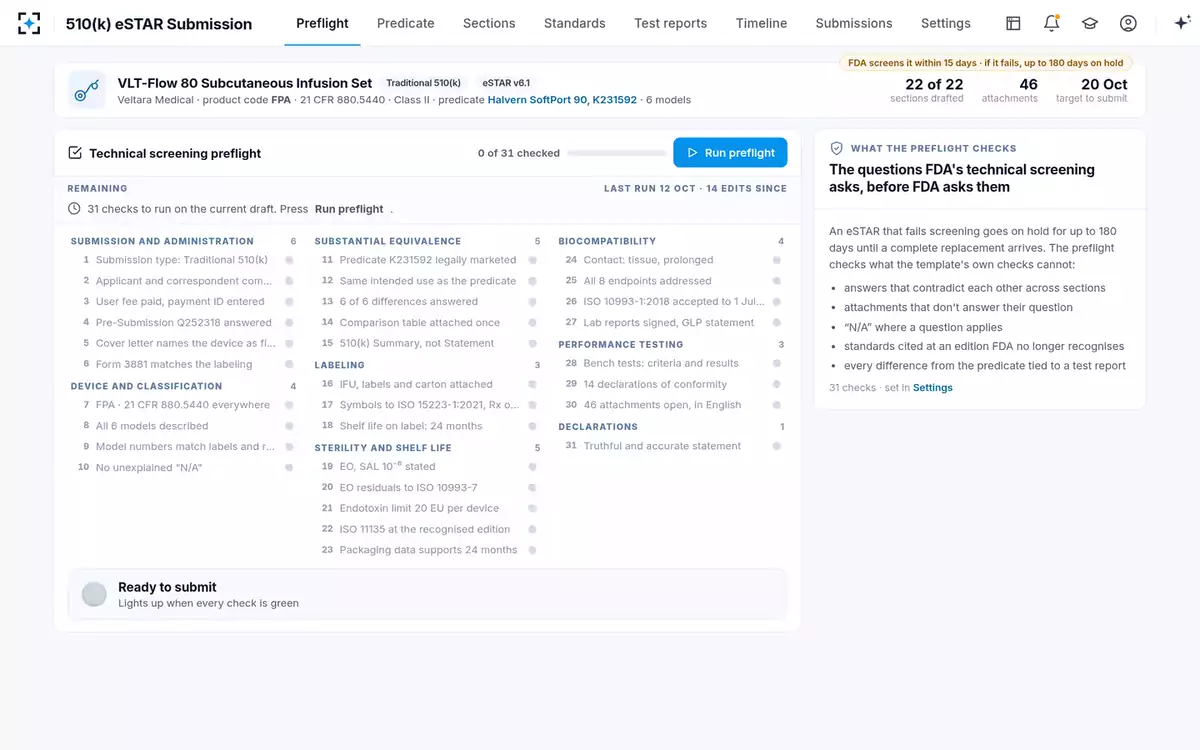
What the message cannot tell you is whether the answers are right. It reports coverage, not correctness, and the gap between the two is where the technical screen operates.
A preflight that reads the sections rather than the boxes
If you are starting a submission rather than auditing one, how to prepare a 510(k), starting from one you cleared takes the same material in programme order, from the predicate decision to the day the file goes.
Questions people ask
Where do you download the FDA eSTAR template?
From FDA's eSTAR programme page, which lists the current non-IVD and IVD templates — version 7.1 at the time of writing — alongside the PreSTAR used for Q-Submissions, IDEs and 513(g) requests. FDA tells users to download and save the file, because eSTAR cannot be opened in a web browser.
What sections are in the 510(k) eSTAR?
FDA's own table of the template's structure has twenty-two rows, twenty-one of them content for an original submission; the last is where a response to an Additional Information request goes. How many a given submitter sees is a different number, because the logic opens and closes questions according to the answers given.
Is eSTAR mandatory for a 510(k)?
Yes. FDA requires all 510(k) submissions, including Traditional, Special and Abbreviated originals and their supplements and amendments, to be submitted electronically unless a listed exemption applies, and says it does not intend to grant waivers. The exemptions cover correspondence such as interactive review responses, appeals, add-to-files and withdrawal requests.
Can you use eSTAR for a Special 510(k)?
Yes — the same template serves all three routes, and a Special opens one part nobody else fills: Design/Special Controls, Risks to Health, and Mitigation Measures. FDA generally reviews a Special within 30 days of receipt, and converts a submission it does not consider appropriate for the Special route into a Traditional, notifying the submitter.
Do you need a 510(k) Summary in eSTAR?
You need either a 510(k) Summary under 21 CFR 807.92 or a 510(k) statement under 21 CFR 807.93. The Summary is published by FDA with the clearance and must begin on a new page, end on a page it shares with nothing else and be clearly identified. The statement is a signed promise to supply the safety and effectiveness information in the submission within 30 days of any person's request.
What goes in the eSTAR Device Description section?
FDA asks for the technological characteristics — materials, design, energy source and other features — the principle of operation, the proposed conditions of use, whether the device is marketed with accessories, its listing number, and any device-specific guidance or special controls that apply. Nearly all of it is already written in the design history file.