How long does a 510(k) take? FDA's review goal is a decision within 90 FDA days, and its shared goal for the whole elapsed time was 124 days for the fiscal year 2024 cohort and 112 days for fiscal 2025. Neither is the number a launch plan needs. FDA days count only the days your file is under review at the agency; the last cohorts for which FDA has published a measured elapsed figure ran from 123 days to 147. And none of those numbers covers the weeks before you file, which on a Traditional 510(k) can be the longest stretch of the calendar. Botminds' 510(k) eSTAR Submission works on that part: it drafts the eSTAR's sections from the design history file, the test reports and the labeling, ties every difference from the predicate to the report that answers it, and runs a technical screening preflight before the file goes.
The split matters because the two clocks behave differently. One is FDA's: published, audited and largely outside your control. The other is yours, measured by nobody, and it is the one a team can actually change.
The worked figures below come from a fictional sample submission inside the solution — Veltara Medical's VLT-Flow 80 infusion set, target submission 20 Oct — and are labelled as sample data or as our estimate where they are. Every published figure is FDA's or the Government Accountability Office's, linked where it appears.
The three numbers FDA publishes about a 510(k)'s length
60days
calendar days to a substantive interaction, the MDUFA V goal for 95% of 510(k)s
90FDA days
to a decision, the MDUFA V goal for 95% of 510(k)s — FDA days, not calendar days
124days
total time to decision, the shared goal for the FY 2024 cohort; 112 days for FY 2025
147days
the measured total time to decision for the FY 2022 cohort, against a 108-day goal
How long does a 510(k) take?
Answer the question in two parts, because FDA does. For review time, the Medical Device User Fee Amendments goals for 510(k) premarket notifications are a substantive interaction within 60 calendar days for 95% of submissions, and a decision within 90 FDA days for 95%. For elapsed time, FDA publishes a separate shared outcome goal on total time to decision: 128 days for the fiscal 2023 cohort, 124 for fiscal 2024 and 112 for fiscal 2025, with 112 days falling to 108 in fiscal 2026 and 2027 where a performance improvement adjustment applies.
The two sets of numbers are not alternatives and they do not add. A 510(k) that takes 90 FDA days has not taken 90 calendar days unless the file never left FDA, and FDA's own elapsed goal of 124 days for the same cohort is the acknowledgement that files usually do leave. Adding ninety and sixty to get a hundred and fifty is an easy mistake in a submission plan; the sum means nothing, which is why FDA reports the elapsed number as a measure of its own.
Two clocks over one submission: whose days are whose
FDA's clock — FDA days, the published review goal
- At FDA, first cycle · 38%
- Not counted: with you · 40%
- At FDA, second cycle · 22%
The calendar — total time to decision, the shared goal
- At FDA, first cycle · 38%
- Answering the request · 40%
- At FDA, second cycle · 22%
What are FDA days?
FDA days are a defined term, and the definition is the whole argument of this page. FDA's performance report sets it out plainly.
FDA days are the calendar days in which a submission is considered to be under review at the Agency for submissions that have been accepted (510(k) or De Novo classification request), filed (PMA), or submitted (CLIA Waiver by Application). FDA days begin on FDA's date of receipt of the submission or of the amendment to the submission that enables the submission to be accepted (510(k) or De Novo classification request) or filed (PMA).
FDA, Performance Report to Congress for the Medical Device User Fee Amendments, FY 2024
Read the second sentence twice. The clock begins on receipt of the submission — or on receipt of the amendment that makes it acceptable. A file that arrives incomplete starts its clock when the thing that fixed it arrives, and every day in between belongs to the applicant and appears in no performance figure.
The Government Accountability Office said the same in plainer words when it examined the gap in 2012: "This time to final decision includes the days FDA spends reviewing a submission as well as the days FDA spends waiting for a device sponsor to submit additional information in response to a request by the agency. FDA review time excludes this waiting time, and FDA review time alone is used to determine whether the agency met its performance goals" (GAO-12-418). A review-time goal can be met in full while the average decision takes more than five months, and in the years GAO studied that is exactly what happened.
When does the 510(k) review clock start?
For an eSTAR, the clock starts on the day FDA received the submission, provided it passes technical screening. FDA's electronic submission guidance is explicit: "The technical screening review time does not impact the review clock for files that pass the technical screening. For a submission that passes technical screening, the review clock starts on the day the submission was received by FDA" (FDA, Electronic Submission Template for Medical Device 510(k) Submissions). Screening itself is therefore free — if you pass it.
If you do not, the days stop being free. A file held at screening is not under review, so it accrues no FDA days, and the replacement eSTAR is the amendment that starts the clock. Everything between notification and replacement is elapsed time nobody counts for FDA and everybody counts against your launch date. Why a complete eSTAR still fails technical screening follows that path in detail.
One step comes earlier still. FDA's own workload tables count only submissions "that have passed applicable, preliminary administrative requirements (e.g., eCopy, User Fee)" (FY 2024 performance report, Table 6). An unpaid fee is not a review problem; it is a submission that has not begun.
One Traditional 510(k) with one question, drawn in calendar days
- First cycle at FDA60
- Second cycle at FDA30
- First cycle at FDA60
- Your days: reading, testing, drafting the response60
- Second cycle at FDA30
The shared goal: total time to decision
Total time to decision is the only published figure that measures what a launch plan measures, and FDA is careful to say whose number it is: "Shared outcome goals represent a commitment by both FDA and applicants; these goals are reported as the average total time to decision (TTD) within a closed cohort and are based on the methodology prescribed in the MDUFA V commitment letter" (FY 2024 performance report).
Three words in that sentence do real work. Shared means your response days are inside the number, so an applicant who takes eight weeks to answer a question has moved a goal FDA reports to Congress. Average means a slow submission is absorbed by fast ones, and yours is not promised anything. Closed cohort means the figure for a fiscal year cannot be computed until the last submission received that year has a decision, which is why FDA's report shows the fiscal 2024 and 2023 goals with performance still pending.
Why is my 510(k) taking longer than 90 days?
Almost always because the submission went round twice. FDA's goal is a substantive interaction within 60 calendar days, and that interaction is frequently a request for additional information rather than a decision — the normal case, not the exception, as what a 510(k) actually costs works out from FDA's own counts. The request stops the review clock and starts yours.
The regulation's own deadline for your half is short. Under 21 CFR 807.87, "if the additional information is not submitted within 30 days following the date of the request, the Commissioner will consider the premarket notification to be withdrawn" (21 CFR 807.87). In practice FDA allows longer: its review clock guidance says the agency's current policy is to allow a submitter 180 calendar days to respond, and that it considers the 510(k) withdrawn if a complete response to every deficiency has not arrived by then (FDA, Effect on FDA Review Clock and Goals). Whichever window you are working to, every day of it lands in total time to decision and none of it lands in FDA days. That asymmetry is why a team can be told its submission is on track and watch the launch slip anyway.
There is a second, quieter reason: the question you answer in cycle two is usually a question you could have answered in cycle one. An unexplained omission, a shelf-life claim with no report behind it, a standard cited at an edition FDA has withdrawn — each is a fact about your own file, knowable before it went.
What the published history shows about elapsed time
The trend is published and it is not flattering. GAO found that "from FY 2005 through FY 2010, the average time to final decision for 510(k)s increased 61 percent, from 100 days to 161 days" (GAO-12-418) — while FDA met its review-time goals every year of that period. The measure that was watched improved; the measure that mattered to a launch almost doubled.
Under MDUFA IV the elapsed figure had a goal of its own, and FDA's report shows what each closed cohort did against it.
510(k) total time to decision: goal and measured performance, MDUFA IV cohorts
| Cohort | Shared outcome goal | Measured performance | Outcome |
|---|---|---|---|
| FY 2018 | 124 days | 123 days | Met |
| FY 2019 | 120 days | 128 days | Missed |
| FY 2020 | 116 days | 139 days | Missed |
| FY 2021 | 112 days | 141 days | Missed |
| FY 2022 | 108 days | 147 days | Missed |
The arithmetic in that caption is the useful part. Between the fiscal 2018 and fiscal 2022 cohorts the goal fell from 124 days to 108 and the measured average rose from 123 to 147. FDA's MDUFA V goals continue the descent — 128, then 124, then 112 — and nobody should read them as forecasts of what their own submission will do. They are the commitment both sides signed up to, and the half you control is the half that has been moving.
Traditional, Abbreviated, Special: three different clocks
FDA's published review goals are set by submission type, and all 510(k) premarket notifications share one: a decision within 90 FDA days. What differs between the three 510(k) programs is what FDA intends to do inside that envelope and what it will accept into each one. Under the Special 510(k) program FDA intends to review a submission within 30 days, and the program is reserved for changes a submitter can fully evaluate with its own methods — FDA's guidance rules out, among other cases, a change whose evaluation involves more than three scientific disciplines (FDA, The Special 510(k) Program).
The clock on a Special also tells you what a wrong choice costs. "If the 510(k) submission was accepted for a substantive review and later converted to a Traditional 510(k), the review clock continues into FDA's 90-day statutory deadline under section 510(n)(1) of the FD&C Act and remains subject to MDUFA performance goals for 510(k) submissions," the same guidance says. A conversion does not restart anything; the thirty-day expectation simply disappears and you are in the ninety-day file you were trying to avoid.
Three 510(k) programs against one 90-FDA-day decision goal
What FDA expects of the review: The full substantive review: a substantive interaction goal of 60 calendar days and a decision goal of 90 FDA days, for 95% of submissions.
What it asks of your file before it goes: Every applicable section answered with the evidence behind it. This is the file the eSTAR template is built around.
What FDA expects of the review: The same MDUFA goals. The reliance is on recognised consensus standards, special controls or guidance rather than on summarising each report in full.
What it asks of your file before it goes: Declarations of conformity at the editions FDA recognises today — the cheapest way to lose the saving is to cite a withdrawn one.
What FDA expects of the review: FDA intends to review within 30 days. If the submission is converted to a Traditional 510(k), the clock continues into the 90-day statutory deadline.
What it asks of your file before it goes: A change to your own cleared device that you can evaluate with your own methods, inside the program’s limits — including no more than three scientific disciplines.
Which program fits is a judgement about the device and the change, not about the calendar, and it is made before anything is drafted. The earlier decision — which cleared device you are claiming equivalence to at all — is worked through in how to choose a predicate device.
The weeks before the submission, which no goal measures
No FDA goal, and no GAO figure, covers the time between a design freeze and a submission going out of the door. That silence is not an accident: the agency measures its own performance, and the preparation is yours. It is also, on most programmes, the largest single block of calendar in the whole exercise, and the only block a team can change without anybody's permission.
In the fictional sample submission inside the solution the drafting work is estimated at about ten weeks by hand for a Traditional 510(k), against a design target of three with the agents doing the assembly and cross-checking. Both figures are ours — the ten weeks an estimate of the manual work, the three weeks a design target — and neither is a measured result or an average of anybody's results.
Where the working days go before a 510(k) eSTAR is ready
The weeks you own, on one screen: what is drafted, what is checked and what is left
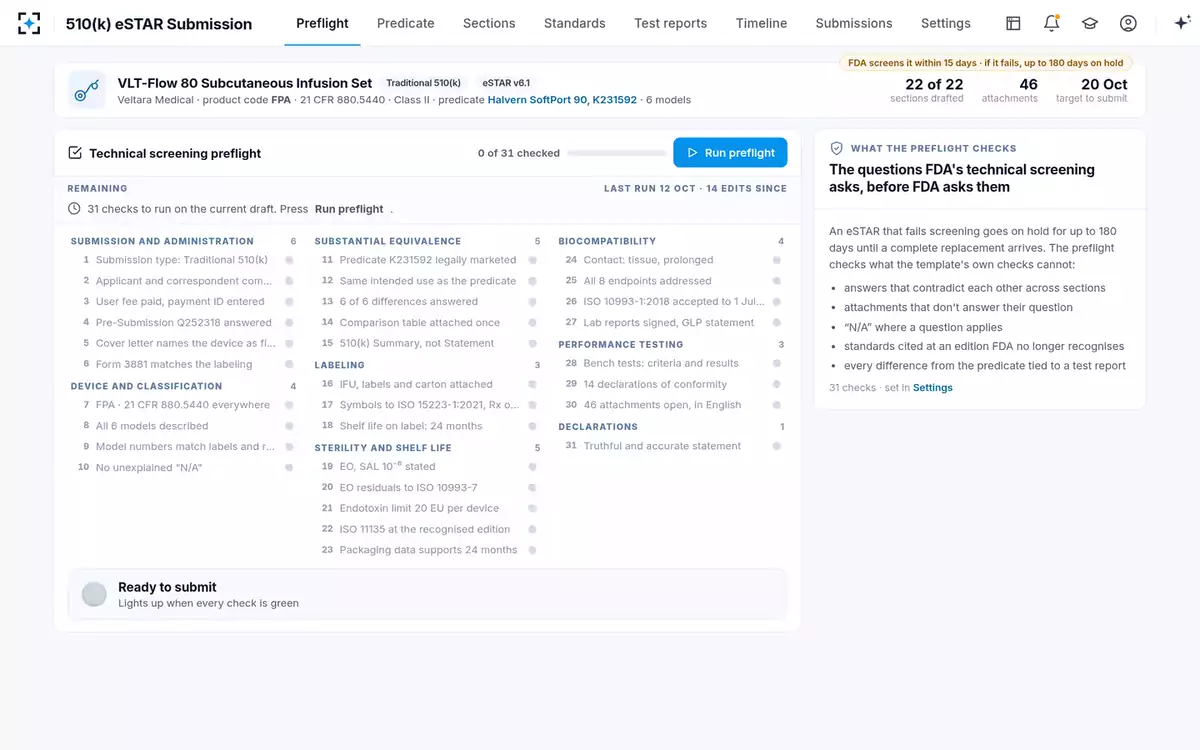
Where the preparation time actually goes, and which part moves
Three of those five activities are reading work: carrying the same model number, shelf life and standard edition across sections written at different times, and then reading the whole file again to find the places where two answers disagree. That is where the solution's design target does its work — drafting from twenty days to six, the predicate comparison from eight to two, standards checking from five to one, and the second read from ten days to one.
The fifth activity barely moves, and should not. Approvals, the cover letter and the 510(k) Summary fall from seven days to five, because a named person still has to approve each section, a lab lead still co-approves the test sections, and a person still signs the statement that everything in the submission is truthful and accurate. The sample submission's own trail shows it: five sections sent for approval, approved and signed on 13 Oct, and a person submitting through the CDRH Portal.
The five preparation activities, and how much of each is reading rather than deciding
| Activity | What the days are spent on | Estimated days, by hand | Design target |
|---|---|---|---|
| Drafting the sections | Finding the answer in the design file, a test report or the labeling, and writing it with its citation | 20 | 6 |
| The predicate comparison | Laying the device beside its predicate row by row and finding the report that answers each difference | 8 | 2 |
| Standards and declarations | Checking every citation against the edition FDA recognises today, and the transition dates ahead | 5 | 1 |
| The second read | Looking for the same fact stated two ways in two sections, and attachments that miss their question | 10 | 1 |
| Approval and signature | A named approver per section, a co-approver on the test sections, one person signing and one submitting | 7 | 5 |
The submission timeline in 510(k) eSTAR Submission, from design freeze to FDA's decision goal
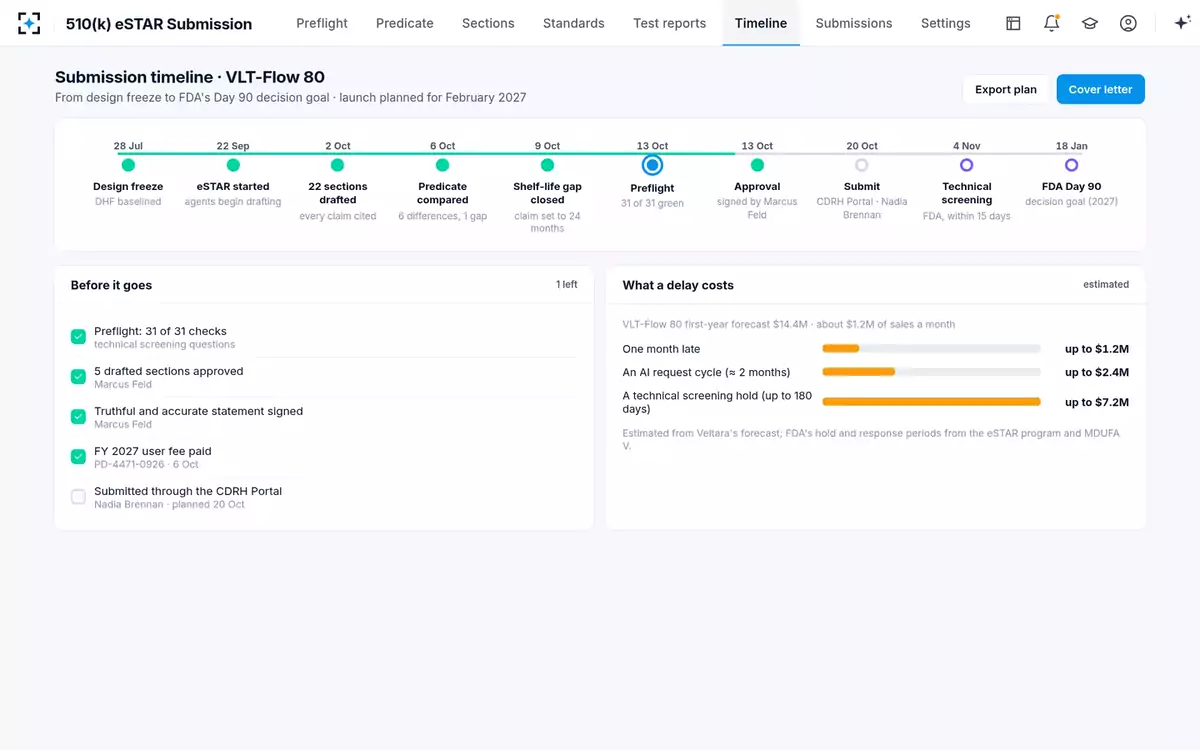
Reading the track from left to right is the honest version of the question this page opens with. The right half is FDA's and is already as short as the agency's goals allow. The left half is yours, is longer than the right on most programmes, and is the only half a decision this quarter can change.
To see the preflight, the predicate comparison and the submission timeline on one of your own devices, start from 510(k) eSTAR Submission.
Questions people ask
What is the FDA 510(k) review time?
FDA's review-time goal for 510(k) premarket notifications under MDUFA V is a decision within 90 FDA days for 95% of submissions, with a substantive interaction within 60 calendar days for 95%. Those are goals for FDA's own days, not a promise about your calendar, and FDA reports elapsed time separately as total time to decision.
Does the 510(k) clock stop while you answer FDA's questions?
FDA's review clock does; the calendar does not. FDA days count only the days a submission is under review at the agency, so the weeks you spend answering an additional information request are excluded from the review-time goal. They are included in total time to decision, the shared goal FDA reports for both sides.
What is total time to decision for a 510(k)?
It is the average elapsed time from receipt to decision within a closed fiscal year cohort, reported as a goal shared between FDA and applicants. The goal was 128 days for the fiscal 2023 cohort, 124 for fiscal 2024 and 112 for fiscal 2025. The last MDUFA IV cohorts measured between 123 and 147 days against tighter goals each year.
How long does a Special 510(k) take?
FDA intends to review a Special 510(k) within 30 days, and the program is limited to changes a submitter can evaluate with its own methods — not, for instance, a change whose evaluation spans more than three scientific disciplines. If FDA converts an accepted Special to a Traditional 510(k), the review clock continues into the 90-day statutory deadline rather than starting again.
Does technical screening add to the review clock?
Not if the file passes. FDA's electronic submission guidance says the technical screening review time does not affect the review clock for files that pass, and that the clock starts on the day FDA received the submission. A file that fails is a different matter: it accrues no FDA days while it is held, and the clock starts from the replacement.
What happens if you miss the deadline to answer a request for additional information?
21 CFR 807.87 says that if the additional information is not submitted within 30 days following the date of the request, the Commissioner will consider the premarket notification withdrawn. FDA's review clock guidance relaxes that in practice: its current policy allows 180 calendar days from the request, after which a 510(k) without a complete response is considered withdrawn. A withdrawn notification means starting again with a new submission, which is a very expensive way to lose a launch date.