AI for 510(k) submissions, and for device regulatory affairs generally, is usually sold as speed and bought as risk, and the first question in the room is whether it is allowed at all. It is: no FDA regulation forbids preparing a 510(k) with software, and the agency's draft framework for artificial intelligence that supports regulatory decision-making expressly excludes the drafting of one from its scope — a framework that is in any case a draft, and written for drugs and biological products rather than devices. The real limits are older and harder than any AI policy: a named person signs a statement that everything in the submission is truthful and accurate, electronic records carry controls that cannot be quietly rewritten, and every claim has to name the evidence behind it. Botminds' 510(k) eSTAR Submission is built to those three, and this page is about where the line falls rather than what a demonstration can show.
Buy against the line, not the demonstration. Any tool can draft a plausible device description; the question is what the tool is structurally incapable of doing, who is named when it is wrong, and whether its checking can be measured on a submission whose answer you already know.
The sample figures below come from a fictional submission inside the solution and are labelled as such. Nothing here should be read as FDA clearing, endorsing or approving any product for preparing regulatory submissions.
One submission, by what the agents did and did not do
31checks
proposed and run on the sample submission, each with the evidence behind it
0signatures
by an agent — the truthful and accurate statement is a person’s
0submissions
sent by an agent — a named person submits through FDA’s portal
1approver
named for every section, with a co-approver on the test sections
Does FDA allow AI to prepare a regulatory submission?
Nothing in FDA's regulations addresses how a submission is written. 21 CFR part 807 says what a premarket notification must contain and who must attest to it; it is silent on the tools used to produce it. The practical answer is therefore yes — and the interesting part is that FDA's own AI framework says so by omission, in a sentence drawing its own boundary.
The draft's scope paragraph sets aside two uses: AI models in drug discovery, and AI used for operational efficiencies that do not affect patient safety, drug quality or the reliability of nonclinical or clinical study results. Its examples of such efficiencies are internal workflows, resource allocation and — in its own words — "drafting/writing a regulatory submission" (FDA, Considerations for the Use of Artificial Intelligence To Support Regulatory Decision-Making for Drug and Biological Products, draft guidance, January 2025).
Read it carefully, because it is easy to over-claim in both directions. FDA is not blessing the practice; it is saying the practice is outside what this document is about. And the document is a draft guidance for drug and biological products, so a device team quoting it to an auditor is quoting something that does not govern them. What it does establish is that the agency, writing specifically about AI and regulatory submissions, treated the drafting of one as an operational matter rather than a regulatory one.
What does FDA's AI guidance actually cover?
It covers AI whose output is evidence: models used to produce or support information a sponsor submits about safety, effectiveness or quality. For that case the guidance proposes a risk-based framework, and its central idea is worth borrowing even where the guidance does not apply.
The draft treats model risk as the product of two factors: model influence, meaning how much the evidence from the AI model contributes compared with the other evidence on the question, and decision consequence, meaning how significant an adverse outcome would be if a decision on that question were wrong (FDA draft guidance, January 2025). Two questions, in plain words: how much does the machine's output decide, and how bad is it if the output is wrong.
The model-risk question applied to four jobs in a 510(k)
| What the software does | How much its output decides | How bad if it is wrong | What holds the risk down |
|---|---|---|---|
| Drafts a section from documents you supply | Low: every factual sentence cites a document a person owns | Visible — the citation points at the page, so a wrong sentence is checkable in seconds | A citation on every factual sentence, and a named approver per section |
| Builds the comparison with the predicate | Medium: it decides which rows exist and which differences get a report | A weak comparison invites a question on the first cycle | A person chooses the predicate; each difference must name a report or stay open |
| Matches cited standards to FDA’s recognised editions | Medium: it proposes the citation that goes in the file | A withdrawn edition is a visible defect in the submission | It changes only the citation, never what the laboratory tested to, and a person applies the change |
| Checks the file against itself before it goes | Low on its own: it proposes findings, it does not change the file | A missed defect leaves the file where it was; a false finding costs a few minutes | No check passes without its evidence; the measure is what it catches on a file you already know |
The statement a person signs, and why it settles the argument
Every argument about AI in a submission ends at the same place, and it is in the regulation that governs devices rather than in any AI policy.
A statement that the submitter believes, to the best of his or her knowledge, that all data and information submitted in the premarket notification are truthful and accurate and that no material fact has been omitted.
21 CFR 807.87(l)
"To the best of his or her knowledge" is a person's knowledge. A submission is not a document a company produces and a company signs; it is a document a named individual attests to on their own understanding of it. Part 807 makes no exception to that requirement, and it is the reason the structural question about a tool is not "how good is the draft" but "can a person who signs still know what they are signing".
Which makes citation the feature that matters most. A sentence whose source opens at the page it came from can be checked by the person who owns that document in seconds. A fluent paragraph with no source behind it transfers the whole burden of verification to the signatory, and that is the version of this technology that should not be bought.
Who is responsible for an AI-drafted submission?
The submitter, exactly as before. There is no provision in part 807 that distributes responsibility to a supplier, and the statement the submission carries is the submitter's. It is worth being blunt about where that lands when something is wrong: FDA's guidance on consensus standards notes that "intentionally or unintentionally falsifying a DOC to obtain device clearance or approval is a prohibited act under section 301(q)(2) of the FD&C Act" (FDA, Appropriate Use of Voluntary Consensus Standards in Premarket Submissions). Unintentionally is the word to notice. A declaration of conformity that is wrong because nobody checked the edition is still a false declaration.
That is a reason to use checking software and no reason at all to trust it. The defence against an unintentional falsehood is evidence attached to each claim and a person who reviewed it — not a report saying that a tool passed the file.
Where Part 11 applies, and where it does not
21 CFR part 11 attaches to records, not to tools. Its scope section says the part "applies to records in electronic form that are created, modified, maintained, archived, retrieved, or transmitted, under any records requirements set forth in agency regulations", and also "to electronic records submitted to the agency under requirements of the Federal Food, Drug, and Cosmetic Act and the Public Health Service Act, even if such records are not specifically identified in agency regulations" (21 CFR 11.1).
So a scratch draft on somebody's laptop is not a part 11 record. The moment the output becomes part of what is submitted, or part of a quality record a regulation requires you to keep, part 11 is in play — and two of its controls bear directly on how a tool should behave. The first is validation: 11.10(a) asks for systems to be validated for accuracy, reliability and consistent intended performance, and for the ability to tell an invalid or altered record apart (21 CFR 11.10(a)). The second is the audit trail: 11.10(e) asks for secure, computer-generated, time-stamped trails that independently log when operators create, modify or delete electronic records, and adds that record changes "shall not obscure previously recorded information."
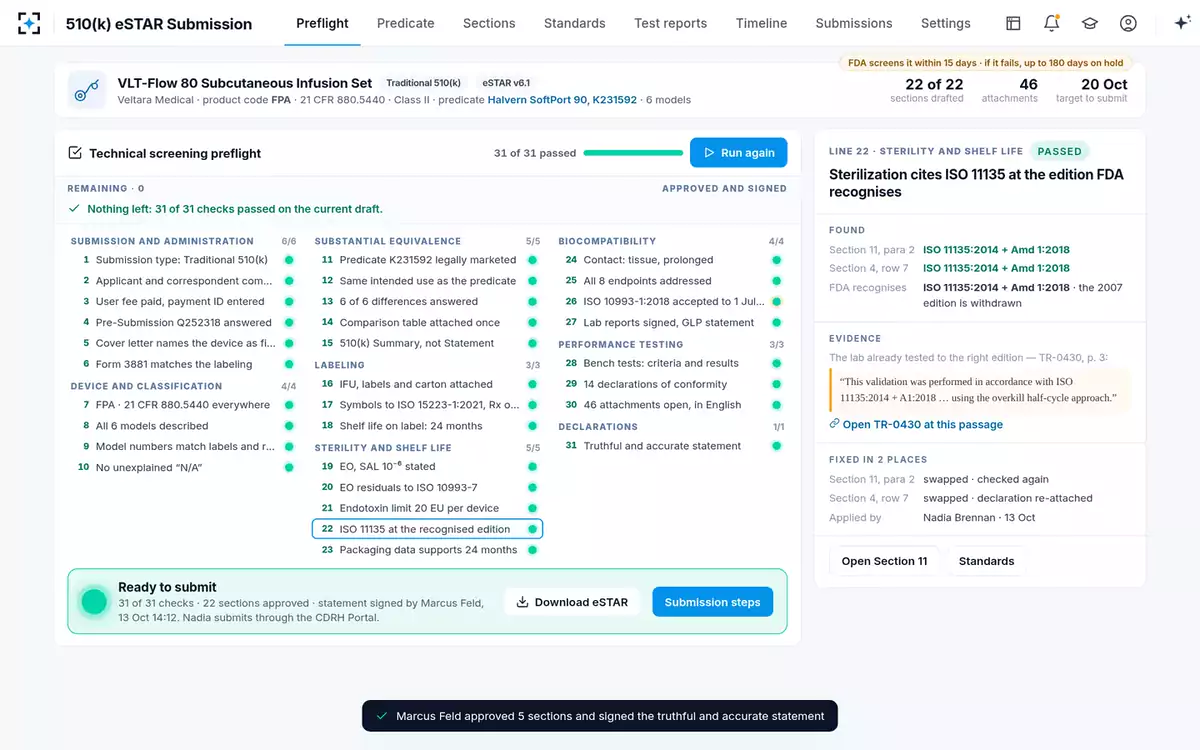
"Shall not obscure previously recorded information" is the sentence to put in an evaluation. A tool that rewrites a section in place, with no trace of what it said before and who changed it, has made a part 11 problem out of a convenience feature. In the sample submission every draft, edit, check, fix and approval carries a who, a what and a when — "applied by the regulatory specialist, 13 Oct", "signed by the regulatory affairs director, 13 Oct 14:12" — and the earlier version is still there.
Can AI choose a predicate device?
It should not, and the reason is legal rather than technical. Choosing a predicate is the first move in an argument about intended use, and FDA's substantial equivalence guidance says where that determination comes from: "FDA's determination of intended use of a device 'shall be based upon the proposed labeling' submitted in a 510(k)" (FDA, The 510(k) Program: Evaluating Substantial Equivalence). The labeling is a document a person writes and the company stands behind. A predicate chosen by matching product codes and specification tables is a search result; a predicate chosen on intended use is a position the submitter will have to defend.
Software is genuinely useful either side of that decision — assembling candidates, and then building the comparison once a person has chosen. In the solution the predicate comparer never chooses; it reads the predicate's public summary and the design records, lays out the rows and ties each difference to the report that answers it or leaves it open. How to choose a predicate device, and what rules it out works through the judgement itself.
The four jobs worth giving an agent, and the three to withhold
The line: four jobs to give, three to keep
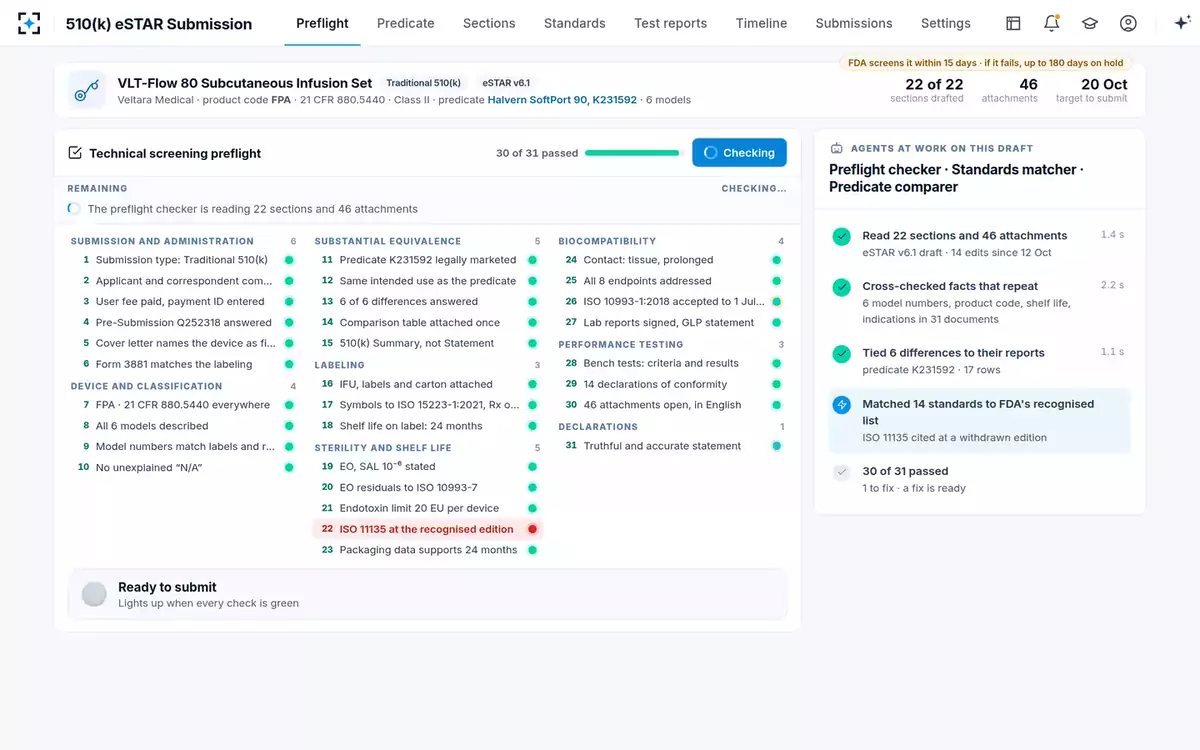
An agent may
- Draft a section from documents you supply
- Lay the device beside its predicate, row by row
- Match a cited standard to the edition FDA recognises today
- Check the file against itself for facts that disagree
An agent may not
- Sign the statement that the submission is truthful and accurate
- Send anything to FDA
- Change what a signed test report says
The three withheld jobs are not a policy anyone writes into a settings screen; they are the shape of the product. Signing is a person's act under 807.87(l). Submitting is a person's act because the portal account belongs to a person. And a test report is evidence as the laboratory signed it — when a claim and a report disagree, the claim changes or new testing happens, and the report does not move. Who owns what in a 510(k) maps the rest of those desks.
The agents at work, each step timed and bounded
What should you ask a vendor about AI in regulatory affairs?
Twelve questions, each with the answer that should satisfy you. They are ordered so that a demonstration cannot answer the first four.
Twelve questions to ask, and what a good answer sounds like
- Can the software sign the truthful and accurate statement?
The only acceptable answer is no, with an explanation of how a person’s signature is captured instead.
- Can it submit to FDA?
No. Submission is an act by a named person with a portal account.
- Can it change a test report?
No. It may describe, quote and cite a report; altering one is not a feature with a safe version.
- Does every factual sentence carry a citation that opens at the page?
Yes, and you should be able to click one in the demonstration and land on the passage.
- What happens when a claim has no evidence behind it?
It is held, flagged and shown as a gap, rather than drafted with a plausible number.
- Who chooses the predicate device?
A person. The software may assemble candidates and build the comparison afterwards.
- Is there an audit trail that cannot be overwritten?
Yes, with who, what and when on every draft, edit, check, fix and approval, and earlier versions still readable.
- How is approval captured?
By name, time and meaning, per section, with a second approver available on test sections.
- Where do the recognised standards come from, and how often?
From FDA’s own recognised list, on a refresh you set, with the date of the last refresh visible.
- Can we add our own checks, and switch yours off?
Yes, in plain words, and each check should name what it examines and what evidence it needs to pass.
- Can we run it on a submission we have already cleared?
Yes. This is the only honest trial: a file whose right answer is known.
- What does it do with a question it cannot answer?
Leaves it open and says so. A tool that never reports a gap is not checking anything.
How to measure whether the checking is right
A preflight that cannot fail is not checking anything, and a count of green lights proves nothing on a file you have not independently examined. The measurable version takes an hour and uses a submission you have already cleared.
A measurement a regulatory team can run in-house, on one past submission
| Step | What you do | What the number tells you |
|---|---|---|
| 1. Pick a cleared submission | One of your own, ideally one that drew a question from FDA on the first cycle | You already know the right answers, including the one FDA found |
| 2. Plant known defects | Change a model number in one section, cite a standard at a withdrawn edition, remove the report behind one difference | A defect you planted is a defect you can score |
| 3. Run the checks | Record which planted defects are found, and where the evidence points | Found and not found, by defect type — not an overall percentage |
| 4. Count what it raised that you did not plant | Read every other finding and judge it | False findings cost minutes each; a tool with none is probably not looking hard |
| 5. Re-read the sections it drafted | Follow four or five citations to the page they name | Whether a signatory could realistically verify the file |
Two numbers are worth writing down afterwards. How many of the planted defects were found with evidence that pointed at the right place — not merely flagged. And how long it took one person to confirm a sample of the drafted sentences against their sources. The second is the number that predicts whether the signature at the end will mean anything.
Where 510(k) eSTAR Submission fits, and where it does not
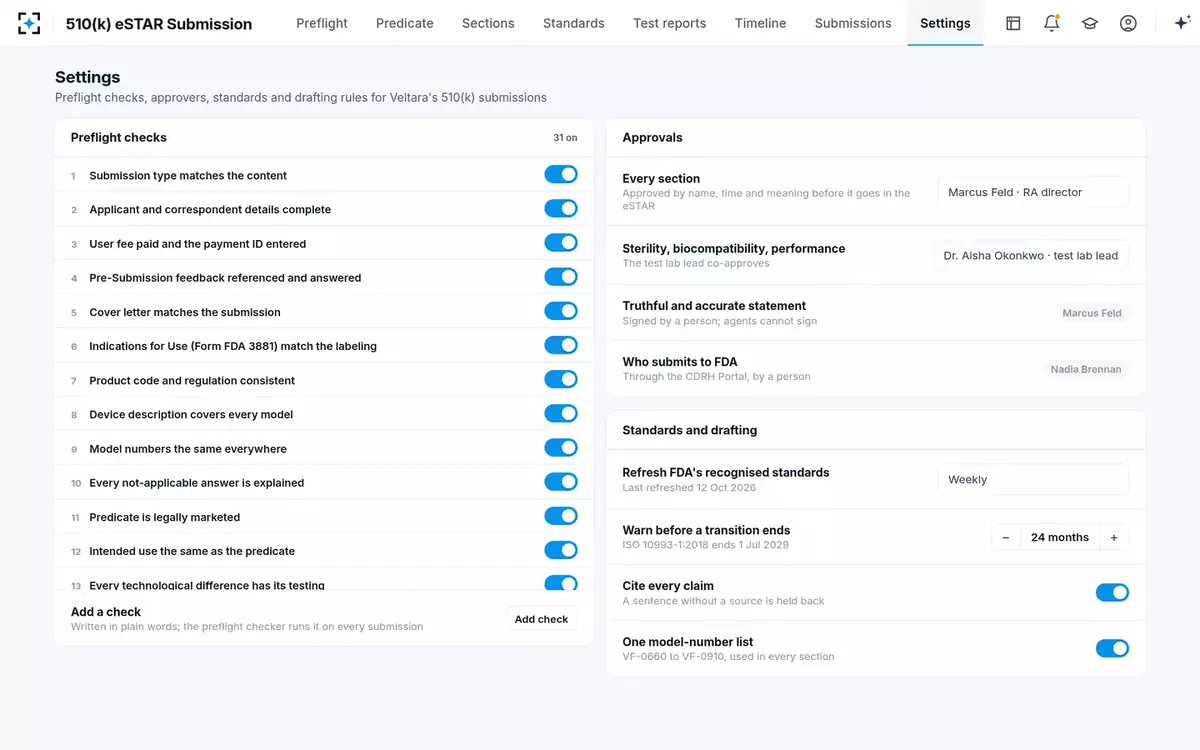
It fits where a submission is assembled from documents you already have and checked before it goes: drafting the sections with a citation on every factual sentence, building the comparison with the predicate and tying each difference to a report, matching cited standards against FDA's recognised editions, and running a preflight modelled on FDA's technical screening with the evidence behind each line. The settings that matter are yours — which checks run, who approves each section, who co-approves the test sections, who signs and who submits.
It does not do several things a buyer might hope for. It does not choose a predicate, decide an intended use, or write a claim your evidence does not support. It does not produce test data, and it will not make a thin file into a strong one — a submission missing a report is missing a report. It does not talk to FDA. And it cannot shorten FDA's own clock, which the two clocks behind a 510(k)'s timeline separates from the part you control.
The settings: who approves, who signs, who submits
The end of the chain: approved by name, signed by a person
To run it on a submission of your own that FDA has already cleared, start from 510(k) eSTAR Submission.
Questions people ask
Can AI write a 510(k) submission?
It can draft one, and nothing in FDA's device regulations prohibits that. What it cannot do is attest to it: 21 CFR 807.87(l) requires a statement from the submitter, on their own knowledge, that all data and information in the notification are truthful and accurate and no material fact has been omitted. The useful test of a drafting tool is whether a person signing can still verify what it wrote.
Does Part 11 apply to AI-drafted submission content?
It applies to the records, whoever or whatever produced them. 21 CFR 11.1 brings in electronic records kept under a regulation's records requirements and electronic records submitted to FDA under the FD&C Act. So a working draft usually sits outside it, while the submitted content and the quality records you must keep sit inside — which is why an audit trail that does not obscure what was previously recorded matters.
What audit trail does AI regulatory work need?
At minimum what 21 CFR 11.10(e) describes: secure, computer-generated, time-stamped records of the entries and actions that create, modify or delete electronic records, with changes that do not obscure previously recorded information. In practice that means every draft, edit, check, fix and approval carries a person's name and a time, and an earlier version is still readable.
Who is responsible if an AI-drafted 510(k) is wrong?
The submitter. The statement 21 CFR 807.87(l) requires is the submitter's own, and part 807 has no provision that shifts it to a supplier. The sharpest illustration is in FDA's consensus standards guidance, which treats intentionally or unintentionally falsifying a declaration of conformity to obtain clearance as a prohibited act — a wrong declaration nobody checked is still wrong.
Is there an FDA guidance on using AI to prepare submissions?
Not for devices. FDA's January 2025 draft guidance on AI to support regulatory decision-making is written for drug and biological products, and it states that it does not address AI used for operational efficiencies such as drafting or writing a regulatory submission. Its risk framework — how much the model's output decides, and how bad an incorrect decision would be — is still a sound way to think about a device tool.
Can AI choose a predicate device?
It should not. The choice is an argument about intended use, and FDA determines intended use from the proposed labeling submitted with the 510(k). Software can assemble candidates and, once a person has chosen, build the comparison row by row and tie each difference to the report that answers it.