A substantial equivalence comparison table sets your device beside its predicate, characteristic by characteristic, marks each row the same or different, and — for every difference — names the evidence showing that the difference does not raise a new question of safety or effectiveness. FDA does not prescribe its shape, but it asks for the comparison and it recommends the format: "FDA highly recommends that the manufacturer summarize this information in tabular format to facilitate this step of review" (FDA, The 510(k) Program). Botminds' 510(k) eSTAR Submission builds the table from the predicate's published 510(k) Summary and your design history file, and ties each difference to the test report that answers it, or opens it as a gap.
The table is where a submission's weaknesses become visible in one glance, which is exactly why it repays the effort. A difference nobody has evidence for is a difference whether or not anyone has written it down; putting the rows side by side only makes it impossible to keep not noticing. The worked example on this page comes from a fictional sample submission in the solution — invented company, invented device, invented predicate and report numbers.
Does FDA require a comparison table in a 510(k)?
FDA requires the comparison. The table is a strong recommendation, not a regulation. The requirement sits in 21 CFR 807.87(f), which asks every premarket notification to contain "a statement indicating the device is similar to and/or different from other products of comparable type in commercial distribution, accompanied by data to support the statement", and notes that this may include "an identification of similar products, materials, design considerations, energy expected to be used or delivered by the device, and a description of the operational principles of the device" (21 CFR 807.87).
The eSTAR template asks for the same thing in its Predicates and Substantial Equivalence section: "The submission should include a comparison of the predicate and subject device and a discussion why any differences between the subject and predicate do not impact safety and effectiveness." Two artefacts, then, not one — the comparison and the discussion. Teams that produce only the table have answered half the question; teams that produce only prose have made the reviewer build the table themselves.
Once the technological characteristics of the new and predicate device(s) have been clearly identified, the next step involves a comparison of these characteristics to identify any differences. This may involve a comparison of detailed specifications as well as a comparison of the system-level technological characteristics of the devices.
FDA, The 510(k) Program: Evaluating Substantial Equivalence (July 28, 2014)
Note "detailed specifications as well as system-level technological characteristics". A table of dimensions and materials that never rises to how the device works as a system has answered the easy half. A single row that says "operating principle: same" and nothing else has answered the hard half badly.
What rows go in a 510(k) comparison table?
Enough rows that a reviewer could tell the two devices apart from the table alone, and no row whose only purpose is to add a line marked Same. Four groups cover most devices.
The first group is the regulatory frame: intended use, indications for use, patient population, prescription status, product code and classification. These rows are usually identical to the predicate's — and if they are not, the submission has a larger problem than a table, because intended use must be the same for substantial equivalence to be available at all.
The second group is what the device is made of and how it is built: patient-contacting materials, fluid path materials, design and construction, dimensions where they matter, the energy source if there is one. FDA's glossary defines technological characteristics as materials, design, energy source and other features, which is a useful prompt for what belongs here.
The third is what the device does: operating principle, performance specifications, accuracy or delivery ranges, duration of use, environment of use, the human interaction required. The fourth is everything a user or a hospital has to handle: sterility and sterilisation method, single or multiple use, shelf life, packaging, reprocessing, software and cybersecurity where applicable, and the labeling claims that depend on any of the above.
A worked comparison: seventeen rows for one fictional sample device
| Characteristic | Subject device | Predicate | Verdict | What answers the difference |
|---|---|---|---|---|
| Intended use | Subcutaneous delivery of a prescribed infusion | Same | Same | — |
| Indications for use | Word for word as filed on the indications form | Same | Same | — |
| Patient population | Adults and adolescents over 12 | Same | Same | — |
| Prescription status | Prescription use only | Same | Same | — |
| Anatomical site | Abdomen, upper arm, thigh | Same | Same | — |
| Single use, sterile | Single use, supplied sterile | Same | Same | — |
| Wear time | 72 hours | 72 hours | Same | — |
| Sterilisation method | Ethylene oxide, sterility assurance level 10⁻⁶ | Same | Same | — |
| Needle gauge | Within the predicate’s range | Same | Same | — |
| Connector | Small-bore connector to the recognised standard | Same | Same | — |
| Flow path and pressure rating | Within the predicate’s stated range | Same | Same | — |
| Cannula material | FEP | PTFE | Different | Biocompatibility of the finished device (TR-0412) and kink and joint-strength testing (TR-0418) |
| Hub material | A polycarbonate-free copolyester | Polycarbonate | Different | Biocompatibility of the finished device (TR-0412) and joint-strength testing (TR-0418) |
| Adhesive | A hydrocolloid-backed acrylic | Acrylic | Different | Skin-contact biocompatibility and the adhesion report covering the full wear period |
| Tubing length options | Three lengths, the longest above the predicate’s | Two lengths | Different | Flow and occlusion testing at the longest length |
| Inserter | Spring-assisted | Manual | Different | Insertion force and depth testing, with the human factors validation report |
| Shelf life | 24 months | 36 months | Different | Packaging integrity and accelerated aging (TR-0433), which supports 24 months |
How a reviewer reads your table, step by step
FDA's guidance sets out the sequence its own reviewers follow, and reading the table in that order is the fastest way to find what will be asked about.
The three steps a reviewer takes over your comparison
- Identify the technological characteristics of both devices
The manufacturer should clearly identify them for each device individually. FDA notes it also relies on information in its own files about the predicate — so a characteristic described loosely in your table is not invisible, it is just described loosely by you.
- Compare them and identify the differences
Detailed specifications and system-level characteristics both. This is the step the tabular format is for, and the step FDA says it highly recommends you do the work of.
- Decide whether the differences raise different questions of safety and effectiveness
Only now does evidence enter. If the answer is no, the scientific review of the performance data proceeds; if yes, the device is found not substantially equivalent.
The sequence has a consequence worth internalising: differences are not a problem to be minimised, they are the subject of the review. FDA says devices cleared through the programme commonly have different technological characteristics from their predicates, and that it rarely finds a device not substantially equivalent at Decision Point 4. A table with no differences is not a strong table. It is usually an incomplete one.
Where the work sits in one sample comparison
Seventeen rows
- Rows marked the same — each still a claim someone must be able to support · 65%
- Rows marked different — each needing a named report, a criterion and a result · 35%
What is a different question of safety and effectiveness?
FDA defines it narrowly: "A 'different question of safety or effectiveness' is a question raised by the technological characteristics of the new device that was not applicable to the predicate device, and poses a significant safety or effectiveness concern for the new device." Two conditions, both required — the question must be new, and it must be significant.
The guidance's own illustrations make the point better than the definition does. A biological indicator moving from natural bacterial spores to a recombinant plasmid, where the signal indicates enzyme expression rather than viability: the new device can produce a false negative by a mechanism the predicate did not have. A device for embryo dissection moving from a mechanical process to an electrical one: the heating effect of the energy source raises concerns the mechanical predicate never posed. A pharyngeal airway device moving from mechanical displacement inside the mouth to external negative pressure on the mandible and neck: pressure on vascular, respiratory and nerve structures that the predicate did not touch. In each case, FDA concluded the device would be found not substantially equivalent.
What the three share is a change in mechanism, not a change in specification. A longer tube, a different grade of the same polymer, a tighter tolerance — these raise the same questions as before, only with new answers. A new way of achieving the effect raises questions nobody asked of the predicate, and no amount of testing against the old questions addresses them. That distinction is worth making explicitly in the discussion that accompanies the table, because it is the distinction the reviewer is making.
Answering a difference: the report, not the paragraph
A difference is answered by evidence with three parts. Anything less is an assertion.
What it takes to close one row of the table
A named report
report number, title, date, signatory
Identified precisely enough that the reviewer can find it among the attachments, and attached under the question it answers.
Test lab lead
An acceptance criterion
set before the test, not after it
The criterion is what makes a result meaningful. A report with results and no criterion asks the reviewer to decide what good looks like.
Design and test engineering
A result that meets it
stated as measured, against the criterion
With the sample size and the conditions. "Passed" without a number is not a result.
Test lab lead
The sentence that ties it to the row
difference → why it raises no new question
The discussion FDA asks for alongside the comparison: why this difference does not affect safety and effectiveness.
Regulatory affairs
The failure this guards against is the reassuring paragraph: a difference explained in prose that sounds authoritative and cites nothing. What it invites is an Additional Information request for the data the paragraph implied existed — a review cycle measured in months, in place of the hour it would have taken to name the report.
Same, different, not comparable: three honest verdicts
Most tables offer two verdicts. A third is often the truthful one. "Not comparable" belongs in a row where the predicate's published information simply does not say — an older 510(k) Summary that never stated a shelf life, a performance specification the predicate's manufacturer expressed in a different unit, a material described only as "a medical-grade polymer".
Marking such a row Same because the predicate did not contradict you is a quiet error, and one a reviewer is well placed to catch: FDA says it relies on the information in its own files about the predicate as well as on yours. The better move is to say what is known, say what is not, and bring your own evidence for the characteristic rather than leaning on an equivalence you cannot show. It reads as rigour, and it is.
The reverse error is marking a row Different out of caution when the two devices genuinely match, which buys nothing and adds a row of work. Each verdict should be a claim you would defend; a hedge in either direction is a sentence the reviewer has to resolve for you.
The rows teams leave out, and the letters that follow
Four omissions are worth checking for. Shelf life, where the predicate's claim is copied across because it is the obvious number and the aging data at home supports something shorter. Sterilisation, where the method is stated but the sterility assurance level and the validation approach are not, leaving the reviewer unable to tell whether two "ethylene oxide" rows mean the same thing. Patient-contacting materials, listed by trade name only, so the comparison turns on whether the reviewer recognises the brand. And the human interaction a device requires — a change from a manual step to an assisted one is a technological difference with human factors consequences, however small the hardware change looks.
Each of these produces the same outcome: a question, an Additional Information request, and another review cycle. The cheapest moment to find them is while the table is being built, which is the argument for building it early rather than as the last section before submission.
The table in the eSTAR and the comparison in the 510(k) Summary
The comparison appears twice in a 510(k), with different audiences. Inside the submission it sits in the Predicates and Substantial Equivalence section, in full, with the reports attached. In the 510(k) Summary it appears again, in public, and 21 CFR 807.92(a)(6) prescribes what it must contain: where the device has the same technological characteristics as the predicate, "a summary of the technological characteristics of the new device in comparison to those of the predicate device"; where it has different ones, "a summary of how the technological characteristics of the device compare to" the predicate (21 CFR 807.92).
The Summary carries one further obligation that catches teams out. Under 807.92(a)(5), if the indication statements differ from the predicate's, the Summary must explain "why the differences are not critical to the intended therapeutic, diagnostic, prosthetic, or surgical use of the device, and why the differences do not affect the safety and effectiveness of the device when used as labeled". That is a separate argument from the technological one, and it belongs in the Summary in its own words.
The Summary is also the document your competitors read. It is published with the clearance, and it is where the next manufacturer looking for a predicate will find your device. A thin comparison is a small kindness to yourself today and an obstacle to whoever cites you later — including your own team, on the next submission. The eSTAR template section by section sets out where each of these lands in the file.
One worked row: a shelf-life claim with no report behind it
In the sample submission the draft claimed a 36-month shelf life, matching the predicate. The comparer flagged it: the claim had no report behind it, and the packaging integrity and accelerated aging report supported 24 months. Nobody had falsified anything — the number had been carried over from the predicate's published Summary at the point where the table was first sketched, and never revisited once the aging data came in.
A row with a claim on one side and no evidence on the other
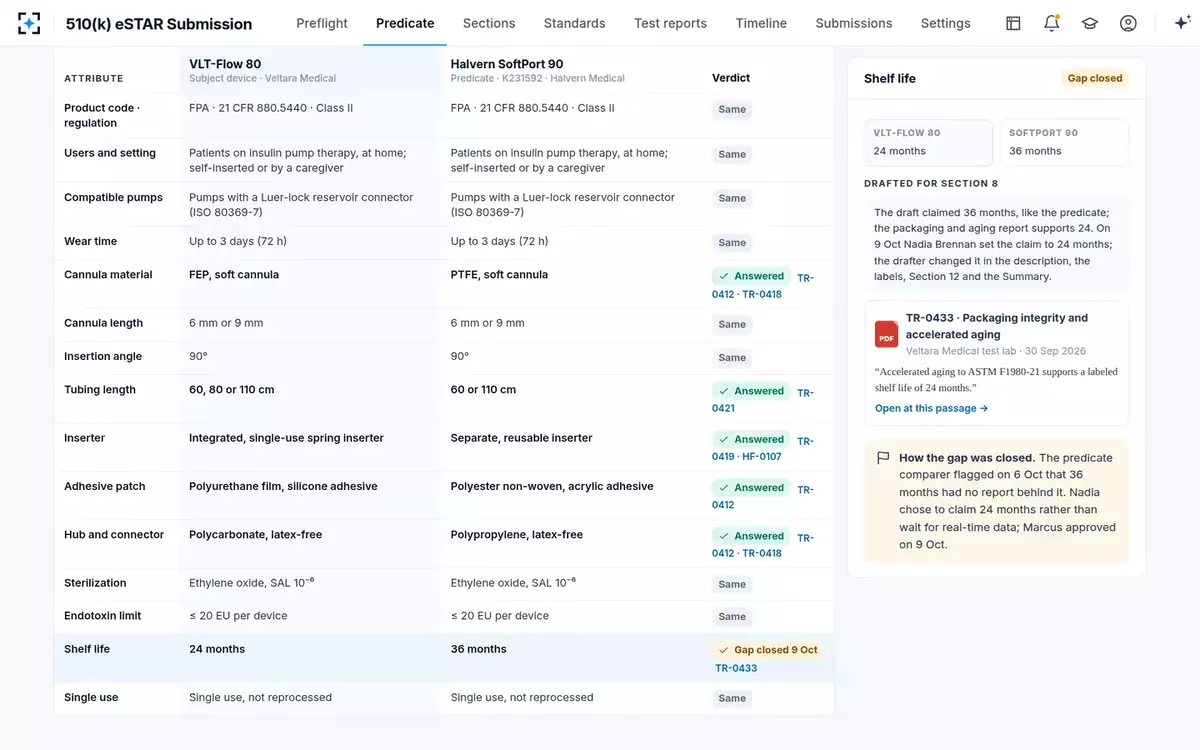
The decision was a person's: claim 24 months rather than wait for real-time data to support 36. What followed was mechanical, and it is where most of the error risk in a late change actually lives — the number appears in the device description, on the labels, in the shelf-life section and in the Summary, and all four had to move together. A change made in two of four places is how a submission ends up contradicting itself.
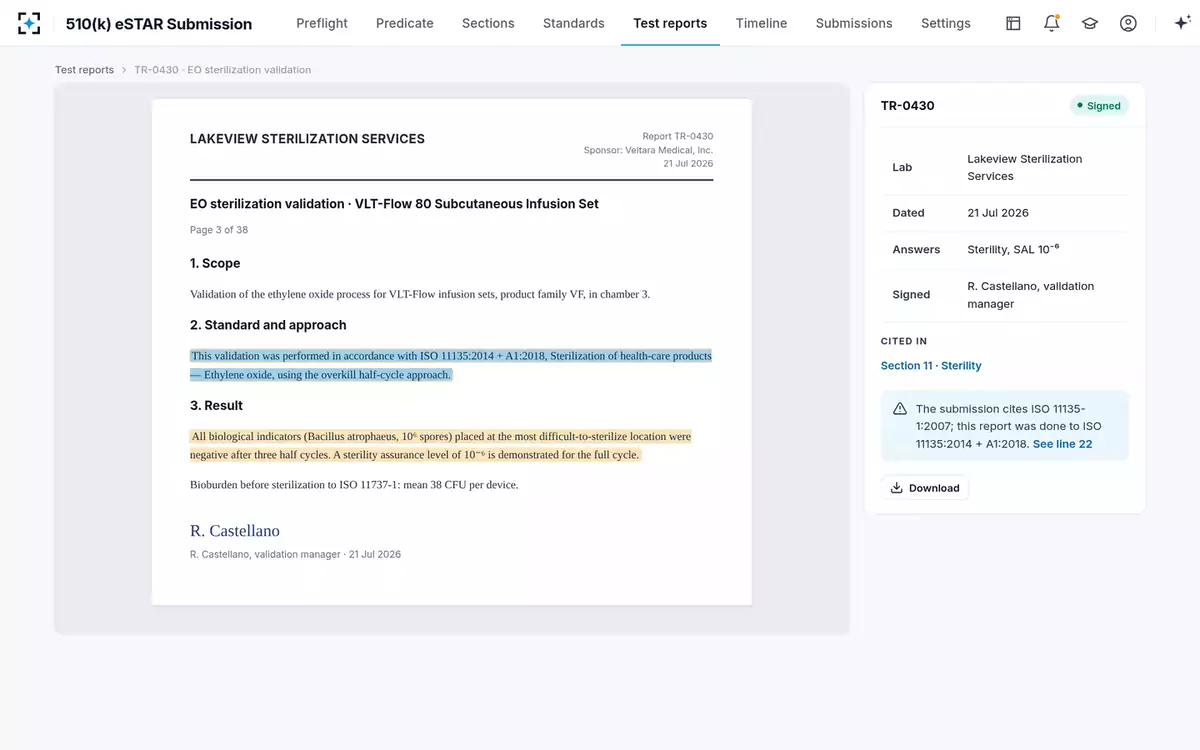
The report opened at the passage the row depends on
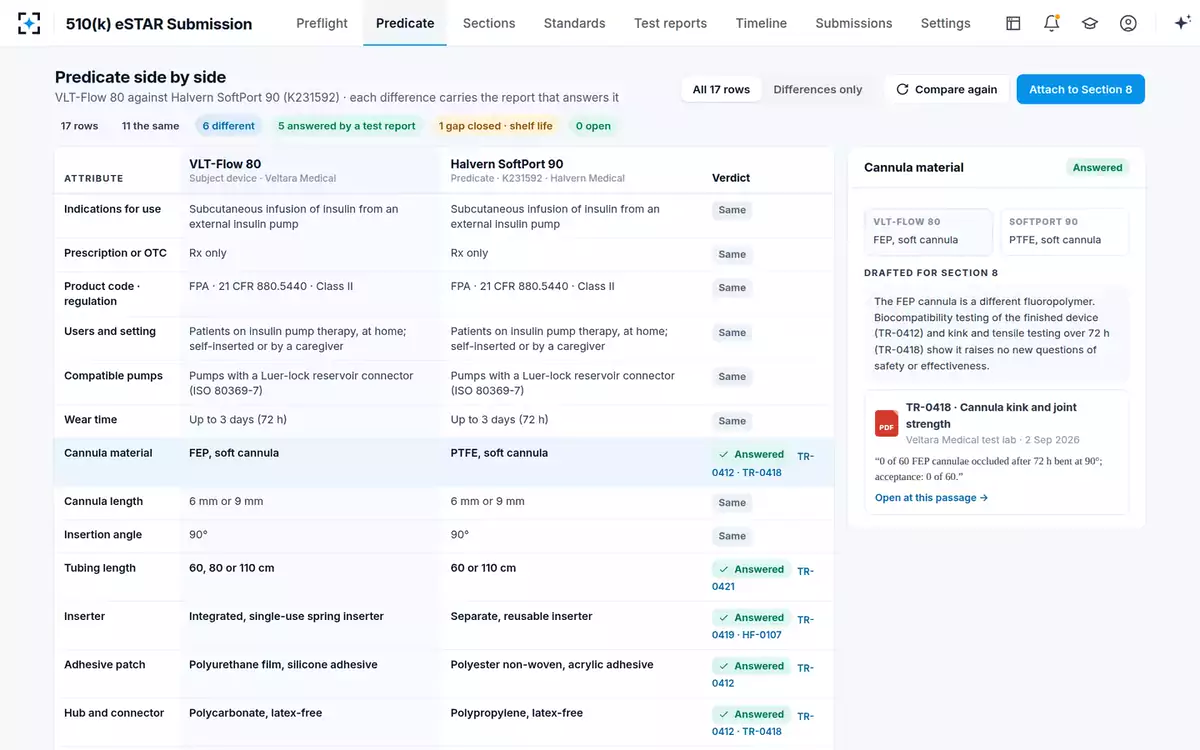
Seventeen rows, six differences, every one tied to its evidence
If the predicate itself is still open, how to choose a predicate device covers the decision this table depends on. If the evidence is the open question, who owns the evidence in a 510(k) follows the reports back to the people who sign them.
Questions people ask
Does FDA require a comparison table in a 510(k)?
FDA requires the comparison, not the table. 21 CFR 807.87(f) asks for a statement of how the device is similar to and different from comparable marketed products, accompanied by data supporting it, and the eSTAR template asks for a comparison plus a discussion of why differences do not affect safety and effectiveness. FDA "highly recommends" the tabular format to facilitate review.
What rows go in a 510(k) comparison table?
Enough that a reviewer could distinguish the two devices from the table alone: the regulatory frame (intended use, indications, population, prescription status), materials and construction, operating principle and performance, and the handling characteristics — sterility and method, single use, shelf life, packaging, software where applicable. Rows that exist only to add a line marked Same are not worth their space.
How do you explain a difference from the predicate?
With a named report, an acceptance criterion set before the test, a result that meets it, and a sentence saying why the difference raises no new question of safety or effectiveness. A paragraph of reassurance without a citation invites an Additional Information request for the data the paragraph implied existed.
What is a different question of safety and effectiveness?
In FDA's words, a question raised by the new device's technological characteristics that was not applicable to the predicate and that poses a significant safety or effectiveness concern. Both halves matter: new, and significant. FDA's own examples all involve a change of mechanism — a different signalling principle, a different energy source, a different way of moving tissue — rather than a change of specification.
Where does the comparison table go in eSTAR?
In the Predicates and Substantial Equivalence section, alongside the identification of the predicate and the discussion of why differences do not affect safety and effectiveness. The reports that answer the differences are attached under the questions they answer, which matters because FDA's technical screen checks for a relevant attachment per applicable question.
What has to be in the 510(k) Summary comparison?
Under 21 CFR 807.92(a)(6), a summary of the new device's technological characteristics compared with the predicate's where they are the same, or a summary of how they compare where they differ. And under 807.92(a)(5), if the indication statements differ from the predicate's, an explanation of why the differences are not critical to the device's intended use and do not affect safety and effectiveness when used as labeled.