The FDA recognized consensus standards database is the public list of the standards FDA has agreed to accept in support of a premarket submission, and the thing it lists is not a standard but an edition of one, with a recognition number, an extent of recognition and — when a successor arrives — the date on which declarations of conformity to the outgoing edition stop being accepted. That is why a citation can be wrong while the testing behind it is right: the laboratory worked to one edition, the submission names another, and nobody notices because both sentences contain the same four digits. Botminds' 510(k) eSTAR Submission checks every standard a submission cites against FDA's list and flags withdrawn editions and transition dates, without ever changing what the laboratory tested to.
The database sits at FDA's recognized consensus standards search, and each entry's supplementary information sheet is the authoritative page for one edition. The worked examples below are real FDA entries; the submission around them is fictional sample data in the solution.
What is the FDA recognized consensus standards database?
It is a searchable list of consensus standards FDA has recognised under section 514(c) of the Federal Food, Drug, and Cosmetic Act, published entry by entry. Each entry has two halves. The first is identification: the standards development organisation, the standard's designation and edition, the title, any identical national adoption, and a recognition number such as 2-258 or 14-529. The second is FDA's own position on it: the extent of recognition, the rationale, any transition statement, the CFR citations and product codes it relates to, and the FDA technical contacts.
FDA publishes recognition lists in the Federal Register and says it usually does so at least twice a year, so the database is a moving object rather than a reference you can take a copy of. A submission prepared over ten weeks can be checked against the list at the start and be wrong by the time it goes.
How do you check if a standard is FDA recognized?
Search the database for the standard's designation, then open the entry for the exact edition your report used — not the one with the same number. Three fields decide the answer. The recognition number is what you will cite in the declaration of conformity. The extent of recognition tells you whether the whole standard counts or only part of it. The transition period, if the entry has one, names the successor edition and the date after which your edition's declarations will not be accepted.
Two mistakes recur. One is checking the standard rather than the edition, which is the error the whole system exists to catch. The other is checking once: a recognition list published between assembly and submission changes the answer without anybody touching the file.
Recognition is by edition, and partial recognition is normal
Partial recognition means FDA accepts the standard with named exclusions, and it is ordinary rather than a warning sign. FDA's entry for ISO 10993-1 Fifth edition 2018-08, recognition number 2-258, states the extent of recognition as "Partial recognition. The following part(s) of the standard is (are) not recognized: Table A.1 in Annex A" (FDA, Recognized Consensus Standards, Rec# 2-258). The entry's rationale explains the reason: that table conflicts with an existing published final guidance.
The practical consequence is specific. Conformance to a partially recognised standard means conformance to the recognised part; relying on the excluded part means relying on something FDA has said it does not accept here, and the submission has to carry the argument itself. An entry that says "Complete standard" — as FDA's entry for ISO 11135 Second edition 2014-07-15, recognition number 14-529, does (Rec# 14-529) — carries no such carve-out.
Editions also carry their amendments in FDA's own wording, and copying that wording is worth the pedantry. FDA's entry for ISO 11135 names the standard "ISO 11135 Second edition 2014-07-15 … [Including: Amendment 1 (2018)]" and gives the identical adoption as ANSI AAMI ISO 11135:2014/A1:2018. A submission that writes the edition in the laboratory's shorthand, or in a form the entry does not use, invites a question that costs more to answer than it would have cost to copy the line.
Four rows from a standards check, and what each one obliges the submission to do
| Standard as cited | Where it is used | What FDA’s record says | What the submission must do |
|---|---|---|---|
| ISO 10993-1 Fifth edition 2018-08 | Biological evaluation of the patient-contacting materials | Recognition number 2-258, entered 14 January 2019. Partially recognised: FDA’s entry states that Table A.1 in Annex A is not recognised. The entry also carries a transition statement naming the Sixth edition 2025-11 [Rec# 2-313] as its successor, with declarations to 2-258 accepted until July 1, 2029. | Cite the fifth edition with its recognition number, and plan the next biological evaluation against the successor rather than against the deadline. |
| ISO 11135 Second edition 2014-07-15 | Ethylene oxide sterilisation validation | Recognition number 14-529, entered 15 July 2019, extent of recognition "Complete standard". FDA’s entry names the standard "[Including: Amendment 1 (2018)]" and gives the identical adoption as ANSI AAMI ISO 11135:2014/A1:2018. | Write the edition exactly as FDA’s entry writes it, amendment included, rather than in the laboratory’s shorthand. |
| A superseded edition still being cited | Anywhere an old submission was reused as a starting point | FDA states that superseded standards withdrawn from the list of recognised standards cannot subsequently be used in declarations of conformity. | Change the citation, not the testing — if the laboratory worked to the current edition, only the submission is wrong. |
| A standard FDA does not recognise | A method with no recognised equivalent | Not in the database at all, which is not a disqualification: the eSTAR Consensus Standards section asks for "both FDA-recognized and non-recognized consensus standards". | Declare it, and attach the underlying data rather than relying on a declaration of conformity. |
What is a transition period for a consensus standard?
A transition period is the window in which FDA accepts declarations to both the outgoing edition and its successor. FDA's guidance explains the purpose: "When a consensus standard has been replaced by a newly recognized standard, the older version will be withdrawn following a transition period. The transition period is intended to decrease the burden of implementing a shift from one version of a consensus standard to a newer version" (FDA, Appropriate Use of Voluntary Consensus Standards in Premarket Submissions for Medical Devices).
The window exists so that work already under way does not have to be repeated. FDA says the arrangement lets a submitter "continue current product development and testing potentially without having to conduct additional testing due to a newer version of a consensus standard having been published and recognized" — with one caveat worth reading twice: where the newer version raises significant questions the older one did not address, a justification for using the older version should be provided.
The statement itself is published on both entries, in a fixed form.
"FDA recognition of [the outgoing version of the consensus standard] will be superseded by recognition of [the newer version of the FDA-recognized consensus standard]. FDA will accept Declarations of Conformity, in support of premarket submissions, to [the outgoing version of the consensus standard] until [Month, Date, and Year]. After this transition period, Declarations of Conformity to [the outgoing version of the consensus standard] will not be accepted."
FDA, Appropriate Use of Voluntary Consensus Standards in Premarket Submissions for Medical Devices (September 14, 2018)
What a transition window asks of FDA, and what it asks of a programme
- The edition is recognised; declarations acceptedno successor yet
- The successor is recognised; both acceptedthe transition window
- Declarations to the outgoing edition not acceptedafter the published date
- Nothing changes for testing already completed
- Plan the next test campaign against the successorwhile there is still a choice
- Retest, or justify the older versionthe expensive option
What happens if you cite a withdrawn edition of a standard?
The declaration stops being accepted, and FDA expects testing to a current edition instead. The guidance is direct: "If a submission is submitted to FDA after the transition period has expired, as noted in the SIS, FDA expects that testing will be completed using a standard with a current recognition number. Statements declaring conformance to expired or earlier versions of the consensus standard will generally not be accepted." Elsewhere it states the rule flatly: "Superseded standards that FDA has withdrawn from the list of recognized standards cannot subsequently be used in DOCs."
But that is the expensive case — the one where the testing is genuinely out of date. The cheap case is common in programmes that reuse their own submissions, and is worth separating from it carefully, because the two look identical in a draft and cost very different amounts to fix.
Two problems that look the same in a draft
The laboratory tested to the old edition: The work was done against requirements FDA no longer accepts for a declaration of conformity.
The submission cites the old edition: Nothing about the work. One line of text names an edition the laboratory did not use.
The laboratory tested to the old edition: The report’s own method section names the old edition.
The submission cites the old edition: The report names the current edition; the submission does not.
The laboratory tested to the old edition: A test campaign, a laboratory slot and a schedule, or a justification FDA may not accept.
The submission cites the old edition: An edit, in every place the citation appears.
The laboratory tested to the old edition: Testing completed before the successor was recognised, carried forward without a check.
The submission cites the old edition: An earlier submission reused as a starting point, with its citations intact.
The laboratory tested to the old edition: Re-labelling old testing as conformance to the new edition.
The submission cites the old edition: Changing the report instead of the citation.
A worked example: ISO 10993-1 and the 1 July 2029 date
FDA's entry for ISO 10993-1 Fifth edition 2018-08 carries the transition statement filled in: recognition of the fifth edition "will be superseded by recognition of ISO 10993-1 Sixth edition 2025-11 [Rec# 2-313]", and FDA "will accept declarations of conformity, in support of premarket submissions, to [Rec# 2-258] until July 1, 2029. After this transition period, declarations of conformity to [Rec# 2-258] will not be accepted."
Read as a programme instruction, that is three statements. A submission going now may cite the fifth edition and rely on biological evaluation performed against it. A biological evaluation being planned now should be planned against the sixth edition, because a campaign that starts against the fifth will be defending a choice rather than making one by the time the next device is ready. And the date is a date, not a target: it was published when the successor was recognised and it does not move because a programme is busy.
The 2029 date is also a good illustration of why this is the one part of a submission that can be checked arithmetically. Nothing about it requires judgement. It requires somebody to look, on a schedule, at a list that changes without telling them.
The predicate that relied on a standard FDA has since withdrawn
A question that comes up once a programme starts reading its predicate's history: if the predicate was cleared partly on a declaration of conformity to a standard FDA has since withdrawn, is it still usable? FDA answers it directly.
"If a submitter received clearance or approval based in part on a DOC, but the standard is withdrawn from recognition, the cleared or approved device remains legally marketed and it remains eligible (for 510(k)s) as a predicate device. However, any new device citing such a predicate in a 510(k) submission cannot similarly rely on a DOC to the withdrawn standard."
So the predicate survives and the shortcut does not. This matters most where a comparison leans on a characteristic the predicate established through conformance rather than through published data: the row is still comparable, but your side of it needs evidence of its own. It is worth checking at the point the predicate is chosen rather than at the point the table is built — choosing a predicate device covers the other disqualifiers alongside it.
What goes in a declaration of conformity
FDA lists the elements a declaration should contain, and notes that a submitter may follow the format of ISO/IEC 17050-1. There are eight.
The eight elements FDA says a declaration of conformity should contain
- The applicant or sponsor responsible for the declaration
Name and address of whoever is accountable for it.
- Product and device identification
Product codes, the device marketing name, model number and any other unique identification specific to this declaration.
- A statement of conformity
The claim itself.
- The list of standards it applies to, with the options selected
Where a standard offers choices — test methods, levels, annexes — say which ones were taken.
- The FDA recognition number for each standard
The number from the database entry for that edition. This is the field that goes stale.
- The date and place of issuance
When and where the declaration was made.
- Signature, printed name and function of the responsible person
A declaration is signed by somebody with a role, not by an organisation.
- Any limitation on its validity
FDA’s examples: how long the declaration is valid, what was tested, or concessions made about the testing outcomes.
The supporting-documentation point catches teams out. FDA observes that standards which are broad, process-oriented or full of choices — its example is ISO 14971 for risk management — generally need the underlying data too, because they set no detailed acceptance criteria for the performance tests. A declaration alone, against a standard of that kind, is an answer FDA has said in advance it cannot act on.
What if the standard changes while FDA is reviewing
FDA's position is that a submission under active review is generally reviewed against the version recognised when it arrived. The guidance adds the exception: if the updated standard addresses a new safety or effectiveness issue relevant to the final decision, FDA may ask the submitter either to meet the parts of the new version that address that issue, or to provide alternative data and a scientific rationale for why the alternative addresses it.
For a change that lands before the submission goes, the guidance encourages early interaction about the strategy for handling the differences between two versions. It notes that it may not be necessary to comply with all parts of a revised standard, only the parts that significantly affect the evaluation of safety and effectiveness — a more proportionate answer than the instinctive one, which is to retest everything.
A standing check instead of a yearly scramble
The work this section describes is checkable by a machine and genuinely tedious for a person: take every standard the submission cites, with its edition and amendments, find the matching entry in FDA's list, and compare. Doing it once, late, is how a withdrawn edition reaches a submission. Doing it on a schedule is how it does not.
Every standard a submission cites, against the edition FDA recognises today
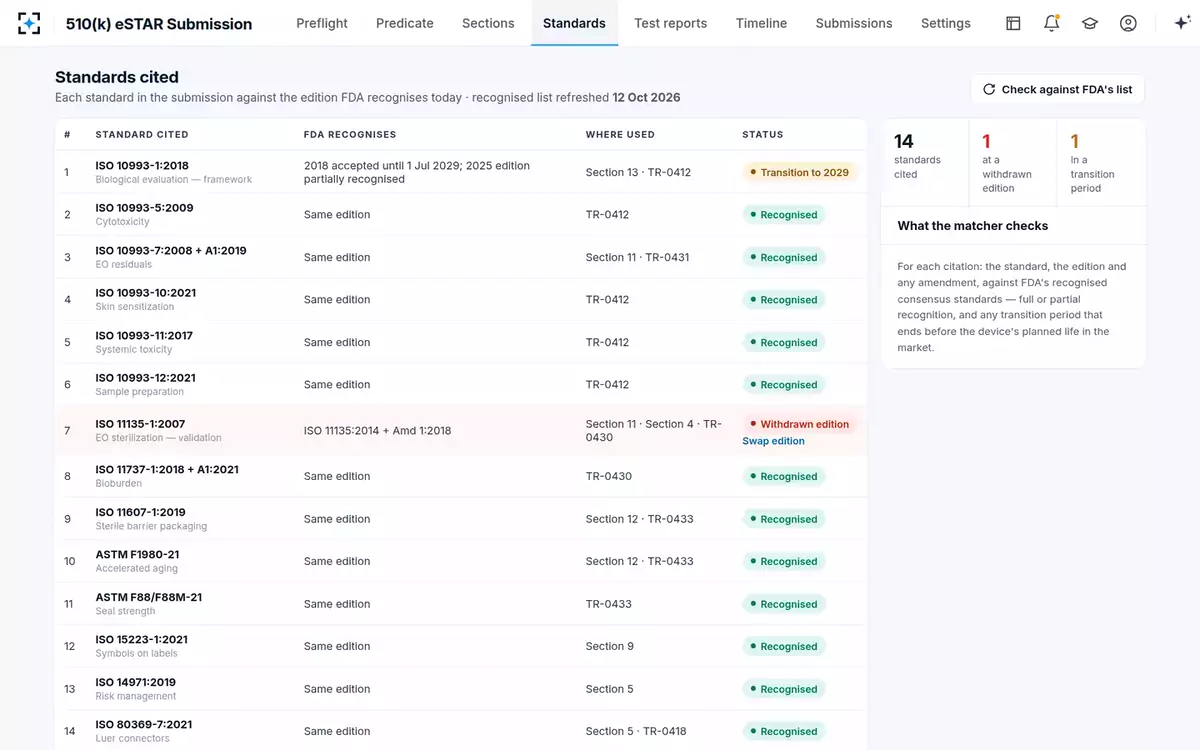
Where fourteen cited standards stood on one sample submission
Fourteen standards
- Cited at an edition FDA recognises today · 86%
- Inside a transition period — usable now, not later · 7%
- At a withdrawn edition — the citation, not the testing · 7%
What makes the withdrawn-edition case tractable is that the evidence for the fix is already in the building. In the sample submission a superseded edition appeared in two places while the signed validation report named the current one, so the fix changed two sentences and left the report as the laboratory signed it.
The report says one edition; the submission said another
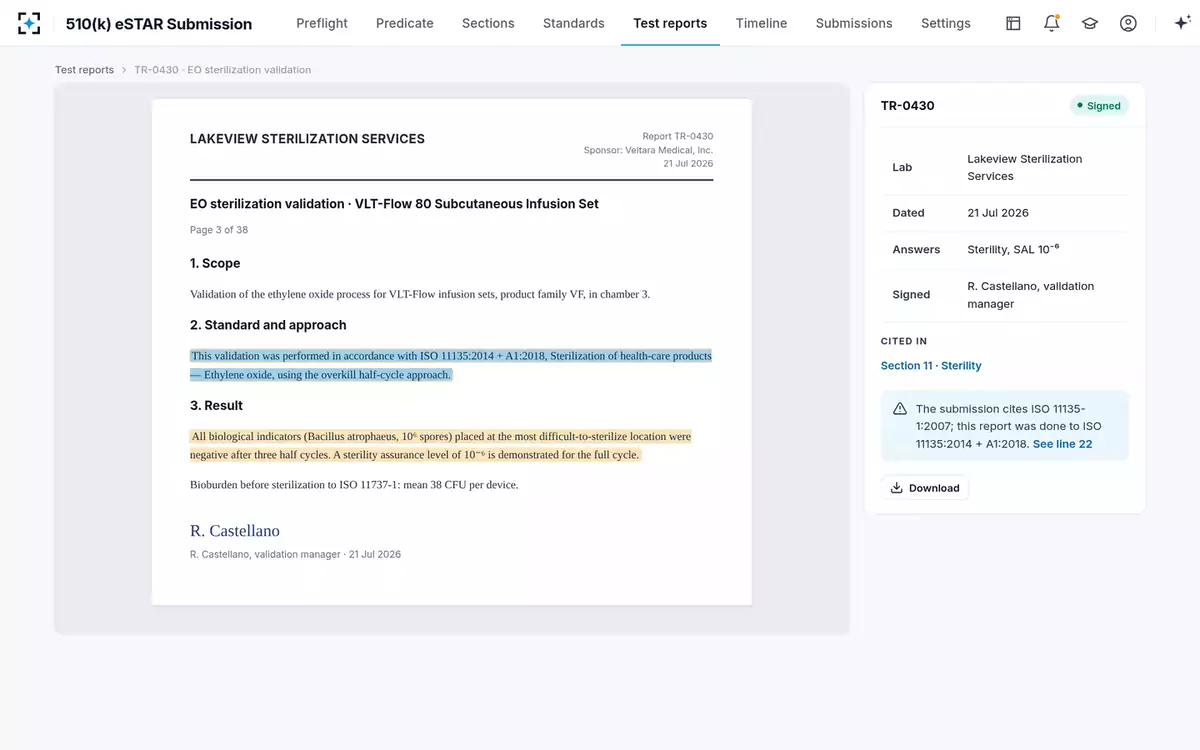
Standards citations are one of the facts an eSTAR asks for in more than one place, which is why they belong in the same discipline as model numbers and shelf life; the eSTAR template section by section sets out where each lands. And a citation at a withdrawn edition is exactly the kind of answer that does not describe the device, which is what FDA's technical screen is looking for.
Questions people ask
How do you check if a standard is FDA recognized?
Search FDA's recognized consensus standards database for the designation and open the entry for the exact edition your test report used. Read three fields: the recognition number you will cite, the extent of recognition (complete or partial, with the excluded parts named), and any transition statement naming a successor edition and the date your edition's declarations stop being accepted.
What is a transition period for a consensus standard?
The window during which FDA accepts declarations of conformity to both an outgoing edition and its newly recognised successor. FDA says it exists to decrease the burden of shifting versions, so that development and testing under way need not be repeated. The window's length is set at the successor's recognition and published on the supplementary information sheets for both editions.
What happens if you cite a withdrawn edition of a standard?
FDA says statements declaring conformance to expired or earlier versions will generally not be accepted, and that superseded standards withdrawn from the list cannot subsequently be used in declarations of conformity. The important question is whether the testing or only the citation is out of date: if the laboratory worked to the current edition, the fix is an edit, not a test campaign.
Is partial recognition of a standard a problem?
No — it is ordinary, and the entry tells you what is excluded. FDA's entry for ISO 10993-1 Fifth edition 2018-08, recognition number 2-258, records partial recognition with Table A.1 in Annex A not recognised, because that table conflicts with a published final guidance. Conformance means conformance to the recognised part; anything relying on an excluded part needs its own support.
When does the ISO 10993-1 2018 transition end?
FDA's entry for recognition number 2-258 states that declarations of conformity to that edition will be accepted until July 1, 2029, after which they will not be, its recognition being superseded by ISO 10993-1 Sixth edition 2025-11 [Rec# 2-313]. A submission going before then may still rely on the fifth edition; a biological evaluation being planned now is better planned against the successor.
What if the standard changes while FDA is reviewing?
FDA generally continues reviewing against the version recognised when the submission arrived. If the newer version addresses a new safety or effectiveness issue relevant to the decision, FDA may ask you to meet the parts that address that issue, or to supply alternative data with a scientific rationale. It may not be necessary to comply with all parts of a revised standard — only those that significantly affect the evaluation.