An excess casualty underwriter decides whether, and at what price, to write a layer of liability insurance that attaches above other insurers' primary and umbrella policies: for example $10M excess of $20M on a trucking company or a building-materials distributor. What sets the job apart is that the layer is only as good as the policies beneath it, and the underwriter wrote none of them. Before the price means anything, someone has to read every underlying policy, its endorsements, the schedule of underlying insurance and several years of loss runs, and confirm limits, attachment points, policy periods and whether each layer really follows the one below. That reading is most of the week. Botminds' Excess Casualty Tower Analysis is built for this seat: its agents read the tower, mark the gaps with their pages and draft the note, and the underwriter prices, refers and signs.
Where one excess submission's working days go: mostly reading, not pricing
By hand · about 2.8 working days
- Reading policies and endorsements · 36%
- Comparing wording with the lead umbrella · 21%
- Schedule against policies · 11%
- Loss runs and erosion · 11%
- Who pays on a large loss · 11%
- Note and subjectivities · 10%
With the solution · about 0.5 working days
- Checking the agents' reading · 20%
- Judging the wording differences · 40%
- Note, price and subjectivities · 40%
What does an excess casualty underwriter do?
The underwriter answers three questions for each submission: what sits beneath the layer, what can reach it, and what it should cost. Only the third is pricing in the narrow sense, and it depends entirely on the first two.
What sits beneath is a reading problem. A typical tower has a primary carrier writing general liability, auto and employers liability, a lead umbrella, and one or more excess layers, often from five or more carriers on five different forms. The underwriter needs each limit and aggregate, each attachment point, each policy period, the defence terms, and every endorsement that narrows a lower layer. The broker's schedule summarises all this; the policies decide it.
What can reach the layer is a scenario problem. The underwriter drops a large loss of each kind (a multi-vehicle crash, a premises injury, a products claim) on the tower and asks which layers pay, which exhaust, and whether anything stops the loss before it reaches the layer, or lets it through a gap. The loss runs say how often losses of that size have happened, and how much of each underlying aggregate is already used.
Only then comes the price: an exposure rate for the layer, a credit or debit for experience, loads for weaknesses beneath (defence inside a lower limit, a period mismatch), and the subjectivities the broker must satisfy before binding. Most excess desks also refer larger limits, larger fleets or any serious gap to a head of excess casualty, who co-signs; how referral rules are written is a subject of its own in the underwriting referral process guide.
What is excess casualty insurance?
Excess casualty is liability insurance that pays only after underlying liability insurance is used up. It protects businesses against the large third-party claims that exceed their primary limits: bodily injury from a truck crash, a product that causes harm across many claimants, an injury on premises.
It sits close to umbrella insurance, and the two are often sold in the same form, but they are not the same thing. The Colorado Supreme Court described the difference in September 2026: umbrella coverage "runs horizontally: It extends the scope of coverage afforded by a primary policy", while an excess carrier "bargains to insure against occurrences that are covered by an underlying primary policy and result in losses that exceed the limits of that policy" (A.R. Wilfley & Sons v. National Union, 2026 CO 64). Excess layers above an umbrella usually follow the umbrella's terms; the follow form guide explains how far that following goes.
When a layer is placed in the surplus lines market, the paper varies more from carrier to carrier. Florida, for one, has the insured acknowledge in writing that no Florida regulator has approved a surplus lines insurer's rates or forms (Fla. Stat. § 626.916). Each layer's form has to be read for what it is, not assumed from the one beneath it.
How is excess casualty different from primary underwriting?
Primary and excess casualty underwriting: same risk, different job
Primary casualty: The underwriter's own forms, filed or standard, read once and known well
Excess casualty: Other carriers' forms and endorsements beneath the layer, different on every tower
Primary casualty: Many small and mid-size claims; the loss runs are the pricing base
Excess casualty: Few losses ever reach the layer; the loss runs show erosion and severity, not frequency
Primary casualty: Under-pricing the expected losses
Excess casualty: A gap beneath the layer, an eroded aggregate, a period mismatch or an exhaustion clause that changes when the layer is reached
Primary casualty: Rating and risk selection
Excess casualty: Reading and reconciling wording across layers, then rating a layer for severity
Primary casualty: Usually owes the defence from the first dollar
Excess casualty: Often pays defence only above the underlying limits, or not at all, as the layer's own words decide
The difference in frequency is the one newcomers feel first. A primary underwriter can price from hundreds of claims. An excess underwriter may see one loss in five years reach an umbrella on an account, as on the solution's fictional sample submission, where a single $3.4M auto loss in 2023 was the only one to get past the $2M primary. Pricing therefore leans on exposure, the layer's place in the tower and the quality of what sits beneath it.
How many submissions does an excess underwriter see?
We found no public statistical source that counts submissions per excess underwriter, and figures quoted in trade commentary vary with the desk, the attachment band and the broker mix. The useful number is your own: count submissions received, submissions fully read and submissions quoted per underwriter per week, from the clearance log, for a recent quarter.
The arithmetic that follows is what makes the role hard. If a full read of one tower takes about 2.8 working days by hand, Botminds' estimate shown above, one underwriter can fully read fewer than two towers a week. Every other submission gets a partial read: the lead umbrella and the layer directly beneath, the declarations of the rest, and the endorsements someone already suspects. The gaps live in the parts that were not read.
One underwriter's five-day week: towers fully read, by hand and with Excess Casualty Tower Analysis
- Tower 1, full read2.8 days
- Tower 2, partly read2.2 days
- Tower 1
- Tower 2
- Tower 3
- Tower 4
- Tower 5
- Tower 6
- Tower 7
- Tower 8
- Tower 9
- Tower 10
What skills does an excess casualty underwriter need?
Close reading comes first, then judgement about severity, then the ability to say no to a broker with reasons. The Bureau of Labor Statistics lists analytical skills, decision-making, attention to detail, interpersonal skills and mathematics as the qualities underwriters need in general (BLS Occupational Outlook Handbook, insurance underwriters). The excess seat weights them unevenly.
Reading is the skill that separates good excess underwriters. It means knowing which clauses change a layer: definitions of loss and damages, defence terms, exhaustion and maintenance conditions, other insurance clauses, and the endorsements that remove a line or an operation. It also means knowing which courts' readings matter. The Texas Supreme Court's 2024 ruling that a follow-form excess policy is governed by its own text, and the California and New York rulings on horizontal vs vertical exhaustion, are the kind of law an excess underwriter applies every week without ever being a lawyer.
Severity judgement is the second. A layer at $20M attaches above losses that are rare and large, so the underwriter has to think in scenarios and in the shape of the tail rather than in averages. The third is the conversation with the wholesale broker: subjectivities that name the endorsement and the cure, early enough for the broker to fix the tower before quote day.
Four people carry each excess submission; the reading moves, the decisions stay
Today
Reads ten to fifteen policies by hand for each tower, and reads some of them only in part.
With agents
Opens a tower already read, with every gap cited to its page, drops a loss on it and spends the time on price and subjectivities.
Still theirs: The price, the option chosen, the subjectivities and the signature
Today
Chases the broker for endorsement schedules and policies the file may already hold.
With agents
Sees which documents carry a finding and asks the broker for exactly what is missing.
Still theirs: Document requests and the completeness of the file
Today
Gets a referral that says the tower looks thin, without the clause behind it.
With agents
Gets the tower, the gaps, the losses and the drafted note together, with the rule that triggered the referral.
Still theirs: Referrals, co-signature and the excess guidelines
Today
Hears about a gap on quote day, or after a claim.
With agents
Receives subjectivities that name the endorsement and the cure before the quote.
Still theirs: The placement and the conversation with the retail broker and insured
How much do excess casualty underwriters earn?
The Bureau of Labor Statistics does not separate excess casualty from other underwriting, so its figures describe all insurance underwriters. The median annual wage was $81,370 in May 2025; the lowest 10 percent earned less than $55,530 and the highest 10 percent more than $145,160 (BLS). Senior specialty roles such as excess casualty sit, in our reading, nearer the top of that range, but the BLS does not break the figures out by line of business, so that cannot be measured directly.
Median annual wage for insurance underwriters, by the industry that employs them, May 2025
The BLS also projects employment of insurance underwriters to fall 4 percent between 2025 and 2035, while still expecting about 6,800 openings a year, all of them from replacing people who leave. It attributes the decline to automated underwriting software. Excess casualty is not a simple line, but the same pressure applies to the reading part of the job.
Is excess casualty a hard market?
Casualty is the firm half of a split market, by the regulators' own account. The NAIC's analysis of 2025 results describes property lines moving towards soft-market conditions while casualty lines stay firm, driven by social inflation and nuclear verdicts (NAIC, U.S. property and casualty industry, 2025 full-year results). Losses incurred in other liability, occurrence, the statutory line that carries most commercial umbrella and excess liability, rose $3.1 billion, or 6%, in 2025; earned premium grew faster because of rate increases, and the pure net loss ratio improved slightly to 67%.
The Federal Insurance Office's 2026 annual report gives the premium side: direct premiums written in other liability grew 8.0% in 2025, as part of rate increases in liability lines "to counter underwriting losses" (FIO, Annual Report on the Insurance Industry, September 2026). The same report notes that reserve development across the property and casualty sector was more favourable in 2025 than in any year of the previous ten, which is a reminder that the pressure is concentrated in liability rather than spread across the industry.
What drives those liability costs is the Casualty division's subject, and the nuclear verdicts guide sets out the evidence. For the reinsurers behind excess casualty writers, the casualty reinsurance market guide covers the NAIC's 2025 figures. For the excess underwriter, a firm market raises the stakes of the reading: a price that rises 10% on a layer that sits over an unread exclusion is still the wrong price.
Excess Casualty Tower Analysis: every submission in flight, its tower read before pricing
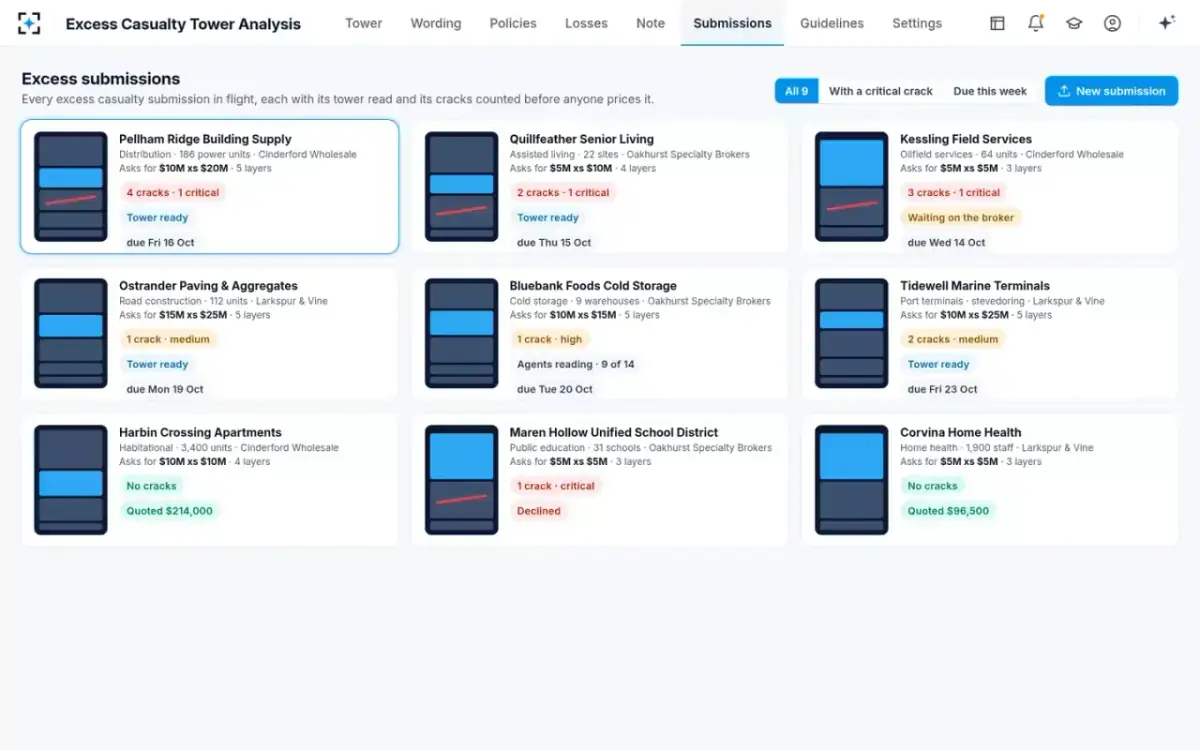
What the solution changes in the excess underwriter's week
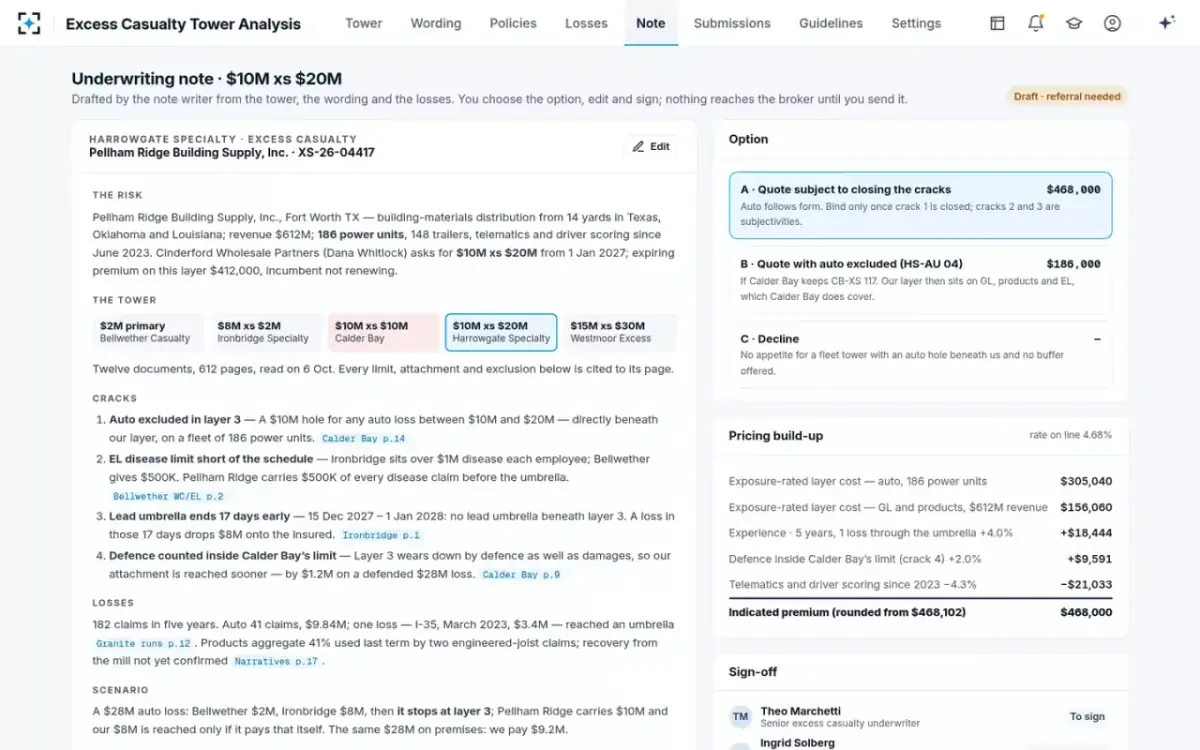
The reading moves; the judgement does not. In Excess Casualty Tower Analysis six agents take the mechanical part. The policy reader turns every policy, declarations page and endorsement into limits, aggregates, attachments, periods and exclusions, each tied to its page. The schedule matcher checks the broker's schedule against the policies actually supplied. The follow-form comparer compares every layer with the lead umbrella, provision by provision. The loss run reader puts every carrier's loss runs into one view with aggregate erosion. The tower loss modeller pours a chosen loss down the tower. The note writer drafts the underwriting note and subjectivities, with options.
None of them quotes, binds or writes to a broker. The underwriter chooses the option, edits and signs the note; referrals go to the head of excess casualty under the carrier's own guidelines; and every gap the underwriter accepts needs a reason under their name.
The drafted note: options, a pricing build-up and the gaps, each cited
Questions people ask
What is the difference between an excess casualty underwriter and an umbrella underwriter?
The titles overlap, and many desks write both. An umbrella underwriter also prices coverage the underlying policies do not give, above a self-insured retention, while a pure excess underwriter prices only additional limits over underlying coverage; the reading work is the same.
Do excess casualty underwriters need legal training?
No law degree is required, but the job involves reading policy language the way courts do. The BLS says underwriters typically need a bachelor's degree, and that certification through insurance coursework may be needed to advance to senior roles.
What is an excess casualty underwriting guideline?
It is the carrier's written rules for writing layers: minimum attachments, required underlying limits, exclusions always carried, defence and exhaustion positions and referral triggers. On the solution's sample desk, nine such rules are checked on every tower, and a referral to the head of excess casualty is required for larger limits, large fleets or any critical gap.
Where do excess casualty underwriters work?
At insurers that write excess and umbrella liability, including surplus lines carriers, and at managing general agents with delegated authority. BLS counts 52% of all underwriter jobs at direct property, casualty and other non-life carriers and 24% at agencies and brokerages.
Is excess casualty underwriting being automated?
The pricing decision is not, and should not be. What can be automated is the reading: turning a dozen policies into one cited table of limits, attachments, periods and exclusions, which is where most of the time goes and where most gaps are missed.