An attachment point, in insurance, is the amount of loss that must be absorbed beneath an excess or umbrella layer before that layer starts to pay: a layer written as $10M excess of $20M has a $20M attachment point, normally the sum of the limits of the policies scheduled beneath it. The number is simple; what it promises is not. It assumes the underlying policies cover the same losses as the layer, run for the same dates, still have their aggregates, and pay defence the same way, and that the underlying limits will be exhausted in the way the layer's own wording requires. Each assumption that fails moves the layer's real attachment up, down or out of reach, and changes what the layer should cost. Botminds' Excess Casualty Tower Analysis reads every underlying policy so that the attachment an underwriter prices is the one that actually exists, with each gap shown and cited before the layer is quoted.
The worked figures on this page come from the solution's fictional sample submission, a request for $10M excess of $20M over a five-layer tower; they are sample results, not a customer's.
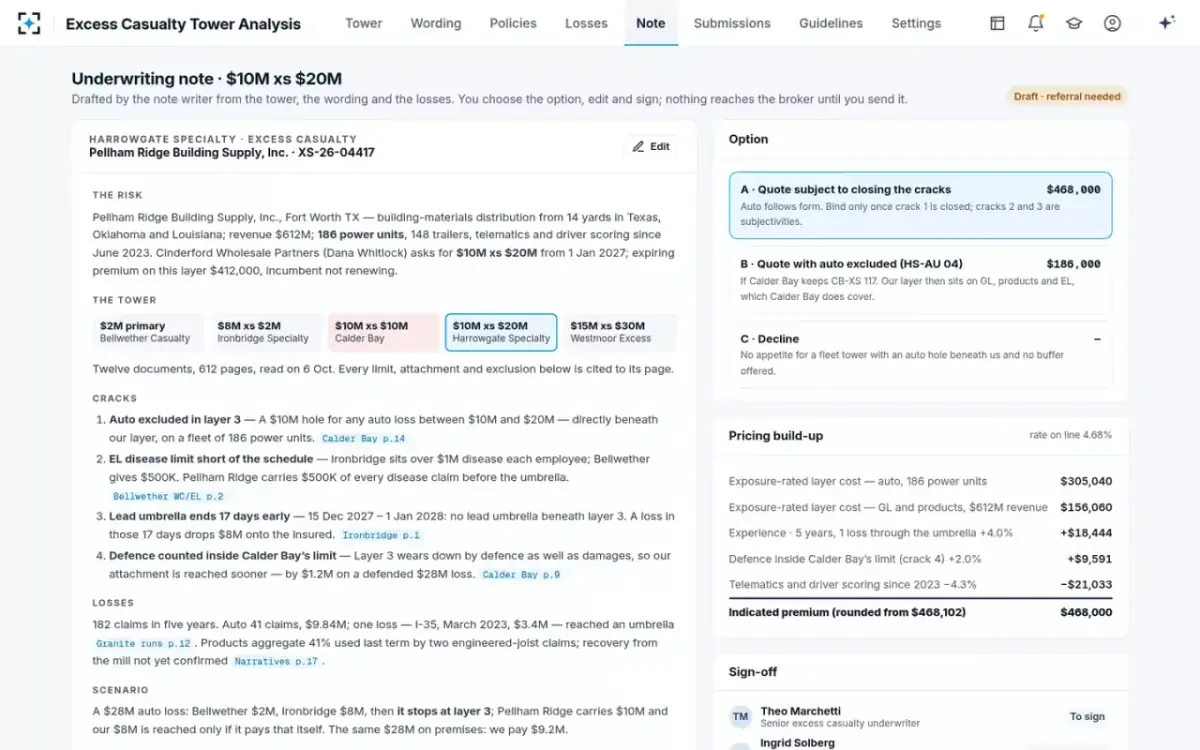
One layer's price in Excess Casualty Tower Analysis: what the reading added, and what one endorsement beneath it was worth
Exposure cost · auto, 186 power units
$305,040
Exposure cost · general liability and products
$156,060
Experience · one loss through the umbrella in five years
+$18,444
Defence inside the limit of the layer beneath
+$9,591
Telematics and driver scoring
−$21,033
Indicated premium, auto following form (option A)
$468,000
If the auto exclusion beneath stays: auto excluded here too (option B)
$186,000
What is an attachment point in insurance?
It is where an excess layer starts. The Supreme Court of California put it this way in 2020: "An excess insurer’s coverage obligation begins once a certain level of loss or liability is reached; that level is generally referred to as the “attachment point” of the excess policy" (Montrose Chemical Corp. v. Superior Court, Cal. 2020). In a tower, each layer's attachment is the top of the layer beneath it, so the attachments stack: $2M, $10M, $20M, $30M on the sample tower.
An attachment point insurance example makes the arithmetic plain. The sample tower has a $2M primary, an $8M lead umbrella excess of $2M, a $10M first excess layer excess of $10M, the requested $10M excess of $20M, and $15M excess of $30M on top: $45M in five layers from five carriers. A $28M loss, if every layer covers it, is paid $2M, $8M, $10M and then $8M by the requested layer. That is the attachment working as written.
"Attachment point" also has a meaning in health stop-loss insurance and in reinsurance, where it marks where a stop-loss or treaty layer begins. The idea is the same; this page is about casualty excess layers. For the treaty side, the casualty reinsurance market guide covers the reinsurers that sit behind them.
What is the difference between an attachment point and underlying limits?
Underlying limits are what the policies beneath can pay; the attachment point is where the layer's own wording says it begins. They are equal only when the schedule is right, the policies cover what the layer covers, and nothing has been used up. Many excess forms fix the attachment by reference to the scheduled limits, whether or not those limits are actually available, and leave any shortfall with the insured. The schedule of underlying insurance guide shows how often the two drift apart.
That arrangement protects the excess carrier on paper and exposes it in practice. A shortfall the insured carries is a shortfall the insured may not be able to pay, and an insured left with a large uninsured band has every reason to argue that a layer above should respond. The price of the layer should reflect both the paper and the practice.
Four things that move a layer's real attachment
The stated attachment moves for four reasons, and each can be found in the documents before the layer is priced.
What moves the real attachment point of an excess layer, and where to find it
| What happens beneath the layer | Effect on the real attachment | Sample tower, or the source |
|---|---|---|
| A line excluded in a lower layer (a gap) | For that kind of loss, the layer is reached only if the insured pays the gap and the layer's wording accepts that; otherwise never | Auto excluded in the first excess layer: a $10M band beneath the requested layer with no auto cover |
| Defence costs paid inside a lower limit | Lower: the layer beneath runs out on damages sooner, so the layer above pays more of each defended loss | Defence inside the first excess layer's limit: $1.2M of defence on a $28M loss moves $1.2M up into the requested layer |
| An underlying aggregate already used | Lower for the next loss of that kind: less is left to absorb it | Products-completed operations aggregate 41% used by two open claims, against the carrier's 33% warning |
| An exhaustion clause that demands payment by insurers | Higher, or out of reach: a below-limits settlement or a gap beneath leaves the layer unreached | Fifth Circuit, Citigroup v. Federal (2011): a $15M settlement of a $50M primary did not trigger the excess layers |
The last row is the one that surprises people. In Citigroup v. Federal Insurance (5th Cir. 2011), the insured settled with its primary insurer for $15M of a $50M limit and then sought cover from the excess layers. Applying Texas law, the court held that the excess policies' "plain language" required the primary insurer to pay "the full amount of its limits of liability before excess coverage is triggered", and declined to apply the older Zeig rule, under which a below-limits settlement could count as exhaustion where the wording was ambiguous. The excess layers' attachment, for that insured, was out of reach. Long-tail claims add a fifth mover, the order across policy years, which the horizontal vs vertical exhaustion guide covers.
What happens to an excess layer when there is a gap beneath it?
It waits, and how long depends on its own exhaustion clause. Excess policies vary in what they accept as exhaustion of the layers beneath. The California Supreme Court quoted three in one tower in July 2026. One accepted payment by the underlying insurers "or the Insured(s) shall have paid the full amount of such liability due to the financial insolvency of an insurer of the Underlying Insurance"; another required that the underlying limits be "paid in legal currency by the issuers of all Underlying Insurance as covered loss thereunder" (Fox Paine & Co. v. Twin City Fire Ins. Co., Cal. 2026).
The sample tower shows the same spread. The requested layer's form accepted payment by the underlying insurers or by the insured; the first excess layer beneath it required payment by underlying insurers; the top layer accepted insurers only. On a $28M auto loss, with auto excluded in the first excess layer, the requested layer's $8M would be reached only if the insured first paid the $10M gap itself.
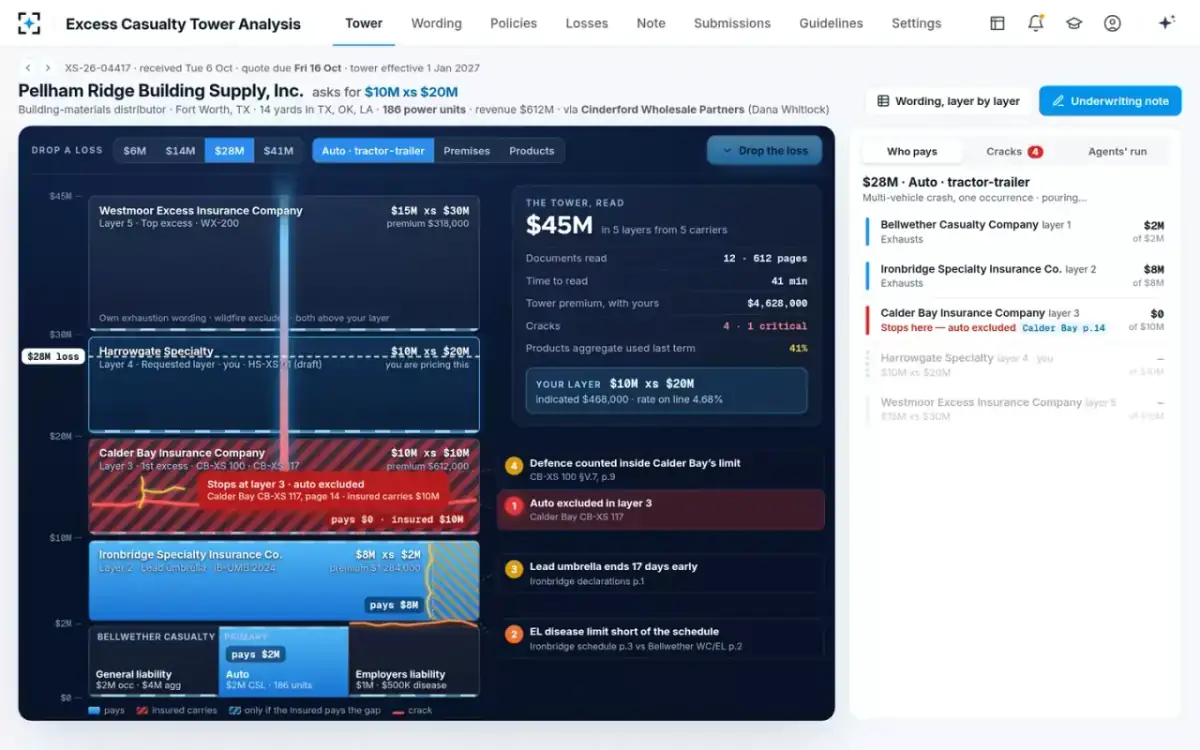
Who carries a $28M auto loss on the sample tower: more than a third falls in the gap
$28M auto loss, one occurrence
- Primary, exhausts · $2M · 7.1%
- Lead umbrella, exhausts · $8M · 28.6%
- The insured, in the gap · $10M · 35.7%
- Requested layer, only if the gap is paid · $8M · 28.6%
A gap also brings the layer into disputes before its attachment is reached. In Fox Paine the California Supreme Court held in 2026 that an insured may sue excess insurers for declaratory relief, and for bad faith, without first alleging that all underlying insurance was exhausted: "We conclude that the absence of exhaustion is not fatal to these claims." The holding was about pleading, not coverage, but for a layer above a disputed gap it means legal cost can arrive before any loss reaches the layer.
Who pays when underlying coverage is missing?
The insured, first. Where a lower layer excludes what the layers above cover, or a scheduled policy is missing, short or expired, the usual maintenance wording treats the missing cover as if it were there, so the excess layers attach at the same point and the insured carries the band in between. What happens next depends on whether the insured can and will pay that band, and on whether the layer above accepts the insured's payment as exhaustion.
Three outcomes follow, and each has a cost for the layer above. If the insured pays the gap and the wording accepts it, the layer pays as priced. If the insured cannot pay, or the wording demands insurer payment, the layer is not reached for that loss, which is cheap for the layer but leaves an insured and a broker looking for someone to blame. And if a court finds the wording ambiguous, the layer may be argued into responding sooner than priced. The drop-down guide sets out when an umbrella has to pay first.
How do coverage gaps affect excess pricing? The expected cost of one missed gap
A missed gap costs the layer in three ways: the loss it ends up paying that it never priced, the legal cost of the disputes the gap invites, and the premium it gave away or failed to charge. None has a published industry rate, so the method below uses the underwriter's own estimates, and the sample tower shows the sizes involved.
The expected cost of one missed gap beneath an excess layer
Losses that land in the gap
Frequency of losses large enough to reach the gap × chance they are of the excluded kind
From the loss runs and exposure: on the sample tower one auto loss in five years reached the umbrella
Excess underwriter
Share the layer ends up bearing
Chance the layer is argued into responding × the band it would pay
Depends on the layer's exhaustion and drop-down wording, and the law that will apply
Coverage counsel and underwriter
Dispute cost
Chance of litigation × expected defence and coverage costs
Fox Paine (2026): in California, an insured need not plead exhaustion to sue an excess insurer for declaratory relief
Claims
Premium mismatch
Price charged − price the layer would have carried with the gap known
Sample: option A at $468,000 with auto following form; option B at $186,000 with auto excluded
Head of excess casualty
The premium term is the easiest to see. On the sample layer, $282,000 of a $468,000 indicated premium, about 60%, depended on whether auto followed form beneath it, because auto exposure from a 186-unit fleet was the larger part of the exposure cost. An underwriter who priced the layer as option A without seeing the exclusion would be charging an auto premium for a layer that, for auto losses, might never be reached, and the broker would discover the mismatch at claim time.
The defence term is smaller but certain. With $1.2M of defence on a defended $28M premises loss, the first excess layer's damages cover runs out at $8.8M and the requested layer pays $9.2M instead of $8M. The note writer loaded 2.0% for it, $9,591, within the sample carrier's guideline of 1–3% for defence inside a limit below.
On a defended $28M premises loss, defence inside the layer beneath moves $1.2M into the requested layer
What is a minimum attachment point?
It is the lowest attachment at which a carrier will write a layer for a given kind of risk, set in its underwriting guidelines. It keeps a desk's capacity above the band where losses are frequent. On the sample carrier's guidelines, the first rule sets a $10M minimum attachment for fleets over 150 power units; the requested $20M attachment passed.
A minimum attachment only protects a desk if the attachment is real. A layer attaching at $20M over an auto gap from $10M to $20M is, for auto losses, sitting directly on the insured's own money. The guideline that matters as much as the minimum is the one requiring every layer beneath to cover the same lines, which on the sample desk is a separate rule and the one the auto exclusion broke.
Excess Casualty Tower Analysis drops the loss and shows where payment stops
Why the line's results make a missed gap expensive now
Because other liability is the line still losing ground on old years. The NAIC's 2025 results show losses incurred in other liability, occurrence, up $3.1 billion, or 6%, with premiums growing faster on rate increases (NAIC, 2025 full-year results). Its chart of prior-year reserve development by line shows other liability, occurrence, with $7,278 million of adverse development in 2025, the largest of any line, even as the industry as a whole released reserves. The Federal Insurance Office reported that reserve development across the sector was more favourable in 2025 than in any of the previous ten years (FIO, September 2026), which makes the liability line's movement stand out rather than disappear.
For an excess desk the implication is about precision, not appetite. Rate is rising in the line, and an underwriter who charges more for a layer while misreading where it attaches has priced the wrong risk at a higher number.
The note that prices the attachment that actually exists
Questions people ask
Is the attachment point the same as the retention?
Not quite. A retention, or self-insured retention, is the amount the insured itself pays before a policy responds; an attachment point is where a layer begins, usually above other insurance. On an umbrella, the retention applies to claims the underlying policies do not cover, and the attachment to claims they do.
Can an attachment point change during the policy period?
The stated attachment does not, but its effect does. As underlying aggregates are used by claims, less is left to absorb the next loss, and some umbrella forms say the umbrella then pays excess of the reduced limit or takes the place of an exhausted one.
How is rate on line related to the attachment point?
Rate on line is the premium divided by the layer's limit; on the sample layer, $468,000 for $10M is 4.68%. Higher attachments usually carry a lower rate on line, because fewer losses reach them, which is why a hidden gap that lowers the real attachment is under-priced at the stated one.
Who sets the attachment point in a tower?
The broker designs the tower with the insured, choosing limits and layers; each carrier's underwriter then decides whether to write a layer at that attachment under its guidelines. The attachment in the excess policy's declarations, tied to its schedule, is what binds.
Does a higher attachment point always mean less risk?
Only if what sits beneath is sound. A layer above a gap, an expired underlying policy or an exhausted aggregate can be closer to the insured's losses than its attachment suggests, and the Montrose court described how horizontal exhaustion could lift one policy's effective attachment from $30 million to upwards of $750 million.