A schedule of underlying insurance is the list, inside or attached to an umbrella or excess policy, of the policies that layer sits on: each underlying carrier, its policy number, its limits and its policy period. It matters because it is not a summary for convenience. It defines the attachment point, it sets the promise the insured makes to keep those policies in force, and courts read it as the presumptive list of insurance that must be used up before the layer pays. The trouble is that the schedule is usually typed from a broker's spreadsheet, and the policies beneath it are often read only in part, so a schedule can say "follow form, all lines" over an endorsement that excludes a whole line. Botminds' Excess Casualty Tower Analysis exists for that comparison: its agents read every underlying policy and endorsement and check each field of the schedule against the page it came from, before the underwriter prices the layer.
The example on this page is a fictional tower for a fictional steel fabricator; the screens show the solution running on its own fictional sample submission. Legal quotations come from the courts' own published opinions, linked where they appear.
One fictional schedule of underlying insurance, annotated against the policies beneath it
General liability
Carrier and policyAshbourne Casualty Co.
AC-GL 55120
Limits as scheduled$1M each occurrence · $2M general aggregate · $2M products-completed operations aggregate
Period as scheduled1 Jul 2026 – 1 Jul 2027
What the policy itself saysLimits match the declarations. The products-completed operations aggregate is already 55% used by one open claim from a 2025 project; the schedule shows the limit, not what is left of it.
Business auto
Carrier and policyAshbourne Casualty Co.
AC-CA 55121
Limits as scheduled$1M combined single limit
Period as scheduled1 Jul 2026 – 1 Jul 2027
What the policy itself saysThe auto policy was rewritten mid-term when the fleet grew: its declarations run 15 Mar 2026 – 15 Mar 2027. The last 108 days of the umbrella period have no scheduled auto policy beneath them.
Employers liability
Carrier and policyAshbourne Casualty of Texas
ACT-WC 7710
Limits as scheduled$1M each accident · $1M disease policy limit · $1M disease each employee
Period as scheduled1 Jul 2026 – 1 Jul 2027
What the policy itself saysA different company from the one named on the schedule, and the policy number on the schedule reads ACT-WC 7701. Same group, different balance sheet: it matters if either is ever unable to pay.
Lead umbrella
Carrier and policyTenterden Specialty Ins. Co.
TS-UMB 8807
Limits as scheduled$9M each occurrence and aggregate, excess of the scheduled limits
Period as scheduled1 Jul 2026 – 1 Jul 2027
What the policy itself saysMarked "follow form, all lines". Endorsement 14 of 22 adds a designated operations exclusion for steel erection above the third floor, the insured's largest source of large losses.
What is a schedule of underlying insurance?
It is the excess policy's own list of the insurance it expects to find beneath it. Most schedules carry the same columns: the type of coverage, the carrier, the policy number, the limits (each occurrence, aggregate, and any separate products-completed operations or disease limits) and the policy period. The total of the scheduled limits is the attachment point, the level of loss at which the layer starts to pay.
California's Supreme Court catalogued how real excess policies do this when it decided the Montrose exhaustion case in 2020. Describing the stipulated language of more than 115 excess policies, it listed four patterns. The first is the full schedule: "Some policies contain a schedule of underlying insurance listing all of the underlying policies in the same policy period by insurer name, policy number, and dollar amount." The others name a dollar amount and point to a schedule "on file with the insurer", name a dollar amount and some of the insurers, or name only a dollar amount equal to the combined underlying limits (Montrose Chemical Corp. v. Superior Court, Cal. 2020). Each pattern gives the excess underwriter a different amount to check against.
Four ways an excess policy names its underlying insurance, and what each leaves to check
| How the excess policy describes its underlying | What it fixes | What the underwriter still has to read |
|---|---|---|
| A full schedule: insurer, policy number and amount for each underlying policy | Which policies, by name and number, and their limits | Each policy's endorsements, periods and aggregates, none of which a schedule row shows |
| A dollar amount plus a schedule on file with the insurer | The attachment in dollars | Whether the schedule on file matches the policies actually bound, and who holds the current version |
| A dollar amount plus one or more named underlying insurers | The attachment and part of the cast | Every unnamed policy that fills the rest of the amount |
| Only a dollar amount equal to the combined underlying limits | The attachment in dollars | Everything: which policies make up the amount, and whether they cover what the layer covers |
Why does the schedule of underlying insurance matter? It sets the attachment and the promise
The schedule matters for three reasons, and only the first is arithmetic. It fixes the attachment point. It is the list against which exhaustion is judged. And it carries the insured's promise to keep those policies in force, which decides who absorbs a shortfall if they are not.
On exhaustion, the courts read the schedule as close to complete. In Montrose the court accepted the insured's reading of those schedules as "a presumptively complete list of insurance coverage that must be exhausted before the excess policy may be accessed". New York's Court of Appeals had reached the same rule four years earlier in the Viking Pump asbestos coverage case, in part because the excess policies tied their attachment to underlying policies "specifically identified by either name, policy number, or policy limit" in the same period (Matter of Viking Pump, N.Y. 2016). How that list interacts with policies from other years is a question of its own, worked through in horizontal vs vertical exhaustion.
On the promise, the Colorado Supreme Court put it plainly in September 2026. In a footnote to its decision on an insolvent primary carrier, it defined a scheduled policy as one "listed in an excess or umbrella policy’s schedule that must remain in effect for the excess or umbrella policy to operate as intended" (A.R. Wilfley & Sons v. National Union, 2026 CO 64). The policies before that court required the scheduled insurance to "be maintained in full effect during the currency of this policy". The schedule, in other words, is a condition the insured has signed up to, not a description the broker has offered.
Thus, the Federal Policies reflect a calculated allocation of risk from the outset: Wilfley agreed to maintain scheduled underlying insurance, and Federal agreed to sit above the scheduled underlying insurers to cover umbrella/excess claims.
Colorado Supreme Court, A.R. Wilfley & Sons v. National Union, 2026 CO 64
What goes on a schedule of underlying insurance, field by field
Every field on a schedule has a source document, and each source can disagree with it. The useful way to read a schedule is as six claims, each to be confirmed against a page.
Line of coverage. The schedule says general liability, auto, employers liability, and often the lead umbrella. The policy says which coverage forms, which auto symbols and which states. A line that appears on the schedule can still be partly missing in the policy.
Carrier. Insurance groups write through several companies, and the schedule tends to carry the group's brand. The policy's declarations carry the legal entity. The difference decides whose balance sheet stands behind the limit, and, for a surplus lines company, whether any state guaranty association would respond if it failed. Texas, for one, requires every surplus lines contract to state that the insurer is not a member of the state's property and casualty guaranty association (Tex. Ins. Code § 981.101).
Policy number. A typo looks harmless until a policy has to be identified in a dispute over exhaustion, where courts look at whether the excess policy tied its attachment to policies identified by name and number.
Limits. The schedule shows each occurrence and aggregate limits. It does not show how much of an aggregate is already used, whether defence costs erode the limit, or whether a sublimit applies to the kind of loss the excess layer worries about most.
Period. The schedule often repeats the umbrella's own dates for every line. Underlying policies are renewed, rewritten and extended on their own calendars, so the dates on their declarations are the ones that count.
The follow-form label. "Follow form" on a schedule is a summary of dozens of endorsements. The Texas Supreme Court has held that the excess policy's own words decide how much of the underlying policy it adopts (Ohio Casualty v. Patterson-UTI, Tex. 2024); the follow form guide works through that decision.
What the schedule says, and what decides
On the schedule: "Auto"
In the policy beneath it: The coverage form and the symbols that say which autos are covered, and in which states
On the schedule: The group's trading name
In the policy beneath it: The legal entity on the declarations, admitted or surplus lines
On the schedule: Each occurrence and aggregate
In the policy beneath it: What is left of each aggregate, whether defence erodes it, and every sublimit
On the schedule: Often the umbrella's own dates
In the policy beneath it: The dates on each policy's declarations, after any rewrite or extension
On the schedule: "Follow form, all lines"
In the policy beneath it: Every endorsement, including the ones that exclude a line or an operation
Reading the annotated schedule: four discrepancies, four different risks
The fictional schedule at the top of this page has four rows and four problems, and no two are the same kind. That is typical of how schedules go wrong: not one big error but several small ones, each harmless on its own line.
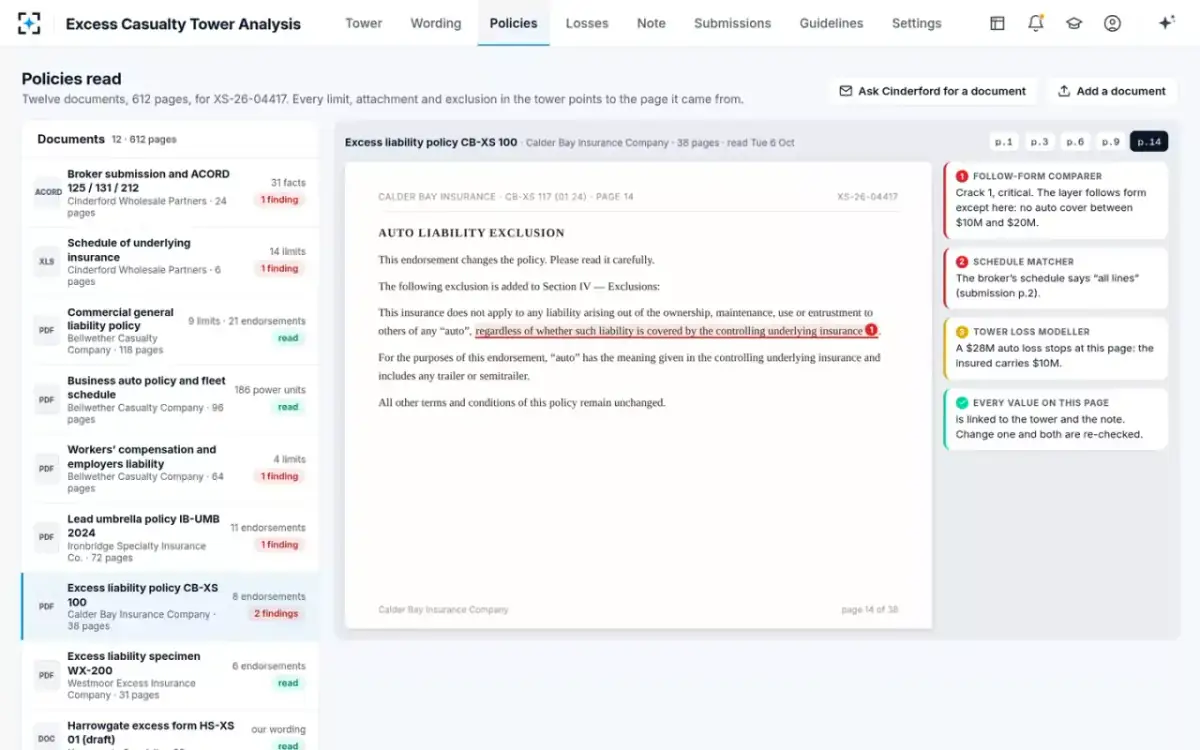
The auto period is the most dangerous. The fabricator's auto policy was rewritten when it added trucks, and its period now ends on 15 March 2027, 108 days before the umbrella's. Unless the auto policy is renewed on that date, the umbrella's last three and a half months sit on nothing, and a truck loss in that window falls first on the insured. The 17-day hole case follows a loss through a gap of the same kind.
The designated operations exclusion is the most expensive. Steel erection above the third floor is where this insured's serious injuries come from, and the lead umbrella excludes it in endorsement 14. A $10M excess layer that follows the lead umbrella would inherit the exclusion, which may be acceptable. A layer that follows the primary instead would sit over a $9M hole for exactly those losses.
The eroded aggregate and the different carrier entity cost less, but they change the picture. More than half of the products-completed operations aggregate is gone before the year starts, so a second products loss reaches the umbrella sooner than the schedule suggests. And employers liability is written by a different company in the group, under a policy number the schedule has wrong.
What happens if underlying limits are lower than scheduled?
Under the usual wording, the insured, not the excess carrier, pays the difference. Many umbrella and excess forms attach above the scheduled limits whether or not those limits are actually there, and pair that with a condition requiring the insured to keep the scheduled policies in force. If a primary policy carries $500,000 where the schedule says $1M, the layer still attaches at the scheduled $1M, and the insured carries the $500,000 between.
That is how the clause worked in the Colorado case. The umbrella policies there said that if the insured failed to maintain the scheduled insurance, the insurer "shall only be liable to the same extent as if the insured had complied with this condition", and the court held that the umbrella did not step down to replace a scheduled primary insurer that had become insolvent. The wording varies from form to form, so the answer for any one layer is in its own conditions and its own definition of the retained or underlying limit. The attachment point guide works through what a shortfall like this does to the price of the layer above it.
For the excess underwriter the practical point is the reverse of the insured's. A shortfall the insured carries is still a shortfall the insured may not be able to fund, and an unfunded gap is where coverage disputes between the insured and the layers start.
What is controlling underlying insurance?
Controlling underlying insurance is the policy whose terms a following-form excess layer adopts, most often the lead umbrella and sometimes the primary. Forms that use the phrase name or describe that policy, and the excess layer then follows its terms except where its own endorsements say otherwise. The excess policy in the Texas Patterson-UTI case worked this way: it said its coverage would follow one named underlying policy, an umbrella, except for the excess policy's own terms, conditions, definitions and exclusions.
The phrase matters for the schedule because the schedule rarely says which policy controls. A schedule that lists a primary and a lead umbrella, and marks every layer "follow form", leaves open whether the second excess follows the lead umbrella's exclusions or the primary's broader grant. Underwriters should ask for the controlling policy by name and read it whole.
Who prepares the schedule of underlying insurance, and who answers for it?
The broker usually compiles it, the excess carrier puts it into its policy, and the insured promises to keep it true. In a submission, the schedule arrives as a page of the umbrella or excess application (commonly the ACORD 131 umbrella and excess section in the United States) or as the broker's own spreadsheet. The excess carrier then sets it into its declarations or a schedule endorsement, sometimes copied, sometimes summarised.
Each hand-off is a chance for drift. The broker types from last year's schedule and this year's binders; the underlying policies are issued weeks later; mid-term changes are endorsed onto the underlying policies without anyone updating the excess schedule. When a loss arrives, the excess policy's schedule is what the excess carrier relies on, and the policies are what the claimant's lawyers will read. The underwriter is the one person in the chain paid to compare the two before the layer is bound.
Excess Casualty Tower Analysis reads the schedule against the policies it summarises
Checking a schedule of underlying insurance: eight comparisons before pricing
A schedule check is a set of comparisons, each between one field and one page. Done by hand it is slow because the pages are scattered across a dozen documents; the comparisons themselves are simple. The list below is the order we would work in, from the cheapest to settle to the most consequential.
Eight comparisons Excess Casualty Tower Analysis makes on any schedule of underlying insurance
- Carrier: the legal entity on each declarations page
Not the group name. Note whether it is admitted or surplus lines in the insured's home state.
- Policy number: one for one
Every scheduled policy should be one you have read, under the number the excess policy will cite.
- Each occurrence and aggregate limits
Including products-completed operations and employers liability disease limits, which are often scheduled at the wrong figure.
- What is left of each aggregate
From the loss runs, at a stated valuation date. A schedule shows the limit, never the erosion.
- Defence costs: inside or outside each limit
Defence inside a limit wears it down faster, so the layer above is reached sooner.
- Policy periods, day by day
Every underlying period against the layer's own. Any mismatch is a hole for the days it lasts.
- Every endorsement on the controlling policy
Exclusions of a line, an operation, a product or a location: the gaps "follow form" hides.
- The excess layer's own conditions
Maintenance of underlying insurance, the definition of the underlying limit and how exhaustion is achieved.
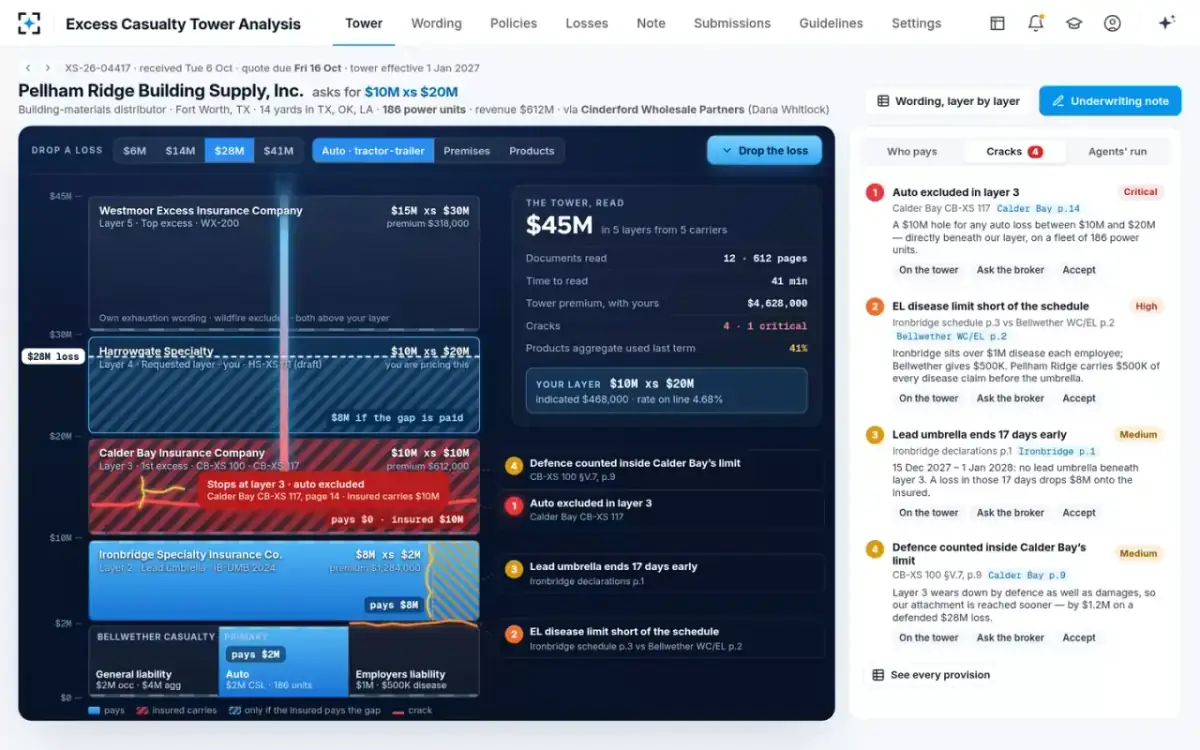
In the solution, two agents share the work. The schedule matcher compares the broker's schedule and the ACORD forms with the policies actually supplied, field by field, and cites both sides of every difference; it never accepts the schedule over the policy. The follow-form comparer then compares every layer with the lead umbrella, provision by provision. On the sample submission, the schedule matcher took a little over three minutes to check the schedule and the ACORD forms against nine policies and found three mismatches; the other 38 limits and all five attachments agreed.
A limit short of the schedule, ranked and cited beside the tower
When a schedule and a policy disagree, which wins?
The policy wins on what the underlying insurance covers; the schedule usually wins on where the excess layer attaches. Those are different questions, and confusing them is how a gap reaches a claim. An underlying exclusion the schedule does not mention is still in the underlying policy. An underlying limit lower than the schedule's figure usually does not lower the excess attachment. Either way the difference lands on the insured first, and on the excess carrier's coverage position second.
Excess Casualty Tower Analysis is built on the first half of that rule: the policy decides, not the schedule, and both sides of every difference are cited. What the difference means for the layer, a subjectivity, a price load or a decline, stays with the underwriter, who signs the note.
Questions people ask
Is the schedule of underlying insurance part of the excess policy?
Usually, yes. It appears in the declarations or as a schedule endorsement, and the excess policy's attachment and maintenance conditions refer to it. Some policies only state a dollar amount and refer to a schedule held on file, which the California Supreme Court listed as one of four patterns in Montrose.
Does the excess policy rely on the schedule or on the underlying policies?
On both, for different things. The schedule fixes the attachment and the list of policies that must be exhausted; the underlying policies decide what is actually covered beneath the layer. Courts in California and New York have read the schedule as the presumptive list of same-period insurance to be exhausted.
What is the difference between a schedule of underlying insurance and a certificate of insurance?
A certificate tells a third party that insurance exists; it is information, not part of any policy. A schedule of underlying insurance is a term of the excess policy itself, and its accuracy decides where the layer attaches and what the insured has promised to maintain.
Should the schedule show aggregate erosion?
It rarely does, and it should be checked separately. An aggregate already half used by open claims means the layer above is reached sooner for every further loss of that kind; the loss runs, read at a stated valuation date, are the source for what is left.
What should a broker send with a schedule of underlying insurance?
The full policies beneath the layer, with every endorsement, not only declarations pages; the loss runs from each carrier; and any mid-term changes to an underlying policy. Most discrepancies between a schedule and the policies are found in endorsements and in periods, and neither shows on a declarations page summary.