Horizontal vs vertical exhaustion is the question of the order in which a policyholder can reach its excess insurance when one long-tail injury, such as pollution or asbestos exposure, spans several policy years. Under horizontal exhaustion, every policy with a lower attachment point, in every triggered year, must be used up before any higher layer in any year pays. Under vertical exhaustion, the policyholder can reach an excess layer once the policies directly beneath it in the same year are exhausted. The Supreme Court of California chose vertical exhaustion in Montrose in 2020, and New York's Court of Appeals did the same in Viking Pump in 2016; both said the answer comes from the policy wording, not from a rule of law that overrides it. For an excess underwriter that makes exhaustion a reading task: what the layer's own attachment, schedule and exhaustion clauses say. Botminds' Excess Casualty Tower Analysis reads that wording in every layer of a tower and puts it beside the lead umbrella's, so the underwriter sees how the layer is reached before pricing it.
One court's own example: the same nine policies, reached in two different orders
Horizontal exhaustion
Every layer, in every year, before the layer above
- 1Primary · Y1
- 2Primary · Y2
- 3Primary · Y3
- 41st excess · Y1
- 51st excess · Y2
- 61st excess · Y3
- 72nd excess · Y1
- 82nd excess · Y2
- 92nd excess · Y3
Vertical exhaustion
Up one year's tower once the layer directly beneath is used
- 1Primary · Y1
- 2Primary · Y2
- 3Primary · Y3
- 41st excess · Y1
- 52nd excess · Y1
- 61st excess · Y2
- 72nd excess · Y2
- 81st excess · Y3
- 92nd excess · Y3
What is horizontal exhaustion? What is vertical exhaustion?
They are two answers to one sequencing problem. In Montrose the insurers argued for a rule of "horizontal exhaustion," whereby the insured "may access an excess policy only after it has exhausted other policies with lower attachment points from every policy period in which the environmental damage resulting in liability occurred." The insured, a former DDT manufacturer facing cleanup costs it put at more than $100 million, asked for the opposite: the right to any excess policy "once it has exhausted directly underlying excess policies for the same policy period" (Montrose Chemical Corp. v. Superior Court, Cal. 2020).
The rules only diverge when injury runs through several years and the courts let every triggered year's policies respond. That was Montrose's position: 40 insurers had issued more than 115 excess policies to it between 1961 and 1985, and the damage ran from 1947 to 1982. A single truck crash on one day triggers one policy period, and the excess layers that year are reached in the ordinary way, from the bottom up.
Under horizontal exhaustion the insurers with the lowest layers across all years pay first. Under vertical exhaustion the insured can choose a year and climb its tower; the insurer that pays can then seek contribution from insurers in other years. The difference is who does the work of spreading the loss, and when the insured gets paid.
What did Montrose decide about exhaustion?
The Supreme Court of California held that, under the policies before it, the insured "is entitled to access otherwise available coverage under any excess policy once it has exhausted directly underlying excess policies for the same policy period." Insurers that pay can still seek reimbursement from insurers that covered other years. The decision was unanimous, written by Justice Kruger, on 6 April 2020.
The court's reasons were textual first. The excess policies stated their attachment points, generally as a dollar amount of underlying insurance in the same policy period, and their schedules listed policies "all for the same policy period." (What else a schedule fixes is set out in the schedule of underlying insurance guide.) The insurers relied on "other insurance" clauses, which the court said had traditionally been used to stop double recovery when concurrent policies overlap, not to set an order among successive years. It noted that courts in New York, Wisconsin, Utah, Massachusetts and New Jersey had read such clauses the same way.
Its second reason was practical, and it is the one an excess underwriter should remember. Policies across 25 years did not line up into neat horizontal layers. "If one were to stack the excess policies on a graph based on their coverage limits or attachment points, the first layer of excess insurance in 1984, for example, would appear to reach as high as the 13th layer of excess coverage in 1974." And each lower policy's exclusions would have to be litigated before the next layer could be reached.
[H]orizontal exhaustion would create as many layers of additional litigation as there are layers of policies.
Supreme Court of California in Montrose (2020), quoting the Wisconsin Court of Appeals in Westport Ins. Corp. v. Appleton Papers
Two limits on the ruling matter to anyone citing it. The court said parties "are, of course, free to write their policies differently to establish alternative exhaustion requirements". And it left the other conditions of each policy untouched, including "actual exhaustion of directly underlying insurance, according to the specific terms of its excess policies." Vertical exhaustion settles the order; it does not settle whether a layer beneath has been exhausted in the way the policy above requires.
Which states follow horizontal exhaustion?
There is no reliable list, because the answer turns on the policy wording in each case rather than on a state-wide rule. The highest courts of California and New York have applied vertical exhaustion to policies that tied attachment to same-period underlying insurance. The opinions also show where horizontal reasoning has been used.
What the courts' own opinions say about horizontal and vertical exhaustion
| Court and year | What it decided or said | Where the rule came from |
|---|---|---|
| Supreme Court of California, Montrose (2020) | Vertical exhaustion for excess policies across 1961–1985 in a continuous-injury case | Attachment stated by same-period underlying amounts and schedules; insured's reasonable expectations |
| New York Court of Appeals, Viking Pump (2016) | All sums allocation and vertical exhaustion for excess policies with non-cumulation provisions | Attachment tied to underlying policies in the same period, identified by name, number or limit |
| New York Court of Appeals, Keyspan (2018) | Under pro rata time-on-the-risk allocation, the insured bears years when no coverage was available | The "during the policy period" language behind pro rata allocation |
| California Court of Appeal, Community Redevelopment Agency (1996), as described in Montrose | A horizontal rule between primary and excess insurers in a contribution action over defence costs | Montrose distinguished it: a dispute between insurers, not between insurers and their insured |
| Illinois Appellate Court, U.S. Gypsum v. Admiral (1994), as cited in Viking Pump | Cited as support for the insurers' view that "other insurance" can include successive policies | New York called that view "not completely baseless" and rejected it for the policies before it |
New York's route is worth following closely because it shows the wording at work. In Viking Pump the Court of Appeals answered two questions certified by the Delaware Supreme Court, and it concluded that "vertical exhaustion is more consistent than horizontal exhaustion with this language tying attachment of the excess policies specifically to identified policies that span the same policy period" (Matter of Viking Pump, N.Y. 2016). It added a caution of its own: neither method "necessarily militates in favor of insurers or insureds, with much depending on the specifics of the underlying policies and their limits."
Pro rata, all sums, and the years nobody insured
Exhaustion sits on top of allocation, and allocation changes what each year's tower owes. Under all sums, as California applies it, each triggered policy can be asked for the whole loss up to its limits; Montrose described the stacked result, quoting its own earlier case, as one giant "uber policy". Under pro rata allocation, each year answers only for its share of a continuous loss.
Two years after Viking Pump, New York's Court of Appeals showed what pro rata does to the gaps. In Keyspan, a manufactured gas plant cleanup, the question was who bears the years when no insurance was available on the market. The answer was the policyholder: "we hold that KeySpan, not Century, bears the risk for those years during which such coverage was unavailable" (Keyspan Gas East Corp. v. Munich Reinsurance America, N.Y. 2018). The court noted that courts elsewhere had split on this "unavailability" question, some declining to put the policyholder on the risk for those years.
For an excess underwriter the connection is direct. A tower with a missing year, or a layer missing from one year, is a gap under pro rata allocation and a reason for contribution claims under all sums. Either way the missing piece shows up as someone else's argument when a long-tail claim arrives.
Does vertical exhaustion apply to primary policies?
Montrose did not decide it. The court said so in a footnote: "we do not decide when or whether an insured may access excess policies before all primary insurance covering all relevant policy periods has been exhausted." In Montrose itself the parties agreed that all primary coverage had been exhausted, so the question was only how to climb through the excess layers.
The older California authority on primary policies pointed the other way in a different setting. In Community Redevelopment Agency v. Aetna (1996), a primary insurer sued an excess insurer for contribution to defence costs, and the Court of Appeal held that an excess insurer in a continuous-loss case is not required "to ‘drop down’ and provide a defense to a common insured before the liability limits of all primary insurers on the risk have been exhausted." Montrose distinguished that case as a contribution action between insurers and declined to decide whether it was right. The practical reading for an underwriter is that the primary layer, across all triggered years, is still where the first money is expected to come from; when an umbrella can be made to pay first is a separate question, covered in the drop-down guide.
What is elective stacking?
Elective stacking is the policyholder's right, under vertical exhaustion, to choose which year's tower to climb and to stack layers within it. Montrose described the insured's proposal as a rule of "vertical exhaustion" or "elective stacking". It follows from California's all-sums-with-stacking approach, under which, as Montrose quoted its earlier decision, "the insured has immediate access to the insurance it purchased."
Stacking across years is not the same as stacking within one year, and policies can limit both. Non-cumulation and anti-stacking clauses, the provisions at issue in Viking Pump, are written to stop an insured adding together the limits of successive policies for one continuing loss. In that case the clauses pushed New York towards all sums allocation, because they "plainly contemplate" that more than one policy period can cover the same loss, and a pro rata method would have made them pointless.
How does exhaustion affect an excess layer? The real attachment point
The exhaustion rule decides where a layer actually attaches when a long-tail claim arrives, and the gap between the stated and the actual attachment can be enormous. Montrose gave the figure for one Fireman's Fund policy that attached above $30 million of same-period underlying insurance. Over 25 years of continuous injury, horizontal exhaustion "would increase the operative attachment point for this policy from $30 million to upwards of $750 million."
For the layer's price, the useful question is less which rule a court would pick than what the layer's own words commit it to. A layer whose attachment is tied to scheduled, same-period policies should expect vertical exhaustion in California and New York. A layer that wants horizontal exhaustion has to say so in terms, because an "other insurance" clause has not been enough for those courts. And a layer whose exhaustion clause accepts payment by the insured will be reached in cases where one that demands payment by the underlying insurers will not; the attachment point guide prices that difference.
A decision tree for an excess layer: which exhaustion rule is likely to reach it
1Does one injury or occurrence trigger more than one policy period?
YesGo on: the order between years is the question.
NoExhaustion runs up one year's tower. Neither rule is in play; read the layer's exhaustion wording (step 5).
2Which allocation does the governing law apply to these policies: all sums or pro rata?
All sumsAll sums (California; New York where the policies carry non-cumulation clauses): go on.
Pro rataPro rata by time on the risk: each year's tower answers for its own share, and the insured carries uninsured years (New York, Keyspan, 2018). Read each year's tower vertically for its share.
3Does the excess policy tie its attachment to named underlying policies, or a dollar amount, in its own policy period?
YesThe wording points to vertical exhaustion: the rule Montrose (California, 2020) and Viking Pump (New York, 2016) applied.
NoGo on.
4Does the excess policy expressly require exhaustion of insurance from other policy periods?
YesHorizontal exhaustion is what the parties wrote. Montrose said parties are free to write their policies that way.
NoAn "other insurance" clause alone has not been read as that requirement in California or New York: vertical is the likely reading.
5Whatever the rule: how must the layer beneath be exhausted?
If insurers onlyPayment by the underlying insurers only: a below-limits settlement leaves the layer unreached.
If insured tooPayment by insurers or the insured: the insured can fill the gap and reach the layer.
Reading exhaustion wording in a tower: what Excess Casualty Tower Analysis checks
The decision tree needs four pieces of text from each layer: the attachment clause, the schedule or definition of underlying insurance, the other insurance clause and the exhaustion clause. In a five-layer tower that is twenty clauses in five forms, and in practice they are rarely read side by side.
Six questions Excess Casualty Tower Analysis puts to every layer's exhaustion wording
- What exactly is the attachment?
A dollar amount, named policies, or both, and in which policy period.
- Is the schedule same-period and complete?
Courts in Montrose and Viking Pump relied on schedules limited to the same period.
- Does any clause reach other periods expressly?
Montrose said parties may write horizontal exhaustion in; an "other insurance" clause alone was not read that way.
- How must the layer beneath be exhausted?
Payment by underlying insurers, or payment by insurers or the insured.
- Is there a non-cumulation or prior insurance clause?
In Viking Pump these pointed New York to all sums allocation.
- Which law is likely to govern?
New York applied pro rata allocation to the policies in Consolidated Edison (2002) and all sums to those in Viking Pump, because their language differed.
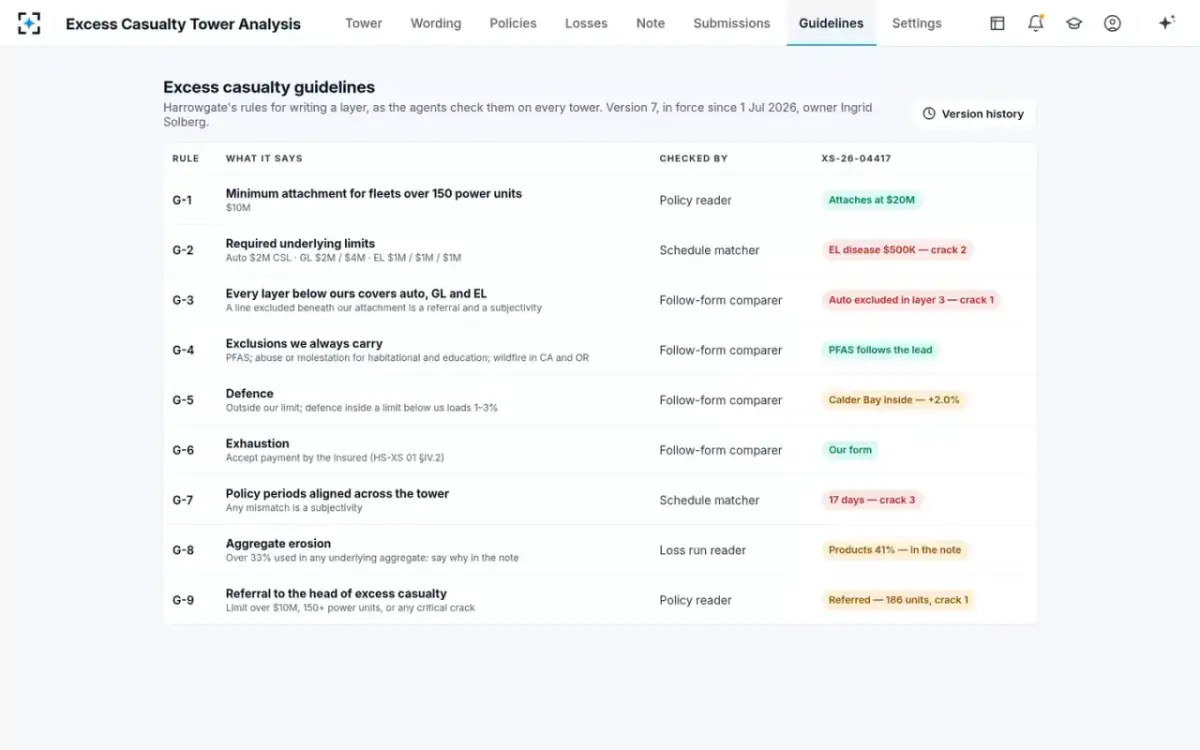
In the solution, exhaustion is one of the twelve provisions compared across every layer, and the carrier's own exhaustion rule is a guideline the agents check. On the fictional sample tower, the requested layer's form accepted payment by the underlying insurers or by the insured, while the layer beneath it required payment by the underlying insurers, and the top layer by insurers only. Those three lines decided whether a $28M auto loss could ever reach the requested layer through a gap.
Excess Casualty Tower Analysis checks each layer against the carrier's own exhaustion rule
Questions people ask
Is vertical exhaustion better for policyholders?
Usually, because it lets the policyholder reach the excess layers of a chosen year sooner. New York's Court of Appeals warned that neither method necessarily favours insurers or insureds, since much depends on the underlying policies and their limits, and non-cumulation clauses can change the arithmetic.
What is California's rule on horizontal exhaustion?
For excess policies that tie attachment to same-period underlying insurance, Montrose (2020) applied vertical exhaustion in a continuous-injury case. It left open whether all primary insurance in all years must be exhausted first, and said parties may write other exhaustion terms if they wish.
What is New York's rule on horizontal exhaustion?
The Court of Appeals applied vertical exhaustion in Viking Pump (2016) to excess policies tied to identified same-period underlying policies, after holding that their non-cumulation clauses required all sums allocation. Where pro rata allocation applies, Keyspan (2018) puts years without available coverage on the policyholder.
Do horizontal and vertical exhaustion matter for a single-occurrence loss?
Rarely. They decide the order across policy periods, so a loss that triggers only one period, such as a truck crash on a known date, climbs that year's tower. What still matters is how each layer must be exhausted, by insurers' payment or by the insured's.
Can an insurer that pays under vertical exhaustion recover from other insurers?
Yes. Montrose said an insurer called on to indemnify may seek reimbursement from insurers that issued policies for other triggered periods; vertical exhaustion changes who carries the administrative burden of spreading the loss, not the insurers' rights among themselves.