Lead umbrella insurance is the first umbrella policy in a liability tower: it sits directly on the primary policies, typically above general liability, auto and employers liability, and it is usually the policy whose terms the excess layers above say they follow. That position makes it the hinge of the tower. Its limits set the attachment of the first excess layer, its exclusions are inherited upward, and its policy period, if it differs from everyone else's, leaves the layers above sitting on nothing for the days it does not cover. This page follows one fictional tower in which the lead umbrella ended 17 days before the primary and the excess layers, through the submission, the binding and a serious truck crash on the eighth day of the gap. Botminds' Excess Casualty Tower Analysis exists to catch exactly this before a layer is priced: its agents check every policy period in a tower against the others and against the broker's schedule, day by day, and cite the page behind each date.
Everything about the tower on this page is fictional and illustrative: the insured, the carriers, the people and the loss. The screens show the solution on its own fictional sample submission, which happens to carry a 17-day lead umbrella gap of its own.
Two windows on one tower: the 57 days to binding, and the last 59 days of the policy year
- Days 1–9: declarations in the file9 days
- Days 10–57: quote, subjectivities, binding48 days
- 1 Feb – 15 Mar: every layer in force42 days
- 15 Mar – 1 Apr: no lead umbrella17 days
What is a lead umbrella, and why does it matter in a tower?
The lead umbrella is the umbrella layer that attaches directly above the primary policies, and it matters because the tower is built on it. In most towers the excess layers above follow its form, so its grants and its exclusions become theirs. New York's Court of Appeals described a tower built this way in its 2016 Viking Pump decision: "The majority of the excess policies at issue also follow form to a “non-cumulation” of liability or “anti-stacking” provision in the Liberty Mutual umbrella policies" (Matter of Viking Pump, N.Y. 2016). One clause in the umbrella decided how the whole tower allocated a long-tail loss.
The lead umbrella also usually does the umbrella's other job: it drops down over claims the primary does not cover, above a self-insured retention. The layers above it generally do not. That is why a fault in the lead umbrella, whether an exclusion, a short limit or a short period, tends to land on the insured rather than on the excess layers; the drop-down guide sets out the clauses.
The tower, as the broker's schedule described it
Hesketh Ready-Mix Concrete runs 140 mixer trucks from four plants. For the year from 1 April 2026 its broker built a $50M tower in four layers. The schedule of underlying insurance in the submission listed every layer for the same twelve months.
Hesketh Ready-Mix's tower: as scheduled, and as the lead umbrella's own declarations read
| Layer | Carrier | Limit and attachment | Period as scheduled | Period on the declarations |
|---|---|---|---|---|
| Primary: auto, general liability, employers liability | Wexcombe Mutual | Auto $1M combined single limit; GL $1M / $2M; EL $1M | 1 Apr 2026 – 1 Apr 2027 | 1 Apr 2026 – 1 Apr 2027 |
| Lead umbrella | Larkhollow Specialty | $9M excess of $1M | 1 Apr 2026 – 1 Apr 2027 | 15 Mar 2026 – 15 Mar 2027 |
| First excess (the layer in this story) | Dunmarra Excess | $15M excess of $10M | 1 Apr 2026 – 1 Apr 2027 | 1 Apr 2026 – 1 Apr 2027 |
| Second excess | Quillon Indemnity | $25M excess of $25M | 1 Apr 2026 – 1 Apr 2027 | 1 Apr 2026 – 1 Apr 2027 |
The difference was in the file from the first day. The umbrella's declarations, attached to the submission, showed 15 March to 15 March. The schedule, typed from the previous year's spreadsheet, showed the program dates for every layer. Nothing else in the submission flagged it; the umbrella's limits, form and exclusions matched what the schedule said.
Days 1 to 57: where the period mismatch could have been caught
It could have been caught on any of the first nine days, and again at binding. On day 1, 4 February 2026, Dunmarra's excess underwriter received the submission: twelve documents, including the umbrella's full policy. Over the next week she read the umbrella's form and endorsements closely, because Dunmarra would follow it, and she checked its limits against the schedule. She took the period from the schedule. On day 12 she quoted $15M excess of $10M, subject to the usual conditions.
Binding came on day 57, 1 April 2026, with the umbrella already two weeks into its own policy year. Nothing about that was visible on the binder, which repeated the schedule. Over the following year Hesketh's broker prepared the program's renewal for 1 April 2027. The umbrella, renewing on its own date, was not renewed on 15 March 2027: its renewal had been folded into the 1 April program by mistake, and no one noticed that its old policy ran out two weeks before the new one would start.
Neither failure was unusual. The underwriter read what mattered most about the umbrella, its wording. The broker renewed a program on its program date. The gap lived in a field each of them took from somewhere else.
What happens if policy periods do not match?
For an occurrence-based tower, a period mismatch is a hole for every occurrence in the days it lasts. Liability policies written on an occurrence basis respond to injury or damage during their own period. The Supreme Court of California summarised its rule for long-tail injury in Montrose: a policy is "triggered if specified harm is caused by an included occurrence, so long as at least some such harm results within the policy period" (Montrose Chemical Corp. v. Superior Court, Cal. 2020). A truck crash happens on one day. If that day is outside the lead umbrella's period, the lead umbrella is simply not there.
The layers above usually do not move down to fill the space. Their maintenance conditions require the insured to keep the scheduled policies in force, and say what happens if it does not. In the umbrella and excess policies the Colorado Supreme Court read in 2026, the condition said the scheduled policies "shall be maintained in full effect during the currency of this policy", and: "Failure of the insured to comply with the foregoing shall not invalidate this policy" (A.R. Wilfley & Sons v. National Union, 2026 CO 64). The policy stays alive; it pays as if the scheduled policy were there. The missing layer becomes the insured's.
The loss on 22 March 2027: a mixer truck in the 17 days
On the eighth day of the gap a loaded Hesketh mixer truck rolled at a highway on-ramp and came down across a car, seriously injuring its two occupants. Liability was not in doubt. Over the next eighteen months the claims were valued, and later settled, at $14M in total, a single occurrence on a single day, 22 March 2027.
Who responded to the 22 March loss, in order
Wexcombe Mutual · primary
Auto policy in force on 22 March: pays its $1M combined single limit and exhausts.
$1M
Larkhollow Specialty · lead umbrella
Policy expired on 15 March: no cover for an occurrence on 22 March.
$0
Hesketh Ready-Mix · the insured
Faces the $9M band the umbrella should have filled, under the first excess layer's maintenance condition.
$9M
Dunmarra Excess · first excess
In force; attaches above $10M as if the umbrella had been maintained, if its exhaustion wording accepts the insured's payment of the band beneath it.
$4M
Quillon Indemnity · second excess
Not reached: the loss stops at $14M.
$0
Who pays a loss in a coverage gap? Three readings of the same tower
The insured pays first, and how much depends on the exhaustion clause of the layer above. Three readings are possible, and each was argued in some form once the claim was presented.
The $14M loss under each reading: what Hesketh Ready-Mix carries
The first reading follows if Dunmarra's form, like some, accepts payment of the underlying limits by the insurers or the insured. Hesketh pays $9M, and Dunmarra pays the $4M above $10M. The second follows if Dunmarra's form requires exhaustion by payment of the underlying insurers, as the excess policies did in Citigroup v. Federal Insurance (5th Cir. 2011), where the court refused to treat anything less than the underlying insurer's full payment as exhaustion. Then the umbrella's $9M can never be "paid" by an insurer, and Dunmarra is not reached at all. The third reading is the insured's argument that Dunmarra should step down into the umbrella's place. The usual maintenance condition, and the Colorado court's reasoning on a different kind of missing umbrella, point against it.
In this story, Dunmarra's form accepted payment by the insured, and Hesketh, with a $9M band to fund, settled with the claimants in stages over eighteen months. What it could recover from anyone else for the lapse was a question for a different forum. For Dunmarra the cost was smaller but real: a $4M payment it had priced, and a year of correspondence over whether it owed more.
Can an excess layer drop down into a gap?
Not usually, and not by default. A follow-form excess layer attaches above the scheduled limits; it has no self-insured retention to drop down to, and its maintenance condition says it pays as if the scheduled insurance were there. The cases in which an excess layer is made to pay lower come from its own words, an express drop-down, an ambiguous exhaustion clause, or a definition of "underlying limit" that counts only collectible insurance. The attachment point guide prices what that uncertainty costs a layer before any court decides it.
How do you check policy periods in a tower?
Against the declarations, every layer, every line, to the day. A period check takes minutes when the declarations are side by side and is easy to skip when they are not.
Five checks for policy periods in any liability tower
- Read every period from the declarations
Not from the schedule, the binder or the application. They repeat the program dates.
- Compare each underlying line separately
A primary auto policy rewritten mid-term can end on a different day from the general liability policy.
- Count the days, both ends
A layer that starts late is a gap too, at the start of the year rather than the end.
- Ask what renews when
Where one layer has its own anniversary, ask the broker how and when it will be renewed or extended.
- Make any mismatch a subjectivity
Extension of the short policy, or a new policy bound for the gap, before your layer binds.
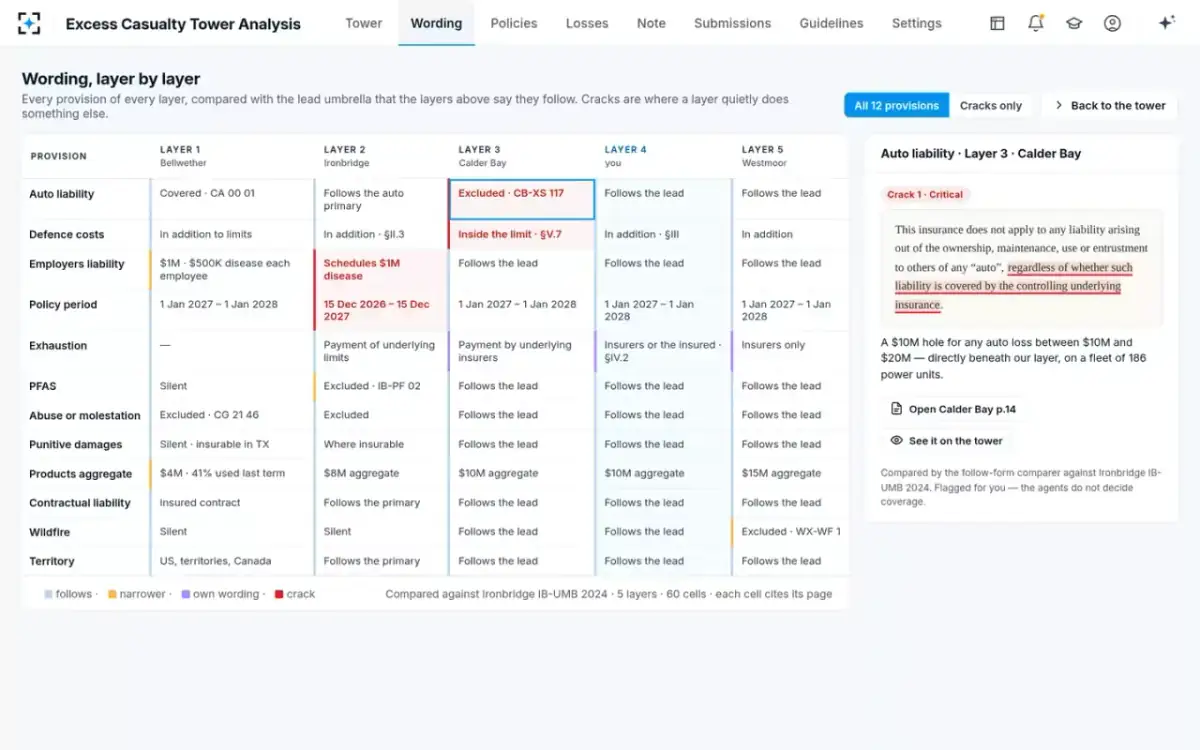
On the solution's sample submission, the period check is the third of four gaps the agents found: the lead umbrella ends 17 days before the layers above, and the drafted note makes it a subjectivity, with the umbrella's period moved or extended before binding. The carrier's guideline in the sample treats any period mismatch as a subjectivity, and its tolerance is set to zero days.
What the solution would have shown on day 1
A ranked gap, with both dates cited. Applied to the Hesketh file, the same comparison would have put the umbrella's 15 March expiry next to the excess layers' 1 April dates as soon as the documents were read, and the drafted note would have carried the subjectivity before the quote went out.
How Excess Casualty Tower Analysis would have caught the Hesketh gap on day 1
Agent
Policy readerReads the umbrella's declarations: period 15 Mar 2026 – 15 Mar 2027, cited to its page.
Never: Takes a date from the schedule when the policy is in the file
Agent
Schedule matcherCompares that period with the schedule and with every layer above: 17 days short at the end of the year.
Never: Accepts the schedule over the policy
Agent
Tower loss modellerDrops a $14M auto loss in the gap: primary $1M, umbrella $0, the insured $9M before the first excess layer.
Never: Produces a price or reserve
Agent
Note writerDrafts the subjectivity: umbrella extended to 1 April 2027, or a new umbrella bound for the gap, before binding.
Never: Sends anything to the broker
A person decides
Excess underwriterAccepts the subjectivity, sends it to the broker with the quote, and binds only once it is met.
Excess Casualty Tower Analysis ranks the 17-day gap and says what it would cost the insured

The period row, layer by layer, against the lead umbrella
Questions people ask
What is a lead umbrella carrier?
The insurer that writes the lead umbrella, the first umbrella layer above the primary policies. Because the excess layers above usually follow its form, the lead umbrella carrier's wording and exclusions often govern how much of the tower responds to a loss.
Is the lead umbrella the same as the first excess layer?
Not always. Some towers have a lead umbrella followed by excess layers; others have a follow-form first excess layer directly over the primary with no umbrella at all, and then nothing in the tower drops down over a claim the primary excludes.
How long can a gap between policy periods be before it matters?
One day. An occurrence on a day when a layer is not in force finds no cover in that layer, whatever its limit. Some carriers set a tolerance in their guidelines; the solution's sample carrier sets it to zero days.
Can a lead umbrella be extended to match the rest of the tower?
Usually, by endorsement extending the period, or by binding a short-period policy for the gap, if the carrier agrees. Either should be in place, and confirmed on the declarations, before the layers above bind.
Who is responsible for a lapsed lead umbrella?
Coverage follows the policies: the expired umbrella does not respond, and the layers above pay as if it were in force. Whether anyone else is responsible to the insured for the lapse, such as the person who arranged the renewal, is a separate question outside the policies.