Drop down coverage on an umbrella is wording that makes the umbrella respond where the underlying insurance would have, instead of only above it. It works in two situations. When an underlying aggregate limit is reduced or exhausted by claims the umbrella would also cover, the umbrella pays above the reduced limit or takes the exhausted policy's place. And when an underlying policy does not cover a claim at all, the umbrella's second insuring part pays above a self-insured retention, as if it were primary. It does not usually work in a third situation people expect: an underlying insurer that cannot pay because it is insolvent. In September 2026 the Colorado Supreme Court held that an umbrella's promise to cover occurrences "not covered" beneath it speaks to the scope of the underlying cover, not to whether it can be collected. Whether a layer really sits over a hole therefore depends on its own drop-down text, read against every exclusion beneath it. Botminds' Excess Casualty Tower Analysis reads both sides of that comparison for each layer of a tower, before the layer is priced.
Who pays a claim the primary excludes: an excess layer that only follows form, and an umbrella that drops down
Excess layer that only follows form
- PrimaryExcludes the product: pays $0
- Excess layerFollows the primary's exclusion, and has no retention to drop down to: pays $0
- The insuredCarries the whole claim: $3M
Umbrella with drop-down wording
- PrimaryExcludes the product: pays $0
- The insuredPays the $25,000 self-insured retention
- UmbrellaDrops down: pays $2,975,000, if its own terms cover the product
What is drop down coverage?
Drop down coverage is any wording that brings an umbrella or excess policy below its stated attachment point, so that it pays losses the underlying insurance would otherwise have paid or never covered. The term is informal; the policies themselves speak of a retained limit, a self-insured retention, or what happens when underlying limits are "reduced or exhausted". The three triggers are worth keeping apart, because the words and the court decisions differ for each.
Three ways an umbrella can drop down, the words that do it, and what courts have said
| Trigger | The words that usually decide it | What courts have held |
|---|---|---|
| An underlying aggregate is used up by claims | "In the event of reduction, pay in excess of the reduced underlying limits"; "in the event of exhaustion ... continue in force as underlying insurance" | Fifth Circuit (2014): an umbrella with this wording attached once the underlying limits were exhausted, even by claims it did not itself cover |
| The underlying policy does not cover the claim | A second insuring part, or a "retained limit" or self-insured retention, for occurrences "not covered" by the underlying insurance | Colorado Supreme Court (2026): "not covered" means outside the scope of the underlying policy |
| An underlying insurer is insolvent | The same "not covered" words, plus whether the policy uses "collectible" and for which policies | Colorado Supreme Court (2026), following federal appeals courts: insolvency does not make a covered occurrence "not covered" |
Does an umbrella drop down when underlying is exhausted?
If its wording says so, yes, and many umbrella forms do. The clause reviewed by the Fifth Circuit in 2014 is a common pattern. Where the limits of the scheduled underlying policies "are reduced or exhausted by payment of one or more claims that would be insured by our Policy", the umbrella insurers agreed: "1. In the event of reduction, pay in excess of the reduced underlying limits of insurance; or 2. In the event of exhaustion of the underlying limits of insurance, continue in force as underlying insurance" (Indemnity Ins. Co. of North America v. W&T Offshore, 5th Cir. 2014).
The case turned on what exhausts the underlying limits. After Hurricane Ike in 2008, the energy company's underlying limits were used up by claims the umbrella policies did not cover, and the umbrella insurers argued they only attached if exhaustion came from claims they would have covered. The court disagreed and rendered judgment for the insured: the reduction-and-exhaustion clause described the insurers' extra duties when exhaustion came from covered claims, but did not stop the umbrella attaching above its retained limit once that limit was used up some other way. It contrasted a Texas policy that said so expressly, applying the policy as if "such aggregate limit [had] not been reduced or exhausted" when exhaustion was "by reason of payment of losses not covered by this policy".
For an underwriter, the lesson is that aggregate drop-down is set by two clauses read together: the definition of the retained limit and the reduction-and-exhaustion clause. A layer that does not want to drop down for aggregates used up by claims it would not cover has to say so in terms. And every eroded aggregate on the loss runs is a place where this clause will be tested; the tower diagram guide shows how to draw erosion so it is seen.
When does an umbrella pay before underlying? Claims the underlying does not cover
When the underlying policy does not cover the claim at all and the umbrella does. That is the "umbrella" half of an umbrella policy, and the reason it is called one. The Colorado Supreme Court described it in 2026: umbrella coverage "provides primary coverage in situations where the primary insurance provides no coverage at all", while excess coverage "constitutes no part of the foundational layer of coverage—it rests atop that foundation" (A.R. Wilfley & Sons v. National Union, 2026 CO 64).
The mechanism is the retained limit. The umbrella policies in that case paid above the greater of two amounts: the "underlying limit", meaning the scheduled limits plus other collectible underlying insurance, or the "retained limit", an amount specified "as the result of all occurrences not covered by said underlying insurance". The second is the self-insured retention. For a claim the primary excludes, the insured pays the retention and the umbrella pays the rest, subject to its own exclusions. Whether a particular umbrella drops down over a particular primary exclusion depends on whether the umbrella carries the same exclusion; umbrellas often repeat the primary's exclusions for the risks the market will not take, which closes the drop-down for exactly those claims.
What is a self insured retention on an umbrella?
It is the amount the insured pays itself, per occurrence, before the umbrella responds to a claim no underlying policy covers. It applies only in the drop-down situation; for claims the underlying policies do cover, the umbrella attaches above their scheduled limits instead. Retentions are set in the umbrella's declarations and vary with the account and the class of business.
The retention matters to the layers above as well as to the insured. An excess layer that follows an umbrella's form inherits the umbrella's drop-down only as far as the excess layer's own wording takes it, and most follow-form excess layers attach above the umbrella's limit, not above its retention. That is one of the differences the follow form guide explains.
What is the difference between umbrella and excess drop down?
An umbrella is designed to drop down; a pure excess policy is not. The excess layer's only trigger is exhaustion of the limits beneath it, so for a claim the underlying excludes it simply stays above, and the insured carries the whole band beneath the excess layer's attachment.
Umbrella and follow-form excess: how each responds when something goes wrong beneath it
Umbrella: May drop down above a self-insured retention, if its own terms cover the claim
Follow-form excess: Follows the exclusion, or attaches above the scheduled limit if its own terms cover the claim; the insured carries the band beneath
Umbrella: Often pays excess of the reduced limit, by its reduction clause
Follow-form excess: Depends on its own attachment wording; many attach only above the full scheduled limits
Umbrella: Often continues in force as underlying insurance
Follow-form excess: Attaches once the layer beneath is exhausted in the way its exhaustion clause requires
Umbrella: Not usually a trigger: courts read "not covered" as scope, not collectibility
Follow-form excess: Not a trigger: the usual maintenance condition leaves the shortfall with the insured
Does excess liability drop down when an underlying insurer is insolvent?
Not under the wording most courts have read. The Colorado Supreme Court answered the question unanimously on 21 September 2026, on a certified question from federal court. A pump manufacturer facing asbestos suits had a scheduled primary insurer, Reliance, that had become insolvent, and it asked its umbrella insurer to step into Reliance's shoes and provide first-dollar defence and indemnity. The court answered "no": "not covered," as used in the umbrella policies, "addresses the scope of coverage, not the collectibility of payment for a covered occurrence."
Because the umbrella/excess policies do not provide protection against the financial misfortune of a scheduled primary insurer selected by the insured, they cannot assume the role the insured urges them to take.
Colorado Supreme Court, A.R. Wilfley & Sons v. National Union, 2026 CO 64
The court leaned on the drafting. The policies used "collectible" only for unscheduled underlying insurance, which told it that collectibility mattered only there. It cited federal appeals courts that had read the phrase the same way, including the Fifth Circuit in 1986: "[W]hen an excess insurer uses the term ‘covered’ or ‘not covered,’ it is agreeing to drop down only in the event that the terms of the underlying policy do not provide coverage for the occurrence or occurrences in question." And it overruled, to the extent of any conflict, a 1989 Colorado Court of Appeals decision that had pointed the other way.
The result is a hole the insured carries. The court acknowledged that the insolvency had "left a crack at the base of the coverage tower"; under the maintenance of underlying insurance condition, the insurer above was liable only as if the scheduled policy had been kept in force. That is why the identity and solvency of each underlying carrier, not only its limits, belongs in a tower review.
Guaranty funds and surplus lines: the insolvency gap nobody drops into
When an admitted insurer fails, a state guaranty association pays some claims, up to a cap, and only after other insurance; when a surplus lines insurer fails, there is usually no guaranty association at all. Both rules shape what is left beneath an excess layer after an insolvency.
California's guaranty association statute is typical of the first. Its "covered claims" exclude "that portion of a claim, other than a claim for workers’ compensation benefits, that is in excess of five hundred thousand dollars ($500,000)", and any claim "to the extent it is covered by any other insurance of a class covered by this article available to the claimant or insured" (Cal. Ins. Code § 1063.1). A $1M primary limit from an insolvent admitted carrier is therefore at most a $500,000 guaranty payment in California, and the association looks first to other insurance.
Surplus lines policies sit outside those funds, which matters wherever a primary, umbrella or excess layer is placed in that market. Texas requires each surplus lines contract to tell the insured that the insurer is not a member of the state's property and casualty guaranty association (Tex. Ins. Code § 981.101; the notice is quoted in admitted vs non-admitted cyber insurance). Florida has the insured acknowledge that the Florida Insurance Guaranty Act will not pay if an unlicensed insurer becomes insolvent (Fla. Stat. § 626.916; the full disclosure is set out in the guide to Florida surplus lines diligent effort). If a surplus lines lead umbrella fails, nothing state-funded replaces it, and under the Colorado reasoning the layers above do not either.
Reading a drop-down clause against each underlying exclusion
The question for a layer is not whether it drops down but for which losses, beneath which exclusions and from what retention. Answering it means pairing each exclusion in the policies beneath with the layer's own coverage grant and exclusions, and the layer's retained-limit and exhaustion clauses with the aggregates and periods beneath it.
Excess Casualty Tower Analysis: how a drop-down question is read across a tower
Agent
Policy readerReads every exclusion in the primary and underlying policies, the umbrella's insuring parts, retained limit, self-insured retention and reduction-and-exhaustion clause, each with its page.
Never: Infers a clause that is not on a page
Agent
Follow-form comparerPairs each underlying exclusion with the same provision in every layer above: follows, narrower, own wording or a gap.
Never: States whether a claim is covered
Agent
Loss run readerShows how much of each underlying aggregate is used, so a reduced-limit drop-down can be seen coming.
Never: Estimates a reserve it was not given
Agent
Tower loss modellerPours a chosen loss down the tower and shows where a layer drops down, where payment stops and what the insured carries.
Never: Produces a price
A person decides
Excess underwriterDecides whether a drop-down exposure is priced, excluded, made a subjectivity or declined; refers under the carrier's guidelines.
On the solution's fictional sample tower, the comparison found the case the Colorado court described in reverse: not an umbrella asked to drop down, but an excess layer above a hole. The first excess layer excluded auto by endorsement while the layer above covered it, leaving a $10M band with no auto cover. Neither layer would drop into it; the insured would carry it, and the requested layer above would be reached only if the insured paid the band itself.
Excess Casualty Tower Analysis draws the hole where it sits, and what would have to be paid to cross it
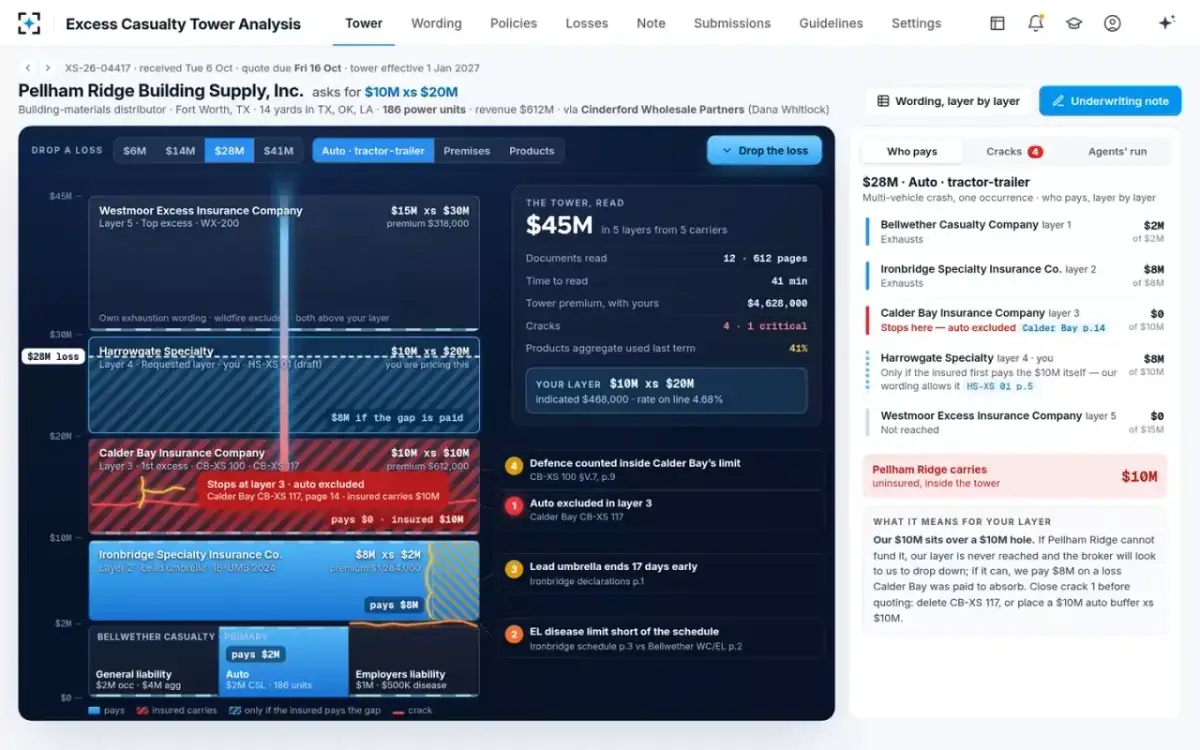
The screen's own note is the excess underwriter's worry in one line: if the insured cannot fund the band, the broker will look to the layer above to drop down. The wording usually says it does not have to. The attachment point guide prices what it costs to find out in a dispute.
Questions people ask
What is a drop down clause?
A clause in an umbrella or excess policy that says when the policy will respond below its stated attachment: usually above a self-insured retention for claims the underlying insurance does not cover, and in excess of reduced underlying limits, or in place of exhausted ones, when underlying aggregates are used up.
What is a drop down exclusion?
An exclusion in an umbrella that removes drop-down cover for a kind of claim, often by repeating the primary's exclusion so the umbrella does not respond where the primary refuses. It is one reason an umbrella that "drops down" in general may not drop down for the claims that matter most.
Does a personal umbrella drop down?
Many personal umbrellas also cover some claims the homeowners or auto policy does not, above a retention, but the terms vary by insurer and state. This guide is about commercial towers; check the personal umbrella's own insuring agreement and retention.
Is drop down coverage the same as follow form?
No. Follow form describes which terms an excess layer adopts from the policy beneath; drop down describes when an umbrella responds below its stated attachment. A follow-form excess layer usually has no drop-down at all.
Who pays when the primary insurer is insolvent?
A state guaranty association may pay part, up to its cap and after other insurance, if the insurer was admitted; California's cap is $500,000 for most claims. Surplus lines insureds usually have no guaranty fund, and the Colorado Supreme Court held in 2026 that an umbrella's "not covered" wording does not make it replace an insolvent scheduled primary.