A follow form insurance policy is an excess liability policy that adopts the terms of an underlying policy, usually the lead umbrella or the primary, instead of setting out a full coverage grant of its own; it pays on those terms once the underlying limits are used up, except where its own definitions, conditions and endorsements say otherwise. That exception is the whole question. In December 2024 the Supreme Court of Texas held that a follow-form excess policy is still its own contract: courts start with the excess policy's text and look to the underlying policy only as far as the excess policy brings it in. A schedule that reads "follow form, all lines" can therefore be accurate as a label and wrong as a description of the layer. Botminds' Excess Casualty Tower Analysis is built to find that difference before pricing: its agents compare each layer of a tower with the policy it says it follows, provision by provision, and cite the page behind every cell.
Follow form is a label; the layer is its text: four combinations an underwriter meets
Schedule says follow form · the excess text adopts the provision
Valid and accurate
The label is true for this provision. The layer responds to this kind of loss on the terms beneath it.
Schedule says follow form · the excess text defines its own terms
Valid, and wrong for this layer
The label passes every form check and still misdescribes the layer: its own definition of loss, its own exclusion endorsement or its own defence wording decides. This is where coverage disputes between layers start.
Schedule says own wording · the excess text adopts the provision
Cautious, and harmless
The schedule undersells the layer. It may be priced as narrower than it is, but no loss falls through it.
Schedule says own wording · the excess text defines its own terms
Known, and priced
Everyone has read the difference. Whether it is a gap is an underwriting decision, made with the wording in hand.
What is a follow form insurance policy?
A follow form insurance policy is an excess layer that borrows its coverage from a policy below it. It can be short, sometimes a few pages of declarations and conditions over a long underlying form, because it does not restate what it covers. Its insuring agreement says it will pay loss in excess of the underlying limits, and that its coverage will follow the underlying policy except for its own terms.
The excess policy in the leading Texas case put it in one sentence: "Except for the terms, conditions, definitions and exclusions of this policy, the coverage provided by this policy will follow the [underlying policy]." Read quickly, that sentence promises identical coverage. Read closely, it promises identical coverage minus everything the excess policy says for itself, and an excess policy can say a great deal for itself in its definitions alone.
The Texas Supreme Court described the convention in 2015 in terms it has since repeated: the parties there agreed the excess policy was "a ‘follow form’ policy, meaning that it is generally subject to the terms and conditions of [the] primary policy except where [the excess] policy expressly modifies those terms." In 2024 it made clear that "generally" was doing real work.
What did the Texas Supreme Court say about follow form?
It said the excess policy, not the underlying policy, is the contract that decides a dispute about excess coverage, follow form or not. The case was Ohio Casualty Insurance Co. v. Patterson-UTI Energy, decided on 20 December 2024. Patterson, an oil-and-gas driller, had built what the court called an "insurance tower" for its 2017–2018 policy year: an umbrella policy from Liberty Mutual Insurance Europe as the underlying, and several excess policies above it, including Ohio Casualty's. A drilling-rig incident led to lawsuits that Patterson settled after extensive litigation. Ohio Casualty paid towards the settlements and refused to pay any of Patterson's defence costs.
The trial court and the Houston court of appeals sided with Patterson: the underlying umbrella covered defence costs, the excess policy followed form, and it did not clearly exclude them. The Supreme Court reversed, and rendered judgment for Ohio Casualty. Its objection was to the method as much as the result. The court of appeals had said "We start from the ground up, first examining the terms of the [underlying] policy and then looking to the excess policy to determine coverage." The Supreme Court called that an inversion.
But even for follow-form excess policies, the contract that governs a dispute about excess coverage is the excess policy, not the underlying policy.
Supreme Court of Texas, Ohio Casualty Ins. Co. v. Patterson-UTI Energy, Inc., No. 23-0006 (20 Dec 2024)
Does follow form mean identical coverage? Three degrees of adoption
No. Follow form means the excess policy adopts the underlying terms to some degree, and the degree is set by the excess policy's own text. The court described a range rather than a switch: "The excess policy could adopt the underlying policy in its entirety; it could do so except for various express exclusions; or it could substantially change the scope of initial coverage by providing its own terms."
Even Patterson accepted the starting point. The court quoted its concession that "Texas courts do not presume that a follow-form policy necessarily follows the entirety of the underlying policy’s coverage." The argument it lost was narrower: that the excess policy had to be read as covering whatever the umbrella covered unless it repudiated that coverage in terms. The court called that "the approach we emphatically reject: starting with the underlying rather than the excess policy."
For an underwriter the practical consequence is a reading order. Read the excess policy's insuring agreement, definitions, conditions and endorsements first; then read the underlying policy only for the provisions the excess policy actually adopts. A layer that defines "loss", "damages", "occurrence" or "insured" for itself has, to that extent, stopped following form.
Do follow form excess policies cover defense costs?
Only if the excess policy's own words cover them. That was the precise holding in Patterson-UTI, and the wording that decided it is common enough to check for in any tower.
Same tower, two definitions: why the umbrella paid defence costs and the follow form excess did not
Underlying umbrella (the policy followed): "Ultimate net loss": what the insured must pay as damages from an occurrence, including all "Defence Expenses".
Ohio Casualty follow-form excess: "Loss": sums actually paid in the settlement or satisfaction of a claim the insured is legally obligated to pay as damages.
Underlying umbrella (the policy followed): Defined separately, to include defence and appeal costs paid or incurred by or on behalf of the insured.
Ohio Casualty follow-form excess: Not mentioned. The court read "damages" in its ordinary sense, which in Texas does not include a party's own attorney's fees.
Underlying umbrella (the policy followed): —
Ohio Casualty follow-form excess: Coverage follows the underlying policy except for the excess policy's own terms, conditions, definitions and exclusions.
Underlying umbrella (the policy followed): Covered the insured's defence expenses (undisputed).
Ohio Casualty follow-form excess: No duty to pay the insured's own defence costs; settlement amounts were paid as loss.
Two details of the reasoning are worth carrying into any review. First, the excess policy's "loss" was limited to sums paid "in the settlement or satisfaction of a claim", which the court read as money paid to the adverse party, like the injury claimants. Second, the court was not moved by the asbestos and pollution exclusions in the same policy, which mentioned attorneys' fees. Patterson argued those references would be pointless if fees were never covered; the court called them "understandable redundancies designed to eliminate any conceivable doubt".
Defence wording matters to a tower even when no one disputes coverage. A layer that pays defence inside its limit is used up faster than one that pays defence on top, so the layer above it is reached sooner on a defended loss. On the solution's fictional sample tower, the first excess layer counted defence inside its $10M limit while the lead umbrella paid defence in addition; on a defended $28M premises loss with $1.2M of defence, the requested layer above would pay $9.2M rather than $8M. That arithmetic is in the attachment point guide.
Can a follow form policy add exclusions?
Yes, and that is how most follow-form gaps are made. An excess policy can follow form and then exclude a line, an operation, a product, a pollutant or a jurisdiction by endorsement. Under Texas law the insurer bears the burden of proving an exclusion it relies on; the Insurance Code places on the insurer the burden to show "[l]anguage of exclusion in the contract or an exception to coverage claimed by the insurer" (Tex. Ins. Code § 554.002, as quoted by the court in Patterson-UTI). But a burden of proof is a rule for litigation. For an underwriter pricing a layer above, an exclusion in a lower layer is a hole whoever has to prove it.
The exclusions that matter most are the ones that remove a line the layers above still cover. On the solution's sample tower, the first excess layer was scheduled as "follow form, all lines" while an endorsement excluded any liability arising out of any "auto", "regardless of whether such liability is covered by the controlling underlying insurance". The requested layer above it followed the lead umbrella and covered auto. The result was a $10M band, between $10M and $20M, in which no insurer paid an auto loss.
Excess Casualty Tower Analysis opens the clause behind the label
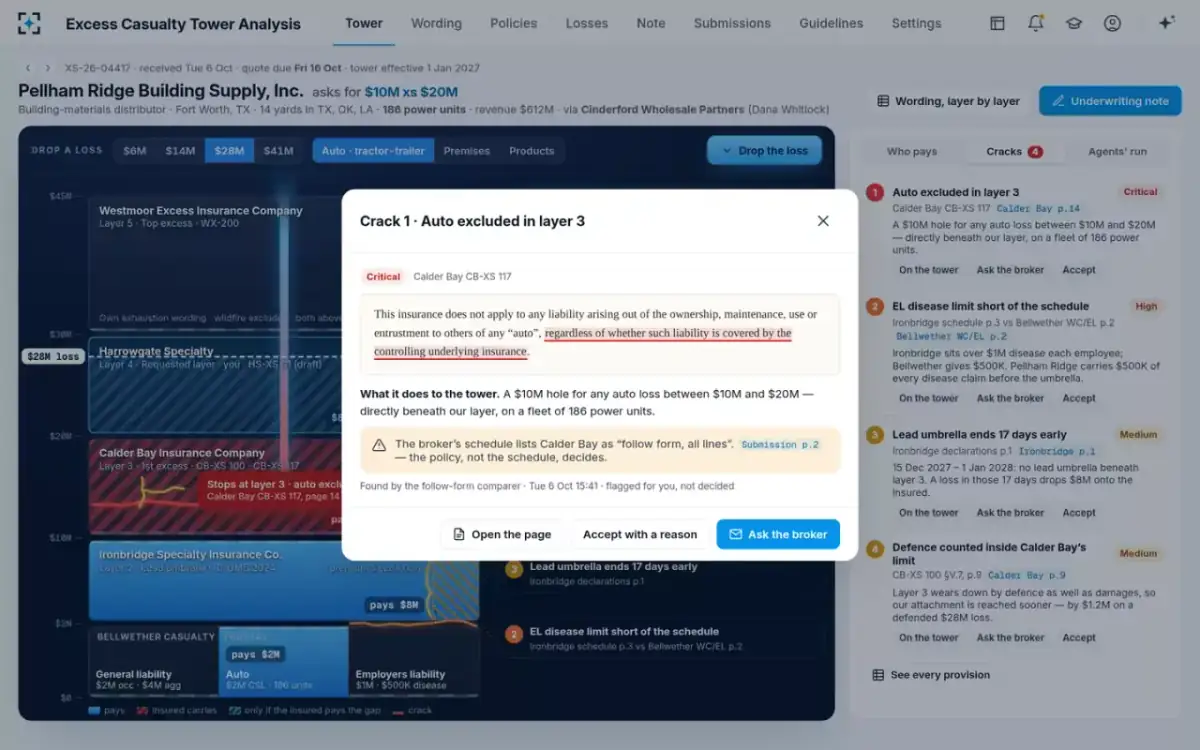
Who pays when a follow form assumption is wrong?
First the insured, then whoever promised the tower would respond. The excess carrier that wrote its own terms pays only on those terms; the insured pays what falls outside them, and then looks for someone to recover it from.
Patterson-UTI shows the sequence. The ruling did not end Patterson's case. Its broker, Marsh, had been sued in the alternative for failing to procure a policy that covered defence costs, and the parties had agreed that a reversal in Ohio Casualty's favour would reopen that claim. The Supreme Court sent it back to the trial court. The cost of the follow-form assumption did not vanish when the coverage question was answered; it moved down the chain of people who had described the tower.
For the excess underwriter, a gap below is not someone else's problem either. If a lower layer's own wording leaves a band of loss uncovered, the insured carries that band, and the layer above it waits. Whether it waits for ever depends on its own exhaustion wording: some layers accept payment of the gap by the insured, others require payment by the underlying insurers, as the exhaustion guide explains. Either way the layer above is exposed to an insured under pressure and to arguments that it should respond where the layer below did not.
What is the difference between follow form and umbrella?
A follow form excess policy only extends limits; an umbrella can also extend coverage. The Colorado Supreme Court drew the line in a footnote in September 2026: umbrella coverage and excess coverage "are markedly different concepts in the insurance context. The former extends the protection afforded by an underlying primary policy, whereas the latter applies only after the limits of an underlying policy have been exhausted" (A.R. Wilfley & Sons v. National Union, 2026 CO 64).
In practice the two are often sold in one form, and the distinction lives inside it. An umbrella typically has two insuring parts: one that sits excess of the scheduled underlying insurance, and one that responds above a self-insured retention to claims the underlying insurance does not cover at all. A follow form excess policy has only the first. That second part is what people mean by drop-down coverage, and its limits are set out in the drop-down guide.
The difference shapes what "follow form" can mean in a tower. Layers above an umbrella usually follow the umbrella, not the primary, so they inherit both its broader grants and its exclusions. A schedule that says "follow form" without naming which policy is followed leaves that choice unstated; the schedule of underlying insurance guide covers how to pin it down.
How do you check if an excess policy follows form? Twelve provisions, every layer
You compare each provision that can change what a layer pays, in each layer, against the policy the layer says it follows, and you note which of four answers applies: follows, narrower, own wording, or a gap. The Patterson-UTI method is the method: start with the excess text, then go to the underlying policy only where the excess text sends you.
Twelve provisions to compare in every follow form insurance policy in a tower
| Provision | What to look for in each layer | Why it matters to the layer above |
|---|---|---|
| Auto liability | An endorsement excluding auto, or covering only scheduled autos | A band of the tower with no auto cover at all |
| Defence costs | Defence inside the limit, or no defence in the definition of loss | Inside: the layer above is reached sooner. Absent: the insured pays defence above the umbrella |
| Employers liability | Disease limits that differ from the schedule; EL excluded | A shortfall the insured carries below the umbrella |
| Policy period | Dates on the declarations, after any rewrite | Days with no layer beneath the layers above |
| Exhaustion | Payment by underlying insurers only, or by the insured too | Whether the layer can be reached at all after a below-limits settlement |
| Pollution and PFAS | A separate exclusion that the underlying form does not carry | A long-tail exposure dropped at one layer |
| Abuse or molestation | Exclusion or sublimit | Common for schools, care homes and hospitality |
| Punitive damages | Silence, exclusion, or a most-favourable-law clause | Insurability varies by state; the wording decides which state's rule applies |
| Products aggregate | A separate aggregate, and how much of it is used | An eroded aggregate moves the attachment down for the next loss |
| Contractual liability | How "insured contract" is defined, or narrowed | Indemnity owed to customers and landlords |
| Wildfire and catastrophe | Exclusion by state or peril | A peril the insured cannot buy back at that layer |
| Territory | Narrower than the primary | Exports, foreign travel, offshore work |
Done by hand, the comparison is a grid of sixty cells for a five-layer tower, and each cell means finding a clause in a policy that, in the solution's sample tower, runs from 31 to 118 pages. That is why it is usually done for the provisions an underwriter already suspects, and why the surprises come from the ones nobody suspected.
Sixty cells, each with its page: Excess Casualty Tower Analysis compares every layer with the lead umbrella
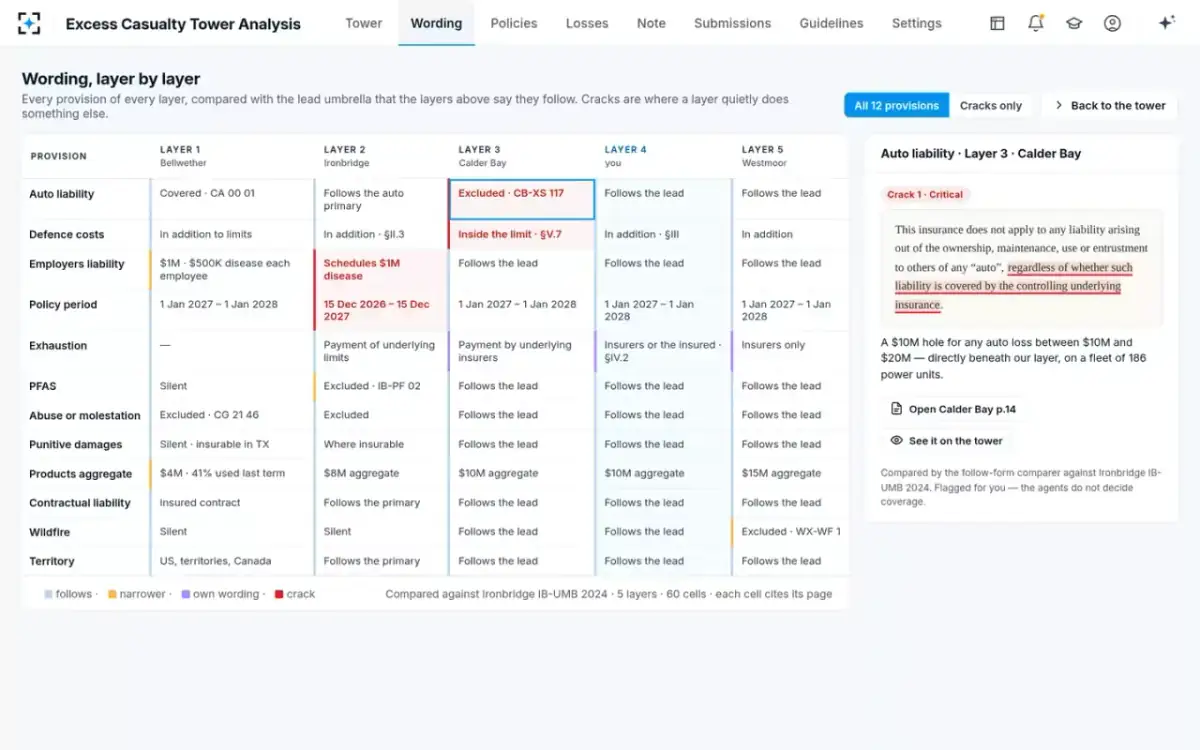
In the solution, the follow-form comparer fills that grid for every tower, against the policy the layers above say they follow, and marks every cell with its page. It flags; it never states a legal conclusion on coverage. The tower loss modeller then applies each layer's own exclusions, defence and exhaustion wording to a loss the underwriter chooses, so a gap is seen as money, not only as a cell. The underwriter decides whether a difference is a subjectivity, a price load or a reason to decline.
Questions people ask
Is a following form excess policy the same as a follow form policy?
Yes. "Following form" and "follow form" are used interchangeably for an excess policy that adopts the terms of an underlying policy except where its own terms differ. The Texas Supreme Court used "follow-form" throughout Patterson-UTI.
What is a non follow form endorsement?
It is an endorsement on an excess policy that sets its own terms for a provision instead of following the underlying policy, often an exclusion or a narrower definition. In Patterson-UTI the departure was not an endorsement at all but the excess policy's own definition of "loss", which is why definitions need reading as closely as endorsements.
Does follow form include the underlying policy's endorsements?
Only as far as the excess policy's wording incorporates them. The Texas court said the degree of incorporation "is determined by the excess policy’s text", so an excess policy that follows "the underlying policy" may or may not take in endorsements issued to that policy after the excess layer was bound.
Who is responsible if a follow form layer does not respond as expected?
The coverage answer comes from the excess policy's text. Who bears the cost of a mistaken expectation is a separate question: in Patterson-UTI the insured's alternative claims against its broker for failing to procure defence cover were sent back to the trial court after the coverage ruling.
Does follow form apply to the underlying policy's limits?
No. Each layer has its own limit and its own attachment, set in its own declarations. Follow form concerns the coverage terms; how the layer is reached is governed by its own exhaustion and maintenance conditions.