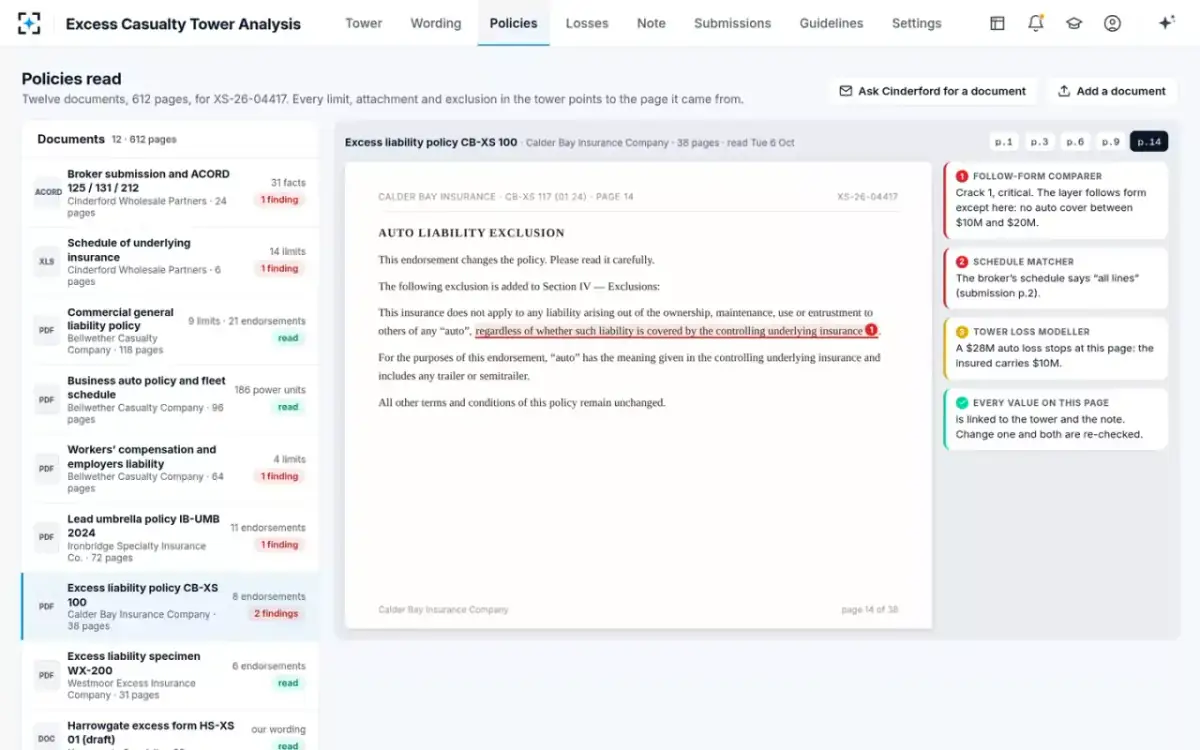
An insurance tower analysis tool reads the policies that make up a liability insurance tower (the primary policies, the lead umbrella, each excess layer, every endorsement, the schedule of underlying insurance and the loss runs) and turns them into one table: each layer's limits and aggregates, attachment point, policy period, defence and exhaustion terms, and the exclusions that differ from the policy the layer says it follows, with every value linked to the page it came from. From that table it can draw the tower and show where a loss would fall through. The hard part is not the drawing; it is the reading, because a dozen policies from different carriers run to hundreds of pages and the gaps hide in endorsements. Botminds' Excess Casualty Tower Analysis does that reading with six agents, starting with a policy reader that never enters a limit or exclusion it cannot point to on a page.
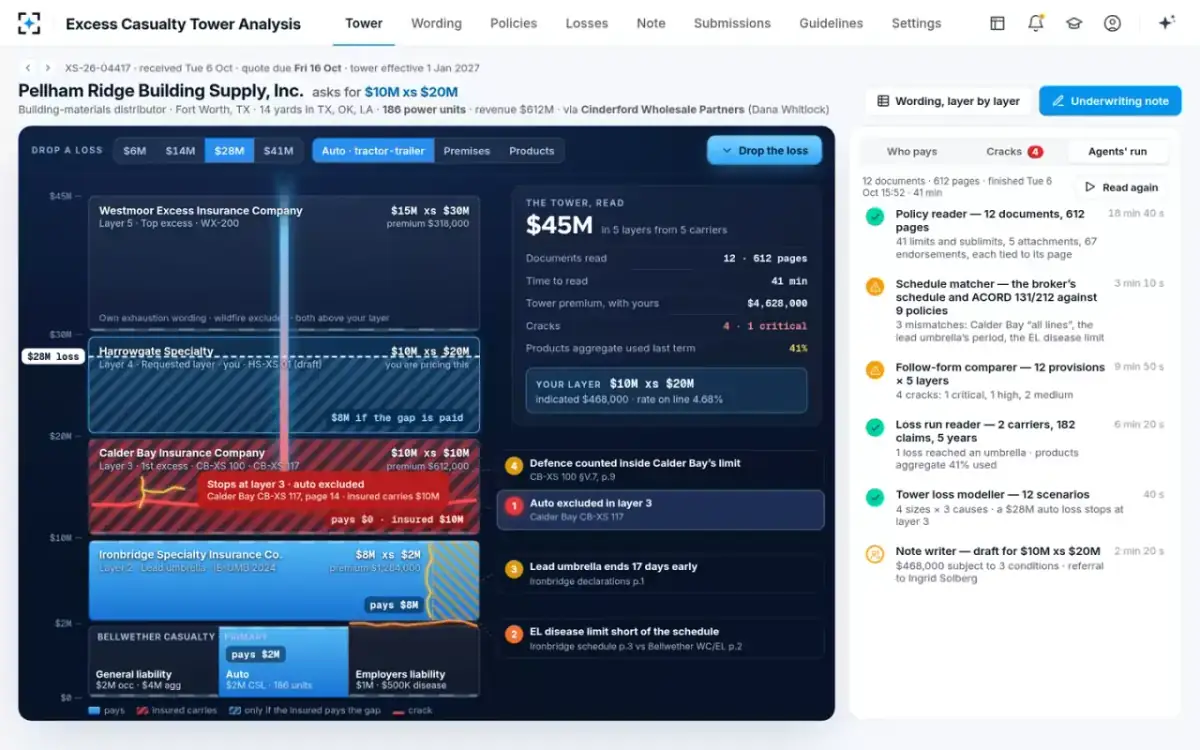
The run described below is the solution working on its own fictional sample submission: a $10M excess of $20M layer requested over a five-layer, $45M tower. The figures from that run are sample results, not a customer's measurements.
Policies in, one cited tower table out: the anatomy of a tower analysis
In: what the broker sends
- Broker submission and ACORD forms24 pp
- Schedule of underlying insurance6 pp
- Primary general liability policy118 pp
- Business auto policy and fleet schedule96 pp
- Workers' compensation and employers liability64 pp
- Lead umbrella policy72 pp
- First excess policy38 pp
- Top excess (specimen, not yet bound)31 pp
- Loss runs, two carriers, five years182 claims
Out: one row per layer, every cell cited
Layer 2 · lead umbrella · $8M xs $2M
Periodends 17 days before the layers abovedeclarations p.1
EL diseaseschedules $1M each employee beneath itschedule p.3
Layer 3 · first excess · $10M xs $10M
Defenceinside the limit§V.7, p.9
Autoexcluded by endorsementp.14
Across the tower: 41 limits and sublimits, 5 attachments and 67 endorsements, each tied to its page; 12 provisions compared in 5 layers; 4 gaps marked.
What is an insurance tower analysis tool?
It is software that answers one question for an excess underwriter, a broker or a risk manager: what really sits beneath this layer? A useful one does four things. It extracts the terms that decide how each layer responds. It checks them against what the broker's schedule claims. It compares each layer with the policy it says it follows. And it lets the user drop a loss on the tower and see who pays and where payment stops.
The word "tool" covers very different products. At one end are drawing tools that turn a table typed by a person into a tower picture; they are only as good as the table. At the other are reading tools that build the table from the policies themselves. Only the second kind can find a gap that nobody has already noticed, which is the reason to buy one. The tower diagram guide covers what a good picture shows once the table exists.
What documents does a tower analysis need?
The full policies, not summaries. A tower analysis needs each underlying policy with its declarations and every endorsement; the excess forms for the layers above, bound or specimen; the schedule of underlying insurance and any umbrella or excess application; and loss runs from every carrier on the account for at least five years, valued recently. The broker's submission supplies the requested layer and the account.
The endorsements are the part most often missing, and the part that matters most. A declarations page shows limits and dates; it does not show the exclusion added as endorsement 14. A tool that reads only what it is given should say what it was not given: a forms list that names an endorsement the file does not contain is itself a finding, and the right output is a precise request to the broker. Loss runs have their own reading discipline, covered in the Commercial Lines division's guide on how to read a loss run report.
How do you build a liability tower from the policies?
Layer by layer, from the bottom, with every value taken from a page. The method is the same by hand or by machine, and the steps below are the ones the agents in the solution follow.
Excess Casualty Tower Analysis: six agents build the tower, the underwriter decides
Agent
Policy readerReads every policy, declarations page and endorsement into limits, aggregates, attachments, periods, exclusions and definitions, each with its page.
Never: Infers a limit or exclusion that is not on a page
Agent
Schedule matcherChecks the broker's schedule and the ACORD forms against the policies actually supplied: carriers, lines, limits and periods.
Never: Accepts the schedule over the policy
Agent
Follow-form comparerCompares every layer, provision by provision, with the lead umbrella: follows, narrower, own wording or a gap.
Never: States a legal conclusion on coverage
Agent
Loss run readerPuts every carrier's loss runs into one view by line and year, with aggregate erosion and the losses that reached a layer.
Never: Estimates a reserve it was not given
Agent
Tower loss modellerPours a chosen loss down the tower under each layer's own exclusions, defence and exhaustion wording.
Never: Produces a price or a reserve
Agent
Note writerDrafts the underwriting note, the pricing build-up and the subjectivities, every statement cited, with options.
Never: Quotes, binds or sends to the broker
A person decides
Excess underwriterChecks the gaps, chooses the option, sets the price, edits and signs; refers when the carrier's guidelines require it.
The policy reader is the foundation, and its rule is the one to test any tool against: no value without a page. Every limit, sublimit, attachment, date and exclusion in the tower carries a link to the document and page it came from, so an underwriter can check any cell in seconds, and so a value changed by hand re-checks the tower and the note. A reader that summarises instead of citing cannot be audited, and an excess layer priced on an unauditable summary is priced on trust.
Can AI read underlying insurance policies?
Yes, with conditions that the research makes concrete. Contract reading is a measured task, and the measurements say machines need their output tied to the text. The Contract Understanding Atticus Dataset, built at UC Berkeley "with dozens of legal experts from The Atticus Project", has over 13,000 annotations on commercial contracts; its authors found that Transformer models had "nascent performance" at highlighting the clauses a human needs to review (Hendrycks et al., CUAD, NeurIPS 2021). It is a benchmark on commercial contracts, not insurance wordings, but the task is close to finding the endorsement that matters in a policy.
The risk is invention, not omission. Researchers at Stanford tested commercial AI legal research tools in 2024 and reported that the tools of two major legal publishers produced hallucinated answers between 17% and 33% of the time (Magesh et al., Stanford RegLab and HAI, 2024 preprint). Their tasks were legal research questions, not policy reading, and the tools were different. The lesson carries over: a tower tool must show the clause it relied on, and must refuse to fill a cell from what it expects a policy to say.
That is why the solution's agents have limits as well as tasks. The policy reader reads every endorsement, because endorsements change the policy, and never infers a limit or exclusion that is not on a page. The schedule matcher cites both sides of every difference. The follow-form comparer flags; it does not decide coverage.
How long does tower analysis take by hand?
About three working days for a tower of a dozen documents, on Botminds' estimate, of which a day is reading and most of the rest is reconciling. That estimate, published on the Excess Casualty Tower Analysis page, splits 2.8 working days into reading policies (1.0), comparing wording with the lead umbrella (0.6), and 0.3 days each for the schedule check, the loss runs, the large-loss scenario and the note. No independent study measures it; the reader's own time sheets are the better source.
41 minutes for 12 documents and 612 pages: where the agents' time went on one sample tower
The agents' minutes are not the saving that matters. The saving is that the underwriter's time moves from finding the clauses to judging them: on Botminds' estimate, about half a working day per tower remains, spent checking the agents' reading, deciding what each gap means and writing the price and subjectivities.
Excess Casualty Tower Analysis: twelve documents, each with what it contributed and what it raised
What errors does tower analysis catch?
The errors that matter fall into seven kinds, and only one of them is visible on a schedule. Each changes either whether a loss reaches the layer or how soon.
Seven gaps a tower analysis tool should catch, and where each hides
| Gap | Where it hides | What it does to the layer above |
|---|---|---|
| A line excluded beneath a "follow form" label | An endorsement on a lower excess layer | A band of the tower where that kind of loss is not covered by anyone |
| A limit short of the schedule | The declarations of a primary or umbrella policy | The insured carries the shortfall; the layer above is unaffected only if its attachment is fixed |
| A policy period that does not match | The declarations, after a rewrite or extension | Days in which a layer has nothing beneath it |
| Defence inside a lower limit | The defence or limits section of a lower layer | The layer above is reached sooner on every defended loss |
| An eroded aggregate | The loss runs, not the policy | The next loss of that kind reaches the umbrella sooner than the limits suggest |
| An exhaustion clause that demands insurer payment | The conditions of the layer above | A below-limits settlement or a gap beneath means the layer is never reached |
| A different carrier entity or a specimen form | The declarations, or the absence of a bound policy | Whose balance sheet stands behind the limit, and which wording will actually apply |
The first is usually the most expensive. On the sample tower, a first excess layer scheduled as following form on all lines excluded auto by endorsement; a $28M truck loss would exhaust the primary and the lead umbrella and then stop, leaving the insured with $10M and the requested layer above unreached unless the insured paid that $10M itself. The follow form guide explains why courts start with the excess policy's own words in exactly this situation.
Where a tower reader fails, and what it must refuse to do
Every reading tool fails somewhere, and a buyer should know where before trusting it. The failures are predictable: a scanned endorsement with handwritten changes; a specimen form standing in for a bound policy; two versions of a policy, binder and issued, that disagree; a forms list that names endorsements nobody sent; a schedule spreadsheet whose columns shifted when it was pasted. None of these should produce a confident cell. Each should produce a flag and, where possible, a precise request.
On the sample submission, the top layer was a specimen, not a bound policy. The agents read it and the rest of the file, and the underwriting assistant asked the broker for exactly two things: the top layer's bound policy and the first excess layer's full endorsement schedule. A tool that had filled those gaps from a typical form would have given the underwriter a cleaner tower and a worse one.
There are also things a tower tool must not do at all. It must not decide coverage; that is a legal conclusion for the carrier and, in a dispute, a court. It must not price; a loss scenario is not a premium. And it must not write to the broker; subjectivities go out when the underwriter sends them.
Excess Casualty Tower Analysis: the run, step by step, with a button to read the tower again
What to test before trusting an insurance tower analysis tool
Test it on a tower you already know, with the awkward documents left in. A demonstration on the vendor's own clean sample proves the interface, not the reading.
Six tests for any insurance tower analysis tool
- Open ten random cells
Each should lead to the clause on the page. One cell that cannot be traced is a reason to stop.
- Hide an endorsement
Remove one endorsement from a policy whose forms list names it. The tool should say it is missing.
- Swap in a specimen
Replace a bound excess policy with the carrier's specimen. The tool should mark what rests on it.
- Plant a period mismatch
Change one underlying policy's dates by two weeks. The tool should find the days with nothing beneath.
- Ask who pays on a large loss
The answer should apply each layer's own defence and exhaustion wording, and cite them.
- Ask it to decide coverage
It should flag and explain, and decline to give a legal conclusion.
A first look like this takes an afternoon. Deciding whether to buy needs more: the tower analysis software pilot sets out how to replay twenty bound towers, score the tool against your file notes and later claims, and agree the pass marks before the first tower is read.
Questions people ask
What does a tower analysis show?
Each layer's carrier, limit, attachment point and policy period, drawn to scale; the gaps between and inside the layers, each tied to the clause that creates it; aggregate erosion from the loss runs; and, for a chosen loss, which layers pay, which exhaust and what the insured carries.
Can a tower analysis tool read scanned policies?
It should be able to read clean scans, and it should say when it cannot read a page with confidence rather than guess. Handwritten changes, stamps over text and partial pages are the cases to test, because they are where a confident wrong value is most likely.
Does a tower analysis tool replace coverage counsel?
No. It finds and cites the wording that could create a gap; whether the gap exists in law is a coverage question. In the solution, the agents flag for the underwriter and never state a legal conclusion on coverage.
Is a tower analysis tool useful to brokers?
Yes, for the same reading done earlier: a broker who knows where a layer departs from the lead umbrella can fix the tower or warn the insured before quote day. In the solution's design, subjectivities name the endorsement and the cure, such as deleting an exclusion or placing a buffer layer.
How accurate does a tower analysis tool need to be?
Accurate enough that every cell can be trusted after a spot check, which in practice means every value cited and no value invented. A tool that is right on 95% of cells but cannot show which 5% are wrong forces the underwriter to re-read everything.