Evidence of insurability (EOI) is proof of good health that a group life or disability insurer asks for before it approves coverage it would not grant automatically: usually an amount above the plan's guaranteed issue limit, an election made after the enrollment window, or an increase larger than the plan allows without questions. In practice it is a health questionnaire, sometimes called a statement of health, signed by the employee or the spouse being covered, with an authorization that lets the carrier check prescription and insurance records and, if needed, ask a doctor for a statement. Until the carrier approves it, only the amount that needed no evidence is in force. Botminds' Evidence of Insurability Automation is software for group carriers that reads each form as it arrives, matches it to the election, checks it under the authorization and readies it for the underwriter's decision.
The idea is simple; the consequences are not. EOI sits between three parties, the employee who answers, the employer who holds the election and the payroll, and the carrier who decides, and the cases that reach court are almost always about one of those hand-offs. This guide gives the definition, the triggers, the rules that allow it in life and disability but not in medical plans, and what happens to coverage while it is reviewed. Product examples use a fictional carrier, Larkspur Life & Group, and its sample data.
When group coverage needs evidence of insurability: the usual triggers
| Trigger | What it means | An example in plan language or rules |
|---|---|---|
| Above the guaranteed issue amount | The election exceeds what the plan grants without health questions | Shields: voluntary life automatically guaranteed to $100,000; more needed “evidence of good health” |
| Late enrollment | The employee enrolls after the window the plan allows | Silva: a request made more than 31 days after becoming eligible was late |
| An increase beyond the plan’s step | Raising coverage by more than the plan allows each year | Silva: an increase of more than one level at annual enrollment needed evidence |
| A salary multiple above the limit | Coverage stated as a multiple of pay above the non-evidence multiple | Silva: the insurer required evidence above three times base salary |
| Spouse or dependent coverage | Spouse amounts above their own, lower, guarantee | Salyers: spouse coverage above $50,000 required evidence |
| Disability buy-ups and late entrants | Short- or long-term disability elected late or above a base plan | Sample carrier rule FL-3: joined after the 31-day window |
What is evidence of insurability?
It is the information an insurer needs to decide whether to cover a person it has not agreed to cover automatically. Group plans make most coverage automatic: everyone eligible gets the guaranteed amount without questions, because the group as a whole is the risk. Evidence is asked for where that logic breaks down, where an individual chooses a larger amount or joins late, because those are the choices a person with a health problem is most likely to make.
The Eighth Circuit put the insurer's interest in one sentence: the insurer in Silva "has an interest in not allowing those who may be very ill from taking out a large life insurance policy shortly before death." The same court noticed what plans often fail to say: the plan in that case never defined evidence of insurability or described the form, and the court treated that silence as a reason the insurer's denial could not simply be upheld.
When is evidence of insurability required?
When the plan says so, and the certificate is where it says so. The triggers in the table above are the common ones: an amount above guaranteed issue, a late election, an increase beyond the plan's annual step, and sometimes spouse or dependent coverage. A carrier cannot add triggers that the plan documents do not contain, and the plan's summary must explain them in plain language.
That last point is a legal requirement, not a courtesy. The rule for summary plan descriptions requires a clear statement of every circumstance that can cost a participant a benefit they might otherwise expect, whether by ineligibility, denial, loss, reduction or recovery (29 CFR 2520.102-3(l); specimen certificate meaning quotes it beside the certificate it governs). In Silva the plan was nearly 100 pages long and served as its own summary, and the court allowed a fiduciary claim against the employer to proceed on the ground that the employee was never given a clear explanation of the evidence requirement.
Why medical plans cannot ask for it, and life plans can
Federal law forbids group health plans from using evidence of insurability to decide who may enroll, and leaves life and disability income insurance outside that rule. The HIPAA nondiscrimination rules list "Evidence of insurability" among the health factors a group health plan may not base eligibility on, alongside health status, medical history and genetic information. The Department of Labor's version of the rule uses the same list.
Life insurance does not pay for medical care, so it is not a group health plan, and disability income coverage is listed among the benefits excepted in all circumstances. That is why the same employee can enroll in the medical plan without a single health question and be asked eleven of them for supplemental life a page later.
Evidence of insurability in group medical plans against group life and disability
Group medical plan: No. Evidence of insurability is a listed health factor.
Group life and disability income: Yes, where the plan says so; these lines are outside the health-plan rules.
Group medical plan: Special and late enrollment rules; no health questions to get in.
Group life and disability income: Late entrants often need evidence for any amount.
Group medical plan: Benefits are set by the plan, not by an individual election.
Group life and disability income: Employees elect amounts; above the guarantee, evidence is asked.
Group medical plan: Protected under GINA and the health-factor rules.
Group life and disability income: Not covered by GINA’s insurance protections; some states add their own.
What EOI means in life insurance, short-term and long-term disability
In group life it usually means a statement of health for supplemental employee or spouse coverage above the guarantee. In disability it is most often asked of late entrants and of employees buying up to a higher benefit; the form may also ask about past absences, because time off work is the risk the coverage pays for. The sample carrier's late-entrant disability rule, for example, tests that the employee has had no absence of more than 10 days in five years.
Whether short-term disability needs evidence depends on the plan. Many base plans cover every eligible employee automatically, and evidence appears only for late enrollment or a voluntary buy-up. On the sample Monday, five late-entrant disability elections went through the carrier's fast lane and were approved by the underwriter in the morning batch; one long-term disability buy-up, with a recent spinal fusion and nine weeks off work, went to an underwriter with a suggestion to decline.
Does a spouse need evidence of insurability?
Often, and usually at a lower amount than the employee. Spouse coverage has its own, smaller guarantee: in the sample carrier's seven employer plans it runs from $10,000 to $30,000, against $50,000 to $150,000 for employees. The spouse answers the questions and signs the authorization, because it is the spouse's health being underwritten.
Dependent coverage can carry a quieter condition. In its June 2024 settlement with Unum, the Department of Labor described policies that covered dependents without evidence but, if a dependent died within two years of issue, reviewed medical records to see whether the dependent had been disabled since enrollment, and if so "would then deny coverage, citing a delayed effective date of coverage." The settlement required that rule to be made clearer to participants and policyholders. How guarantees differ for employees and spouses is worked through in guaranteed issue amount vs benefit amount.
Who has group life insurance through work: access by worker group, March 2026
Does evidence of insurability mean a medical exam?
Usually not. For group coverage the evidence is normally the employee's signed questionnaire, checked under the authorization against prescription history and the insurers' shared exchange; a physician's statement or a lab test is requested only when an underwriter needs one for a specific answer. Most forms are decided on the questionnaire alone.
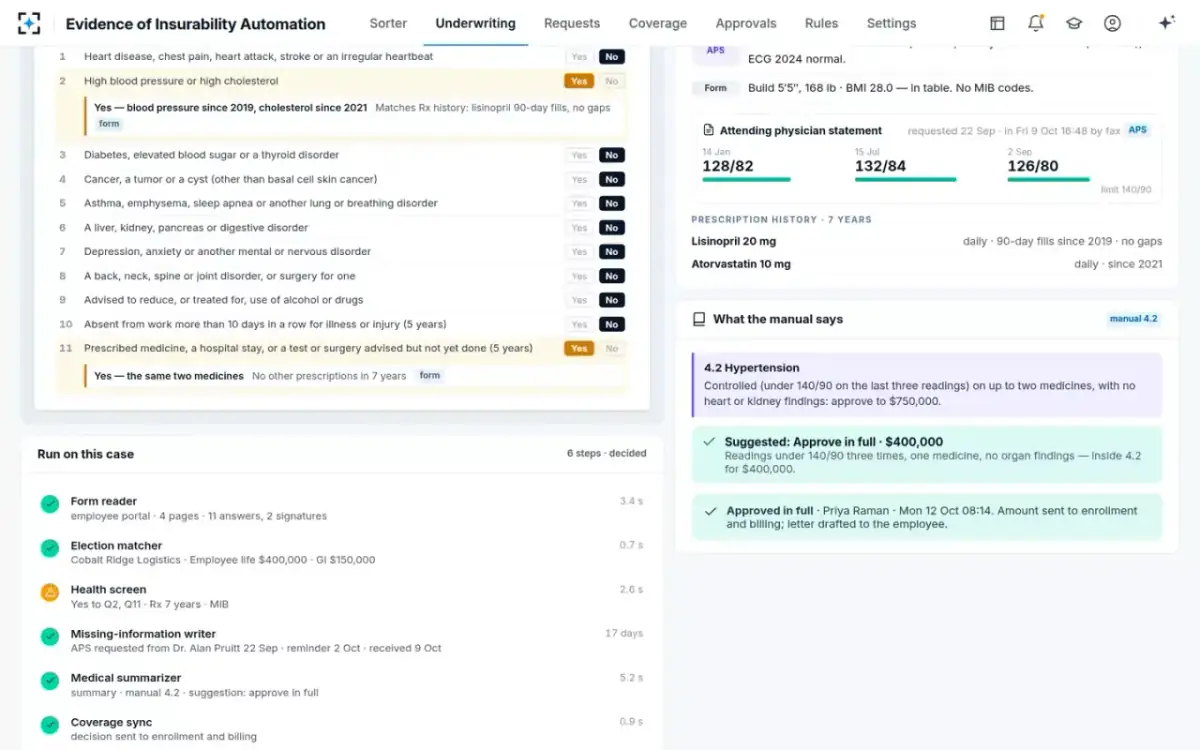
The sample queue shows the escalation in practice. Forms answering Yes to diabetes with metformin fills and no recent blood test on file were suggested "order an A1C", a single lab value, rather than a full examination; Teresa Vance's blood pressure answer led to one physician statement with three readings. Federal tax rules even assume the lighter route for small groups, as the group term life imputed income guide explains.
What happens to coverage and payroll while EOI is reviewed?
The guaranteed amount stays in force, and the excess waits for the decision. Plans say so in their own words; the 2014 enrollment guide in Salyers put it in one line:
"any coverage you elect requiring a statement of health will not take effect until approved by MetLife."
The employer's 2014 open enrollment guide, quoted by the Ninth Circuit in Salyers (2017)
Payroll is where the rule breaks. If the employer's system deducts on the elected amount while the form is reviewed, the employee pays for coverage that has not started, and the pay stub says otherwise. In the sample carrier's daily check of deductions against approvals, six employees across seven employers were paying for coverage nobody had approved. What a pending status means for each party is mapped in EOI pending.
Who decides, and on what evidence
The carrier's medical underwriter decides, on the employee's own answers and, under the signed authorization, records that confirm or contradict them: prescription history, the insurers' shared medical information exchange, and a physician's statement when the underwriter asks for one. In the sample solution the employer sees each employee's status, not the answers. Most forms need no records beyond the screen; in the sample queue 40 of 112 forms had every answer No and clean records, and were approved in one batch with a reason on each.
How one evidence form moves through Evidence of Insurability Automation
A person decides
EmployeeElects coverage above the guarantee, answers the health questions, signs the declaration and authorization.
Agent
Form reader and election matcherRead the form from mail, portal or email and match it to the election and the plan’s guaranteed issue amount.
Never: fill in a blank or change an election
Agent
Health screen and lane sorterCheck answers against build, prescription history and the exchange under the authorization; place the form in a lane with its reason.
Never: approve, or decline on a record alone
A person decides
Medical underwriterApproves the fast lane in one batch; decides every other case from a cited summary.
Agent
Coverage syncSends the approved amount to enrollment and billing and checks payroll against it every day.
Never: send an elected amount
A fast-lane form in Evidence of Insurability Automation, with the reason it was approved
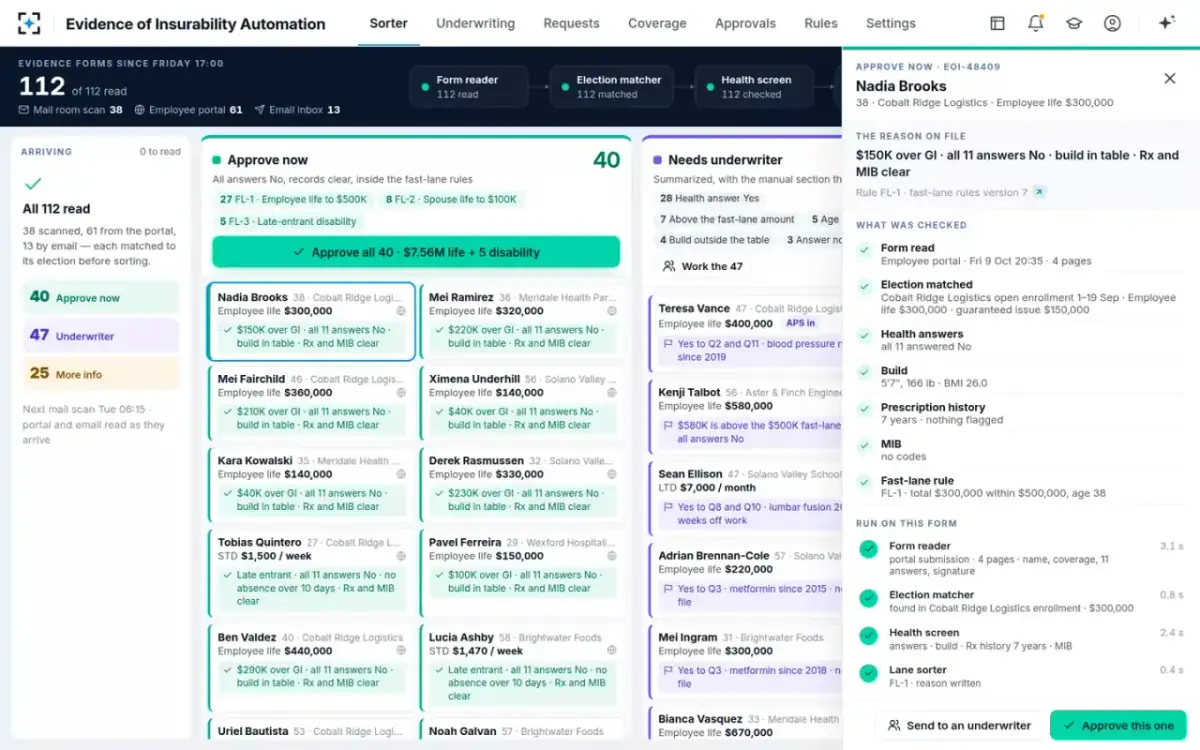
A form like this one is the common case. The harder ones, where an answer is Yes or a record disagrees, go to the underwriter with the evidence and the manual section side by side, and the underwriter's name and time are kept with the decision.
A medical case decided by the underwriter, with every step kept
Who touches an evidence form, and what each keeps
Today
Elects coverage in an enrollment portal and is told a health form may follow, often without knowing why.
With agents
Gets one request naming exactly what is missing, the close date, and what stays in force meanwhile.
Still theirs: The answers and the signature; nobody else can give them.
Today
Holds the election and runs payroll, but rarely sees whether the carrier approved the excess.
With agents
Sees each employee’s status in the employer portal and receives corrected amounts when they change.
Still theirs: Payroll, and the plan documents that explain the rule.
Today
Chases signatures, answers and physician statements one form at a time.
With agents
Reviews and sends requests already drafted for exactly what is missing.
Still theirs: Every message that leaves the carrier.
Today
Reads every form in date order, simple or not.
With agents
Approves the forms with nothing to underwrite in one batch and decides the medical cases from cited summaries.
Still theirs: Every approval and decline.
Every role on that list owns a different piece of the same form. The employee's piece is the answers, and the questions themselves are set out in evidence of insurability questions.
Questions people ask
What does EOI mean in life insurance?
Evidence of insurability: the health information a group life carrier needs before approving coverage above the guaranteed amount, a late election or a large increase. It is usually a signed questionnaire with an authorization to check records.
When is evidence of insurability required?
When the plan says so, most often for amounts above the guaranteed issue limit, late enrollments and increases beyond the plan's annual step. The summary plan description must explain the circumstances that can lead to a denial or loss of benefits.
Is EOI required for short-term disability?
Usually only for late enrollment or a voluntary buy-up above the base plan. The plan decides; the sample carrier's late-entrant disability rule checks the health answers and absences of more than 10 days in five years.
Does a spouse need evidence of insurability?
Often, above a spouse guarantee that is lower than the employee's; in the sample carrier's plans it ranges from $10,000 to $30,000. The spouse completes and signs the form.
What is a statement of health?
Another name for the evidence of insurability form: the applicant's signed answers to the carrier's health questions. Courts and plans use the terms interchangeably.
Why don't medical plans ask for evidence of insurability?
Because HIPAA's nondiscrimination rules list evidence of insurability as a health factor a group health plan may not use to decide eligibility. Life insurance and disability income coverage are outside those rules.