The guaranteed issue amount is the most group life or disability coverage a plan will give an eligible employee without any health questions; the benefit amount is the coverage actually in force, the sum the carrier would pay. They are the same only when an employee elects no more than the guarantee. Elect more, and the election splits in two: the guaranteed part takes effect, and the part above it, the excess, waits for evidence of insurability and becomes part of the benefit only if the carrier approves it. Most confusion, and most of the costly mistakes, come from treating the elected amount as the benefit. Botminds' Evidence of Insurability Automation matches every evidence form to the plan's guaranteed issue amount and the employee's election, and sends only approved amounts to enrollment and billing.
This guide works through the four numbers that sound alike, shows the split on three fictional elections, and answers the questions employees and HR teams ask about the line: whether it is the same for spouses, whether it resets each year, and what happens to the paycheck when an election crosses it. The examples come from a fictional carrier, Larkspur Life & Group, and its sample data; the court cases cited are real.
Four numbers that sound alike, and which one is the benefit
Guaranteed issue amount
The most the plan grants without health questions, to anyone eligible who enrolls on time.
Shields: $100,000 of voluntary life
Maximum amount
The most the plan offers at all, with evidence; often a cap and a salary multiple.
Shields: the lesser of three times salary or $200,000
Elected amount
What the employee chose at enrollment. Above the guarantee, it is a request, not coverage.
Salyers: $250,000 of spouse life
Benefit amount
What is actually in force and would be paid: the guarantee plus any excess the carrier approved.
Shields: $100,000 paid; the $100,000 excess denied
What is a guaranteed issue amount?
It is the coverage level up to which a group plan accepts every eligible person who enrolls on time, with no health questions. The guarantee exists because a group is underwritten as a whole: if every eligible employee can take the same amount, the healthy and the unhealthy take it alike and the price holds. Above that level, choice reappears, and with it the risk that the people electing the most coverage are the ones who expect to need it.
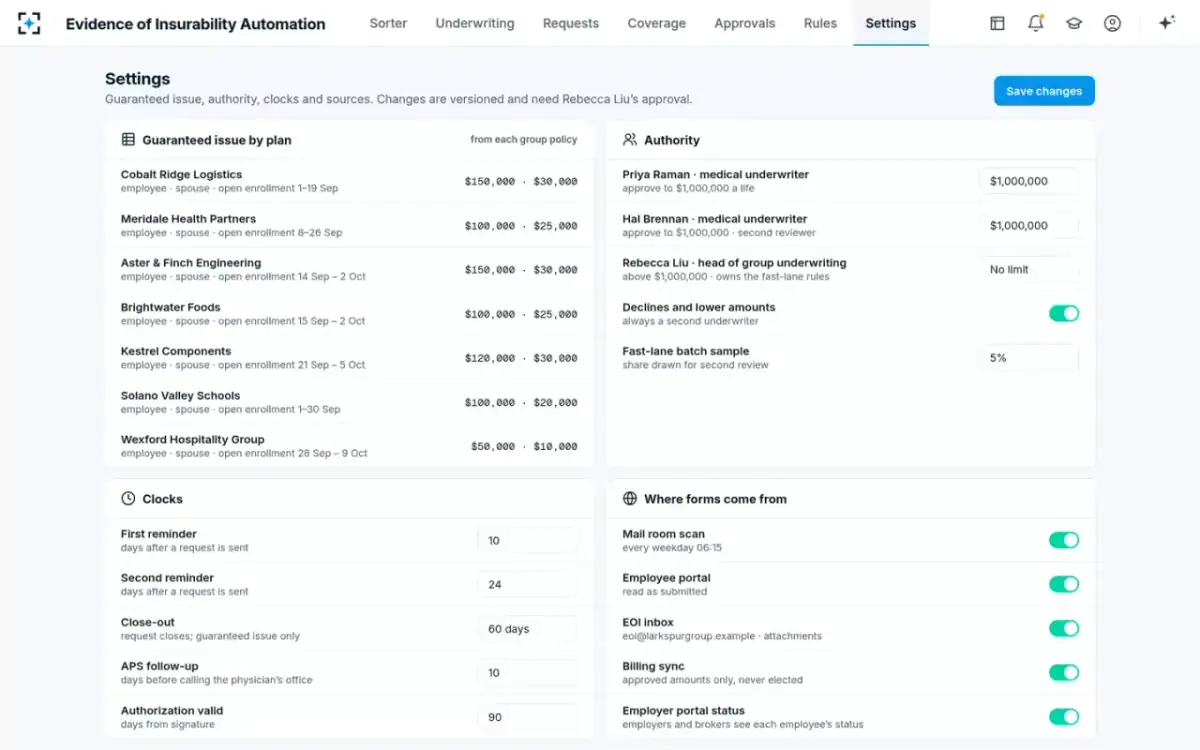
Guarantees are set per plan and often per employer. In the sample carrier's seven employer plans, the employee guarantee runs from $50,000 to $150,000 and the spouse guarantee from $10,000 to $30,000, each read from the group policy. A carrier that applies one number to every employer will send some forms to underwriting that need none and let others through that should have been asked.
Guaranteed issue by plan at the sample carrier: seven employers, seven lines
| Employer (fictional) | Employee guarantee | Spouse guarantee | Open enrollment |
|---|---|---|---|
| Cobalt Ridge Logistics | $150,000 | $30,000 | 1–19 Sep |
| Aster & Finch Engineering | $150,000 | $30,000 | 14 Sep–2 Oct |
| Kestrel Components | $120,000 | $30,000 | 21 Sep–5 Oct |
| Meridale Health Partners | $100,000 | $25,000 | 8–26 Sep |
| Brightwater Foods | $100,000 | $25,000 | 15 Sep–2 Oct |
| Solano Valley Schools | $100,000 | $20,000 | 1–30 Sep |
| Wexford Hospitality Group | $50,000 | $10,000 | 28 Sep–9 Oct |
Guaranteed issue amount vs benefit amount, side by side
The guarantee is a property of the plan; the benefit is a property of the person. The guarantee is the same for everyone in the class. The benefit depends on what the person elected, whether the excess was approved, and sometimes on salary. The First Circuit's Shields case shows all four numbers on one employee. The plan's basic life paid twice annual earnings up to $300,000 with no health evidence. Its voluntary life let employees elect one, two or three times salary, capped at $200,000, and guaranteed the first $100,000.
Myron Shields elected three times his salary. When he died, the carrier paid $236,000: $136,000 of basic life and the $100,000 voluntary guarantee. It denied the other $100,000 because it had never received and approved evidence of good health, though premium for that $100,000 had been deducted for nearly a decade. His benefit amount, on the plan's terms, was the guarantee, not the election. The plan even said as much:
"[p]ayment of premium[s] does not guarantee eligibility for coverage."
The plan in Shields v. United of Omaha, as quoted by the First Circuit (2022)
The court read that sentence narrowly. It did not, the court said, give the insurer a licence to accept premiums indefinitely without determining eligibility, and it sent the family's fiduciary claim back to the trial court. What happened next in cases like it is followed in what happens if EOI expires.
Three elections split at the line
Three employees in the sample data show the three ways an election above the guarantee can end. Nadia Brooks elected $300,000 against a $150,000 guarantee, answered every question No, and was approved in full the next working morning: her benefit equals her election. Samir Qureshi elected $500,000 against $150,000 and was approved at $300,000: his benefit is $300,000. Andre Whitfield elected $300,000 against a $100,000 guarantee and never sent a form: his benefit is $100,000.
Three elections above the guarantee, split into what is in force and what is not
Nadia Brooks · elected $300,000
- Guaranteed $150,000 · 50%
- Approved excess $150,000 · 50%
Samir Qureshi · elected $500,000
- Guaranteed $150,000 · 30%
- Approved excess $150,000 · 30%
- Not approved $200,000 · 40%
Andre Whitfield · elected $300,000
- Guaranteed $100,000 · 33%
- No form: $200,000 not in force · 67%
The line is drawn on every form before anything else is checked. In the sample solution the election matcher finds the employee's election and current coverage, the plan's guaranteed issue amount and the amount above it, and whether the employee joined late; Nadia Brooks's reason on file starts with the amount over the guarantee, because that is the part her answers had to support. A form whose election cannot be found at the employer is not decided at all: it goes back to the employer's enrollment team to confirm the amount.
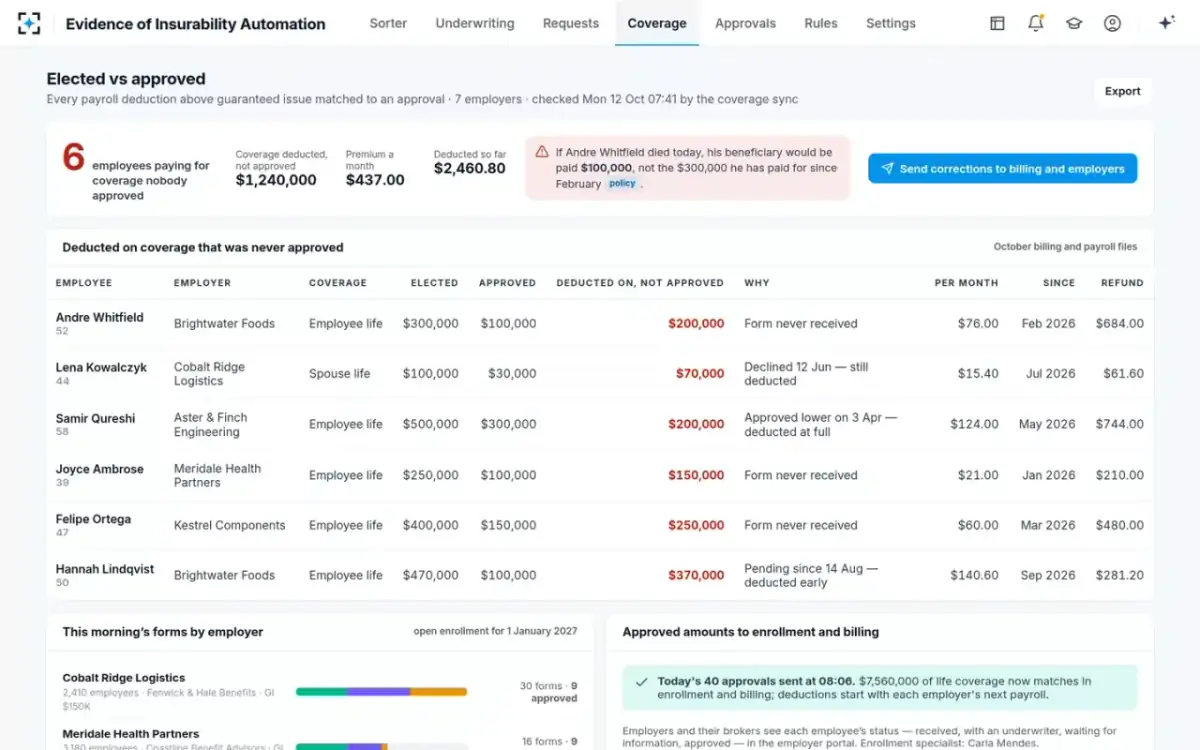
Payroll sees none of these splits unless someone tells it. In the sample data, Samir Qureshi's approval at $300,000 was made on 3 April, and his payroll was still deducting on $500,000 in October. Andre Whitfield had been paying on $300,000 since February. Both were found the same morning by a comparison of every deduction above guaranteed issue with an approval on file.
What happens when an employee elects more than the guaranteed issue?
The guaranteed part starts on the plan's normal effective date and the excess waits for the carrier's decision on the employee's evidence form. If the carrier approves in full, the benefit rises to the election from the approval date or the date the certificate sets. If it approves less, or declines, or the request closes because the form was never completed, the benefit stays at the guarantee or the approved amount. The premium the employer deducts should follow the benefit, not the election.
The sample carrier's requests put this in terms the employee can act on: the guaranteed coverage stays in force while the form is reviewed, and if the request closes, the guarantee is all that applies. What the evidence form asks, and why a blank answer stops it, is covered in what evidence of insurability is.
Elected against approved in Evidence of Insurability Automation: where the benefit and the paycheck disagree
Is the guaranteed issue amount the same for spouses?
No, it is usually lower. Spouse coverage is underwritten on the spouse, who is not part of the employer's workforce and whose health the group says little about, so plans guarantee less: in the sample carrier's plans, a fifth to a quarter of the employee guarantee. In Salyers, the plan guaranteed spouse coverage up to $50,000; the employee elected $250,000, and the carrier initially paid $30,000, the amount the plan allowed without evidence after her first enrollment and one annual step.
Spouse elections also cross the line in a different way. An employee can elect a large amount for a spouse without the spouse ever seeing the form, and the evidence request then goes to someone who did not make the choice. A request that names the spouse, the amount and the guarantee is the one that gets answered.
Does the guaranteed issue reset each year?
The guarantee itself usually stays as the policy sets it; what many plans add is a yearly step that lets enrolled employees increase without evidence, up to the guarantee. The plan in Salyers described both rules in its summary:
"After the first year, spouse/Adult Benefits Recipient domestic partner coverage amounts may be increased by one level per year for coverage levels up to and including $50,000. No evidence of insurability is required for this increase."
The summary plan description in Salyers, quoted by the Ninth Circuit (2017)
The plan in Silva worked the same way from the other side: an increase of more than one level above current coverage at annual enrollment needed evidence, and if the evidence was not given or not accepted, the amount would not increase. So the answer to "does it reset" is plan-specific: read the certificate's increase rule, not only its guarantee.
Salary multiples, maximums and the guarantee
Many plans state coverage as a multiple of pay, which moves the line every time salary changes. In Silva, the employee elected five times his salary, $429,000, as a late entrant; the carrier's internal notes said it required evidence for any late request and for amounts above three times base salary. In Shields, the maximum was the lesser of three times salary or $200,000, and the employee's salary rose until the dollar cap bound.
For a carrier, that means the same election can be inside the guarantee one year and above it the next, and the check has to run on current pay. The sample carrier's fast-lane rule for employee life added a salary test in its seventh version: the total must be within $500,000 and within five times salary before a form can go to the batch for approval.
A flat-dollar guarantee against a salary-multiple plan
Flat dollar: A fixed amount, for example $150,000.
Salary multiple: A multiple of pay, often with a dollar cap.
Flat dollar: Only when the policy changes.
Salary multiple: Whenever salary changes, and when the cap binds.
Flat dollar: One employer’s guarantee applied to another.
Salary multiple: An election checked against last year’s salary.
Flat dollar: The guarantee read from each group policy.
Salary multiple: Current pay from the employer, the multiple and the cap, at the date of election.
When payroll deducts on the whole election
The most expensive version of the confusion is a payroll file that carries the election. Every case in this series began that way: in Salyers, a keystroke error put $500,000 into the employer's system and later elections were never flagged; in Silva, premium was withheld for months on a late election nobody approved; in Shields, it was withheld for nearly ten years. The employee reads the deduction as the benefit, and for months it looks like one.
Whether those deductions sit inside ERISA at all can depend on the employer's role. A voluntary group insurance program falls outside ERISA when, among other conditions, the employer makes no contribution and its "sole functions" are to let the insurer publicise the program, collect premiums through payroll deductions and remit them, without endorsing the program. The plans in all three cases above were governed by ERISA. Either way, the deduction is the employee's money. When the approved amount is employer-provided life above $50,000, it also changes the employee's taxable wages, as the group term life imputed income calculator works through.
The guarantee for each employer, read from its policy into Evidence of Insurability Automation
Questions people ask
What is the difference between guaranteed issue and benefit amount?
The guaranteed issue amount is the most a plan grants without health questions; the benefit amount is what is actually in force and would be paid. When an employee elects more than the guarantee, the benefit is the guarantee plus whatever excess the carrier approves.
Can an employee get coverage above the guaranteed issue amount?
Yes, up to the plan's maximum, if the carrier approves the employee's evidence of insurability. Until it does, only the guaranteed amount is in force.
What should payroll deduct when the election exceeds the guarantee?
Premium on the guaranteed amount only, until the carrier approves the excess. If the health form is never completed, the request closes and only the guarantee applies, and the deduction should match it.
Is the guaranteed issue amount the same for spouses?
Usually not; spouse guarantees are lower. In Salyers the spouse guarantee was $50,000, and in the sample carrier's plans spouse guarantees run from $10,000 to $30,000.
Does the guaranteed issue reset each year?
The guarantee stays as the policy sets it, but many plans let enrolled employees step up one level a year without evidence, up to the guarantee. Increases of more than one level usually need evidence.
What is the difference between guaranteed issue and the maximum amount?
The maximum is the most the plan offers with evidence; the guarantee is the most it offers without. In Shields the voluntary life maximum was the lesser of three times salary or $200,000, and the guarantee was $100,000.