Evidence of insurability questions are the health questions a group life or disability carrier asks when an employee elects coverage above the guaranteed issue amount, enrolls late or increases coverage. A typical form asks whether, over a look-back period, the applicant has been diagnosed with or treated for a list of conditions, whether they take prescribed medicine or have a test or surgery pending, and how much work they have missed; it asks for height and weight; and it ends with a declaration and a medical authorization to sign. Each answer is only useful if it is there. Botminds' Evidence of Insurability Automation reads every form as it arrives, checks the answers against prescription history, the medical information exchange and the build table, and when an answer or a signature is missing it drafts a request for exactly that, for a person to send.
That last step is the subject of this guide. The tempting shortcut in any automation of EOI is to fill a gap from other data: to read a blank as No because the prescription history is clean, or to accept an unsigned form because the employee clearly meant to apply. Each shortcut changes the applicant's statement, and an applicant's statement is what the underwriting decision rests on. The examples below come from a fictional carrier, Larkspur Life & Group, and its sample forms; the people in them are invented.
The 11 health questions on one sample evidence form, and what each answer is checked against
| # | Part B: in the past 10 years, have you been diagnosed with or treated for… | What can confirm or contradict the answer |
|---|---|---|
| 1 | Heart disease, chest pain, heart attack, stroke or an irregular heartbeat | Prescription history, physician statement |
| 2 | High blood pressure or high cholesterol | Prescription fills; readings in a physician statement |
| 3 | Diabetes, elevated blood sugar or a thyroid disorder | Prescription history; an A1C if the underwriter orders one |
| 4 | Cancer, a tumor or a cyst (other than basal cell skin cancer) | Medical-exchange codes, physician statement |
| 5 | Asthma, emphysema, sleep apnea or another lung or breathing disorder | Prescription history |
| 6 | A liver, kidney, pancreas or digestive disorder | Prescription history, physician statement |
| 7 | Depression, anxiety or another mental or nervous disorder | Prescription history |
| 8 | A back, neck, spine or joint disorder, or surgery for one | Absence history, physician statement |
| 9 | Advised to reduce, or treated for, use of alcohol or drugs | Medical-exchange codes, prescription history |
| 10 | Absent from work more than 10 days in a row for illness or injury (5 years) | Employer absence data where the plan uses it |
| 11 | Prescribed medicine, a hospital stay, or a test or surgery advised but not yet done (5 years) | Seven years of prescription history |
What questions are on an evidence of insurability form?
Most forms ask about the same families of conditions: heart and circulation, blood pressure and cholesterol, diabetes, cancer, lungs, liver and kidneys, mental health, the back and joints, alcohol and drugs, time off work, and current medicines or pending tests. Each carrier writes its own wording and look-back periods; the sample form above uses ten years for diagnoses and five for absence and current treatment. Height and weight sit beside the questions because the build table is one of the first tests applied.
The questions are deliberately closed. Yes or No, with a short explanation for each Yes, is what lets a carrier approve most applicants without a medical record. That design only works if every question is answered: an eleven-question form with ten answers is not 91% complete, it is undecidable, because the missing answer could be the one that matters.
What happens if you leave an EOI question blank?
A blank answer stops the form. The carrier cannot treat it as No without changing the applicant's statement, and it cannot treat it as Yes without inventing a condition, so the form goes back to the employee with a request. Until the answer arrives, the amount above guaranteed issue is not approved.
Marco Delgado's form in the Larkspur sample shows the usual case. He elected $250,000 of employee life, left question 9 (alcohol or drugs) blank, and did not sign or date page 3, the declaration and medical authorization. The solution's form reader recorded both gaps and did not fill either. Because the authorization was unsigned, the prescription and medical-exchange checks did not run at all. The missing-information writer drafted one letter asking for exactly those two things.
A request drafted by Evidence of Insurability Automation for exactly what is missing, waiting for a person to send it
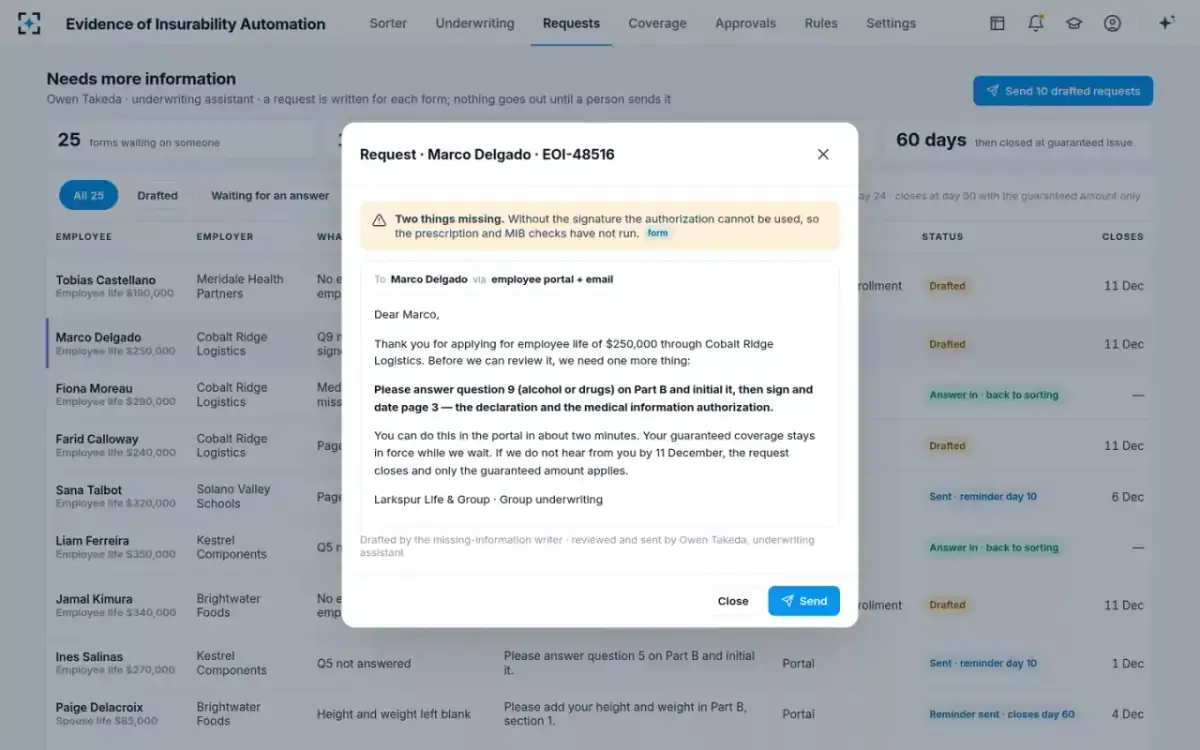
The letter is short because it can be. It names the question by number and subject, says where to answer it, says what stays in force meanwhile, and gives the close date. It does not ask the employee to resubmit the whole form, and it does not ask for anything the form already holds. The closing line is the one employees remember:
"If we do not hear from you by 11 December, the request closes and only the guaranteed amount applies."
Larkspur Life & Group's sample request to Marco Delgado (fictional)
The signature page is a question too: the medical authorization
The authorization is what lets the carrier check the answers, and an unsigned or expired one stops every check that relies on outside records. Most doctors, hospitals and pharmacies are covered entities under HIPAA, and they may release records to a life or disability carrier only under a valid authorization. HIPAA lists its core elements, among them "An expiration date or an expiration event that relates to the individual or the purpose of the use or disclosure" and the individual's signature and date.
The carrier itself sits outside HIPAA's health-plan definition for these lines. A health plan is one that "provides, or pays the cost of, medical care", which life insurance does not, and the definition expressly excludes excepted benefits such as disability income coverage. State insurance privacy law governs what the carrier does with what it receives. The practical rule is the same. Larkspur treats an authorization as valid for 90 days from signature; that is the carrier's setting, not a statutory number. An undated page 3 is treated like an unsigned one, because the expiry cannot be counted.
Can EOI ask about prescriptions and the MIB file?
Yes. Most forms ask directly about prescribed medicine, and with the applicant's authorization the carrier can check a prescription history and the member information exchange that insurers share, run by MIB Group, which New York's regulator names in its 2024 circular on underwriting data. Reports like these come from specialty reporting companies. Federal law defines a nationwide specialty consumer reporting agency as one keeping files "relating to— (1) medical records or payments" among other subjects, and the CFPB tells consumers to "Fact-check your medical specialty report before or when applying for private life, health, critical illness, long-term care, or disability income insurance."
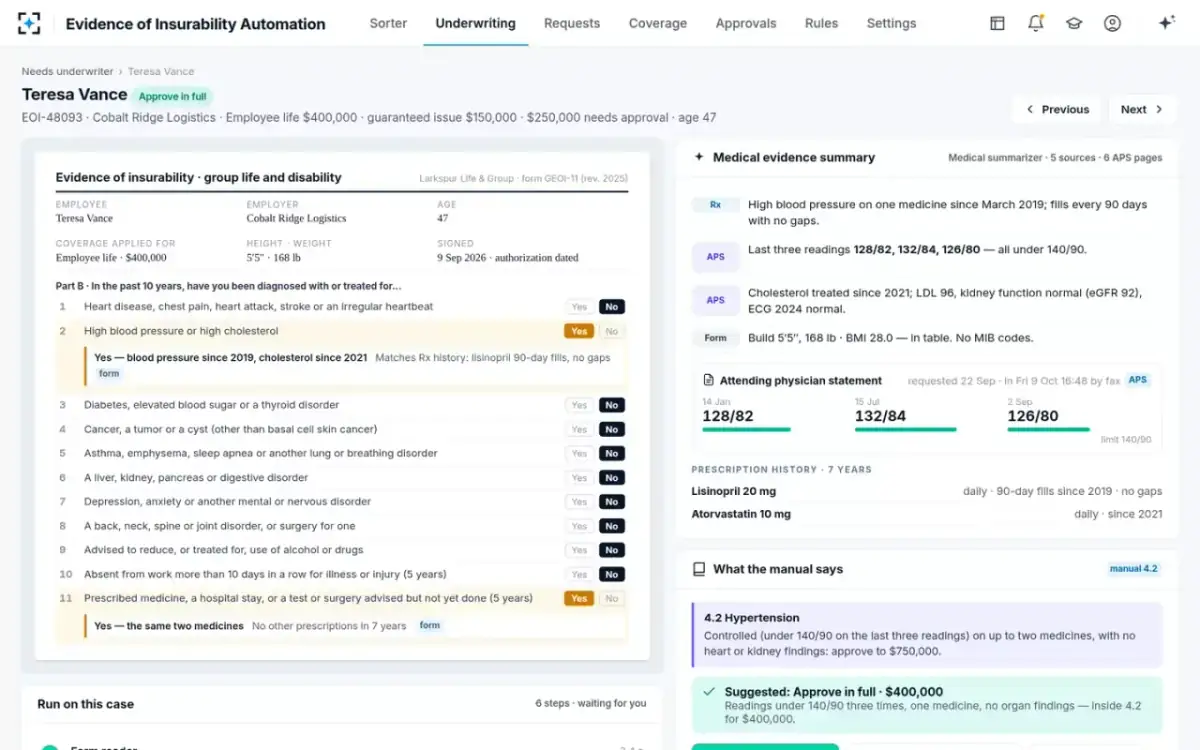
The check confirms or contradicts the answer; it does not replace it. Teresa Vance, in the sample, answered Yes to question 2, blood pressure since 2019 and cholesterol since 2021, and the screen reported that her lisinopril fills every 90 days with no gaps matched what she wrote. When a record contradicts an answer, the solution sends the form to an underwriter with both in view. It never edits the answer to match the record, and a record alone never declines anyone. What a decline built on such a record must then contain is covered in evidence of insurability denied.
The form beside the evidence: each Yes with what the records show
Can an insurer ask about family history or genetic tests?
Family history questions are generally allowed; genetic test results are restricted in some states and not by federal law for these lines. The federal Genetic Information Nondiscrimination Act protects health coverage, and the National Human Genome Research Institute notes that "GINA’s health insurance protections do not cover long-term care insurance, life insurance, or disability insurance", though some states add their own protections.
Florida is one. Its statute bars life insurers, including those adding disability benefits to a life contract, from requiring or soliciting genetic information: they "may not require or solicit genetic information, use genetic test results, or consider a person’s decisions or actions relating to genetic testing in any manner for any insurance purpose." The same section defines genetic information so that it excludes "questions regarding family history". A form that asks about a parent's heart disease is therefore treated differently from one that asks whether the applicant has had a genetic test. Any carrier writing in several states has to check its form against each state's rule; this is one state, read on 27 October 2026.
The ask path for an incomplete form
An incomplete form should follow one path: read, record the gap, stop the checks that depend on it, write the request, send it through the right channel, and re-sort the form when the answer arrives. In the solution each step has an owner, and the only step that reaches the employee is taken by a person.
One incomplete evidence form in Evidence of Insurability Automation, from scan to answer
Agent
Form readerReads the applicant, coverage, amount, the 11 answers, height and weight, signatures and the authorization date, from the mail scan, the employee portal or the EOI inbox.
Never: fill in a blank answer; unclear handwriting goes to more information
Agent
Election matcherFinds the election at the employer, the plan’s guaranteed issue amount and the amount above it.
Never: change an election; a form with no matching election is flagged
Agent
Health screenChecks the answers against the build table, seven years of prescription history and the medical information exchange.
Never: run without a signed authorization dated within 90 days
Agent
Lane sorterPlaces the form in Needs more information with a one-line reason: “Q9 not answered · page 3 not signed”.
Never: approve; any health Yes leaves the fast lane
Agent
Missing-information writerDrafts the request for exactly what is missing, sets reminders for day 10 and day 24 and a close date at day 60.
Never: send without a person, or ask for more than is missing
A person decides
Underwriting assistantReads the draft, edits if needed, and sends it by portal and email; the answer returns the form to sorting.
Answers an agent must never infer
Some gaps look easy to fill from data the carrier already holds. Each of them would turn a carrier's guess into the applicant's statement, and the statement is what the carrier may later rely on, or be held to, at claim time. The rule in the solution is narrow and absolute: an agent may report what a record shows beside an answer, and may never write the answer.
Gaps that go back to the employee or the employer, never into the form
- A blank health question
Not No because the prescription history is clean; a clean history does not show an untreated diagnosis or advice not yet acted on.
- A missing height or weight
Not taken from an old application or a driving licence; the build test needs today’s figures from the applicant.
- An unsigned or undated declaration or authorization
Without it the records cannot be requested, and the declaration is what makes the answers the applicant’s own.
- Handwriting the reader cannot read with confidence
A guessed Yes or No is still a guess; it goes to more information with the image of the answer.
- An amount with no matching election
The employer confirms the election; the form never sets it.
- An answer a record contradicts
The answer stays as written; the form goes to an underwriter with both in view.
Two ways to automate an incomplete EOI form
Fill the gap: Read as No because nothing in the records points to it.
Ask for it: Request for question 9 alone; the form waits with its reason.
Fill the gap: Checks run anyway on an earlier authorization.
Ask for it: No outside records are requested until the page is signed and dated.
Fill the gap: A decision resting on an answer the applicant never gave.
Ask for it: The applicant’s own answers, the records checked under a dated authorization, and the request that was sent.
Fill the gap: Faster on the day, and harder to defend when a claim comes.
Ask for it: A day or two slower for a few forms; the rest of the queue is not held up.
What a good missing-information letter says
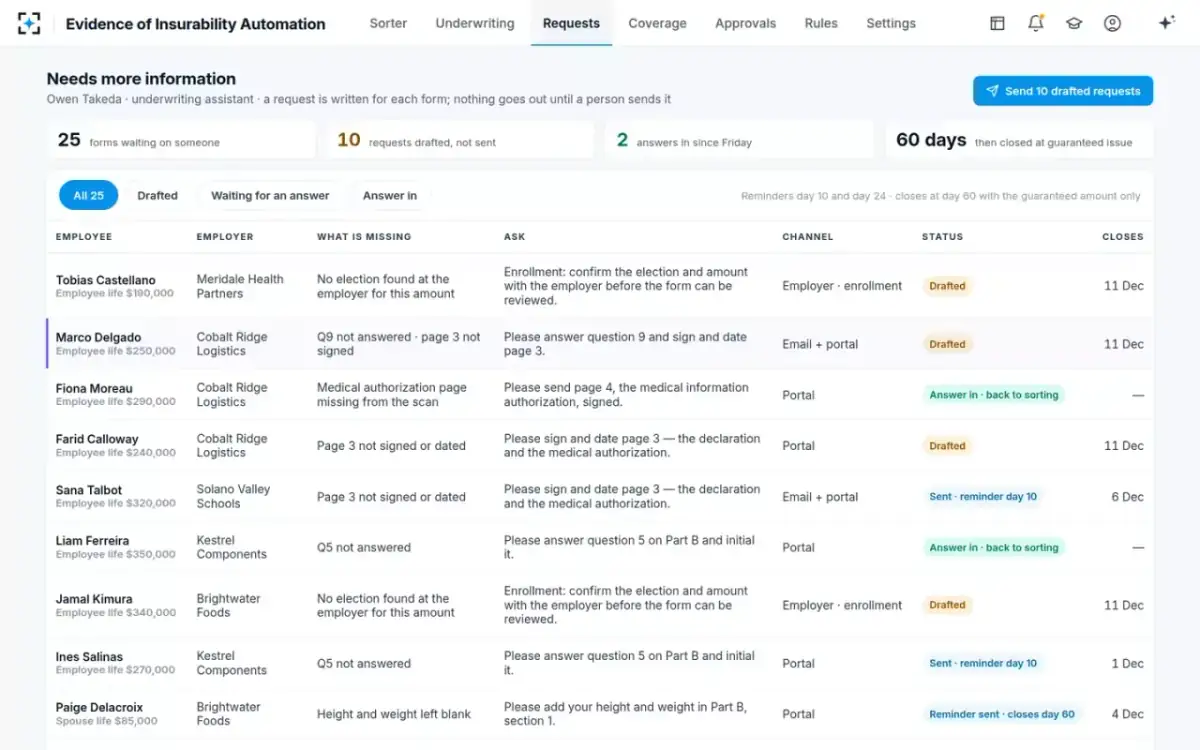
A good request names the gap precisely, says how to fix it, says what coverage stays in force, and gives the date the request closes. Everything else adds a reason not to answer. In the sample, 25 of 112 forms were waiting on someone: nine with a question not answered, seven not signed, four with height and weight missing, three with no matching election and two with the authorization missing. Ten requests were drafted that morning and none had been sent; the underwriting assistant reviews and sends them.
Writing the request is cheap; chasing a vague one is not. A letter that asks for "the missing information" produces a phone call, and a letter that asks for "question 9 on Part B, initialled, and page 3 signed and dated" produces an answer. The same discipline is what an evaluation of any EOI software should test, as twelve questions to ask before you buy sets out. For the basics of when these questions apply at all, start with what evidence of insurability is.
Every form waiting on someone, with the ask and the close date
Questions people ask
What questions are on an evidence of insurability form?
Questions about diagnoses and treatment over a look-back period, such as heart disease, blood pressure, diabetes, cancer, lung, liver or kidney disorders, mental health, back and joint problems, and alcohol or drug use; current medicines and pending tests; time off work; and height and weight. The sample form asks 11 such questions and ends with a declaration and a medical authorization.
What happens if I leave an EOI question blank?
The carrier cannot decide the form until you answer. You will normally get a request naming the question; until it is answered, only the guaranteed amount is in force. In the sample carrier's settings, a request closes after 60 days.
Can EOI ask about prescriptions?
Yes. Forms usually ask about prescribed medicine, and with your signed authorization the carrier can check a prescription history report. The CFPB suggests fact-checking your medical specialty report before or when you apply for life or disability income insurance.
Can an insurer ask about family history on EOI?
Generally yes, unless a state rule says otherwise. Florida, for example, bars life insurers from soliciting genetic information but defines it to exclude questions about family history.
What is a statement of health?
It is another name for the evidence of insurability form: the employee's own answers to the carrier's health questions, signed. Plans and courts use the two terms interchangeably, and some carriers call it evidence of good health.
What is an MIB report?
It is a report from MIB's member information exchange, which insurers share and which New York's regulator lists by name among underwriting data sources. A group carrier checks it only under the applicant's signed authorization, to confirm or question the answers on the form; it is not a medical record, and on its own it should not decide the application.