EOI software is software that a group life and disability carrier uses to receive evidence of insurability forms, check them against the employee's election and the underwriting rules, help an underwriter decide, and send the result to enrollment and billing. Every product in the category can show a form being read on screen. The questions that separate them are harder to demonstrate: who is allowed to approve, what reason each approval carries, how a decline is explained and noticed, what happens to a blank answer, and whether the approved amount ever reaches the bill. Botminds' Evidence of Insurability Automation is one answer to those questions; this guide is written so that a head of group underwriting can put the same twelve to any vendor, including us.
The questions come from where EOI goes wrong in public: appellate decisions about premiums taken on coverage nobody approved, the Department of Labor's settlements with four group life insurers, the NAIC's privacy model act and New York's 2024 circular on AI in underwriting. Product examples come from a fictional carrier, Larkspur Life & Group, on its sample data.
Twelve questions to put to any EOI software vendor, and the answers to listen for
- 1. Who approves, and can the software approve on its own?
Listen for: a named underwriter approves every batch and decides every case; the software sorts and suggests.
- 2. What reason does each approval carry?
Listen for: a one-line reason per form, with the rule and its version, kept after the batch is approved.
- 3. How are fast-lane rules changed and tested?
Listen for: versioned rules, back-tested on forms your underwriters already decided, signed off by the medical director.
- 4. What happens to a blank answer or an unsigned page?
Listen for: a request for exactly what is missing; never a filled-in answer.
- 5. Under what authorization do prescription and exchange checks run?
Listen for: only under a signed, dated authorization inside your validity window, and not at all without one.
- 6. Can a record decline anyone on its own?
Listen for: no; a contradicting record sends the form to an underwriter.
- 7. How are declines and lower amounts reviewed and explained?
Listen for: a second underwriter every time, specific reasons, and the consumer-report notice when a report played a part.
- 8. Does every line of a medical summary cite its source?
Listen for: the form answer, the prescription fill, the physician statement page and the manual section, each linked.
- 9. Does the approved amount flow back to enrollment and billing?
Listen for: approved amounts and dates sent the same day, never the elected amount, and payroll checked against them.
- 10. Which channels does it read?
Listen for: paper scans, the employee portal and email in one queue, with each form’s source and arrival time.
- 11. What can an examiner or a reinsurer export?
Listen for: every batch, who approved it, each form’s reason and what the second reviewer found.
- 12. What will it show us about its own AI?
Listen for: what each agent does and may not do, its inputs, and how a change is tested, in writing, not “proprietary”.
What is EOI software?
It is the system a group carrier uses to run evidence of insurability from receipt to decision to billing. At the narrow end it is an electronic form the employee fills in, with rules that flag answers for review. At the wide end it reads forms from every channel, matches them to elections, checks prescription and exchange reports under the employee's authorization, sorts them by what they need, prepares the medical cases, drafts the requests for missing information and reconciles payroll against approvals.
Buyers usually start from the narrow end, because the form is what employees and brokers see. The losses happen at the wide end. The first thing to establish with any vendor is which of those jobs the product does, and which it leaves to your staff and your other systems.
Can EOI software approve applications?
It can be configured to; it should not approve or decline on its own. A batch of forms with nothing to underwrite can be prepared by software and approved by an underwriter in one action, with each form's reason on file, which captures most of the speed without moving the decision. A product that approves automatically has moved an underwriting decision into a rule nobody signs, and a product that declines automatically has made the decision a consumer is owed reasons for without a person to give them.
Regulators expect insurers to govern AI used in underwriting, whoever built it. The NAIC's model bulletin on AI systems, adopted in December 2023 and since adopted in many jurisdictions, sets out that governance; what it asks of a carrier is covered in the NAIC AI bulletin requirements. In the sample solution the rule is plain: the lane sorter never approves, the medical summarizer only suggests, and the medical underwriter approves every batch and decides every case.
Authority: who may approve, and at what amount
Ask to see the authority settings, not to hear about them. Each underwriter should have an amount limit per life, declines and reduced amounts should go to a second underwriter, and a share of every fast-lane batch should be drawn for review. Those are settings in a sound product, changed only with approval and kept in versions.
The sample carrier's settings show the shape: two medical underwriters approve up to $1,000,000 a life, the head of group underwriting has no limit, declines and lower amounts always go to a second underwriter, and 5% of each batch is drawn for review. On the sample Monday that meant two of the forty fast-lane approvals were sent to a second underwriter, due the next day.
Evidence: the reason every approval carries
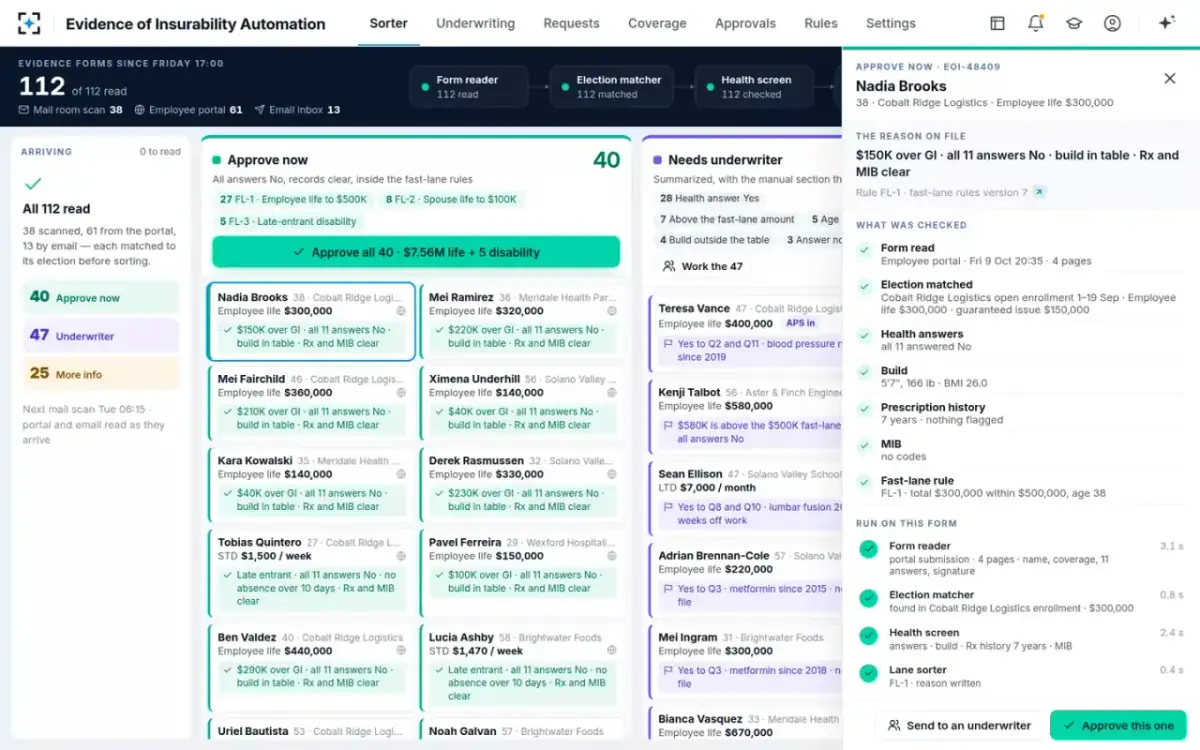
An approval without a reason is an approval nobody can check. Ask the vendor to open one approved form from a batch and show what was checked, by which rule, at what time. In the sample, Nadia Brooks's form carries "$150K over GI · all 11 answers No · build in table · Rx and MIB clear" under rule FL-1, version 7, with each check and its running time listed beneath.
One approved form in Evidence of Insurability Automation: the reason on file and every check behind it
The evidence question also covers forms that never arrive. In Silva, after the lawsuit began, the carrier's own investigation found about 200 employees at one employer without an approved form on file, and one note in its log explained many of them:
"There are a whole truckload of people who filled out a SOH but they were never submitted due to a glitch in the employer's enrollment process."
An internal investigation note quoted by the Eighth Circuit in Silva (2014)
Software that can only report on forms it received cannot find that glitch. Ask how the product learns that a form is missing: by matching every election above guaranteed issue at the employer against a form or a decision, and every payroll deduction against an approval.
Notices: consumer reports, reasons and New York
Ask the vendor to show a decline letter, and ask what triggers each part of it. In states that follow the NAIC's privacy model act, the employee is owed the specific reasons or the right to request them. If a consumer report played any part in a decline or a reduced amount, the Fair Credit Reporting Act adds a notice naming the reporting agency. What a defensible decline file contains is set out in evidence of insurability denied.
New York adds expectations for carriers that use AI systems or external data in underwriting. Its 2024 circular draws a line that matters to EOI products: "ECDIS does not include an MIB Group, Inc. member information exchange service, a motor vehicle report, prescription drug data, or a criminal history search." Those sources are not external consumer data under the letter, but in our reading a model or AI system that uses them in underwriting is still an AI system under it. The same circular closes a common vendor answer:
"An insurer may not rely on the proprietary nature of a third-party vendor’s algorithmic processes to justify the lack of specificity related to an adverse underwriting or pricing action."
New York DFS, Insurance Circular Letter No. 7 (2024)
A vendor that cannot say, in writing, what each step of its product does, from what inputs and under what limits, is asking the carrier to accept that risk. In the sample solution each agent's duties and limits are listed, and the summaries cite the line of each source they rely on. How New York's expectations translate into an AI inventory is covered in NY DFS Circular Letter No. 7.
Data: prescriptions, the exchange and the authorization
Ask when the product runs prescription and exchange checks, and when it refuses to. The answer should be: only under a signed and dated authorization, inside the validity period the carrier sets, and never on a form whose authorization page is blank. In the sample carrier's settings an authorization is valid for 90 days from signature, a carrier choice rather than a legal number.
Ask too what the product does when a record contradicts an answer. It should send the form to an underwriter with both in view, and it should never edit the employee's answer to match the record. Questions that the form asks, and the answers an agent may never infer, are covered in evidence of insurability questions.
Ask to see it, not to be told: what to request in a demonstration
| Question area | Ask to see | In the sample solution |
|---|---|---|
| Authority | The authority settings and their change history | Limits per underwriter, second review on declines and lower amounts, 5% batch sample; changes need the head of group underwriting |
| Reasons | One approved form from a past batch | Reason, rule and version on every form; batch log with who approved it |
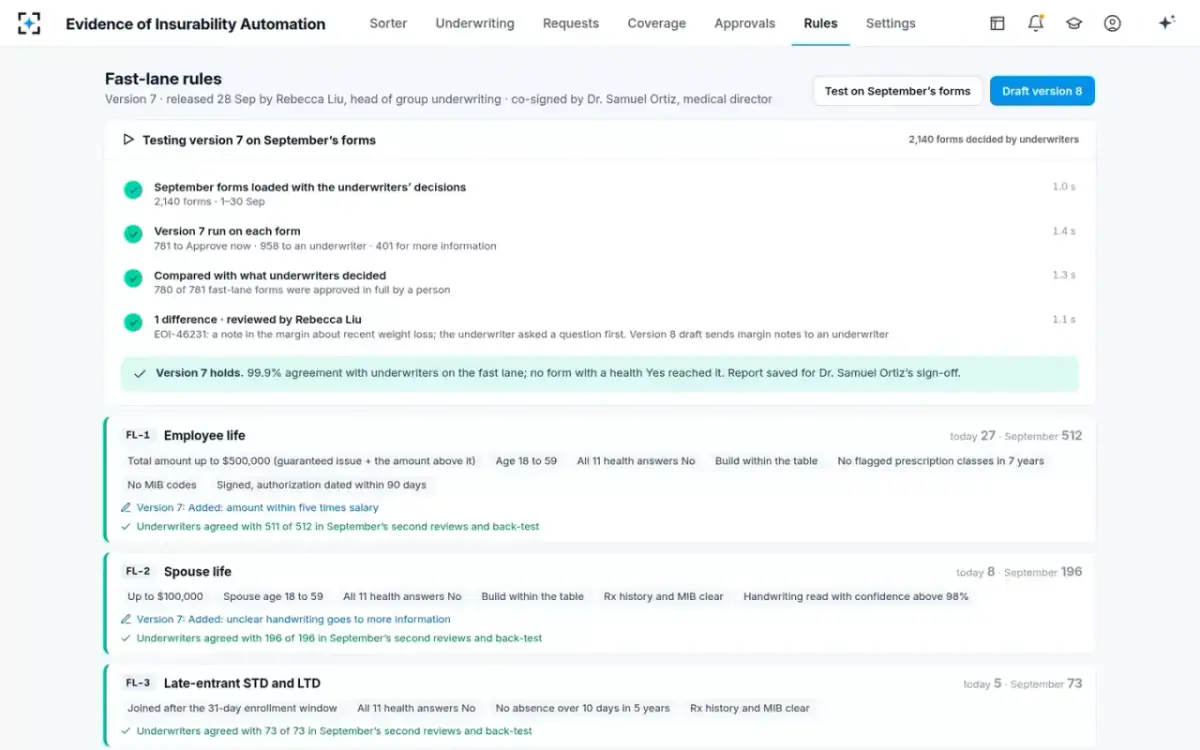
| Rule changes | A rule change tested on decided forms | Version 7 back-tested on 2,140 September forms: 781 to the fast lane, 780 approved in full by underwriters |
| Missing information | A blank answer and an unsigned page, end to end | A request for exactly those two things, sent by a person; checks paused until the page is signed |
| Declines | A decline letter and what triggered each part | Second underwriter on every decline; reasons and sources on file |
| Billing | The approved amount reaching billing, then a payroll check | Approved amounts sent with the batch; payroll compared daily across seven employers |
| Audit | An export of one month of batches | Every batch, approver, reason and second-review finding |
Billing: does the approved amount flow back?
This is the question to ask first, because it is where carriers have lost in court and in settlements. A product that decides quickly and hands the result to a person to key into billing has rebuilt the gap the cases describe: payroll on the elected amount, a decision nobody carried through, and a claim that finds it. The First Circuit quoted the Fourth Circuit's description of what that gap rewards when nobody checks:
"essentially risk-free windfall profits from employees who paid premiums on non-existent benefits but who never filed a claim for those benefits."
McCravy (4th Cir.), as quoted by the First Circuit in Shields (2022)
The answer to listen for has three parts: approved amounts, never elected ones, sent with their effective dates on the day of the decision; payroll files compared with approvals after every cycle; and each difference listed with its cause. Where a product connects, and what it leaves in the carrier's systems of record, is mapped in EOI automation tools that work with enrollment and billing.
Fast-lane rules in Evidence of Insurability Automation, with their versions, counts and back-test
How long does EOI software take to implement?
There is no honest industry figure; it depends on how many channels, employers and systems must be connected. The useful question is what the vendor needs from you and what it will prove first. For the sample solution, Botminds builds from the carrier's evidence form layouts, its underwriting manual, its guaranteed issue table and a sample of forms its underwriters have already decided, and walks the carrier through it on its own forms first.
Two proofs belong in the first weeks of any implementation. A back-test of the fast-lane rules on decided forms shows how many approvals the batch would carry and whether underwriters agreed with them. A payroll comparison on one employer's current files shows how many employees are already paying for coverage nobody approved. Both are measurable before go-live, and both should be in the contract.
How is EOI software priced?
Ask how the price scales and what it includes, because the expensive parts are the connections, not the screens. A price per form rewards the vendor for volume; a price per employer or per covered life tracks the size of the book; either way, ask whether connecting enrollment, billing and payroll files is included, whether rule back-tests are part of the service, and what an extra channel or employer costs. Compare the total against what the payroll comparison finds in the pilot.
What a demonstration shows against what a pilot proves
Demonstration: Clean sample forms read correctly.
Pilot on your own forms: Your scans, your portal and your inbox, including handwriting and missing pages.
Demonstration: A form decided in seconds.
Pilot on your own forms: A season’s forms sorted, with the share your underwriters approve in a batch.
Demonstration: A reading-accuracy figure.
Pilot on your own forms: Fast-lane rules back-tested against your underwriters’ own decisions.
Demonstration: A status changes to Approved.
Pilot on your own forms: Payroll compared with approvals, and the mismatches already in your book.
Demonstration: An audit screen.
Pilot on your own forms: A month of batches exported with reasons, approvers and second-review findings.
Where Botminds fits in an EOI software decision, and where it does not
Botminds' Evidence of Insurability Automation is built for group life and disability carriers that want the simple approvals ready the morning they arrive, the medical cases summarised with sources, the missing information requested precisely, and approved amounts carried to billing and checked against payroll. It is not an employee benefits administration platform, a rating engine or a policy administration system, and it does not decide anything: every approval, decline and refund is a person's decision. A carrier whose main need is an employee-facing enrollment portal should buy one; a carrier whose losses come from the gap between decisions and payroll is the one this product is for.
A one-page scorecard for an EOI software decision
Authority
Named approver for every batch and case; limits, second review and sample are settings with history.
Reasons
Every approval carries its reason, rule and version; every summary line cites a source.
Asking
Blank answers and unsigned pages produce precise requests; nothing is filled in.
Records
Checks only under a valid authorization; no record declines on its own.
Notices
Second underwriter on declines and lower amounts; reasons and consumer-report notices ready.
Billing
Approved amounts to enrollment and billing; payroll compared after every cycle.
Questions people ask
What is EOI software?
Software a group carrier uses to receive evidence of insurability forms, check them against elections and underwriting rules, support the underwriter's decision and send the result to enrollment and billing. Products range from an employee-facing form to systems that also reconcile payroll against approvals.
Can EOI software approve applications?
It can be set up to, but it should not approve or decline on its own. A sound design prepares batches of forms with nothing to underwrite, each with a written reason, for an underwriter to approve, and sends medical cases to a person with a cited summary.
Does EOI software include prescription checks?
Many products can run prescription history and exchange checks, but only under the employee's signed, dated authorization. Ask what the product does when the authorization page is blank; the answer should be that the checks do not run and a request is drafted.
How long does EOI software take to implement?
No public benchmark exists. It depends on the channels, employers and systems to connect; ask the vendor what it needs from you, and require a rule back-test on your decided forms and a payroll comparison on one employer's files early in the project.
What should evidence of insurability software do?
Read every form from every channel, match it to the election, check answers under the authorization, sort it with a reason, summarise medical cases with sources, draft precise requests, and carry approved amounts to billing while checking payroll. People should make every decision.
How is EOI software priced?
Ask how the price scales, per form, per employer or per covered life, and whether connecting enrollment, billing and payroll and testing rule changes are included. Compare the cost with the mismatches a payroll comparison finds in your own book.