If EOI expires, the carrier closes the request and the employee keeps only the coverage that needed no evidence: the guaranteed issue amount, or the prior amount for an increase. The excess is not approved, and to get it the employee usually has to apply again, often at the next open enrollment or as a late entrant with full evidence. The danger is not the closed request. It is what happens to payroll after it: if nobody lowers the deduction, the employee keeps paying for coverage that does not exist, and the problem surfaces when a claim is filed. Botminds' Evidence of Insurability Automation drafts each request with its close date, and every day compares payroll deductions with the amounts actually approved, so an expired request cannot hide behind a full deduction.
This page is a pre-mortem: a fictional story told backwards from a lawsuit, so the step that would have prevented it is visible. The employee, her employer, the enrollment specialist and the carrier are invented, and so are the amounts. The court decisions and Department of Labor settlements quoted in it are real, and the story's turns are the ones those cases describe.
Delphine Marchbanks's supplemental life, from election to claim
- Unsigned form, then a request open 60 days15 Sep–5 Dec
- Closed: guaranteed $150,000 onlyto 10 Sep 2026
- No deduction yetto 31 Dec
- Deducted on the full $350,000Jan 2026 to the claim · $320
What happens if EOI expires?
The request closes and coverage stays at the amount that needed no evidence. Carriers set their own deadline: the sample carrier used elsewhere in this series closes a request 60 days after it is sent, after reminders on day 10 and day 24, and its letter tells the employee that from then on only the guaranteed amount applies. A closed request is not a decline. Nothing was decided about the employee's health, and they can apply again when the plan allows.
What must follow a close-out is a change to the bill. The carrier sends the guaranteed amount, not the elected one, to enrollment and billing, and the employer's payroll must drop the deduction for the excess. When that step is missed, the employee's pay stub and enrollment confirmation keep showing the elected amount. That is the situation every case below began with.
The election: $350,000 on a $150,000 guarantee
Delphine Marchbanks, 44, a shift supervisor at Thornfield Cold Storage, elected $350,000 of supplemental life during open enrollment on 15 September 2025. Thornfield's plan guaranteed $150,000 without health questions, so $200,000 needed evidence of insurability. The enrollment portal told her a form would follow. She filled it in on her phone, answered every question No, and closed the page before the signature screen, so the carrier received a form with no signature and no authorization.
Nothing about her health was in doubt. That detail matters, because it recurs in the real cases: in Silva, the court noted that the defendants did not claim the employee had a disqualifying condition, only that no statement of health was on file. A missing form is an administrative failure; it is treated like a medical one only if nobody fixes it before a claim.
Day 0 to day 60: the request nobody answered
On 6 October the carrier sent Delphine a request to sign page 3 by email. She had changed her personal address in the employer's system but not in the carrier's, and the email went to an account she no longer used. The day-10 and day-24 reminders followed it. On 5 December, day 60, the request closed. The carrier sent the guaranteed $150,000 to its billing system and mailed a close-out letter to the old address.
Two letters about the same $200,000, ten months apart
5 December 2025 · close-out
“We did not receive your signed authorization by the date in our request, so your request for $200,000 above your guaranteed amount has closed. Your coverage is $150,000.”
Sent by email to an address she no longer used, and by post to a former address.
14 October 2026 · claim decision
“We have paid $150,000. The additional $200,000 was never approved because evidence of insurability was not received.”
Sent to her husband, Ivo, who holds eight months of pay stubs showing a deduction for $350,000.
The carrier's records were accurate at every step. The employer's records were accurate too: Delphine had elected $350,000. What nobody held was the comparison between them, and Ignatius Pell, Thornfield's enrollment specialist, had no reason to look, because nobody told him the request had closed.
Months of deductions on coverage nobody approved
From January 2026, Thornfield's payroll took premium on the full $350,000. At a fictional rate of $0.20 per $1,000 a month, the excess cost Delphine $40.00 a month; by August she had paid $320.00 for $200,000 of coverage that did not exist. Her January benefits statement listed $350,000. So did the employer's portal.
This is the pattern the Department of Labor found at four group life insurers. Its Prudential investigation found that the insurer had collected supplemental premiums "despite lacking the evidence of insurability", going back to at least 2004, and denied more than 200 such claims between 2017 and 2020. The settlements announced between April 2023 and June 2024 bar evidence-based denials once premiums have been taken for about three months. The Lincoln settlement adds a limit on asking at all: Lincoln "may only request evidence of insurability from existing participants within the first year of them paying premiums", and may not consider a health condition that arose after it first received the participant's premium.
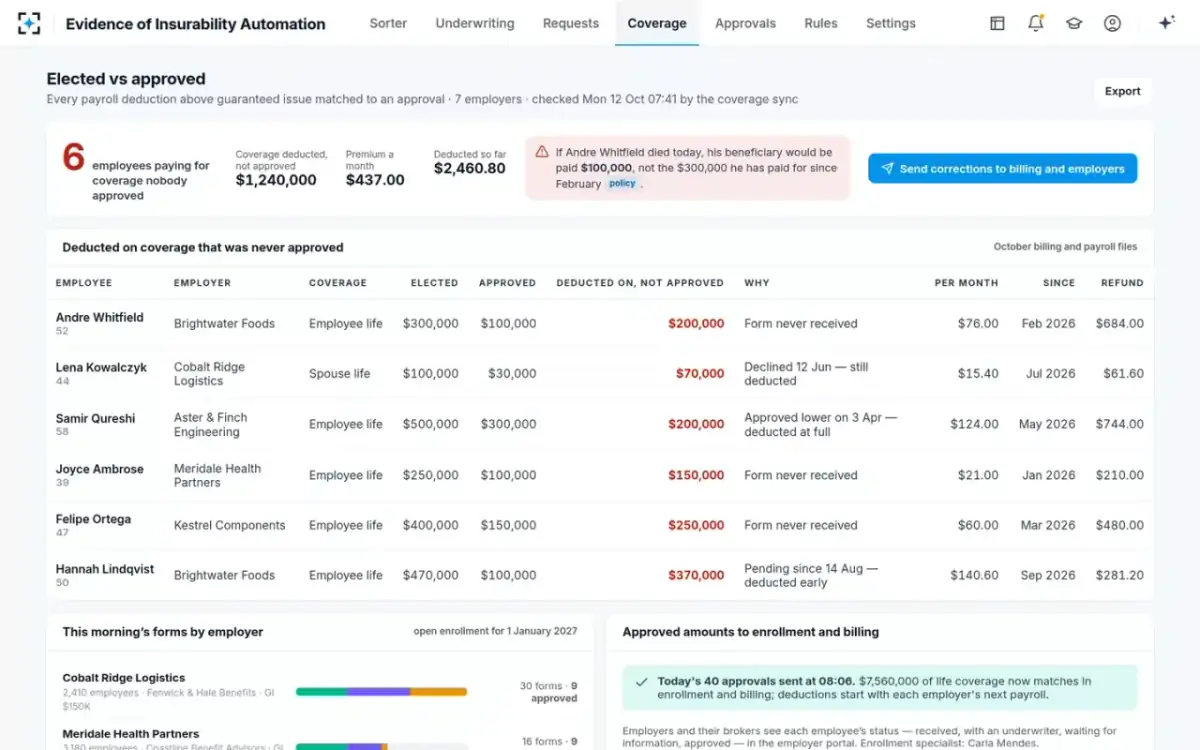
The check in Evidence of Insurability Automation that finds an expired request still being deducted
The claim, and the letter the beneficiary receives
Delphine died on 9 September 2026 after a road accident. Her husband Ivo filed the claim the next day. Thornfield's claim form, completed by Ignatius, said $350,000. The carrier checked its file, found no approved evidence for the excess, paid $150,000 and denied $200,000. Thornfield refunded the $320.00 of premium.
Carriers have written that letter before, and defended it. MetLife's denial letter in Silva set out the position plainly:
"premium payments are not a guarantee of coverage and the acceptance of premium payments in error does not create coverage under an ERISA-governed Plan."
MetLife's benefits denial letter, quoted by the Eighth Circuit in Silva (2014)
Under the plan's words, that may be right. The courts and the Department of Labor have shown it is often not the end of the matter.
What courts have done with forms that never arrived
Three federal appeals courts have ruled on files like Delphine's, each by a different road. The Ninth Circuit found waiver through the employer's agency, the Eighth allowed fiduciary claims for make-whole relief to proceed, and the First held that an insurer with discretion over eligibility owes a duty to decide it reasonably close to taking premiums.
Three appellate decisions on premiums taken without evidence of insurability
| Case | The facts | What the court held | Result |
|---|---|---|---|
| Salyers v. MetLife, 9th Cir. 2017 | Spouse life entered as $500,000 by mistake, then elected at $250,000; premiums deducted for months; no statement of health requested; employer letter confirmed $250,000 after the death. | The employer acted as the insurer’s agent in collecting evidence; deductions and silence waived the requirement. | Reversed; judgment for the unpaid part of the $250,000. |
| Silva v. MetLife, 8th Cir. 2014 | Late supplemental life election of $429,000; about $128 deducted over six months; about 200 employees found without approved forms. | Questions of fact on the benefits claim; fiduciary claims of surcharge, reformation and estoppel may proceed, with make-whole relief possible. | Reversed and remanded. |
| Shields v. United of Omaha, 1st Cir. 2022 | Excess voluntary life deducted for nearly ten years; no evidence form ever given to the employee. | No waiver on the record, but an insurer with discretion over eligibility must decide it reasonably proximate to accepting premiums. | Benefits ruling affirmed; fiduciary ruling vacated and remanded. |
Salyers is the closest to Delphine. Its facts include a confirmation letter from the employer after the death, exactly the kind of statement Ignatius's claim form made. The court staff's summary of the holding is short:
"The panel held that the defendant waived the evidence of insurability requirement because it did not ask the plaintiff for a statement of health, even as it accepted her premiums for $250,000 in coverage."
Court staff summary of Salyers v. MetLife (9th Cir. 2017); the summary is not part of the opinion
The cases do not all point one way. In Shields the First Circuit rejected the waiver argument because nothing showed the insurer knew of the election, and in Salyers the court stressed that an employer is not always the insurer's agent. A carrier can win the benefits claim and still face the fiduciary one. The safer reading for a carrier is the one the four settlements wrote down: decide within about three months of the first premium, or expect not to be allowed to deny on that ground later.
Is the employer responsible if EOI was not submitted?
It can be. In Silva the Eighth Circuit let a claim go forward against the employer, as plan administrator, for failing to give the employee a summary plan description that explained the evidence requirement, with surcharge as a possible remedy. The Department of Labor's Prudential release goes further: group policyholders that collect premiums "may be liable for claims by beneficiaries for supplemental coverage, if they failed to give notice to the participants that Prudential had not approved their evidence of insurability."
For Thornfield, that sentence describes the pre-mortem. The employer collected premium for $350,000, and nobody told Delphine the excess was never approved in a way she received. The employer's defence would rest on the carrier's close-out letter; the carrier's defence would rest on the employer's payroll. Both would be explaining a gap neither of them watched.
The step that would have stopped it
A daily comparison of payroll deductions with approved amounts would have found Delphine's file in the first week of January 2026, when the first deduction on $350,000 met an approval of $150,000. At that point the fix was cheap: one corrected deduction, one notice to Thornfield, and a fresh request to Delphine through the employer, who had her current address. The carrier could have decided her form within weeks, well inside the three-month window the settlements describe.
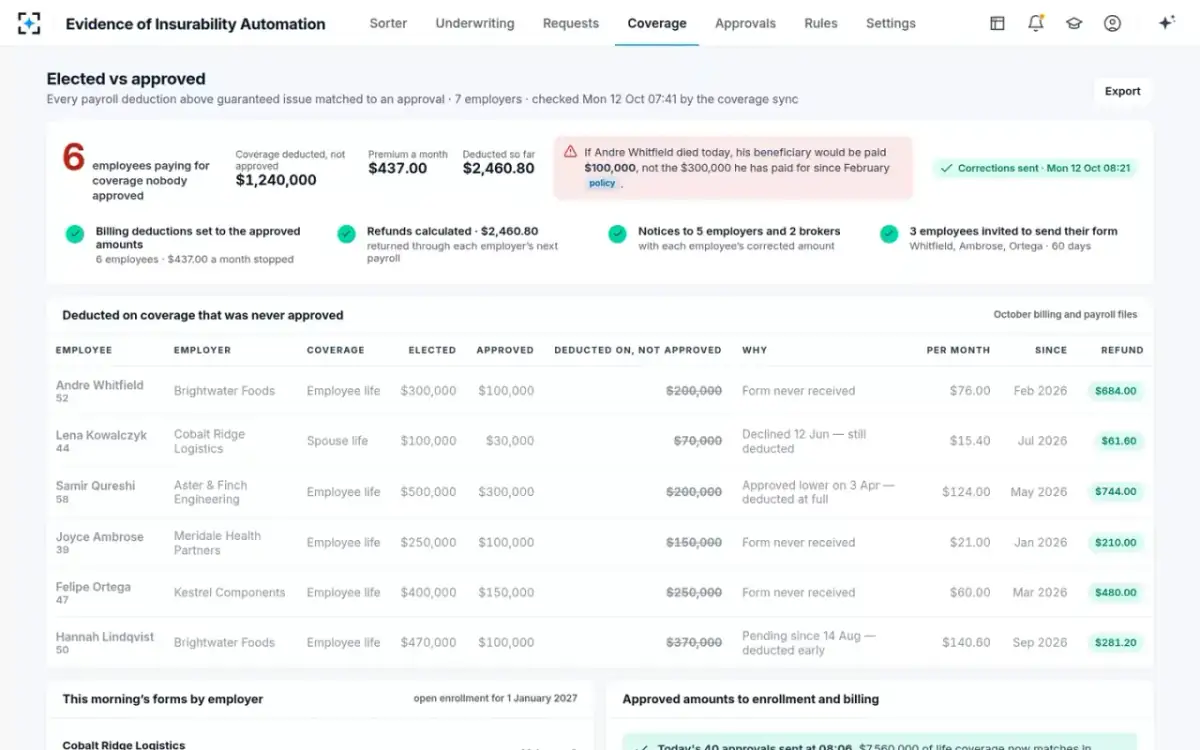
That comparison is what the sample solution's coverage sync does. On its sample Monday it found six employees at seven employers in Delphine's position or close to it, among them three forms never received, and the underwriter sent corrections to billing and employers in one step. Whether a long-paid election is refunded or honoured is the carrier's legal decision; finding it in January rather than at the claim is what keeps it a decision at all. Who each pending form is waiting on is mapped in EOI pending, and the line between the guaranteed and the elected amount in guaranteed issue amount vs benefit amount.
Corrections sent from Evidence of Insurability Automation before a claim finds them
Five points where Delphine's file could have been saved
- At the election: no signature, no submission
A portal that lets an employee close the form before signing should hold it as incomplete and tell the employer.
- At the request: use every channel the employer has
Portal, email and the employer’s enrollment team, which had her current address.
- At close-out: tell the employer, not only the employee
The payroll change is the employer’s, so the close-out notice must reach the person who makes it.
- At the first payroll: compare deduction with approval
A deduction on $350,000 against an approval of $150,000 is a one-line finding in January.
- Before any claim: decide within the window
About three months of premium is where the Department of Labor’s settlements drew the line.
None of these steps needs a medical judgment, and all of them were missed for administrative reasons. The cost of each week a form waits is priced in EOI approval time.
Questions people ask
What happens when an employee never submitted EOI?
The coverage that needed evidence was never approved, so only the guaranteed or prior amount is in force. If premium for the full amount has been deducted, the employer and the carrier have to settle which amount is approved; four Department of Labor settlements barred some insurers from denying claims for missing evidence after about three months of premiums.
Must premiums be refunded if EOI was not approved?
Premium deducted for coverage that was never approved is normally refunded. In Silva the district court ordered $128.76 refunded; on appeal the Eighth Circuit held the family could also pursue fiduciary claims for the benefit itself.
Can a beneficiary collect if EOI was never approved?
Sometimes. In Salyers the Ninth Circuit ordered the unpaid part of a $250,000 policy paid because premiums were taken and evidence never requested. Results depend on the plan, the facts and the court.
Is the employer responsible if EOI was not submitted?
It can be. Silva allowed a claim against the employer for failing to explain the requirement, and the Department of Labor noted, in announcing its 2023 Prudential settlement, that employers collecting premiums may be liable if they did not tell employees their evidence was never approved.
How long does an employee have to submit EOI?
The carrier sets the deadline in its request; the sample carrier in this series allows 60 days with reminders on day 10 and day 24. Lincoln's 2024 settlement limits it to requesting evidence from existing participants within their first year of paying premiums.
What should employer and carrier do when an EOI request is about to expire?
Remind the employee of the close date and the authorization page, and set the payroll deduction to the guaranteed amount until the excess is approved, so nobody pays for coverage that is not in force.