Evidence of insurability is denied when a carrier's underwriter decides that the health evidence does not support coverage above the guaranteed issue amount: a condition outside the underwriting manual, a build outside the table, records that contradict the answers, or a late enrollment the evidence does not support. The employee normally keeps the guaranteed amount, loses the excess, and is owed the reasons. A denial that holds up states those reasons, names the evidence and its source, gives the notices that state privacy law and the Fair Credit Reporting Act require, and is checked by a second underwriter before it goes out. Botminds' Evidence of Insurability Automation prepares the file for each decision, with every line cited to its source, and leaves the decision and the second review to people.
Denials are rarer than approvals but they carry the risk. An approval that was wrong costs a claim; a denial that was wrong, or badly explained, costs a complaint, an appeal and sometimes a lawsuit. The examples on this page come from a fictional carrier, Larkspur Life & Group, and its sample cases. The law quoted is current text, read on 27 October 2026; state versions of the model act differ, and a carrier must read its own states.
What the file should show for each EOI outcome
| Outcome | Reason on file | Evidence and its source | Notice to the employee | Second look |
|---|---|---|---|---|
| Approved in full | The rule or manual section that supports the amount | Answers, records checked, physician statement if any | Approval letter; approved amount to enrollment and billing | A sample of fast-lane batches |
| Approved at a lower amount | Why the full amount fails and the lower one passes | The specific findings, each with its source | Reasons, or how to ask for them; consumer-report notice if a report played a part | Always a second underwriter |
| Declined | The finding and the manual section it fails | The specific findings, each with its source | Reasons, or how to ask for them; consumer-report notice if a report played a part | Always a second underwriter |
| Closed, no response | The request sent, reminders and close date | The request letter and its delivery | Close-out letter: only the guaranteed amount applies | None needed; not a medical decision |
| Disability buy-up reversed after it took effect | Why coverage is cancelled back to an earlier date | The evidence relied on | ERISA adverse benefit determination notice and appeal rights | Counsel, before it is sent |
Why would evidence of insurability be denied?
Because the evidence shows a risk the carrier's manual does not accept at the amount asked for. The usual causes are a health answer Yes with findings outside the manual section that applies, a build outside the table, a prescription history or medical-exchange report that contradicts the answers and is borne out by medical records, or a recent claim or absence. An incomplete form is not a denial: it is closed for no response, and the employee can usually apply again.
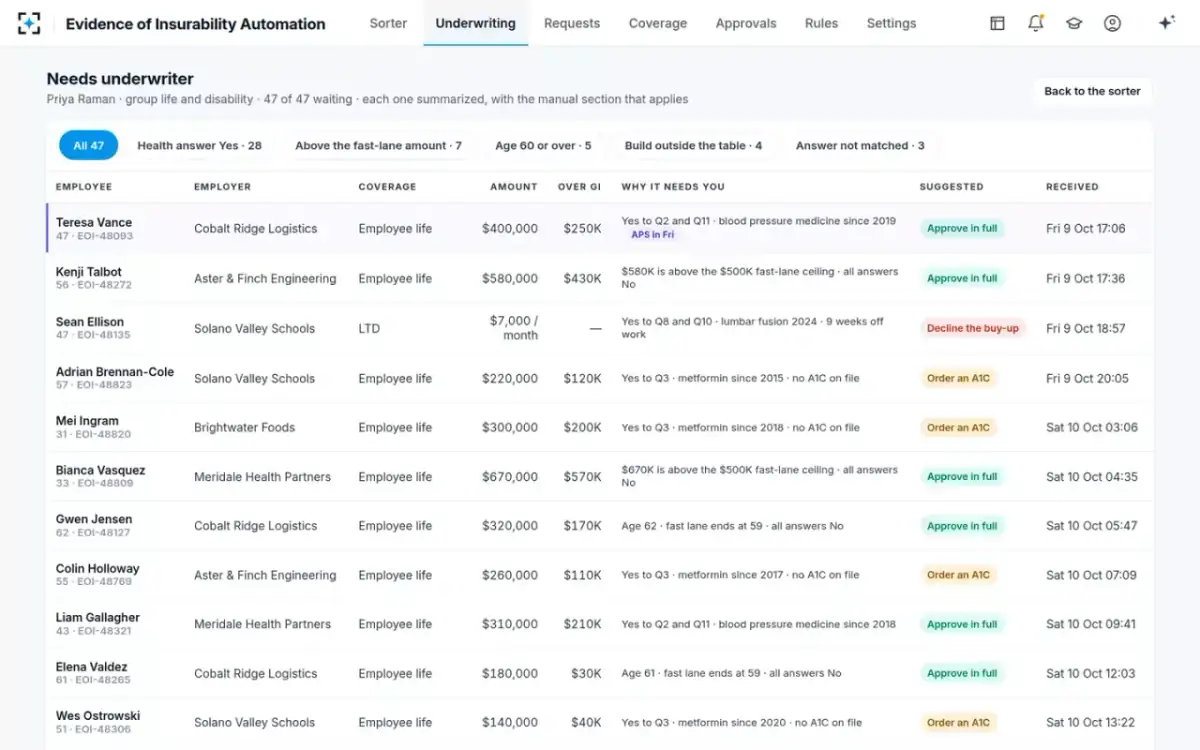
The sample underwriting queue shows how few cases end that way. Of the 47 forms that needed an underwriter on the Larkspur Monday, the eleven on the first screen carry suggestions to approve in full or to order a blood test first, with one exception: Sean Ellison, 47, asked for a long-term disability buy-up to $7,000 a month after answering Yes to questions 8 and 10, a lumbar fusion in 2024 and nine weeks off work. The suggestion was to decline the buy-up. In the solution that suggestion is only a suggestion; the underwriter decides, and a decline goes to a second underwriter before anyone is told.
Needs underwriter: each case with why it needs a person and what is suggested
What letter does the carrier owe when EOI is denied?
The employee should get one, and in states that follow the NAIC's privacy model act it must give the specific reasons or say how to get them in writing. The model act reaches "group insurance which is individually underwritten", which in our reading describes an evidence review. It requires the carrier to "provide the applicant, policyholder or individual proposed for coverage with the specific reason or reasons for the adverse underwriting decision in writing or advise such person that upon written request he or she may receive the specific reason or reasons in writing", and to summarise the person's rights.
The model then sets two clocks. The person may ask within 90 business days of the notice, and the carrier must answer within 21 business days with the reasons, the specific items of information behind them, and the names and addresses of the sources. Medical-record information supplied by a doctor or hospital may be sent either to the person or to a medical professional the person names, as the carrier prefers. These are model provisions from the 1992 text; each state that adopted the act wrote its own version.
The clocks after an adverse underwriting decision under the model act and the FCRA
- Person may ask in writing90 business days
- Carrier answers21 business days
- Free copy from the reporting agency60 days from the notice
When a consumer report drove the decision: the FCRA notice
If a consumer report played any part in a decline or a reduced amount, the Fair Credit Reporting Act adds its own notice. Adverse action in insurance is defined broadly, as "a denial or cancellation of, an increase in any charge for, or a reduction or other adverse or unfavorable change in the terms of coverage or amount of, any insurance, existing or applied for, in connection with the underwriting of insurance". An approval at a lower amount than elected fits that definition as plainly as a decline does.
The notice duty is triggered by any adverse action "based in whole or in part on any information contained in a consumer report". The carrier must tell the person, name the reporting agency with its address and telephone number, say that the agency did not make the decision, and explain the right to a free copy of the report within 60 days and to dispute it. Whether a given prescription-history or medical-exchange report is a consumer report is a question for counsel; a carrier that treats them as such and sends the notice is on the safe side.
A record alone: why an exchange report cannot decline by itself
An exchange report can start an inquiry but should not end one. The model act forbids basing an adverse underwriting decision, in whole or in part, "On personal information received from an insurance support organization whose primary source of information is insurance institutions", while allowing a decision on further information obtained as a result. That describes any exchange whose data comes from its member insurers. An exchange code is a reason to ask; the decision rests on what the asking finds.
The sample solution applies the same rule to every outside record. The health screen reports agreement or contradiction with the record that shows it, and a contradiction sends the form to an underwriter. It never declines on a record alone. In New York, the Department of Financial Services adds that the reasons given after a decline "should include details about all information upon which the insurer based any declination, limitation, rate differential, or other adverse underwriting decision, including the source of the specific information" where the insurer uses AI systems or external data. A file that cites each line's source answers that expectation without extra work.
A record can send a form to an underwriter. Only an underwriter can decline it, and only on evidence the file can show.
The sample solution's rule for every outside record
Approved at a lower amount is also an adverse decision
A reduced approval is a partial decline and needs the same care. The FCRA definition above names "a reduction … in the terms of coverage or amount". New York's insurance law, as the Department summarises it in its 2024 circular, bars a life or accident and health insurer from limiting "the amount, extent, or kind of coverage" because of a disability or impairment unless the limit is permitted and actuarially sound, and then requires notice of the right to the specific reasons.
Lower amounts carry a billing risk that declines share. Once the decision is made, payroll must change. In the sample carrier's daily check of deductions against approvals, Samir Qureshi had been approved at $300,000 on 3 April against a $500,000 election and was still being deducted on the full amount; Lena Kowalczyk's spouse coverage had been declined above $30,000 on 12 June and was still deducted at $100,000. A decline that never reaches the bill leaves the employee believing they are covered, which is where the court cases in what happens if EOI expires begin.
Disability buy-ups: when a reversal is a rescission
Reversing disability coverage after it took effect is not an underwriting decision under ERISA; it is a claims decision. The Department of Labor's claims rule says that for a plan providing disability benefits, "the term “adverse benefit determination” also means any rescission of disability coverage", meaning a cancellation with retroactive effect other than for unpaid premiums. The full disability claims procedure follows: a written notice with the specific reason, the plan provisions, and the right to appeal.
That matters for buy-ups that slipped through. If a long-term disability increase was billed and treated as in force without approved evidence, and the carrier later reverses it back to its start, that reversal triggers the claims rule. The safer course is the one this page argues throughout: decide the evidence before the coverage is billed, so there is nothing to reverse.
What the file must show for each outcome
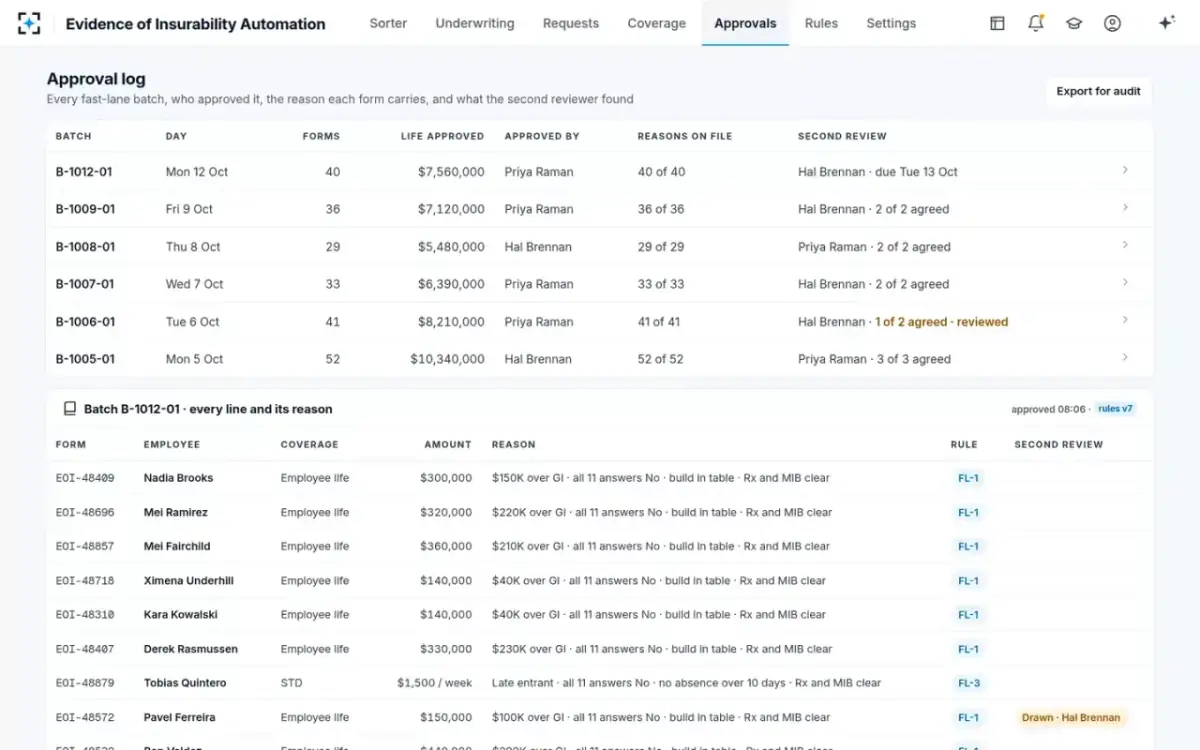
A decision holds up when someone who was not there can read why it was made, from what, by whom and under which rule. That applies to the routine approvals as much as to the declines: a reinsurer or an auditor shown a batch approval without reasons sees a stamp, not underwriting. In the sample solution, every fast-lane approval carries its one-line reason and its rule version, every medical case keeps the cited summary and the underwriter's name and time, and the approval log records what each second reviewer found.
A bulk approval against a decision file that can be defended
Bulk stamp: Approved in batch; no reason per form.
Decision with its evidence: “Late entrant · all 11 answers No · no absence over 10 days · Rx and MIB clear”, rule FL-3, version 7.
Bulk stamp: The form, if it can be found.
Decision with its evidence: Each answer, each record checked and the authorization date, with the time each check ran.
Bulk stamp: A user ID in a workflow system.
Decision with its evidence: The underwriter by name and time; the second reviewer and what they found.
Bulk stamp: Whatever the manual said at the time.
Decision with its evidence: The fast-lane rule version, back-tested on decided forms and co-signed by the medical director.
Bulk stamp: A letter template with a generic reason.
Decision with its evidence: The finding, its source and the manual section, reviewed by a second underwriter before the letter.
The approval log in Evidence of Insurability Automation: each batch, who approved it and what the second reviewer found
A decline in Evidence of Insurability Automation, from summary to letter
Agent
Medical summarizerSummarises the answers, prescriptions, exchange report and physician statements, quotes the manual section that applies, and suggests a decision.
Never: decide; every line cites its source
A person decides
Medical underwriterReads the cited summary and the form, and decides: approve, approve lower or decline, within her authority.
A person decides
Second underwriterReviews every decline and every lower amount before the employee is told; the log records what was found. The letter then goes out with the reasons, or how to request them, and the consumer-report notice where a report played a part.
Agent
Coverage syncSends the decided amount to enrollment and billing, and checks the next payroll file against it.
Never: send an elected amount; refunds need the underwriter
Can an employee appeal an EOI denial? What reconsideration needs from the file
Usually the employee can ask for reconsideration, and the reasons are what make a request worth sending. Carriers set their own route, which the denial letter or the certificate describes. The model act's right to the specific reasons and the sources is what lets an employee, or their doctor, answer the actual finding: a newer blood pressure reading, a corrected prescription record or a specialist's letter.
The stronger protection is a correct decision made on time. The Department of Labor's 2023 settlement with Prudential followed an investigation that found the insurer had collected premiums for supplemental coverage for extended periods and then denied claims after deaths for missing evidence. The Assistant Secretary for EBSA put the point bluntly:
"The Employee Benefits Security Administration will take appropriate action against any insurance company that collects regular premium payments from plan participants, and later plays a game of ‘gotcha’ to wrongfully deny benefits based on technicalities like ‘insurability’ after the participant passes away."
Lisa M. Gomez, Assistant Secretary for Employee Benefits Security, April 2023
That is the denial nobody can defend: one made at claim time about a form nobody asked for. How each step of an evidence form is asked for, and what an agent may not fill in, is set out in evidence of insurability questions; how to test whether a vendor's software keeps a decision file like this is part of twelve questions to ask before you buy.
Before an EOI decline or reduced approval leaves the building
- Name the finding and the manual section it fails
Not “does not meet underwriting guidelines”; the specific reason is what the employee is owed.
- Cite the source of every fact relied on
Form answer, prescription history, exchange report or physician statement, with dates.
- Check that no outside record decided it alone
An exchange code or a refill can prompt a request; the decision rests on what the request found.
- Send the consumer-report notice if a report played any part
Agency name, address, telephone, the statement that it did not decide, and the 60-day free copy.
- Have a second underwriter review it
Every decline and every lower amount, with what the reviewer found kept in the approval log.
- Change the bill the same day
A declined or reduced amount that stays on payroll undoes the decision.
Questions people ask
Why would evidence of insurability be denied?
Because the medical evidence, the build or the records do not support the amount asked for under the carrier's manual. Common causes are a condition outside the manual's limits, recent treatment or time off work, or records that contradict the answers and are borne out on review.
What happens to premiums if EOI is denied?
Premium for the declined amount should stop, and any deducted for coverage that was never in force is normally refunded. In the sample carrier's daily check, a spouse election declined on 12 June was still being deducted in October, and the refund came to $61.60.
Can EOI be denied because of prescriptions?
A prescription history can prompt questions or a request for records, and the medical facts it leads to can support a decline. Under the NAIC model act, a decision may not rest on information from an insurer-sourced support organisation alone, and a carrier that relies on a consumer report must send the FCRA notice.
What is an adverse action notice in insurance?
It is the FCRA notice owed when a decline, a higher charge or a reduced amount is based in whole or in part on a consumer report. It names the reporting agency, says the agency did not make the decision, and explains the right to a free copy within 60 days and to dispute it.
Does the employee get a letter if EOI is denied?
Yes, normally. Where a state follows the NAIC privacy model, the letter must give the specific reasons in writing or say how to request them, and a request made within 90 business days must be answered within 21 business days.
Can an EOI denial be appealed?
Most carriers will reconsider with new medical evidence; the letter or the certificate gives the route. A letter that already states the specific reasons and sources lets the new evidence answer the finding that was made.