EOI pending means the carrier has an election that needs evidence of insurability, usually coverage above the plan's guaranteed issue amount, a late enrollment or an increase, and has not yet decided on it. Until it decides, the guaranteed amount stays in force and the amount above it does not. The word hides who the form is waiting on: the employee who left a question blank, the employer who never sent the election, the doctor's office that has not returned a physician statement, or the carrier's own queue. Botminds' Evidence of Insurability Automation is software for group life and disability carriers that reads each evidence form on arrival and states, for every form still pending, what is missing and who has to act next.
The trouble with a single status is that nobody owns it. An enrollment specialist sees pending and calls the carrier; the carrier's assistant sees pending and waits for the employee; the employee assumes pending means approved soon, while payroll may already be deducting for the full election. The examples on this page come from a fictional carrier, Larkspur Life & Group, on an open-enrollment Monday as it runs through the solution. Every person and employer named in them is invented, and every number about them is sample data.
Four parties behind one pending status, and what each one owes the form
01
The employee
Owes: Answers to every health question, height and weight, a signature on the declaration and a dated medical authorization.
Stalls on: A blank answer or an unsigned page. Nothing downstream can start.
02
The employer
Owes: The election in its enrollment file, the paper forms it collects, and a payroll deduction that matches what was approved.
Stalls on: No election on file, a form left in a benefits office, or a deduction set to the elected amount.
03
The physician’s office
Owes: An attending physician statement when the underwriter asks for one.
Stalls on: A request that sits until someone calls the office.
04
The carrier
Owes: The checks the authorization allows, an underwriter’s decision, the letter, and the approved amount sent back to enrollment and billing.
Stalls on: A form in a queue worked by date, behind cases that need medical judgment.
What does EOI pending mean?
Pending means received but not decided. The carrier knows an employee elected an amount that needs evidence, it may already hold a form, and it has not approved, declined or approved a lower amount. In a typical group policy the decision is what puts the excess in force. The First Circuit quoted one carrier's denial letter, which set out the rule plainly: an employee "will become insured on the first day of the Policy month which coincides with or follows the day [w]e approve the statement of physical condition or other evidence of good health".
Pending is also not the same as never started. A form that the employee has not submitted is often invisible to the carrier, so it shows as pending only in the employer's enrollment system, if anywhere. That is the gap the court cases on this page fall into: the carrier did not know there was a form to decide, the employer did not chase it, and payroll deducted anyway.
Four parties, one status: who each pending form is waiting on
A pending form is waiting on one of four parties, and each needs a different message. The employee owes answers, a signature and a dated authorization. The employer owes the election and, often, the paper forms it collected. A physician's office owes a statement when the underwriter asks for one. The carrier owes the decision, the letter and the approved amount back in the bill.
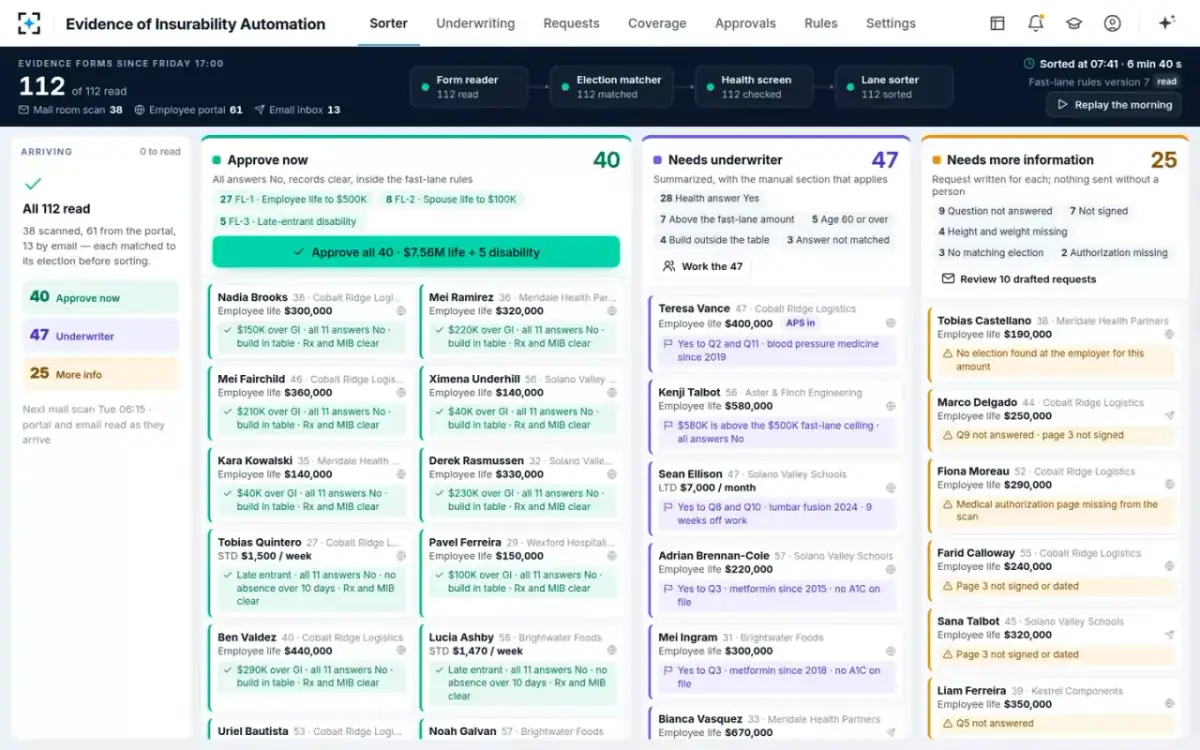
The Larkspur queue shows how lopsided this is. Of 112 forms read since Friday evening, 25 were waiting on someone outside the underwriting desk: 9 with a question not answered, 7 not signed, 4 with height and weight missing, 3 with no matching election at the employer and 2 with no authorization. Another 47 needed an underwriter's judgment. The other 40 had nothing to underwrite. One label, pending, would have covered 72 forms with three different next steps.
Pending, split into what each form is actually waiting on
| Waiting on | What is missing | Who acts next | Sample forms |
|---|---|---|---|
| The employee | A health question left blank; height and weight missing | Underwriting assistant sends a request for exactly that answer | 13 |
| The employee | Page 3 not signed or dated, or no medical authorization | Assistant sends the page back to sign; prescription and medical-exchange checks wait | 9 |
| The employer | No election on file for the amount on the form | Enrollment confirms the election with the employer | 3 |
| The physician | An attending physician statement the underwriter asked for | Assistant follows up with the office on the set day | Inside the 47 |
| The carrier | A medical judgment: a health answer Yes, an amount above the fast-lane ceiling, age, build | Medical underwriter decides from a cited summary | 47 |
| Nobody | All answers No, records clear, inside the rules | Underwriter approves the batch, reasons on file | 40 |
What coverage is in force while an EOI is pending?
Usually the guaranteed issue amount, and not the amount above it until the carrier approves. Larkspur's request letters say so in one line: the employee's "guaranteed coverage stays in force while we wait". The policy and the certificate decide the exact rule, including whether coverage starts on the approval date or the first of the next month, as in the letter quoted above.
What makes the question hard is payroll. If the employer's system loads the elected amount, the employee pays for coverage that is not in force, and the paycheck stub tells them they have it. Courts have treated that combination seriously. In Salyers, a carrier's own employee described what the employer normally did with an election that needed a statement of health, and what it had failed to do:
"Typically[,] if an employee wants to elect an amount that requires SOH [(a statement of health),] Providence would put the amount of life insurance at the max without SOH ($50k for spouse life), mark it as pending, wait for the SOH to be approved by MetLife and send a letter. This was not done."
A MetLife employee's file note, quoted by the Ninth Circuit in Salyers (2017)
That note describes the correct handling of a pending election in four steps: cap the coverage at the guaranteed amount, mark it pending, wait for the decision, write to the employee. What happens when the steps are skipped, and the claim arrives first, is followed step by step in what happens if EOI expires.
How long does an EOI stay pending?
There is no regulatory clock for a group EOI decision; the carrier's own rules set it. A form with nothing to underwrite can be decided the morning it arrives. A form that waits on an employee runs as long as the carrier's request stays open. A form that waits on a physician statement runs as long as the doctor's office takes. No published dataset measures these waits, so each carrier has to measure its own.
Larkspur's clocks are settings: a reminder on day 10 and day 24 after a request is sent, a call to the physician's office after 10 days, and a close-out at day 60, after which only the guaranteed amount applies. The two sample forms below show why the age of a pending form matters less than what it is waiting on.
Two pending forms, two different clocks
- Request out, 12 OctDay 0–10
- First reminderDay 10–24
- Second reminder, then closeDay 24–60 · 11 Dec
- Pending, nothing deducted14–31 Aug
- Pending, and deducted earlySep to 12 Oct
The first lane is a healthy pending form: the request is out, the dates are known and the employee keeps her guaranteed coverage. The second is the dangerous kind. Hannah Lindqvist's form had been pending for eight weeks, and for most of that time payroll had been taking premium for $370,000 of coverage that nobody had approved. Pending was true. It was also the wrong thing to be watching.
Late entrants: why a late enrollment joins the same queue
A late entrant is an employee who enrolls after the window the plan allows, and many group plans require evidence of insurability for any late election, even one below the guaranteed issue amount. The window and the rule are in the certificate. The plan in Silva defined it in one line: "A late request is one made more than 31 days after You become eligible." In that plan, a late request without accepted evidence meant no supplemental coverage at all.
Late entrants matter to the pending queue because they arrive all year and look ordinary. They often elect small amounts, and the reason they need evidence is a date, not a dollar figure. At Larkspur, the fast-lane rule for late-entrant short- and long-term disability tests exactly that: joined after the 31-day window, all 11 health answers No, no absence over 10 days in five years, prescription and medical-exchange records clear. Five such elections were approved in the Monday batch.
Where an employee's question about a pending EOI should go
An employee should start with the employer's benefits team, because the employer usually knows whether the form reached the carrier, and with the carrier's EOI portal or service line if the employer does not. The answer depends on who holds the form. If the carrier never received it, no amount of calling the carrier will move it.
That is the practical reason to know who a form waits on. Silva turned partly on a carrier note describing the employer's practice: "HR does not follow up on if the SOH was completed or not as it is the ee's responsibility to complete". In Shields, the carrier supplied the forms "with the expectation that Duramax would have the form completed by any employee who elected" the excess, yet the employee was never given one. In both cases each party believed another one was waiting.
Where the carrier loses sight of a pending form
The carrier loses sight of a form at the employer. Paper forms collected by an HR office, an election that never reaches the carrier's file and payroll deductions the carrier sees only as a lump-sum remittance are all outside the underwriting desk's view. The carrier learns about them when a claim arrives.
The Department of Labor has drawn a line under this. In settlements announced in 2023 and 2024 with four group life insurers, it required each to make or close the evidence question within a short window of taking premium. The September 2023 settlement gives United of Omaha 90 days after a participant's first premium to determine whether evidence requirements are met, and bars denials on evidence grounds after that. A pending queue the carrier cannot see is a pending queue it cannot close in 90 days. The cost of each week of waiting is set out in EOI approval time, priced week by week.
Needs more information in Evidence of Insurability Automation: each pending form with what is missing and who it waits on
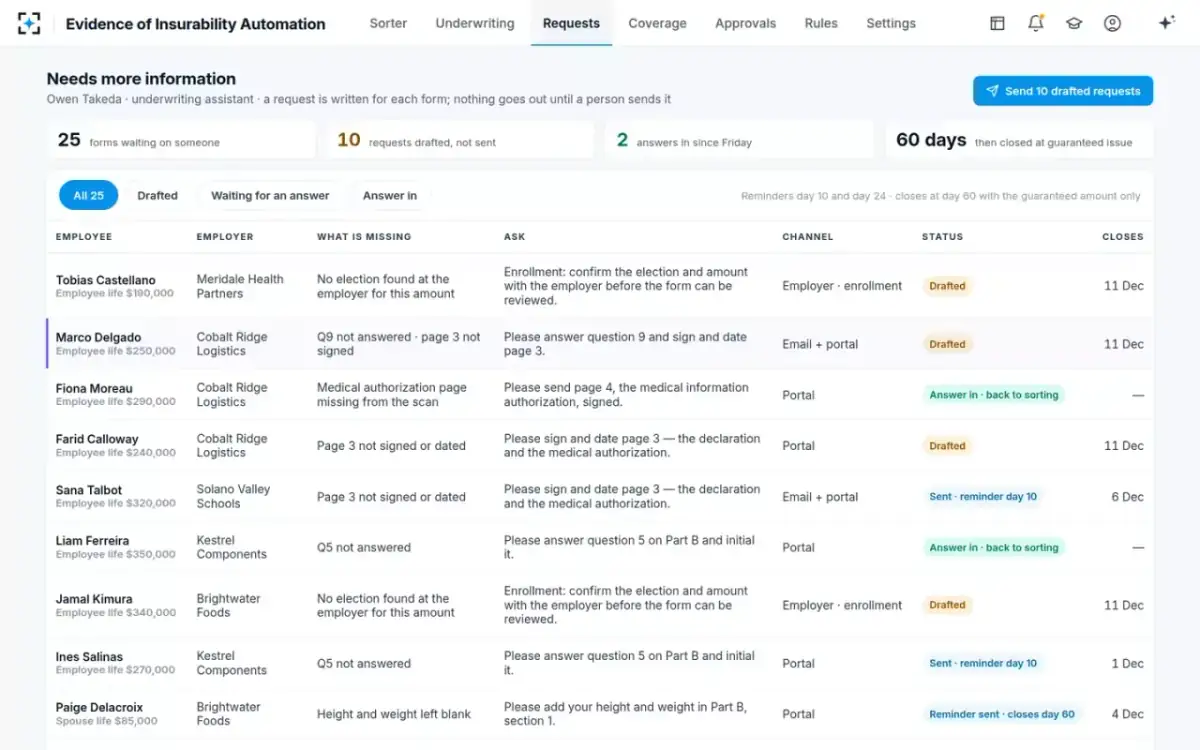
Splitting one pending queue into who acts next
The fix is to replace one status with a reason and an owner for every form. In the solution, seven agents read each form as it arrives by mail scan, employee portal or email; match it to the election at the employer; check the answers against the build table, prescription history and the medical information exchange under the signed authorization; and sort it into Approve now, Needs underwriter or Needs more information, each with a one-line reason. For a form waiting on someone, the missing-information writer drafts the request for exactly what is missing. A person sends it.
The same matching runs the other way. Every day the coverage sync compares payroll deductions above guaranteed issue with the approvals on file, across all seven employers. On the sample Monday it found six employees paying for coverage nobody had approved, among them Hannah Lindqvist with her form pending since 14 August. A pending form with a deduction behind it is the one to move first.
Evidence of Insurability Automation's sorter: every form read and placed with its reason before the desk opens
Who stops asking “is it still pending?” once each form carries its cause
Today
“The broker asks me every day which employees are still pending.” Each answer means opening the carrier’s queue and the employer’s file separately.
With agents
Sees elected against approved for every employer, and each employee’s status in the employer portal: received, with an underwriter, waiting for information, approved.
Still theirs: The conversation with the employer and the broker.
Today
“Most forms aren’t hard. They’re missing a signature.” Chases answers, signatures and physician statements one form at a time.
With agents
Reviews requests already written for exactly what is missing, sends them, and sees each one’s reminder dates and close date.
Still theirs: Every send. Nothing goes out without a person.
Today
Opens forms in date order, and finds that half of what she opens has nothing to underwrite.
With agents
Approves the forms with nothing to underwrite in one batch, each with its reason, and spends the morning on the cases that need her.
Still theirs: Every decision, approval and decline.
Today
Cannot say from one screen how many forms are waiting on employees, on employers or on the desk.
With agents
Reads the pending queue by cause and by age, and sees where premium is being deducted on coverage not yet approved.
Still theirs: The rules, the authority limits and the clocks.
Read with the dependency map at the top of the page, the change is a change of question. Instead of "is it still pending?", each person asks "is it waiting on me?" Of the 25 Larkspur forms waiting outside the underwriting desk, 22 were waiting on an employee for an answer, a signature or an authorization, and a letter asking for exactly that is the shortest path back to a decision. What an EOI form asks, and which answers an agent must never fill in itself, is the subject of evidence of insurability questions.
A pending-queue check any group underwriting desk can run this week
- Count pending forms by who they wait on, not by age
Employee, employer, physician, underwriter. Each needs a different message and a different owner.
- Match every deduction above guaranteed issue to an approval
A pending form with a deduction behind it is the riskiest form in the queue.
- Find the forms the carrier has never seen
Elections above guaranteed issue in the employer file with no form at the carrier are pending only in theory.
- Flag late entrants by date, not amount
A late election needs evidence even when it is small, if the plan says so.
- Set reminder and close-out dates, and write them in the letter
The employee should know when the request closes and what coverage stays in force meanwhile.
- Decide within a known window of the first premium
The Department of Labor’s settlements used 90 days or three months; set the carrier’s own limit and measure against it.
Questions people ask
What does EOI pending mean?
It means the carrier has an election that needs evidence of insurability and has not yet decided it. The guaranteed issue amount is normally in force; the amount above it is not until approval. The certificate states when approved coverage starts, often the first day of the month on or after the approval.
What happens if a pending EOI request is never answered?
The carrier's own rules decide, because no regulation sets a clock for a group EOI decision. In the Larkspur sample settings, a request waiting on an employee gets reminders on day 10 and day 24 and closes at day 60, after which only the guaranteed issue amount applies. Payroll should then stop any deduction for the amount above it.
Can premium be deducted for coverage while EOI is pending?
It should not be, for the amount above guaranteed issue, and courts have held carriers to it. In Salyers, the Ninth Circuit's case summary records that the insurer waived the evidence requirement because it took premium for $250,000 of coverage without asking for a statement of health. On the sample Monday, Larkspur's daily payroll check found six employees paying for coverage nobody had approved.
Why do EOI forms stay pending?
Most often because something is missing: an unanswered question, an unsigned page, an expired authorization or a physician statement. In the sample queue, 25 of 112 forms were waiting on an employee or employer rather than on the underwriter.
Does a late entrant need evidence of insurability?
In many group life and disability plans, yes, for any amount, because the election came after the enrollment window; the certificate says which. The plan in Silva treated a request made more than 31 days after eligibility as late and required accepted evidence before any supplemental coverage applied.
Does a pending EOI change the employee's imputed income?
Not while it is pending. Imputed income is the IRS Table I cost of employer-provided group-term life above $50,000 actually in force, so an amount awaiting approval adds nothing. Once approved, the new amount counts from its effective date, which can move an employee past $50,000 part way through the year.