EOI approval time, the days between an employee's evidence form reaching a group carrier and a decision on it, runs from the same morning to several weeks. The underwriting is rarely the slow part. A form with every health answer No needs minutes of review, but in open-enrollment season it joins one long queue worked in date order and sits behind cases that need a physician statement. Each week it waits, the coverage the employee chose is not in force, premium may already be coming out of their pay, and the carrier's chance to decide before a claim decides for it gets smaller. Botminds' Evidence of Insurability Automation reads every form as it arrives, readies the simple approvals for an underwriter to approve in one batch, and leaves the medical cases to the underwriter with a cited summary.
This page puts a price on the wait. It does not count staff hours, which every carrier measures differently. It counts what the queue holds: premium deducted on unapproved coverage, refunds owed, death benefits in question, and the rule the Department of Labor has used to say how long is too long. The examples come from a fictional carrier, Larkspur Life & Group, on Monday 12 October 2026; the people and employers are invented and the figures about them are sample data.
Where a simple EOI form's days go, in one queue and in a fast lane
| Step | One queue worked by date | Read on arrival, fast lane |
|---|---|---|
| Waiting its turn in the queue | 12 days | A tenth of a day |
| Reading and keying the form | Half a day | A tenth of a day |
| Matching the election and guaranteed issue | Half a day | A tenth of a day |
| Prescription, exchange and build checks | 1 day | A tenth of a day |
| Underwriter decision and letter | 1 day | Half a day |
| Approved amount into enrollment and billing | 2 days | A tenth of a day |
| Total | About 17 days | About 1 day |
How long does EOI approval take?
Anything from a few hours to several weeks, depending on what the form needs. No regulation sets a deadline for a group EOI decision, and no public body publishes carriers' turnaround times, so every figure you will see is a carrier's own. The useful split is by cause: forms with nothing to underwrite, forms waiting on the employee, and forms that need medical judgment, often with a physician statement.
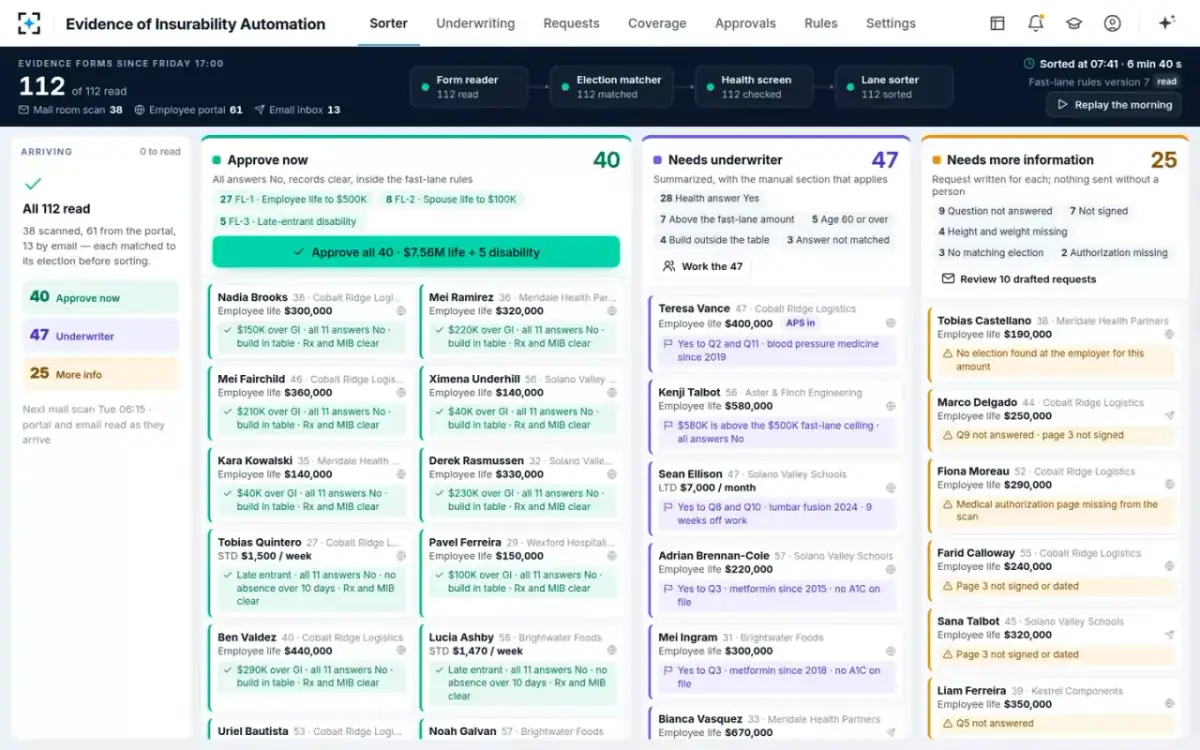
The Larkspur sample shows the shape. Of 112 forms read over a weekend, 40 had nothing to underwrite and were approved at 08:06 on Monday; 47 needed an underwriter; 25 were waiting on an employee or employer. One of the 47, Teresa Vance's, waited 17 days for her physician's statement, requested on 22 September and received by fax on 9 October, and was approved in full at 08:14 on the Monday it was summarised. For her, the physician's office was the clock. For the 40, the clock was the queue.
Why does EOI take so long in open enrollment?
Because open enrollment concentrates the year's elections into a few weeks and most carriers work them in one line. Larkspur's seven employers held their windows between 1 September and 9 October, so their forms arrived together. Worked by date, an easy form that arrived on Thursday waits for a complicated one that arrived on Wednesday, however long that one takes.
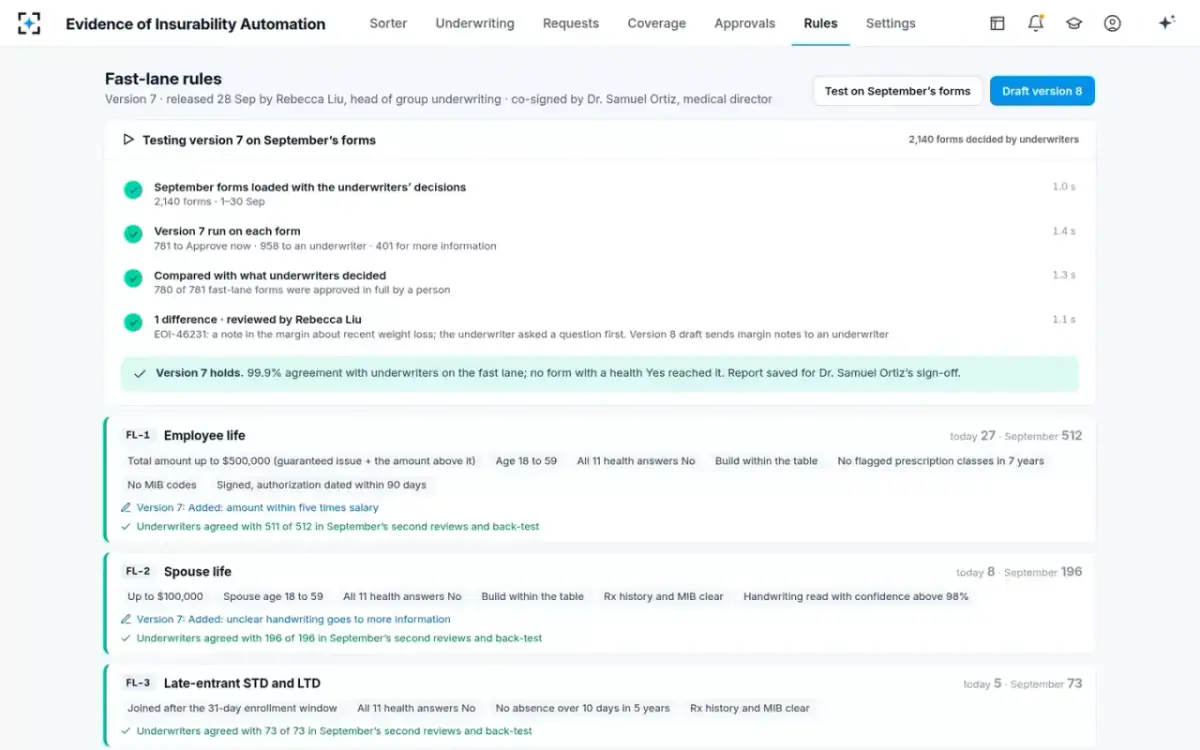
The cost of that ordering shows up in the carrier's own history. Before releasing a rule change, Larkspur ran its fast-lane rules over the 2,140 forms its underwriters decided in September: 781 would have gone straight to the batch for approval, and underwriters had in fact approved 780 of them in full. Every one of those 781 had waited its turn in the single queue.
Evidence of Insurability Automation tests the fast lane on September's decided forms before any rule change
Is coverage effective before EOI approval?
Not for the amount that needs the evidence. The guaranteed amount is in force; the excess starts when the carrier approves it, on the date the certificate sets. The plan in Silva said what happens if evidence is not given or not accepted, for an increase above one level: "If You do not give Us evidence of insurability or the evidence of insurability is not accepted by Us as satisfactory, the amount of Your Supplemental Life Insurance will not be increased."
So a late approval does not reach backwards. If a form is approved on 30 October, the excess runs from that date or the next policy month, not from the election date in September. The weeks in the queue are weeks the employee's family was not covered for what the employee chose, which is the first cost of approval time and the one that never appears on a carrier's report.
Do you pay premiums while EOI is pending?
You should not pay for the excess before it is approved, but many employees do, because the employer's payroll loads the elected amount. In Silva no evidence ever reached the carrier for the employee's supplemental life, yet the employer withheld about $10 from each biweekly paycheck for about six months, until his death in June 2010; the premiums came to $128.76 and the claim was for $429,000. The district court ordered the premiums refunded and nothing more; the Eighth Circuit reversed and let the fiduciary claims go forward.
The daily check in the sample solution found six such employees across seven employers, paying $437.00 a month on $1,240,000 of coverage nobody had approved. Four of the six had no decision on the excess at all: three had never sent a form and one was still pending. The other two had been declined or approved lower months earlier, and their payroll had never changed. The bars below show how long each had been paying before the check found them.
Months of premium on unapproved coverage before the daily check found it
The 90-day line regulators drew
Between April 2023 and June 2024, the Department of Labor announced settlements with four group life insurers over premiums taken without evidence of insurability, and each set a short window for deciding. The common rule: once premiums have been taken for about three months, the insurer cannot deny a claim for lack of evidence. The United of Omaha settlement put it most precisely; it gives the insurer "90 days after it receives a participant’s first premium payment to determine whether the participant has satisfied any applicable evidence of insurability requirements", after which it cannot deny a life claim for reasons related to evidence.
Four settlements, one message: decide the evidence within about three months of the first premium
| Insurer · announced | Window after premiums begin | Other terms reported by the Department |
|---|---|---|
| Prudential · 19 Apr 2023 | No denial for lack of evidence when premiums were collected for more than three months | Protections against denial more than a year after premiums began; group policyholders to be notified |
| United of Omaha · 29 Sep 2023 | 90 days after the first premium to determine whether evidence requirements are met | Also binds its parent and a subsidiary; claims since February 2018 reprocessed |
| Unum · 11 Jun 2024 | No denial solely for lack of evidence after 90 days or more of premiums (ERISA plans) | Clearer disclosure of delayed effective dates for dependents |
| Lincoln National · 12 Jun 2024 | No denial for lack of evidence after three months or more of premiums | Evidence may be requested only in the first year of premiums; no health condition arising after the first premium may be considered |
The First Circuit reached the same place by another road. In Shields, decided in October 2022, it held that an insurer with discretion over eligibility has a fiduciary duty to "make eligibility determinations for each employee from whom the insurer accepts premiums reasonably proximate to the acceptance of those premiums". Read together, the settlements and the case turn approval time from a service measure into a liability measure. A form that waits past the window can become coverage the carrier never underwrote.
Of the four sample employees with no decision on the excess, three were past the three-month mark when the check found them: Joyce Ambrose at ten months, Andre Whitfield at nine and Felipe Ortega at eight. Whether a carrier refunds or honours coverage in that position is a legal decision for the carrier, not an agent's. What happens when nobody makes it before a claim is followed in what happens if EOI expires.
Pricing the queue: held premium, refunds and exposure
A week of EOI approval time has four costs, and only one of them is labour. The carrier holds premium on coverage it has not approved, owes refunds and notices when it finds the mismatch, carries a death benefit whose status is in doubt, and leaves the employee without the coverage they chose. Each can be counted from a carrier's own files.
What one more week in the EOI queue costs a group carrier
Premium held
monthly premium on unapproved coverage × 12 ÷ 52
Sample: $437.00 a month across six employees is about $100.85 a week.
Billing
Refund and rework
refunds owed + notices to employers, brokers and employees
Sample: $2,460.80 refunded, notices to 5 employers and 2 brokers.
Enrollment and billing
Exposure
death benefit not approved × chance a claim arrives first
Sample: $1,240,000 of coverage in question; a court or settlement may decide it.
Head of group underwriting
Coverage gap
excess elected × weeks not in force
The employee’s family is covered only for the guaranteed amount.
The employee
The third term is the one that changes the arithmetic. A carrier that takes premium for months and then denies a claim for missing evidence has learned, from the four settlements, that the denial may not stand. The Department called it what it was:
"This egregious practice left grieving families without the life insurance for which their loved ones had paid, in some cases, for many years."
Seema Nanda, Solicitor of Labor, on the Prudential settlement, April 2023
Can EOI be fast-tracked?
Yes, if the fast track is a rule a person can read and test, not a shortcut. The sample carrier's rule for employee life, FL-1, admits a form only if the total is within $500,000 and five times salary, the employee is 18 to 59, all 11 health answers are No, the build is within the table, there are no flagged prescription classes in seven years and no exchange codes, and the authorization was signed within 90 days. Anything else goes to an underwriter or back for information.
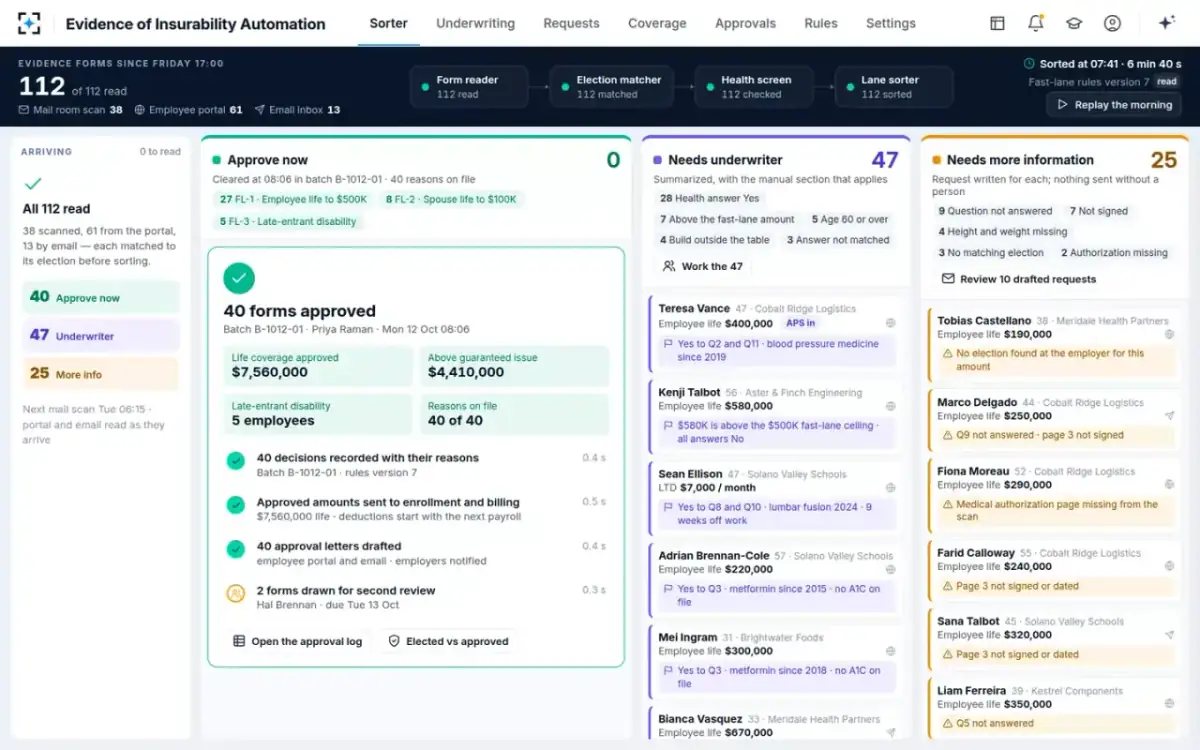
The fast lane does not approve anything itself. On the sample Monday the lane sorter placed 40 forms in Approve now, each with a one-line reason, and the medical underwriter read the reasons and approved them as one batch at 08:06: $7,560,000 of life coverage, $4,410,000 of it above guaranteed issue, plus five late-entrant disability elections. Two forms were drawn for a second underwriter's review the next day. The approved amounts went to enrollment and billing in the same step, which is the part of approval time most carriers forget to count.
Forty approvals in one batch in Evidence of Insurability Automation, sent to enrollment and billing in the same step
What happens if EOI is approved late?
The coverage starts late, and anything that happened in between is outside it. If premium was deducted from the election date, the carrier has to decide whether to refund it or to treat the coverage as in force earlier, and the settlements suggest that after about three months of premium the second may be the only defensible answer. If a claim arrived in between, the carrier is arguing about a form it had not decided.
That is why the cheapest fix is ordering, not speed. Take the forms with nothing to underwrite out of the line on the day they arrive, chase the forms waiting on someone with a dated request, and let the underwriter's week go to the cases that need judgment. Who each pending form is waiting on is mapped in EOI pending; how approved amounts get from the decision to the bill is the subject of EOI automation tools that work with enrollment and billing.
The morning's queue, read and sorted before the underwriter opens it
Questions people ask
How long does EOI approval take?
From the same day to several weeks. A form with nothing to underwrite can be approved the morning it arrives; one that needs a physician statement waits for the doctor's office, which took 17 days for one form in the sample carrier's queue. No regulator publishes industry turnaround figures.
Is coverage effective before EOI approval?
The guaranteed amount is; the amount that needs evidence is not. The excess usually starts on the approval date or the first of the next policy month, as the certificate states.
Do I pay premiums while EOI is pending?
You should not pay for the excess before approval, but some payroll systems deduct on the elected amount. If you see a deduction for the full election while your form is pending, ask your employer which amount the carrier has approved.
Can EOI be fast-tracked?
Yes, through written rules that let an underwriter approve forms with nothing to underwrite in a batch, each with its reason. The sample carrier back-tests any rule change on decided forms and needs the medical director's co-signature before release.
Why does EOI take so long?
Mostly because of waiting: one queue worked by date in open-enrollment season, missing answers or signatures, and physician statements. The underwriting itself is usually the shortest step.
What happens if EOI is approved late?
The excess starts when it is approved, not when it was elected. If premium was deducted in the meantime, the carrier must refund it or treat the coverage as in force, and four Department of Labor settlements barred evidence-based denials after about three months of premium.