A joint clinical assessment is one scientific assessment of a new medicine's relative effectiveness and relative safety, carried out once at Union level by the Member States' health technology assessment bodies working together, against a set of research questions those same countries wrote. It is not a price, not a reimbursement decision and not a second marketing authorisation. Regulation (EU) 2021/2282 forbids the report from containing "any value judgement or conclusions on the overall clinical added value". The hard part is therefore not the assessment but the question set: up to a dozen PICO questions chosen by 27 health systems before anyone knows whether the evidence to answer them exists, and then 100 days to answer all of them. Botminds' EU Joint Clinical Assessment is software for those 100 days — it turns the assessment scope into one row per question, finds the evidence for each, and drafts the dossier section that answers it.
The product examples on this page are sample data in the solution: a fictional medicine, Corventa (corventamab vedotin), in a fictional assessment numbered JCA-26-014, with fictional people and trials. Everything about the law, the procedure and the published assessments comes from the Official Journal, the Coordination Group's own guidance and the four assessment reports published so far, each linked where it is used.
EU Joint Clinical Assessment, by the numbers that govern it
18
joint clinical assessments initiated between January 2025 and June 2026
typical — European Commission, 9 June 2026
~50
more the Coordination Group estimated it may initiate during 2026
typical — HTACG Annual Work Programme 2026
100
days to submit the dossier after the Commission’s first request
Implementing Regulation (EU) 2024/1381, Article 12(2)
0
conclusions about value the report is allowed to draw
HTA Regulation, Article 9(1)
What is a joint clinical assessment?
Mechanically, a joint clinical assessment has three parts, and they happen in this order: a scope, a dossier, a report.
The scope is a list of research questions. The Regulation calls it the assessment scope and defines it as "the set of parameters for joint clinical assessment in terms of patient population, intervention, comparators and health outcomes requested jointly by Member States" (Article 2, point 9). Each combination of those four parameters is a PICO question. The subgroup running the assessment opens a scoping process to identify those parameters, and the Regulation requires the scope that comes out of it to be inclusive and to reflect the Member States' needs (Article 8(6)). Inclusive is the operative word: the scope grows to cover what the countries ask for, not down to what the evidence can support.
The dossier is the developer's answer. It must contain "complete and up-to-date information, data, analyses and other evidence" for every parameter in the scope, analysed with methods fit to answer every research question in the assessment, with the underlying documentation attached so the assessors can verify each figure (Article 9(2) and 9(3)). Its structure is fixed: Annex I of the HTA Regulation sets what a medicinal-product dossier must contain, and Annex I of Implementing Regulation (EU) 2024/1381 gives the template it must be written in. What the JCA dossier template asks for, section by section, goes through it.
The report is the assessors' output: a joint clinical assessment report with a summary report, endorsed by the Coordination Group under Article 12(2), given a procedural review by the European Commission under Article 28, point (d), and then published. That is the whole machine. Nowhere in it does anyone decide whether the medicine is worth buying.
The four things a joint clinical assessment is not
Most of the confusion about the EU HTA Regulation comes from reading "the EU now assesses medicines centrally" as something larger than it is. Four distinctions do most of the work.
It is not a marketing authorisation. The European Medicines Agency's scientific assessment and the Commission's authorisation decision run on their own track and decide whether a medicine may be sold. The first assessment published under the Regulation makes the separation plain: the Commission granted a one-year conditional marketing authorisation for Ojemda (tovorafenib) on 20 April 2026 on the basis of EMA's scientific assessment, and the joint clinical assessment report on the same medicine was endorsed ten days later and published on 9 June 2026. Two processes, two outputs, one medicine.
It is not a price or a reimbursement decision. Nothing in the Regulation touches pricing. Member States keep their own competence "to draw their conclusions on the overall clinical added value of a health technology in the context of their specific healthcare system" (Article 13(1), point (a)).
It is not an appraisal or a ranking. The report describes relative effects and the degree of certainty around them, and stops. Even the list of outcomes in the scope has to be written without ranking them: because a joint clinical assessment carries no value judgement, says the Coordination Group's Guidance on the scoping process, "the listing of outcomes for the assessment scope should also be free of such judgement or ranking".
It is not optional, and the questions are not negotiable. A developer whose product falls in scope is obliged to submit the dossier the Commission requests (Article 10(2)), and disagreeing with a question is not a reason to leave it unanswered. The Coordination Group's own answer to that enquiry is short: the questions reflect what the Member States need, so the developer has to address every one of them appropriately in the dossier (HTACG Q&A, 15 May 2026).
Those reports shall not contain any value judgement or conclusions on the overall clinical added value of the assessed health technology and shall be limited to a description of the scientific analysis.
Regulation (EU) 2021/2282, Article 9(1)
Which medicines are in scope, and from when
Scope is decided by what a medicine is and when its application reached EMA, and it opens in three doors. From 12 January 2025 it covers medicinal products with new active substances where the applicant declares to EMA that the therapeutic indication "is the treatment of cancer", and medicinal products regulated as advanced therapy medicinal products. From 13 January 2028 it adds orphan medicinal products designated under Regulation (EC) No 141/2000. From 13 January 2030 it covers every other new medicine within Article 7(1) (Article 7(2), points (a) to (c)).
Two things about those dates catch teams out. The first is that the doors are cumulative rather than exclusive: an orphan designation does not hold a medicine back until 2028 if it already comes through the first door. Tovorafenib is the proof — the Commission describes Ojemda as "an orphan medicine to treat paediatric low-grade glioma", and it was assessed in the very first wave, because its indication is the treatment of cancer. The second is that the clock is hung on the EMA application, not on the launch: a non-orphan new active substance outside cancer and advanced therapies that is filed with EMA in December 2029 sits outside the regime, and the same molecule filed after 13 January 2030 does not.
Two further routes exist. A variation to an existing marketing authorisation that corresponds to a new therapeutic indication is in scope where a joint clinical assessment report has already been published for the product (Article 7(1), point (b)); the Coordination Group expected to initiate around three of those in 2026. And medical devices in class IIb or III and class D in vitro diagnostics come in by selection, not automatically: the Commission picks them at least every two years against criteria that include unmet medical need, first in class and "incorporation of software using artificial intelligence, machine learning technologies or algorithms" (Article 7(4)). The work programme put the first device assessments at around five, starting June 2026.
The three doors into a joint clinical assessment, drawn to scale
- New cancer medicines and advanced therapiesFrom 12 Jan 2025
- Orphan medicinal products joinFrom 13 Jan 2028
- Every other new medicine in Article 7(1)From 13 Jan 2030
Who runs it: the Coordination Group, the subgroup, the assessor and the co-assessor
A joint clinical assessment is not run by the European Commission, and the reports say so on their own cover page: "the joint clinical assessment is the responsibility of the Member State Coordination Group, and not of the European Commission".
The Member State Coordination Group on Health Technology Assessment — the HTACG — is the body the Regulation establishes, made up of members the Member States designate. It works from an annual work programme and initiates each assessment by handing it to its subgroup on joint clinical assessments. The subgroup then "shall appoint, from among its members, an assessor and a co-assessor from different Member States to conduct the joint clinical assessment" (Article 8(4)), chosen for the scientific expertise the assessment needs. Those two named people, in two national agencies, write the scope proposal and the draft report; an HTA secretariat moves every document between them, the subgroup, the experts and the developer.
The pairs in the four published reports show how concentrated the expertise still is. Germany's IQWiG was assessor on two of the four and co-assessor on a third; Ireland's NCPE was assessor on the other two. Portugal's INFARMED, Hungary's NCPHP and France's HAS took the co-assessor seat once each.
The Commission's role is procedural and it is worth knowing precisely, because three of its acts carry deadlines a developer feels. It informs the developer of the assessment scope and requests the dossier — the "first request" that starts the 100 days (Article 10(1)). It confirms, within 15 working days of submission, whether the dossier meets the requirements of Article 9(2), (3) and (4) (Implementing Regulation, Article 13). And after the Coordination Group endorses the report, it carries out the procedural review under Article 28, point (d), and publishes.
From an EMA application to a published joint clinical assessment report: who acts at each step
| Step | Who acts | What the rule says |
|---|---|---|
| Information for developing the scope | The developer | The proposed summary of product characteristics and the clinical overview from the EMA submission file go to the subgroup (Implementing Regulation, Article 2). |
| The scope proposal and the PICO survey | Assessor and co-assessor, then all Member States | The pair propose a minimum set of parameters and must leave out anything specific to their own country; each Member State answers with its national needs. |
| Consolidation and finalisation | The subgroup | The scope is finalised at the latest 10 days after CHMP adopts its list of questions, or within 75 days of EMA validating the application in the accelerated and new-indication cases. |
| First request | The European Commission | The Commission informs the developer of the scope and requests the dossier, with a submission deadline no later than 45 days before the envisaged CHMP opinion (Article 10(1)). |
| The dossier | The developer | 100 days from notification of the first request; 60 days under the accelerated procedure or for a new-indication variation (Implementing Regulation, Article 12(2)). |
| Confirmation | The European Commission | Within 15 working days, the Commission confirms whether the dossier meets Article 9(2), (3) and (4) — 10 working days in the accelerated cases. |
| Draft, comments, revision | Assessor, co-assessor, subgroup, experts, developer | The developer gets the revised draft and has 7 days to signal technical or factual inaccuracies and claim confidentiality — and may not comment on the results. |
| Endorsement and publication | Coordination Group, then the Commission | The subgroup finalises, the Coordination Group endorses under Article 12(2), the Commission reviews procedurally under Article 28, point (d), and publishes. |
The scope is written by the countries, not by you
This is the single fact that changes how a developer has to work, and it is easy to miss because the Regulation states it so quietly. The questions a dossier must answer are collected from the Member States by survey before the dossier exists.
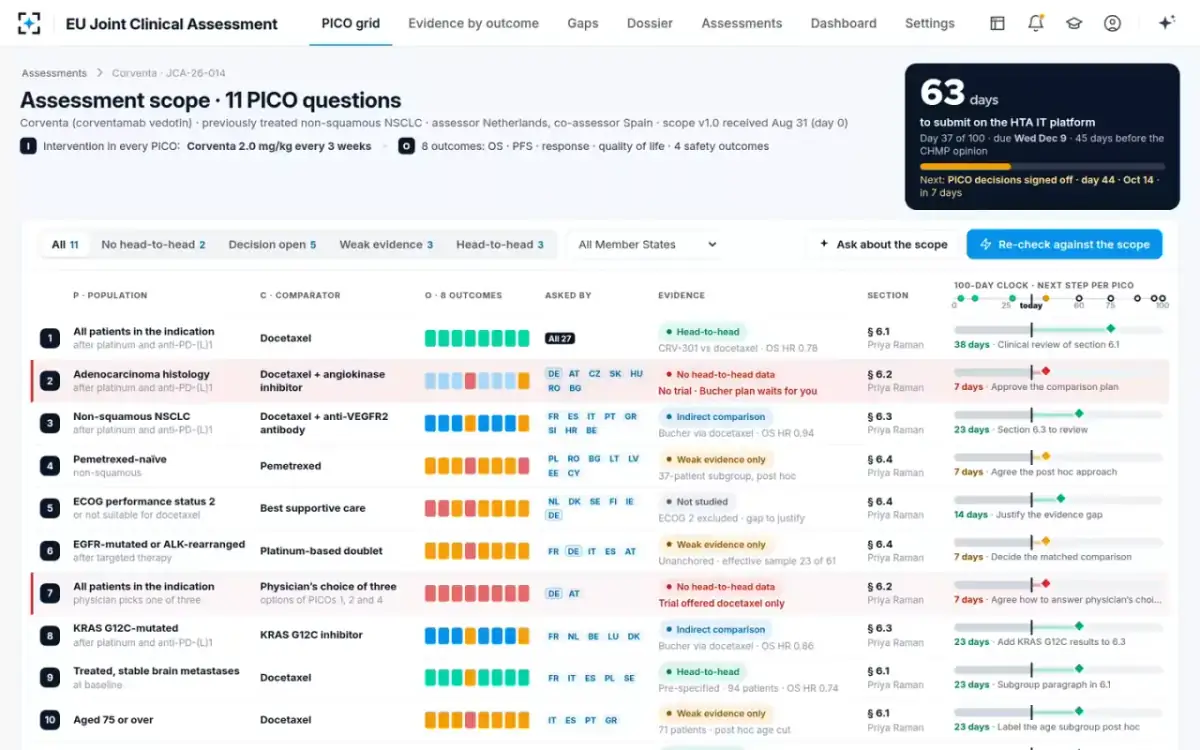
The Coordination Group's scoping guidance describes the mechanism. The assessor and co-assessor draft an assessment scope proposal and are told to keep it thin: nothing specific to their own two countries, and as few parameters as possible. That proposal goes out as a PICO survey to every Member State, which answers with the populations, comparators and outcomes its own system needs. The pair then consolidate, with the stated aim of turning the Member States' needs into the smallest possible number of PICO questions (Guidance on the scoping process).
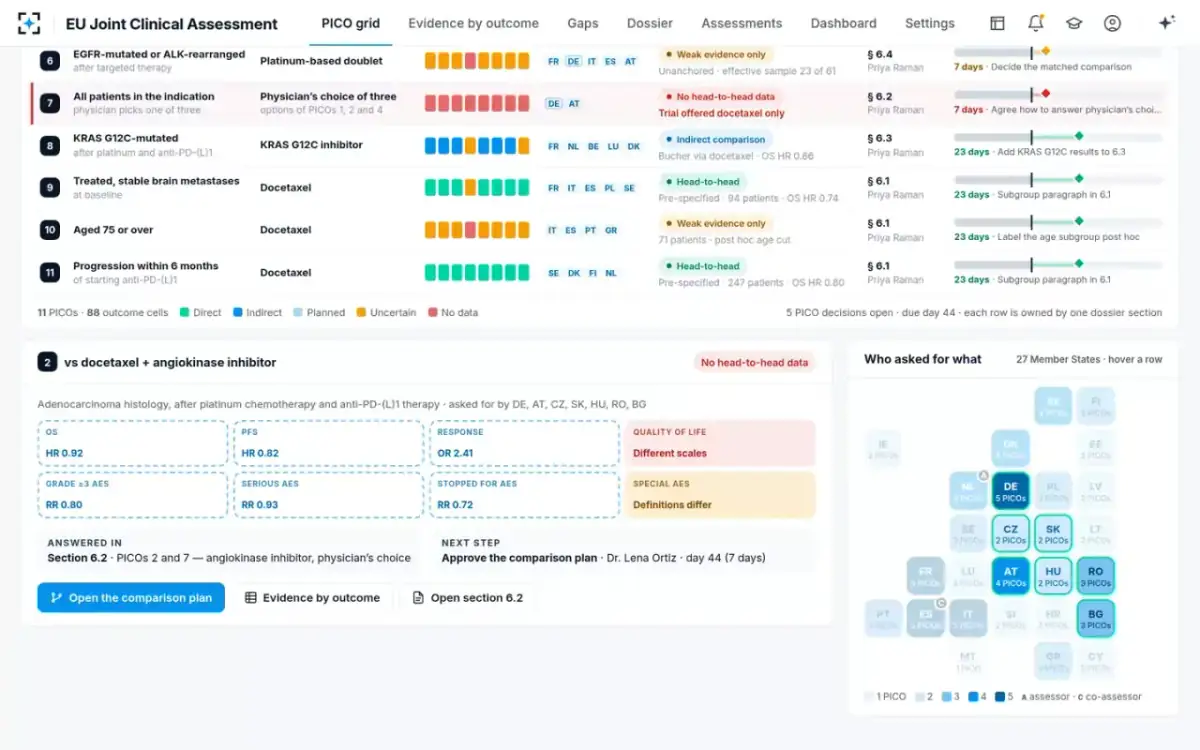
Two consequences follow, and both land on the developer. The first is that the number of questions is not predictable from the medicine. The same consolidation machinery produced one PICO for lurbinectedin and twelve for onasemnogene abeparvovec, because the countries asked for one population in the first case and six in the second. The second is that a question may have no answer anywhere in the evidence base. The guidance is candid about it: "since the assessment scope is mostly considered to be policy driven, it may contain PICOs for which no evidence is available. However, in this case, the JCA report will identify evidence gaps with regard to decision making in health care systems." A question with no trial behind it is not a drafting error; it is a deliberate signal to the health systems that the evidence they need does not exist.
That is why the first useful thing to do with a scope is to count its rows and find the ones nobody can answer. How JCA PICO scoping works, and how to read the scope you are sent, follows the survey and the four consolidation steps in detail.
One row per question the countries asked
Does a joint clinical assessment replace national HTA?
No. A joint clinical assessment replaces the clinical evidence review that each country used to do for itself, and nothing else. Member States must give the published report "due consideration" in their own health technology assessments, but every decision that follows from it stays national: appraisal, added-value conclusions, pricing, reimbursement, restrictions, managed-entry arrangements.
A joint clinical assessment against the national assessment that follows it
At Union level — the joint clinical assessment: All Member States, by survey, consolidated by the assessor and co-assessor into one scope before the dossier is written.
At Member State level — the national HTA: The country itself, from its own policy question — which is where its PICO request in the survey came from.
At Union level — the joint clinical assessment: Relative effectiveness and relative safety against the chosen comparators, and the certainty of those effects.
At Member State level — the national HTA: Whatever the national system assesses on top: cost-effectiveness, budget impact, organisational and ethical aspects, equity.
At Union level — the joint clinical assessment: Nothing. Article 9(1) forbids a value judgement or a conclusion on overall clinical added value.
At Member State level — the national HTA: Everything that matters commercially: added value, price, reimbursement status and conditions of use.
At Union level — the joint clinical assessment: The joint clinical assessment report and a summary report, on the Commission’s site, after a procedural review.
At Member State level — the national HTA: The national HTA report, with the Union-level report and the developer’s dossier annexed to it (Article 13(1), points (b) and (c)).
At Union level — the joint clinical assessment: The assessors, through the secretariat, during the assessment — with deadlines of 7 to 30 days.
At Member State level — the national HTA: Nobody, for evidence already submitted at Union level: Article 13(1), point (d), forbids asking again at national level.
The last row is the one with money in it. Article 13(1), point (d), obliges a Member State to "not request at the national level information, data, analyses or other evidence that has been submitted by the health technology developer at Union level". The practical reading is that a dossier is written once for 27 systems — and that an answer left thin at Union level cannot be quietly strengthened later in a national submission, because the national submission is not supposed to ask for it again.
What due consideration actually obliges a Member State to do
Due consideration is the hinge of the whole Regulation and it is defined by what sits around it rather than by a test. Article 13(1) requires Member States to "give due consideration to the published joint clinical assessment reports and all other information available on the IT platform", and then immediately protects their freedom: "this shall not affect Member States' competence to draw their conclusions on the overall clinical added value of a health technology in the context of their specific healthcare system and to consider the parts of those reports relevant in that context".
So the obligation is procedural and evidential, not substantive. A Member State must take the report into account, annex it and the dossier to its own HTA documentation, share any evidence it receives nationally through the platform, and stop asking for what has already been submitted centrally. It is not obliged to agree with anything, because the report concludes nothing. That asymmetry is exactly what the Commission pressed on when it published the first report: "it is now up to Member States to effectively put these assessments to use — without adding additional requirements, so that innovation can reach patients faster", said the Commissioner for Health and Animal Welfare, Olivér Várhelyi.
For a developer, the useful inference is about where effort goes. Because the countries that will appraise the medicine are the countries that wrote the questions, an answer that is complete for the scope is an answer aimed at each national appraisal already. A PICO answered with a weak indirect comparison is not a Union-level problem to be patched nationally; it is the evidence one named health system will use.
What the published report contains — and what it is forbidden to contain
A joint clinical assessment report is long, structured by population and comparator, and relentlessly descriptive. The scoping guidance sets the shape: "each population or subpopulation then constitutes a chapter in the report, and each comparator requires a subsection thereof", so a scope with six populations produces six assessment chapters, each with as many subsections as it has comparators. Common material — the intervention, the information retrieval, the characteristics of the included studies — is lifted out to the front so it is not repeated.
Inside those chapters the report is confined by Article 9(1) to two things: the relative effects of the technology "on the health outcomes against the chosen parameters which are based on the assessment scope", and "the degree of certainty of the relative effects, taking into account the strengths and limitations of the available evidence". It records where the developer submitted nothing for a PICO and whether the justification was appropriate. It does not say whether the medicine is better.
The developer's own rights in the report are narrow and worth reading twice before planning a review cycle. On receiving the revised draft it has seven days — five in the accelerated cases — to point out purely technical or factual inaccuracies and to flag anything it considers confidential, and it must demonstrate why anything it claims as confidential is commercially sensitive (Implementing Regulation, Article 14(4)). The HTA Regulation closes the door on the rest in one sentence, which bars the developer from commenting on the results of the draft assessment at all (Article 11(5)). The time to influence what the report says about an outcome is while the dossier is being written, which is why the dossier's internal review matters more than the draft-report review.
The four joint clinical assessment reports published so far, and the scope each one answered
Paediatric low-grade glioma with a BRAF fusion, rearrangement or V600 mutation, after one or more prior systemic therapies
3 populations · 8 PICOs
Endorsed 30 April 2026
Assessor Ireland (NCPE) · co-assessor Germany (IQWiG)
Extensive-stage small cell lung cancer that has not progressed after first-line atezolizumab, carboplatin and etoposide
1 population · 1 PICO
Endorsed 22 June 2026
Assessor Germany (IQWiG) · co-assessor Portugal (INFARMED)
Extensive-stage small cell lung cancer after platinum-based chemotherapy, split by treatment-free interval
4 populations · 7 PICOs
Endorsed 22 June 2026
Assessor Germany (IQWiG) · co-assessor Hungary (NCPHP)
5q spinal muscular atrophy with a bi-allelic SMN1 mutation, in patients 2 years of age and older
6 populations · 12 PICOs
Endorsed 16 July 2026
Assessor Ireland (NCPE) · co-assessor France (HAS)
How many assessments there are, and how fast the number is growing
Eighteen joint clinical assessments were initiated between the Regulation starting to apply in January 2025 and the Commission's announcement on 9 June 2026, all of them on new cancer medicines and advanced therapies. Four reports had been endorsed by the middle of July 2026. The gap between those two numbers is the whole shape of the regime in its first eighteen months: an assessment takes most of a year, so the reports arrive long after the assessments start. Measured from the day the assessment scope was shared with the developer to the day the Coordination Group endorsed the report, the four published assessments took about eleven, nine and a half, nine and ten months — and the developer’s own 100 days sat inside the first third of each.
The 2026 work programme is where the volume turns. Adopted on 28 November 2025, it estimates that the Coordination Group "may potentially initiate around 35 joint clinical assessments of medicinal products with new active substances for which the therapeutic indication is the treatment of cancer, and around 15 joint clinical assessments of medicinal products which are regulated as advanced therapy medicinal products", plus around three variations and around five medical devices. That is three to four times the rate of the first eighteen months, inside one calendar year, against a pool of assessor and co-assessor pairs that the four published reports show to be small.
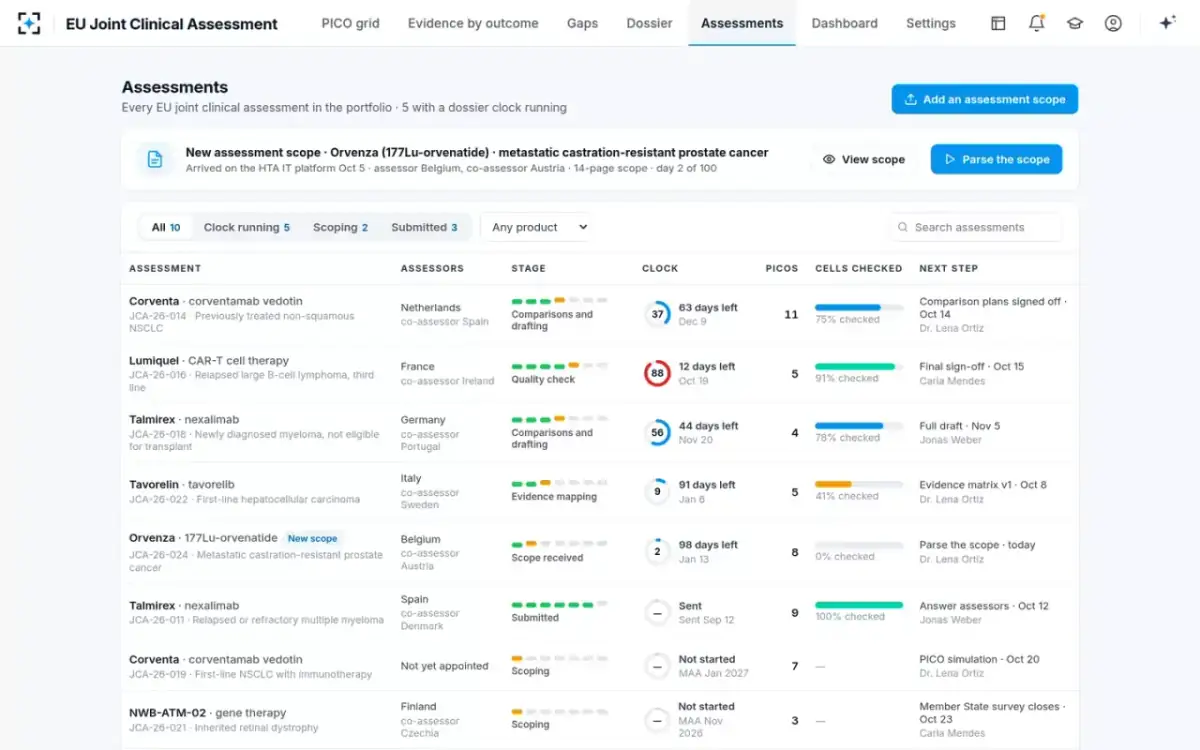
For a developer with more than one product in the EU pipeline, that growth is the planning problem rather than any single assessment. Two scopes landing six weeks apart are two 100-day clocks running in parallel, each with its own question set, its own comparison decisions and its own dossier. The JCA submission timelines, deadline by deadline, lays out what actually has to be done on which day, and who in a market access team now does it.
Several assessments, several clocks
A question with no trial behind it, and the days it has left
Questions people ask
What does JCA stand for in EU HTA?
JCA stands for joint clinical assessment: the single Union-level assessment of a medicine's relative effectiveness and relative safety carried out under Regulation (EU) 2021/2282, the EU HTA Regulation. HTA stands for health technology assessment. The two are often written together because the Regulation created the joint assessment and the Coordination Group that runs it in the same act.
Which medicines need a joint clinical assessment?
Since 12 January 2025, medicines with a new active substance whose declared indication to EMA is the treatment of cancer, and medicines regulated as advanced therapy medicinal products. Orphan medicinal products join from 13 January 2028 and all other new medicines in Article 7(1) from 13 January 2030. A variation adding a new therapeutic indication is also in scope where a report has already been published for that product.
Do orphan medicines need a joint clinical assessment?
Orphan designation by itself brings a medicine into scope from 13 January 2028. But an orphan medicine is already in scope today if it arrives through the first door — a new active substance for the treatment of cancer, or an advanced therapy. Tovorafenib, the subject of the first published report, is an orphan medicine for paediatric low-grade glioma and was assessed in 2025–26 on the cancer route.
Who writes the joint clinical assessment report?
An assessor and a co-assessor, named individuals from national HTA bodies in two different Member States, appointed by the subgroup on joint clinical assessments for the scientific expertise the assessment needs. The subgroup finalises their revised draft and the Coordination Group endorses it; the European Commission reviews it procedurally and publishes it, but does not write it.
Is the joint clinical assessment report public?
Yes. The report and its summary report are published by the Commission after endorsement, and all four published so far can be downloaded in full. Information the developer claimed as confidential, and demonstrated to be commercially sensitive, is redacted; the developer has seven days from receiving the revised draft to make that claim and to flag technical or factual errors.
How many joint clinical assessments have there been?
Eighteen had been initiated between January 2025 and June 2026, and four reports had been endorsed by mid-July 2026 — tovorafenib, lurbinectedin, tarlatamab and onasemnogene abeparvovec. The Coordination Group's 2026 work programme estimates around 50 more initiations during 2026, split roughly 35 cancer medicines to 15 advanced therapies, plus a first handful of medical devices.