A PICO simulation is a rehearsal of the assessment scope: you work out, before the European assessors tell you, which populations, comparators and outcomes the Member States are likely to ask about, and then check what evidence you hold against each of those questions. People run one because the real scope arrives with a deadline attached and no room behind it — and because the questions you cannot answer are the ones you would have needed to start work on a year earlier. This guide sets out how to run a simulation the way the official consolidation guidance works, how many questions to expect, what a good one hands over, and what it cannot promise. Botminds' EU Joint Clinical Assessment is the place the answer lives afterwards, so that the rehearsal does not go stale between the simulation and the scope.
This is a buying guide, so two things up front. A simulation predicts; it does not bind anybody. The only route that puts your question in front of the people who will assess you is the joint scientific consultation, and even that produces a document with no legal effect. The published figures below are linked where they appear; the screens come from a fictional sample assessment inside the solution — Corventa (corventamab vedotin), JCA-26-014 — whose people, products and numbers are invented.
The decision, in four numbers
~50
joint clinical assessments the Coordination Group expects to start in 2026: around 35 cancer medicines and around 15 advanced therapies
8–12
joint scientific consultations on medicinal products planned for the same year — the official route, and a scarce one
50%
of companies surveyed at a 2024 multi-stakeholder workshop had run an internal mock assessment
39days
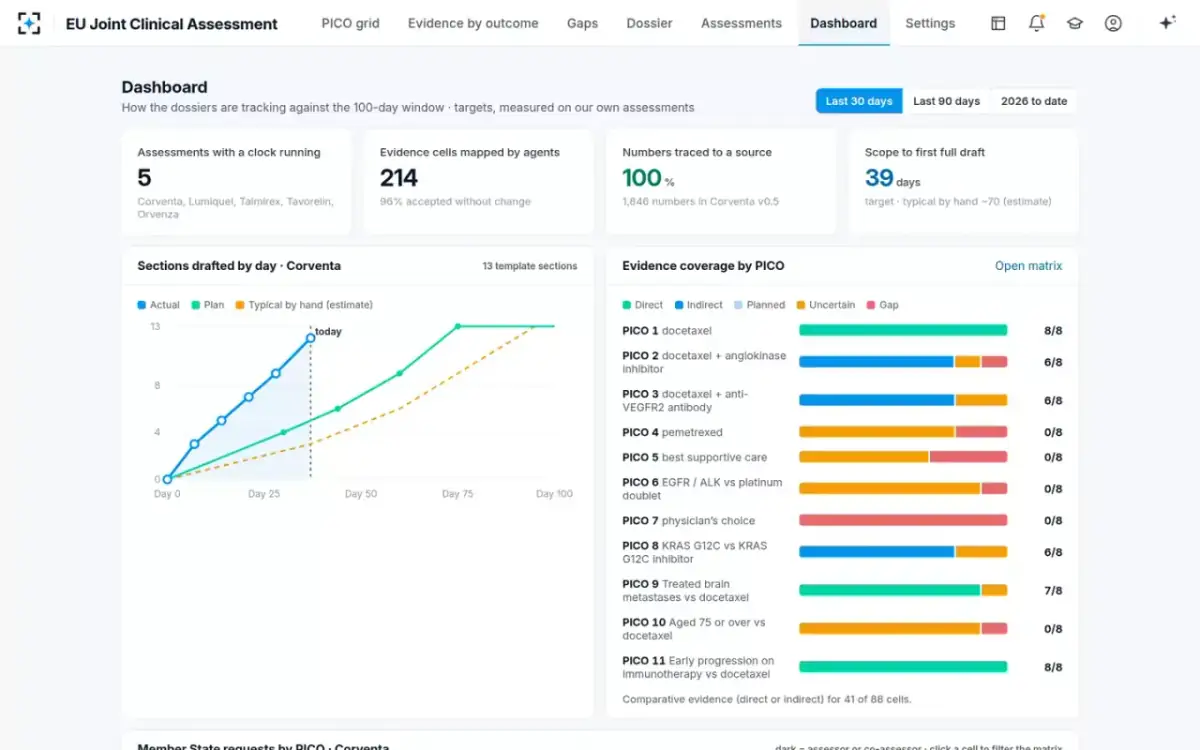
from scope to a full draft dossier, the design target in the solution; about 70 by hand on our own estimate
What is a PICO simulation?
It is an internal exercise that produces the assessment scope you expect to receive. You take the indication you will apply for, read the European and national clinical guidelines for that disease, list the treatments a Member State could reasonably name as the comparator, split the population wherever a country treats a subgroup differently, and attach the outcomes each would want to see. Then you consolidate: merge what can be merged, and count what is left.
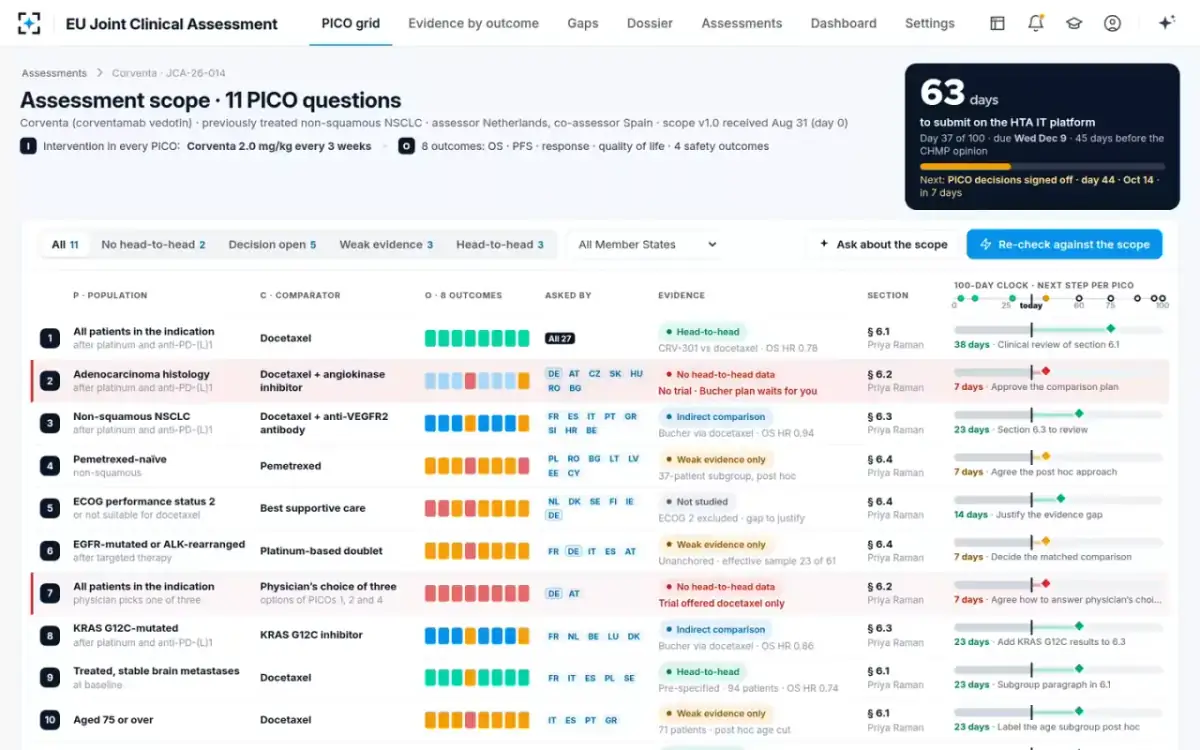
The output is a table of anticipated questions with your own evidence mapped against each one. That second half is what makes it worth money. A list of plausible questions is an interesting document; a list of plausible questions with "no comparative data" written beside four of them is a plan.
The name comes from the four letters the regulation uses for the parameters of an assessment — population, intervention, comparator, outcomes — and the exercise is sometimes also called a mock scope, a PICO exercise or an internal mock assessment. Its bigger cousin, the internal mock joint clinical assessment, had been run by half the companies surveyed for a 2024 multi-stakeholder workshop, against 92% who had assessed which of their pipeline products would face an assessment at all.
Why rehearse a scope at all: the 100 days cannot generate evidence
Because of the arithmetic of the window. The implementing regulation gives the developer 100 days from notification of the Commission's first request to submit the dossier (Article 12(2)), with 60 days where the marketing authorisation is on the accelerated procedure or the assessment follows a new indication added by variation. The paper by D'Oca, Darquennes and colleagues puts the consequence plainly: "Following PICO scoping, HTDs have only a 100 day period (or 60 days for Type II variations) to finalise their JCA dossier prior to submission to the HTA CG."
A hundred days is enough to analyse, write, check and submit. It is not enough to run a new subgroup analysis through a validated pipeline, negotiate access to another sponsor's individual patient data, or commission a systematic review that was never scoped. Every one of those has a lead time measured in months. So the practical question a simulation answers is not "what will they ask" but "which of the things they may ask would I still have time to do something about".
Two further constraints make the rehearsal less optional than it looks. All available evidence must be in the first version of the dossier, not added later. And the literature search behind it cannot be older than three months at submission, so a review done long in advance has to be refreshed inside the window anyway. Both are set out in what belongs in every section of the dossier.
When to run one, against the EMA clock
Earlier than most plans assume, and the published record now says how much earlier. The scoping process starts when the developer submits its information to the assessors at the time of its application to the European Medicines Agency; the assessors build a scope proposal, survey the Member States, consolidate the answers and send the finished scope to the developer. Only then does the 100-day clock start. Counted from the procedural tables of the four published reports, the whole stretch from that first information to the dossier landing ran between 179 and 225 days.
From the developer's first information to its dossier, in the four published assessments
- To the consolidated proposal49 d
- To the scope31 d
- The dossier window99 d
- To the consolidated proposal71 d
- To the scope16 d
- The dossier window101 d
- To the consolidated proposal62 d
- To the scope35 d
- The dossier window99 d
- To the consolidated proposal90 d
- To the scope35 d
- The dossier window100 d
Read the bars from the right. The dossier window is fixed. The middle bar is the few weeks between the consolidated proposal and the finished scope, and the left bar is the survey and consolidation. A simulation delivered during either of those is a late warning: useful for drafting, useless for generating anything. To change what evidence exists, it has to land before the first bar begins — which in practice means while the pivotal trial is still running, and certainly before the application goes to the Agency.
There is a hard outer limit too. The scoping guidance notes that, for medicines, scoping has to be finished before the CHMP gives its opinion, which is why a change to the indication late in the regulatory process can send the scope back for revision — and why the onasemnogene abeparvovec assessment carries a revised scope in its own timetable.
How to run one the way the official guidance does
The Coordination Group has published how it consolidates a scope, which means a simulation does not have to invent a method. The objective is stated: turn the Member States' needs into the fewest PICO questions possible, each pairing a single population and intervention with a single comparator (which may be a basket of treatments) and at least one outcome (Guidance on the scoping process, section 3.2). Follow the same four steps and your count will be comparable with the real one.
A simulation run the way the Coordination Group consolidates a scope
- Start from the guidelines the assessors start from
European clinical guidelines for the disease — natural history, available alternatives, relevant outcomes — with national guidance where no European one exists. That is the source list the assessor and co-assessor are told to build the scope proposal from.
- Cover every Member State, not the big five
All 27 are invited to the survey, and the guidance warns that if a country does not take part, there is a risk its needs will not be covered. The published review of real exercises found an average of 7 countries taking part.
- List requirements country by country
Step 1 of the official consolidation: a table per country, populations across the columns, the comparator treatments down the rows, and the comparator scenario on the first row.
- Split by population, then juxtapose
Step 2: one table per population, the full claimed indication first, with every country that asked for that population beside each other.
- Apply the four collapse rules
Step 3: a unique treatment gets its own question; "effect estimates against each of them" gets one question per treatment; "at least one of them" may be collapsed onto a treatment already chosen unless the country said its list must be kept; an individualised treatment comparator cannot be merged with a several-treatments scenario and gets its own question.
- Write the table, outcomes on every row
Step 4: one column per question, the comparator beneath it, and the outcomes beneath that — in principle all outcomes on all questions.
- Then map your evidence onto it
The step the official guidance does not have, because the assessors are not holding your data. Each row gets a trial, a subgroup, a published study, or nothing.
One rule in the guidance is worth reading twice, because it is the only brake on the count: since every extra request can widen the scope and the workload, Member States are asked to keep their requests to what their own national decision actually needs (Guidance on the scoping process). It is an instruction to the countries, not a guarantee to you. A simulation that assumes restraint will undercount.
How many PICOs should you expect to find?
There is no single answer, and anyone who gives you one is selling something. Three honest reference points exist.
Question counts: two from published exercises, four from real scopes
The published review is the closest thing to a benchmark: "A review of 14 publications, representing 35 individual PICO exercises across 20 indications (74% in oncology), showed an average of 7 countries participating per exercise and 8 consolidated PICOs per analysis." Eight is a useful planning number, with the caution that three quarters of those exercises were in oncology and that the paper's authors work for a medicine developer.
The 67 is the warning. In the same paper, a simulation covering 25 countries for a first-line immuno-oncology treatment in metastatic non-small-cell lung cancer generated 67 questions, largely driven by biomarker- and histology-based subpopulations — a reminder that in a crowded therapy area the count can run far above anything in the published scopes, and that the work of a simulation is as much in the collapsing as in the listing.
The four real scopes sit between 1 and 12. What moves the number is not the medicine's novelty but how many populations a country wants separated and how many comparator lists cannot be merged. How 27 countries become one assessment scope works through the mechanics.
What a good simulation hands you — and what it cannot promise
The six things a simulation should hand over
1 A question table
One row per anticipated question: population, comparator or comparator set, outcomes. The same shape the assessors will hand you, so your evidence can be mapped onto it without being retyped.
2 The evidence held against each row
Which trial, which subgroup, which data cut, which published study — or nothing. A row with no evidence is the output; a row with a reference is a reassurance.
3 The connectedness of each network
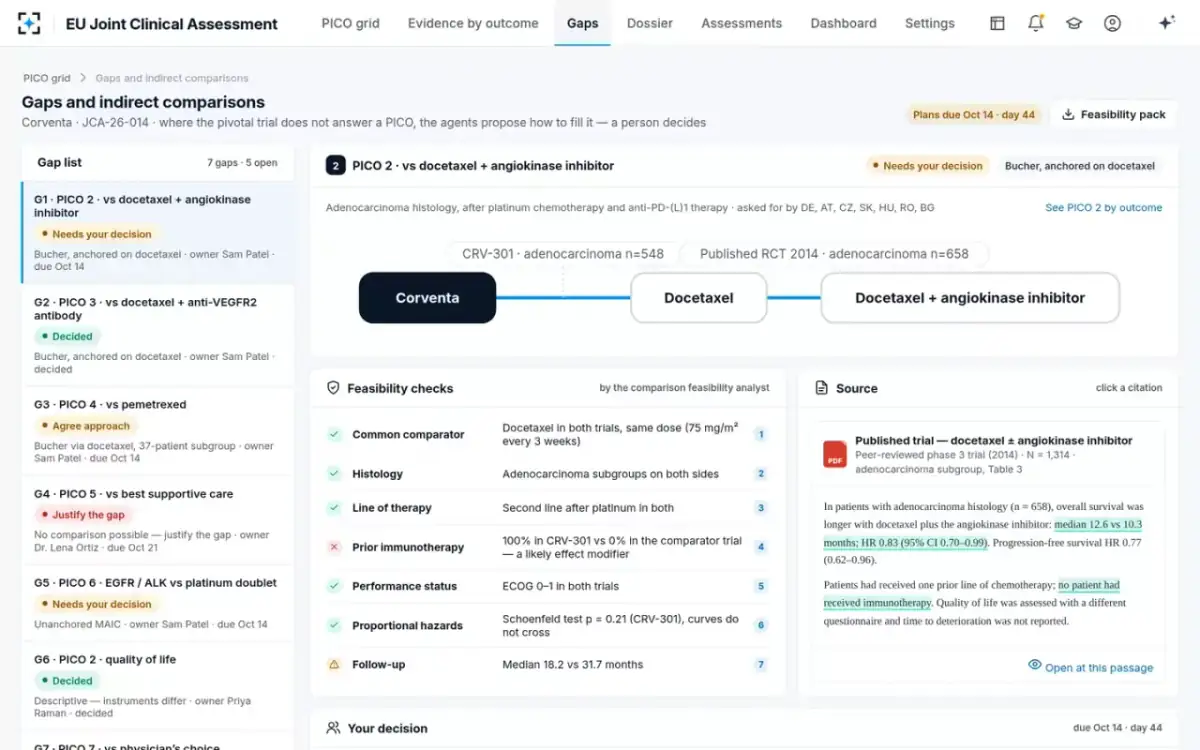
For every row with no head-to-head trial, whether a shared comparator exists at all. This, not the choice of method, is what decides whether the question can be answered.
4 A named owner per row
Somebody who can say in a meeting what will be submitted for that question. Rows without an owner are the ones that arrive unanswered.
5 A decision date per row
The date by which the route has to be settled for the analysis to exist before submission — counted back from the dossier deadline, not forward from today.
6 What would change the answer
The comparators that would appear if a competitor reads out in the next year, and the countries most likely to ask for them.
What it cannot promise is the scope. The countries answer a survey you do not see, the assessors consolidate answers you cannot predict, and a request from one country can add a question nobody modelled. The guidance's own description of the scope as driven mainly by policy is the giveaway: it reflects what health systems need to decide, not what the evidence base can support.
Two more limits are worth being blunt about. A simulation cannot tell you which country asked for which question in the real scope — the consolidated table the assessors share has rows for population, comparator and outcomes, and the published reports do not attribute questions to countries. If your own grid shows which Member States asked, as the solution's does, that is your team's working knowledge from its scoping and simulation work, not something the assessment scope tells you. And a simulation cannot make a disconnected evidence network connected; it can only find out in time, which is the whole of its value.
Is a joint scientific consultation a better use of the money?
Sometimes, and for a different reason than most people give. A joint scientific consultation is advice from the Member States on the design of a study that has not started yet: it is available where the technology is likely to face a joint assessment and "the clinical studies and clinical investigations are still in the planning stage". It ends in an outcome document, and the regulation is explicit that the document "shall not give rise to any legal effects on Member States, the Coordination Group or the health technology developer" and does not prejudice the later assessment.
A PICO simulation against a joint scientific consultation
PICO simulation: Your own rehearsal of the scope, run on published guidelines and your own evidence
Joint scientific consultation: Advice from the Member States on the design of studies still in planning
PICO simulation: Nobody outside your team unless you choose
Joint scientific consultation: The subgroup that advises; the assessors consult the outcome document when they build the scope proposal
PICO simulation: Any time, as often as you like
Joint scientific consultation: While the clinical studies are still in the planning stage — not after
PICO simulation: As many as you commission
Joint scientific consultation: 8 to 12 on medicinal products planned for 2026, and 2 to 5 on medical devices
PICO simulation: Nothing
Joint scientific consultation: Nothing: the outcome document has no legal effect, and the scoping guidance notes its recommendations may no longer apply by the time of the survey
PICO simulation: Finding the questions you cannot answer while there is still time to answer them
Joint scientific consultation: Getting the comparators and outcomes into a trial design before the trial starts
So they are not alternatives on the same shelf. A consultation changes what evidence you generate, and the slots are few and close early. A simulation changes what you do with the evidence you already have, and you can run it as often as the landscape moves. A programme with trials still in design should be competing for a consultation; a programme reading out next year should be simulating.
What a missed PICO actually costs, read off the published reports
It costs you the question, in public, permanently. In the first published assessment report the developer submitted evidence for two of eight questions and argued that the other six could not be addressed; a published report now carries that for every national body to read. In the fourth, evidence was submitted for seven of twelve. These are not scandals — the scopes asked about comparators that no trial of the medicine had used — but they are the exact outcome a simulation exists to reduce, and the arithmetic is unforgiving: a question discovered when the scope arrives has a hundred days of drafting time and no generation time at all.
Every anticipated question on one row, with its evidence and its clock
Keeping a simulation alive: the comparator landscape moves
The most common failure of a simulation is not that it was wrong. It is that it was right in March and nobody re-ran it in October. Between the exercise and the real scope, a competitor reads out, a guideline is revised, a country changes what it reimburses, and your own indication narrows in regulatory review. The scoping guidance makes the same point about the advice track: a consultation's recommendations "might no longer be applicable because of changes in the underlying conditions (intended therapeutic indication, intended use, dynamic therapeutic landscape for comparators, etc.)", and the questions should be generated "considering the situation prevailing at the time of the survey".
That argues for keeping the rehearsal in a form that can be re-run rather than re-bought: a living table where a new comparator adds a row, an evidence check can be repeated against the latest study outputs, and each row carries an owner and a date. A slide deck cannot do that. Neither can a spreadsheet that three people have forked.
Which rows have no evidence, with an owner and a date against each
The same rehearsal as a running position, in EU Joint Clinical Assessment
Whether you build that yourself, buy it, or run the exercise once with an agency and keep the table afterwards is a real choice, and building the capability against buying it in works through the trade. What is not a real choice is doing the rehearsal and letting it age: the published record shows the questions arrive whether or not anybody looked.
Questions people ask
Why run a PICO simulation before a JCA?
Because the dossier window is 100 days — 60 in the accelerated and new-indication cases — and that is a presentation window, not a production window. Anything that needs a new analysis, another sponsor's individual patient data or a fresh systematic review has a lead time longer than the window. A simulation finds those questions while there is still time to do something, and the published assessments show what the alternative looks like: a report recording that most questions could not be addressed.
How accurate are PICO simulations?
Nobody has published an accuracy rate against the real scopes, and you should be sceptical of anyone who quotes one. What can be compared is the count: a review of 35 published exercises averaged 8 consolidated questions, and the four real scopes published so far carry 1, 7, 8 and 12. Expect your simulation to get the shape right — which populations split, which comparators recur — and to miss specific national requests.
What should a PICO simulation deliver?
A question table in the same shape the assessors use, the evidence you hold against each row, whether each row's evidence network is connected, a named owner, a decision date, and a note of what would change the answer. The first three are the analysis; the last three are what keeps it useful six months later, when the real scope arrives.
Can you run a PICO simulation in-house?
Yes. The consolidation method is published: the Coordination Group's guidance on the scoping process sets out the survey, the four consolidation steps and the resulting table, with a worked example. What an external team usually brings is country coverage — people who know what each national body asks for — and what an internal team brings is knowledge of its own evidence. The second half is the harder half.
How do you keep a PICO simulation current?
Re-run it against the comparator landscape rather than re-commissioning it. The scoping guidance makes the same point about joint scientific consultations: recommendations may no longer apply once the indication, the intended use or the treatment landscape has moved, and the questions should reflect the situation at the time of the survey. Keep the table where a new comparator adds a row and an evidence check can be repeated.
What does a PICO simulation cost you if you skip it?
Not money — time, at the point where time cannot be bought. The simulation's whole output is the list of questions you cannot currently answer; without it, that list is produced for you by the assessment scope, with the dossier deadline already running. The visible cost is a published report that records an evidence gap for those questions, and national bodies deciding one by one whether your justification was good enough.