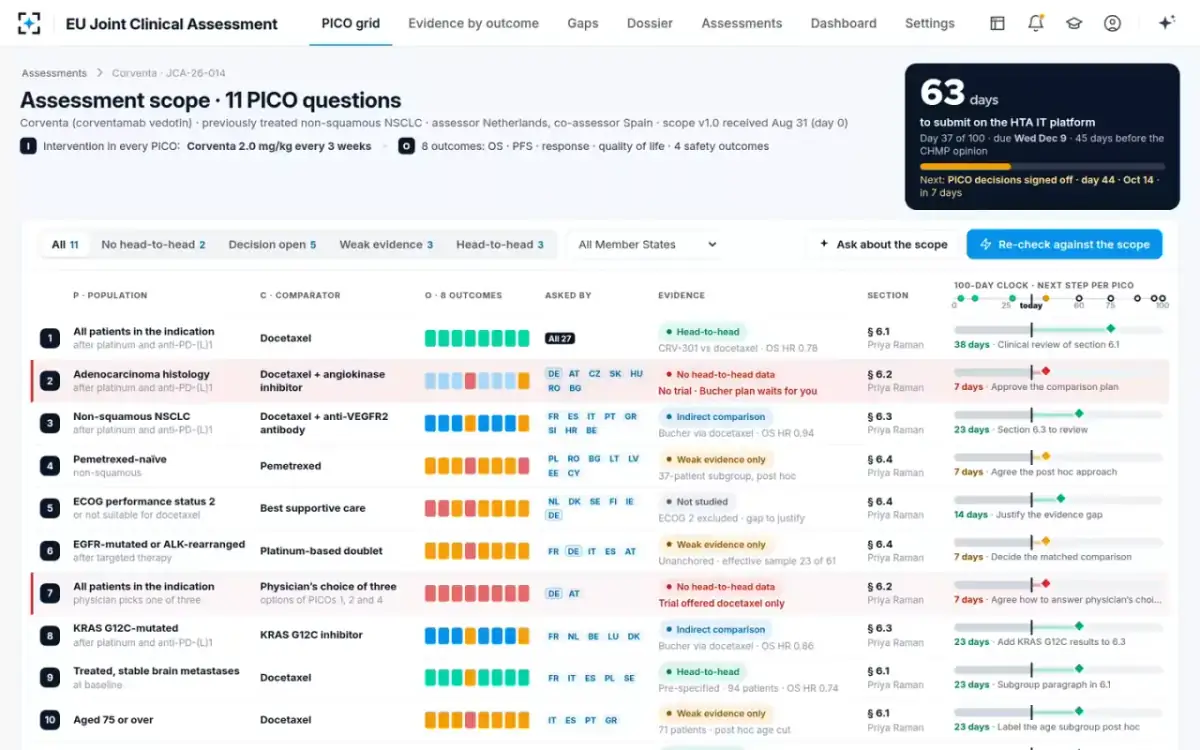
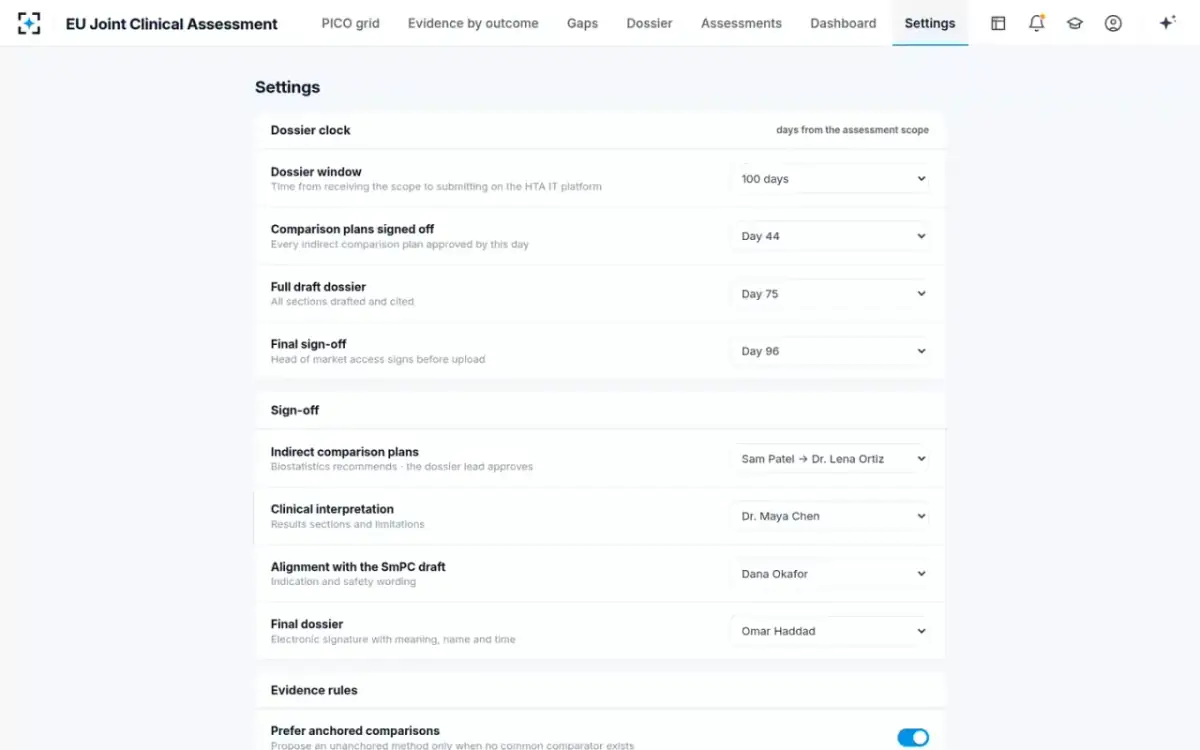
The JCA submission timelines are a short list of statutory deadlines, almost all of them expressed as a distance from a milestone of the European Medicines Agency's centralised procedure rather than as a fixed date. The one a developer actually plans from is the dossier deadline: 100 days from the Commission's first request, or 60 days in two defined cases. Everything else either depends on a regulatory milestone that can move, or belongs to the assessors. Botminds' EU Joint Clinical Assessment keeps that clock against the work — every question in the scope carries its owner and its next dated step, so the day a comparison decision is late is visible before the result that depends on it is.
Every deadline below is cited to the article that sets it. Every measured figure is read from the procedural tables the four published joint clinical assessment reports print on their own pages. The product screens are the solution's fictional sample assessment.
What the first four assessments measured, end to end
415
days from the first information for the scope to endorsement, for the first report
typical — tovorafenib, 11 March 2025 to 30 April 2026
227
of those days came after the dossier was submitted
typical — tovorafenib, dossier V0.1 to endorsement
167
days from dossier to endorsement in the fastest of the four
typical — tarlatamab, 6 January to 22 June 2026
18
joint clinical assessments initiated between January 2025 and June 2026
typical — European Commission, 9 June 2026
What are the JCA submission timelines?
There are eleven dated obligations in a joint clinical assessment of a medicine, and four of them belong to the developer. The rest belong to the subgroup, the Coordination Group or the Commission, and a developer can neither hurry nor delay them. Reading the list in order is the fastest way to see where a plan can be made and where it cannot.
Every statutory deadline in a joint clinical assessment, with the article that sets it
StepThe assessment scope is finalised
The deadline≤ 10 days after CHMP adopts its list of questions
Where it is writtenImplementing Regulation, Article 10(2)
Whose it isThe subgroup. In the accelerated and new-indication cases: within 75 days of EMA validating the application.
StepScope explanation meeting, if you ask for one
The deadline≤ 20 days after finalisation
Where it is writtenImplementing Regulation, Article 11
Whose it isThe developer has to request it; the meeting is with the subgroup.
StepThe first request reaches you
The deadlineAfter the scope is finalised; its submission deadline may fall no later than 45 days before the envisaged CHMP opinion
Where it is writtenHTA Regulation, Article 10(1)
Whose it isThe Commission. This is the day the 100 days start.
StepThe dossier
The deadline100 days — or 60
Where it is writtenImplementing Regulation, Article 12(2)
Whose it isThe developer. 60 days under the accelerated procedure and for a new-indication variation.
StepThe Commission confirms completeness
The deadline15 working days, or 10
Where it is writtenImplementing Regulation, Article 13
Whose it isThe Commission, consulting the assessor and co-assessor as appropriate.
StepAnswer to a second request
The deadline15 days, or 10 — 7 if only minor information is missing
Where it is writtenImplementing Regulation, Article 12(4)
Whose it isThe developer. This is the last chance before discontinuation becomes possible.
StepAnswer to an assessor clarification
The deadlineBetween 7 and 30 days, set case by case
Where it is writtenImplementing Regulation, Article 12(5)
Whose it isThe developer. The assessor and co-assessor set the length by what is asked.
StepFactual accuracy and confidentiality on the revised draft report
The deadline7 days, or 5
Where it is writtenImplementing Regulation, Article 14(4)
Whose it isThe developer — technical and factual inaccuracies and confidentiality claims only.
StepThe subgroup finalises the revised draft reports
The deadlineAt the latest on the day the marketing authorisation decision is adopted
Where it is writtenImplementing Regulation, Article 15(2)
Whose it isThe subgroup.
StepThe Coordination Group endorses
The deadline≤ 30 days after the marketing authorisation decision
Where it is writtenHTA Regulation, Article 11(1)(a)
Whose it isThe Coordination Group, by consensus where it can reach one.
StepThe Commission’s procedural review
The deadline10 working days to object
Where it is writtenHTA Regulation, Article 12(3)
Whose it isThe Commission, then publication on the IT platform.
The clock that sets all the others: the EMA centralised procedure
Almost nothing in the list above is a date. They are offsets, and the things they are measured from belong to the marketing authorisation procedure: the day EMA validates the application, the day the Committee for Medicinal Products for Human Use adopts its list of questions, the envisaged date of the CHMP opinion, the day the Commission adopts the decision granting the authorisation.
Three of those offsets do the structural work. The scope must be finalised "at the latest 10 days after the Committee for Medicinal Products for Human Use adopts its list of questions". The dossier deadline set in the Commission's first request — the request that starts the dossier window — must fall "at the latest 45 days prior to the envisaged date of the opinion of the Committee for Medicinal Products for Human Use". And the Coordination Group must endorse the reports "no later than 30 days following the adoption of a Commission decision granting a marketing authorisation".
The practical consequence is that a slip in the regulatory procedure moves the HTA calendar with it, in both directions, and that a developer planning a joint clinical assessment is planning against its own regulatory team's forecast of a CHMP date. That forecast is the single most load-bearing assumption in the plan, and it is not under the HTA team's control. A team that treats the 100 days as a window it can place wherever it likes is planning against a date that nobody has promised it.
There is one more consequence worth saying out loud: the scope is finalised before the CHMP opinion, so the scope is written against the claimed indication and can be overtaken by the regulatory outcome. That is not an edge case — it has already happened in two of the four published assessments.
The 100 days, and the two cases where it is 60
The dossier deadline is the clearest sentence in the whole procedure: "the deadline to submit the dossier referred to in paragraph 1 shall be 100 days from the date of the notification of the first request to the health technology developer." It is measured from notification, not from receipt, and not from the day the team finishes reading the scope.
Two cases shorten it to 60. The first is an application assessed under the accelerated procedure of Article 14(9) of Regulation (EC) No 726/2004. The second is an assessment conducted for a variation to an existing marketing authorisation of the type in point 2(a) of Annex II to Regulation (EC) No 1234/2008 that corresponds to a new therapeutic indication — in everyday language, a Type II indication variation on a product that already has a published joint clinical assessment report.
The 100-day case and the 60-day case, side by side
The standard case: 100 days from notification of the first request.
Accelerated assessment, or a new-indication variation: 60 days — forty fewer, on a submission of the same size.
The standard case: At the latest 10 days after CHMP adopts its list of questions.
Accelerated assessment, or a new-indication variation: Within 75 days of EMA validating the application or the variation.
The standard case: 15 working days from submission.
Accelerated assessment, or a new-indication variation: 10 working days.
The standard case: 15 days — 7 where only minor information is missing.
Accelerated assessment, or a new-indication variation: 10 days — still 7 where only minor information is missing.
The standard case: 7 days from receipt.
Accelerated assessment, or a new-indication variation: 5 days. The same 5 days apply where a new assessment scope was developed during the assessment.
The standard case: The evidence work can run partly in parallel with the scope being finalised.
Accelerated assessment, or a new-indication variation: Almost everything has to be ready before the scope arrives, because 60 days is not long enough to start an indirect comparison from nothing.
A team that has been through a scoping exercise once tends to describe the 60-day case in the same way: the comparison plans have to exist in draft before the questions arrive. That is also the published view from inside the industry — a 2026 analysis of the scoping process by authors employed by a medicine developer frames it as the central constraint: once scoping ends, the developer has only the 100 days — or 60 for a new-indication variation — to finish the dossier (D'Oca, Darquennes and colleagues, 2026). Modelling the questions before the scope lands is the only lever that moves.
Can the 100-day deadline be extended?
Yes, narrowly, and not on request as a matter of course. "In justified cases, with the consent of the assessor and co-assessor and considering the timetable for the evaluation during the centralised procedure, the HTA secretariat may extend the deadline referred to in paragraph 2. However, that extension shall not exceed the deadline specified in Article 10(1) of Regulation (EU) 2021/2282."
That ceiling is the important half of the sentence. Article 10(1) puts the submission at the latest 45 days before the envisaged CHMP opinion, so an extension can only ever use up slack that exists between the end of the 100 days and that backstop. If the first request went out at the last possible moment, there is no slack to extend into, whatever the justification. An extension is therefore a function of how early the Commission's request happened to land, not of how good the reason is.
The failure mode at the other end is worth knowing precisely, because it is the only true cliff in the procedure. If, after the second request, the Commission finds the dossier late or still short of what Article 9(2) to (4) requires, the Coordination Group must discontinue the assessment (HTA Regulation, Article 10(6)). Discontinuation is published on the IT platform with its reasons. And the protection in Article 13(1), point (d) — that Member States may not ask nationally for evidence already submitted at Union level — stops applying. A discontinued assessment does not simply delay the Union-level step; it returns the developer to answering the same questions country by country.
A discontinued assessment can be re-initiated, at the latest six months after the original submission deadline, once the Coordination Group has received the missing evidence through a Member State and the Commission has confirmed the requirements are met.
The Commission's completeness check, and the second request's 15 days
Submitting the dossier does not end the window; it starts a short, decisive one. The Commission has 15 working days from submission to confirm, on the information it has at that point and consulting the assessor and co-assessor where appropriate, whether the dossier satisfies Article 9(2), (3) and (4) of the HTA Regulation (Implementing Regulation, Article 13). Ten working days in the accelerated and new-indication cases.
If something is missing, the Commission issues a second request, and the answer is due "within 15 days from the date of notification" — 10 days in the accelerated and new-indication cases, and 7 days "for cases where only minor information is missing". Fifteen days is not enough time to run a new indirect comparison, which is the practical reason the completeness test should be applied internally before submission rather than discovered afterwards.
The published reports show how real this is. Lurbinectedin's dossier went through version 0.1 on 16 December 2025, version 0.2 on 2 February 2026 and version 0.3 on 18 February 2026, both marked in the report's procedural table as responses to the second request, with the Commission's confirmation following on 23 February. Tovorafenib and tarlatamab each filed a second version before confirmation and a third afterwards. Not one of the four was confirmed on its first version.
Days from the scope arriving to dossier version 0.1, in the four published assessments
Seven days for the factual accuracy check — and what you may say in them
The developer sees the revised draft reports once, with a deadline measured in days and a scope measured in words. "The health technology developer shall signal any purely technical or factual inaccuracies and any information it considers to be confidential within 7 days from the date on which it received the revised draft joint clinical assessment and summary reports" — five days in the accelerated and new-indication cases, and also where a new assessment scope was developed during the assessment.
Two constraints ride with that deadline. Confidentiality is not asserted but demonstrated: the developer "shall demonstrate the commercially sensitive nature of the information it considers to be confidential". And the HTA Regulation removes the obvious temptation in a single line, which forbids the developer any comment on the results of the draft assessment (Article 11(5)).
So the seven days are for arithmetic, citations, mislabelled populations, a wrong data cut-off, a figure transposed between tables — not for arguing that an effect was understated. A team that wants those seven days to be usable has to be able to find, for any number in the draft report, the table in its own dossier it came from, in minutes rather than days. That is a filing problem solved long before the draft arrives, and it is the same discipline the dossier template itself demands, where every analysis has to be traceable to the documentation in Appendix D.
Endorsement: 30 days after the marketing authorisation decision
The end of the procedure is pinned to the regulatory decision, not to the assessment's own progress. The subgroup must finalise the revised draft reports "at the latest on the date of the adoption of the Commission decision granting the marketing authorisation", and the Coordination Group must endorse them "no later than 30 days following the adoption of a Commission decision granting a marketing authorisation".
Endorsement is by consensus where consensus exists. Where it does not, the Regulation does not stall: "where a consensus cannot be reached, divergent scientific opinions, including the scientific grounds on which those opinions are based, shall be incorporated in the reports and the reports shall be deemed endorsed." The Commission then has 10 working days to object on procedural grounds and ask for a review, and publishes once the reports are procedurally compliant.
The first report shows the shape in practice: the Commission granted the conditional marketing authorisation on 20 April 2026, the Coordination Group endorsed the report on 30 April, the Commission completed its procedural review on 19 May, and publication followed on 9 June. Ten days from decision to endorsement; a further forty to publication.
Two assessments end to end, drawn to the same scale
- Scoping87 days
- The dossier window101 days
- Assessment to endorsement227 days
- Scoping80 days
- The dossier window99 days
- Assessment to endorsement167 days
What the first four published assessments actually measured
Put the four together and three patterns show up, none of which is visible from the legal texts.
The developer's window is used in full, every time. Ninety-nine, ninety-nine, one hundred and one hundred and one days from the scope being shared to the first dossier version. Nobody submitted early. Whatever a plan says about an internal buffer, the observed behaviour of four teams at four companies is that the whole window gets used.
Nobody was confirmed on the first version. Each of the four filed at least one further version before the Commission's confirmation. Treat version 0.2 as part of the plan rather than as a failure.
The long pole is the assessment, and it is not yours. From dossier to endorsement took 167, 188, 211 and 227 days. That phase is the longest of the three in all four assessments, it varies by two months between them, and no amount of internal effort shortens it. A launch plan that assumes a fixed interval from submission to a published report is assuming something the record does not support.
The clock against the work, not beside it
The dates nobody plans for: a change of indication, and a re-initiated assessment
Two sequences sit outside the main chain, and both have already happened.
The first is a change of therapeutic indication during the centralised procedure. The assessor judges whether the change affects the scope and the subgroup decides whether the assessment continues or a new scope proposal is prepared; where a new scope is finalised, the developer is asked for an updated dossier under a deadline the assessors set between 7 and 30 days. In the onasemnogene abeparvovec assessment the developer notified a narrowed indication on 26 February 2026, a revised scope issued on 9 March, and dossier versions 0.3 and 0.4 followed on 10 and 19 March — two submissions in ten days, nearly three months after the original dossier. In the tovorafenib assessment the indication also changed and the subgroup decided no new scope was needed.
The second is a re-initiated or updated assessment. Where the Coordination Group re-initiates an assessment, or initiates an update and no change to the scope is needed, the subgroup finalises the revised draft reports within 180 days; where the scope also has to be updated, within 330 days. Those are year-scale commitments, and they attach to a product that is already on the market.
Five dates to put in the plan the day a product is confirmed in scope
- The envisaged CHMP opinion date, and who owns the forecast
Every other date is measured from it. Name the person in regulatory affairs who updates it, and how often.
- The latest possible submission date: 45 days before that opinion
That is the backstop the first request has to respect. The request usually comes early enough that the 100 days end before it; the gap between the two is the only slack an extension could ever use.
- Scope finalisation, and the 20 days that follow it
The explanation meeting has to happen within 20 days of finalisation and has to be requested. Write the request before the scope lands.
- Submission day, and the 15 working days after it
The Commission’s confirmation window. Hold the statistical capacity that would answer a second request in 15 days; do not release it at submission.
- The seven days on the revised draft report
Diarise a traceability rehearsal before then: for any number in the draft, find the table in your dossier it came from.
A clock a team can set, inside a clock it cannot
Questions people ask
How long do you have to submit a JCA dossier?
100 days from the date the Commission's first request is notified to you. It is 60 days where the marketing authorisation application is assessed under the accelerated procedure, and where the assessment concerns a variation corresponding to a new therapeutic indication on a product that already has a published report.
How long does the Commission take to confirm a JCA dossier?
Within 15 working days of submission, the Commission confirms whether the dossier meets Article 9(2), (3) and (4) of the HTA Regulation — 10 working days in the accelerated and new-indication cases. None of the first four published assessments was confirmed on its first dossier version; each filed at least one further version first.
How long do you get to answer a second request?
15 days from notification, or 10 in the accelerated and new-indication cases, and 7 days where only minor information is missing. It is the last step before the Coordination Group may discontinue the assessment, so plan for it rather than hoping to avoid it.
Can the JCA dossier deadline be extended?
In justified cases, with the consent of the assessor and co-assessor, the HTA secretariat may extend it — but never beyond 45 days before the envisaged CHMP opinion. In practice the available extension is whatever slack exists between the end of your 100 days and that backstop, which depends on how early the first request was sent.
When is the JCA report endorsed?
No later than 30 days after the Commission adopts the decision granting the marketing authorisation. The subgroup must have finalised the revised drafts by the day of that decision. The Commission then has 10 working days to raise a procedural objection, and publishes afterwards: for the first report, authorisation on 20 April 2026, endorsement on 30 April, procedural review on 19 May and publication on 9 June.
How long does a whole joint clinical assessment take?
The four published assessments ran 346 to 436 days from the first information submitted for the scope to endorsement. The dossier window is about a quarter of that; the phase from dossier to endorsement took between 167 and 227 days and belongs entirely to the assessors and the Coordination Group.