JCA PICO scoping is the process that decides what a joint clinical assessment will ask, and it finishes before the developer writes a word. The assessor and co-assessor draft a minimal scope proposal; every Member State answers a survey with the populations, comparators and outcomes its own system needs; the pair then consolidate those answers into the smallest set of PICO questions that still covers everyone. What comes out is the assessment scope, and it is the data request: the dossier must answer every question in it. Botminds' EU Joint Clinical Assessment is built to receive that document — it reads the scope into one row per question, keeps the source sentence behind every element, and shows on day one which rows the evidence base can and cannot answer.
The worked consolidation on this page is the Coordination Group's own hypothetical example from its scoping guidance. The product screens come from the solution's fictional sample assessment. The scope sizes are read from the four joint clinical assessment reports published so far.
PICO questions per published assessment scope, and the populations behind them
What is JCA PICO scoping?
Scoping is the step in which the questions are written. The HTA Regulation gives it to the subgroup that oversees the assessment: it "shall initiate a scoping process in which it identifies the relevant parameters for the assessment scope", and that scope "shall be inclusive and reflect Member States' needs in terms of parameters and of the information, data, analysis and other evidence to be submitted by the health technology developer" (Article 8(6)). The parameters are the four of the PICO framework — patient population, intervention, comparators, health outcomes.
The guidance is explicit about why the questions come from the countries rather than from the evidence. "In the context of the Joint Clinical Assessment (JCA), the assessment scope reflects policy questions from the different healthcare systems in which the JCA will be used." A policy question is a national interest — which treatment this health system would otherwise use, in which patients — and the PICO is its translation into something a scientific assessment can answer.
That gives scoping a property worth stating plainly: it is prospective. "A particular research question (the PICO) is prespecified — i.e. before the dossier is submitted — for a given assessment. As such, the definition of the PICO(s) specifies the data requirements." The scope is not a summary of what the evidence shows. It is a list of things the countries want to know, written before anyone checks whether they can be known.
The scoping chain, from the developer's first package to the Commission's request
| Step | Who does it | What the rule requires |
|---|---|---|
| Information for the scope | The developer, at EMA submission | The proposed summary of product characteristics and the clinical overview section of the EMA submission file (Implementing Regulation, Article 2). |
| The scope proposal | Assessor, assisted by the co-assessor | Built from the developer’s package, European clinical guidelines, expert input and any earlier joint scientific consultation — with a minimum number of parameters, and nothing specific to the pair’s own countries. |
| The PICO survey | Every Member State, via the HTA IT platform | Each country states the populations, comparators and outcomes it needs, and whether its comparator list may be reduced during consolidation. |
| Consolidation | Assessor and co-assessor | Four steps that reduce the answers to the lowest number of PICOs that still meets every stated need; the pair may call a country to clarify a request only it has made. |
| Expert input | Patients, clinical experts, other relevant experts | The consolidated proposal is shared with the selected experts, who may comment before the meeting. |
| The consolidation meeting | The JCA subgroup | The subgroup discusses the consolidated proposal and the expert input and finalises the scope, by consensus. |
| Finalisation | The JCA subgroup | At the latest 10 days after CHMP adopts its list of questions; or within 75 days of EMA validating the application in the accelerated and new-indication cases. |
| The first request | The European Commission | The finalised scope is shared with the developer in the Commission’s first request, which starts the 100 days. |
The PICO survey: what each country is asked, and what it is asked not to do
The survey is run by the HTACG secretariat through the HTA IT platform, and it starts from the assessor's proposal rather than from a blank page. The guidance tells the pair writing that proposal to keep themselves out of it: "assessor and co-assessor should not include PICO parameters that may be specific or unique to their own MS in the assessment scope proposal. National requirements should be included in their own MS response to the PICO survey." The proposal "should rather include a minimum number of PICO parameters" — a floor to react to, not a draft scope.
Each country then states what it needs, under one instruction that pulls against the Regulation's own word inclusive: "given that any specific request might broaden the scope and increase the workload of the European JCA, MS are asked to limit their requests to what is necessary for their national decision-making." Scoping is therefore a negotiation between two pressures written into the same documents — cover every need, ask for as little as possible — and the PICO count is where the balance lands.
Silence is not neutral. "If MS choose to not participate in the survey, there is a risk their needs will not be covered by the JCA." A country that skips the survey gets a Union-level assessment that answers somebody else's question, and then has to work with it anyway, because the evidence it would have asked for cannot be requested again nationally once the developer has submitted at Union level.
One answer in the survey matters more than any other to the final count. A country that lists several acceptable comparators is asked whether effect estimates are needed against each of them, or whether any one will do — and, in the second case, whether its list may be reduced during consolidation. "MS should indicate in the case of an 'OR' scenario whether they need to retain all comparator(s)." A single country refusing to let its list be reduced can add a question that nobody else needs.
Step by step: how the assessors consolidate 27 answers into one table
Consolidation has a stated objective and four steps. The objective: "the objective of the consolidation is to ensure that MS needs are translated in the lowest possible number of PICOs (consolidated assessment scope proposal). One PICO comprises one population, one intervention (or combination), one comparator (which can include more than one treatment), and at least one outcome."
Step one lists each country's requirements in its own table. Step two regroups them by population, so that every country asking about the same population appears side by side. Step three is the arithmetic: a unique comparator becomes its own question; a country requiring estimates against each of several treatments produces one question per treatment; a country that will accept any one of several treatments is satisfied, where possible, by a treatment already selected for somebody else; an individualised treatment bundle gets its own question because it cannot be merged with a named-treatment request. Step four writes the surviving questions into a table, with all the consolidated outcomes applied to all of them.
The guidance works a hypothetical five-country example through, and it is the clearest thing published on how the count behaves.
Five countries' requests, and the seven questions they consolidate into
What the five countries asked for
Country 1 Full claimed indication
Treatment 1 OR Treatment 2
Any one of them will do
Country 2 Full indication, plus subpopulations A and B
Full: 1 OR 2 OR 3 · A: 1 OR 3 · B: Treatment 3 alone
Any one of them will do
Country 3 Subpopulations A and B only
A: 1 OR 2 · B: 2 OR 3
Any one of them will do
Country 4 Full indication, plus subpopulation B
Full: Treatment 3 and Treatment 4 · B: 1 OR 3, both retained
Each one separately — and for B, nothing may be dropped
Country 5 Full claimed indication
Individualised treatment: four options
One bundle of options
The consolidated scope: 7 PICOs
PICO 1 Full claimed indication
Treatment 1 OR Treatment 2
Country 1 needed one of these two, and neither was selected for anyone else.
PICO 2 Full claimed indication
Treatment 3
Country 4 required it on its own; that also satisfies Country 2.
PICO 3 Full claimed indication
Treatment 4
Country 4 required each of its two treatments separately.
PICO 4 Full claimed indication
Individualised treatment
A bundle cannot be merged with a named-treatment request.
PICO 5 Subpopulation A
Treatment 1
One treatment satisfied both countries that asked for this subpopulation.
PICO 6 Subpopulation B
Treatment 3
Country 2 required it alone; Country 3 could be satisfied by it.
PICO 7 Subpopulation B
Treatment 1 OR Treatment 3
Country 4 had said its list could not be reduced.
Two things in that table are worth sitting with. Three of the seven questions exist because of one country: Country 4 required estimates against each of two treatments for the full indication, and refused to let its two-treatment list for subpopulation B be reduced. And the fourth question exists because a bundle and a named treatment are different kinds of object, so no amount of goodwill merges them. Neither is a drafting failure. Both are the rule working as written.
Subpopulation or subgroup? The distinction that doubles or halves the count
The two words sound interchangeable and are not, and the difference is the single largest lever on how big a scope becomes. The guidance's glossary is unambiguous on both.
A subpopulation and a subgroup are different objects, and only one creates a question
Subpopulation: "A subset of the patient population covered by the therapeutic indication."
Subgroup: "A subset of the study population defined by one or more specific patient characteristics (e.g. age, sex, mutations, disease severity) measured at baseline."
Subpopulation: "The definition of subpopulations during the scoping process results in separate PICOs for each subpopulation."
Subgroup: "The definition of subgroups will not lead to a new PICO. Subgroup analyses in the context of a JCA are performed within a given PICO."
Subpopulation: Different comparators apply, the indication explicitly contains distinct groups, or different effectiveness is expected because the prognosis differs.
Subgroup: To explore whether an effect is modified by a characteristic — which is a question about the evidence, not about the policy.
Subpopulation: A full answer: patient characteristics and results for every outcome in the scope, for that population, with its own comparator.
Subgroup: The requested analyses within the question, for all outcomes in the scope — though not for adverse events by system organ class and preferred term.
Subpopulation: Only by justifying an evidence gap, which the assessors then judge.
Subgroup: Where the data defining the characteristic were never collected — and that has to be said and justified too.
Two practical consequences follow. First, a request that reads like a subgroup may have been entered as a subpopulation, and that single classification turns one question into two or six. Second, the two can collide: where a subgroup analysis inside one question covers the same patients as another question's population — a mutation subgroup against a mutation-restricted population — the Coordination Group's answer is that the first needs an interaction test and the results of both subgroups, while the second needs the characteristics and results of that population alone. The same patients, analysed twice, to two different standards.
There is one floor worth knowing before promising an analysis: subgroup analyses "are only required if each subgroup comprises at least 10 people" and, for binary data and survival times, at least 10 events in one of the subgroups.
Comparators: the AND case, the OR case and the individualised treatment bundle
Within one population, the comparator request comes in three shapes, and each has a different effect on the count.
One treatment suitable for everyone. One comparator, one question. This is the lurbinectedin case: one population, one research question, answered with a randomised controlled trial.
Several treatments, all suitable. Here the country's answer to a single survey field decides everything. If estimates are required against each treatment, each becomes its own question. If any one will do, the treatments are joined by OR into a single comparator, and the developer may provide estimates against one or more of them — with an aggregated estimate where that is methodologically appropriate, and individual estimates as well.
No treatment suitable for everyone. When the population is heterogeneous and clinical guidelines offer a range of options chosen by patient characteristics, the comparator becomes a bundle: "to reflect this situation, the SoC is called 'individualised treatment' and comprises the different treatment options recommended in the specific situation. This bundle of treatment options, the 'individualised treatment', represents the comparator." One question, one effect estimate per outcome, against the bundle — which is often the hardest answer in a dossier to produce, because no trial randomised anybody to a bundle.
One instruction cuts across all three, and it is the one most often ignored in a national survey response: "a SoC is an agreed standard treatment in a given health care system. As such, simply naming 'SoC' as a comparator in the PICO survey is not sufficient. The components of SoC need to be specified for the given health care system to allow for the PICO consolidation." A country that writes "standard of care" has not given the assessors anything to consolidate. The guidance also tells countries not to put dose or regimen in a comparator, since practice differs and those are handled nationally.
The tarlatamab scope is a clean worked example of all of this in real life: four populations defined by treatment-free interval and suitability for platinum retreatment, with seven questions across them — two for the platinum-resistant population, three for the platinum-sensitive one, and one each for two further populations whose comparators were joined.
How many PICOs does a scope actually have?
The honest answer is that nobody can tell you an average yet, and anyone quoting a range is extrapolating from a handful of assessments. The four published scopes carried 1, 7, 8 and 12 questions. That is the whole published evidence base.
What can be predicted is the shape. The count is driven almost entirely by two decisions that are made in the survey, not in the consolidation: how many subpopulations the countries define, and how many of their comparator requests are of the each-of-them kind or carry a do-not-reduce flag. A product whose indication contains obvious clinical splits — by mutation, by line of therapy, by prior treatment, by organ function — will attract subpopulations, and every subpopulation multiplies by the comparators that apply to it.
That is why a serious team models the scope before it arrives rather than reacting to it. Working from European clinical guidelines and the comparator landscape country by country, it is possible to write down the plausible populations and the plausible comparators and count the combinations, then check the evidence base against each. The dates make the case for doing it early: the scope arrives with the first request, and the 100 days start the same day.
A revised scope, compared against the one before it
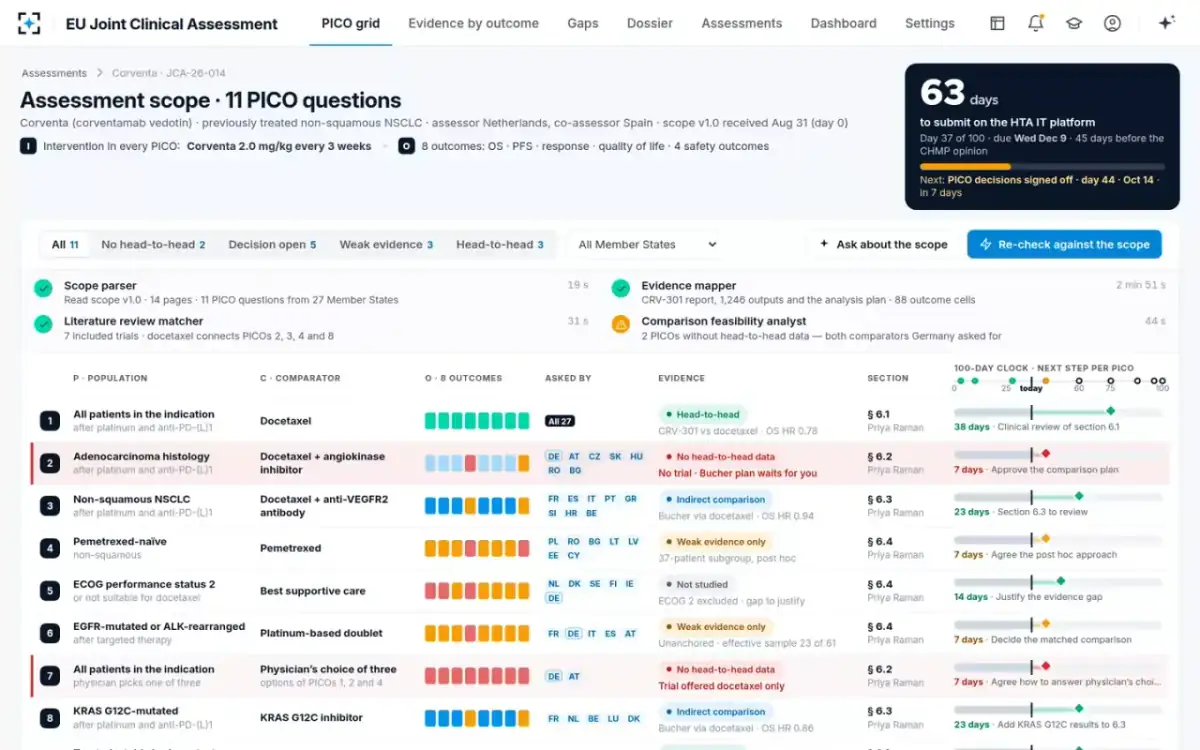
Can a developer argue with a PICO it cannot answer?
Not in the sense of having it removed. The Coordination Group answered the question directly: "the PICOs included in the assessment scope reflect Member States' needs and thus the HTD is required to address all PICOs appropriately in the dossier." There is no appeal, and the scope is finalised by consensus among the Member States before the developer sees it.
What a developer can do is address a question honestly in one of three ways, all of which the Coordination Group has endorsed in writing.
Answer it as closely as the data allow, and justify the distance. Where an exact analysis is impossible, "health technology developers should provide relevant analyses that meet the requirements as closely as possible and explain and justify any deviation", with literature searches supporting the argument, and an explanation of why what is provided is still informative.
Answer it indirectly. Where no head-to-head trial exists, an indirect comparison is expected rather than tolerated: anchored methods with a common comparator first, methods for non-randomised evidence where the network does not connect. Who recommends and who approves that choice is a question of internal governance, not of the Regulation.
Declare an evidence gap. Where no study allows a valid direct or indirect comparison for a question, the Coordination Group treats that as an evidence gap. The scoping guidance says the same from the other side: because the scope is driven by policy, it can include questions no evidence answers, and the report will then identify the gap for the health systems that asked. What is judged is the rationale — "the appropriateness of the provided rationale will be assessed by the assessor and co-assessor and the overall acceptability will be decided at national level".
The published reports show this is not theoretical. For tovorafenib the developer provided evidence for two of the eight questions and argued that the other six could not be addressed for want of data on the specified comparators; for onasemnogene abeparvovec, seven of the twelve were informed and five were not. A scope is routinely larger than the evidence base, by design.
What the scope does not tell you — including which country asked
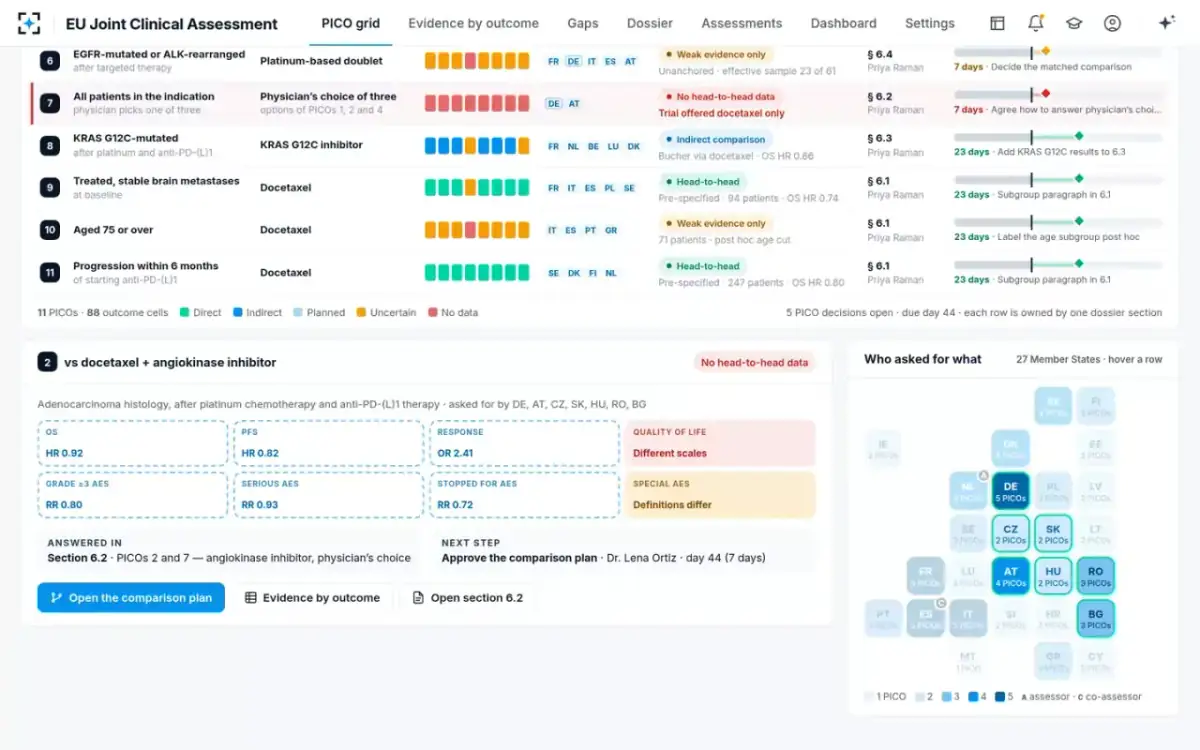
The consolidated PICO table that reaches a developer is smaller than people expect. In the guidance's own template it has three rows — population, comparator, outcomes — one column per question, and nothing else. There is no column for which Member State asked for a question, and the published reports do not attribute questions to countries either.
This matters more than it sounds. Knowing that one question came from a single small market and another from six large ones is exactly the information a team would use to decide where to spend its statistical effort, and the scope withholds it. The only ways to approximate it are to reconstruct it from national HTA practice — which treatment each system actually uses in that indication — or to have asked during a joint scientific consultation before the scope existed.
Two other absences are worth planning around. The scope does not say what evidence exists; it is a question set, and the work of discovering that a question has no connected network is the developer's. And it does not rank the questions: all the consolidated outcomes apply to all the questions, and nothing in the document says which one the countries care about most.
One question, with what the scope said and what the team knows
After the scope is final: the explanation meeting, and what changes it
Two things can still happen after finalisation, and both are worth having in a plan.
The first is a meeting the developer has to ask for. "Upon request of the health technology developer, the HTA secretariat shall invite the health technology developer to an assessment scope explanation meeting with the JCA Subgroup. The meeting shall take place no later than 20 days from the day on which the JCA Subgroup finalises the assessment scope." It is an explanation meeting, not a negotiation, and twenty days is short: the request has to be ready before the scope lands, not drafted after it.
The second is a change of therapeutic indication during the centralised procedure, which the scoping guidance flags as a structural risk: "given the timelines of the JCA, for MP, the scoping process has to be completed before Committee for Medicinal Products for Human Use (CHMP) opinion. This means that the anticipated population might change after the JCA assessment scope has been defined because of changes introduced by the regulatory process." The assessor then judges whether the change affects the scope, and the subgroup decides whether the assessment continues or a new scope proposal is prepared.
Both outcomes have now happened. In the tovorafenib assessment the final indication differed from the claimed one and the subgroup "agreed that there was no need to define a new assessment scope". In the onasemnogene abeparvovec assessment the developer notified a narrowed indication on 26 February 2026; the population it had covered, and the two questions defined for it, "were deemed no longer relevant and were subsequently removed from the assessment scope", and a revised scope was issued on 9 March 2026 with two further dossier versions following within ten days.
The scoping window, as the first assessment actually ran it
- Developer’s information package to consolidated scope proposal shared with experts71 days
- Consolidated proposal with the experts to the scope reaching the developer16 days
- The developer’s own window: scope to dossier version 0.1101 days
Six things to settle before the PICO survey closes
- Write down the populations the indication can be split into
Every clinically meaningful split — mutation, line of therapy, prior treatment, age, organ function — is a candidate subpopulation, and each one a country defines becomes its own question.
- Map the comparator actually used in each market, by population
Not the licensed options: what the health system pays for today. That is what a country will name in its survey answer.
- Decide which comparators your evidence can reach, and by what method
Head-to-head, anchored indirect comparison, unanchored, or nothing. A question whose network does not connect needs a plan agreed with biostatistics before any result exists.
- Find the populations where no single treatment fits everyone
Those attract an individualised treatment comparator — one bundle, one effect estimate per outcome — which is the hardest question type to answer and the easiest to be surprised by.
- Prepare the explanation meeting request before the scope arrives
It must take place within 20 days of finalisation, and the clock does not wait for an internal review of the scope.
- Decide now what a change of indication would do to the plan
The scope is finalised before the CHMP opinion. A narrowed indication can delete a population and its questions, or reopen the scope entirely.
Questions people ask
What is the PICO survey in a joint clinical assessment?
A survey run by the HTACG secretariat through the HTA IT platform, in which every Member State states the populations, comparators and outcomes it needs for its own decision-making, starting from a deliberately minimal proposal written by the assessor and co-assessor. The answers are what the pair then consolidate into the assessment scope.
How are PICOs consolidated?
In four steps: list each country's requirements, regroup them by population, select the smallest set of comparators that satisfies every stated need, and write the survivors into a PICO table with all the consolidated outcomes applied to each. A unique comparator or an each-of-them request always creates its own question; an any-one-will-do request is absorbed where possible; an individualised treatment bundle always stands alone.
What is an individualised treatment comparator?
A comparator made of several treatment options, used when no single standard treatment suits every patient in a population and the choice depends on individual characteristics such as prior treatment, disease severity or general health. It produces one question and requires one effect estimate per outcome against the bundle, not against each option.
Do assessors tell you which country asked for a comparator?
No. The consolidated PICO table shared with a developer has rows for population, comparator and outcomes, and no Member State column; the published reports do not attribute questions to countries either. Any country-level attribution a team works with is its own reconstruction, and should be labelled as such.
What happens if a Member State does not answer the PICO survey?
Its needs may simply not be covered — the guidance says so directly. That is a problem for the country rather than for the developer in the short run, but it has a long tail: evidence submitted at Union level cannot be requested again at national level, so a question nobody asked is a question the dossier will not answer.
When is the assessment scope finalised?
No later than ten days after the CHMP — the EMA committee that gives the scientific opinion — adopts its list of questions. Where the application is assessed under the accelerated procedure, or the assessment concerns a variation adding a new therapeutic indication, the scope is finalised within 75 days of EMA validating the application.