AI in health technology assessment is no longer an open question in Europe: on 15 July 2026 the Member State Coordination Group adopted general principles on using artificial intelligence to prepare a joint clinical assessment dossier, and they are the specification any tool — or any agentic service — now has to meet. They are short. The developer stays accountable for every finding; no step may be fully automated without a human responsible for its quality; every AI-assisted step must be named in the dossier along with the tool's name, version, date and maker; and the prompts must be recorded and produced on request. Botminds' EU Joint Clinical Assessment was built to that shape, and this guide reads the principles the way a procurement team should: as a list of things a vendor has to leave behind, not a list of things it can do.
Everything quoted below is linked where it is used. Where a screen appears it is the solution running on a fictional sample assessment — Corventa (corventamab vedotin), JCA-26-014, with invented studies and invented people — and none of its numbers is a customer result.
Three numbers to hold while reading the rest
15 July 2026
the date the Coordination Group adopted its principles on AI in dossier preparation
1,846
numbers compared with the tables and outputs they came from, in one sample dossier inside the solution
100%
of numbers in the dossier traced to a source table — the design target in the solution
Can AI be used to prepare a JCA dossier?
Yes, with conditions, and the conditions are written down. The Coordination Group's purpose in publishing the principles was not to permit or forbid but to say what accountable use looks like, and its framing of the risk is worth reading in its own words: "However, using AI also carries the risk of compromising the completeness, methodological quality and rigour of a JCA. Therefore, AI should be used in an accountable way and transparently to ensure its outputs are accurate and reliable, thus upholding the scientific quality of all the steps that lead to a JCA."
The scope of the word is broad. For this document, AI means "all models (including generative models) developed through the process of machine learning, regardless of the specific model architecture" — so a screening classifier trained on your own abstracts is in scope exactly as a large language model is. One carve-out exists, and it is narrow: "AI used to improve spelling, and grammar does not need to be disclosed."
The four principles, in the order they will be checked
The document sets them out under three headings — accountability, transparency, reporting — with human oversight stated inside the first. Read as a test, there are four things to satisfy, and they fall in a natural order: who is answerable, who stays in the loop, what the dossier says, and what you can produce if asked.
The principles turned into a procurement test
- Accountability sits with you, not the tool
The developer is accountable for the content, methods and findings — including whether and how AI was used, its effect on the evidence synthesis, and the validity of anything it produced. No contract moves that.
- A human is responsible for every step
No step in dossier preparation or analysis may be fully automated without a human ultimately responsible for quality and accuracy. Ask a vendor where the person is, by name of role, in each step it touches.
- Every AI-assisted step is named in the dossier
Information retrieval including screening, data extraction, risk-of-bias assessment, analysis and reporting are the examples the principles give. A tool that cannot tell you which steps it touched cannot be disclosed.
- Tool name, version, date and maker are reported
The minimum reporting set, plus the specific purposes it was used for. A hosted model that changes under you without a version you can cite is a reporting problem before it is a quality problem.
- Every AI-generated or AI-informed output is identified
Not only text the tool wrote: any judgment it informed. That is a question about how a tool records what it touched, which most do not.
- Prompts are recorded and produced on request
Kept for the whole assessment and handed over if the assessors ask. Ask to see the export, in a real format, before you buy.
- The methods still have to be verifiable
Using AI does not change the applicability of the methodological guidance, and it must remain possible to verify compliance with the methods.
- Copyright, data protection, and the AI Act
The developer is responsible for legal compliance too, bearing in mind that the dossier will be published, and use of AI systems should be consistent with the requirements and guidance under the AI Act.
Accountability: the name on the dossier does not change
The first principle is the one that resolves most vendor conversations before they start. "HTDs are accountable for the content, methods and findings of the evidence synthesis presented in the dossier. This includes decisions relating to the use of AI, such as if and how it is used, the impact of AI use on the evidence synthesis and the validity of any output resulting from AI use."
Three things follow. The decision to use a tool is itself something you are accountable for, so "the tool chose that" is not available as an explanation. The validity of what it produced is yours, which means an output nobody could check is an output you cannot defend. And the legal exposure is yours as well: the principles make the developer responsible for compliance with copyright and data protection too, with the pointed reminder that the dossier will be published.
Underneath this sits the regulation's own completeness test, which has not moved: the dossier must be complete against every available study and dataset that could inform the assessment, and the data must have been analysed with methods fit to answer all of the assessment's research questions (Article 9(3)). A tool that improves your speed and leaves that test unmet has made things worse, not better.
Why may no step be fully automated?
Because the Coordination Group said so, in one sentence that is easy to quote and hard to work around.
It is the understanding of the HTACG that human oversight should be maintained throughout any steps which are assisted by AI in the preparation of the JCA dossier. None of the steps in the dossier preparation or analysis process should be fully automated without a human being ultimately responsible for the quality and accuracy.
General principles on the use of AI in the preparation of dossiers for Joint Clinical Assessments — Coordination Group, 15 July 2026
Read it precisely: the bar is a human ultimately responsible for quality and accuracy, maintained throughout the step — not a signature at the end of a pipeline nobody inspected. That is a design constraint, and it is the difference between a tool that drafts and a tool that decides. A screening model that excludes studies silently has automated a step; one that proposes exclusions a reviewer confirms, with the reason recorded, has not.
The three seats in a dossier that a tool cannot take
Today
Works out by hand which comparisons have a common anchor, then writes a plan.
With agents
Gets the evidence network and the feasibility checks with the passage behind each, and recommends the method.
Still theirs: The recommendation. A machine may lay out the options; the choice of method is a scientific judgement with a name on it.
Today
Tracks questions, plans and deadlines across several assessments in spreadsheets.
With agents
Sees which question is unanswered, why, and how many days its decision has.
Still theirs: The approval, and the written reason. Only approved plans run, and the reason travels with the plan.
Today
Signs the dossier before upload with limited sight of what changed underneath.
With agents
Sees each version, what the check found and what was fixed, before signing.
Still theirs: Accountability for content, methods and findings — which the principles place on the developer and nowhere else.
What must be disclosed, step by step
Disclosure is per step, not per project. The expectation is that use of AI "is clearly documented in the dossier, including a specification of all AI-assisted steps (e. g. information retrieval (incl. screening of studies), data extraction, risk of bias assessment, analysis, reporting)", and that any output or judgment that is AI-generated or AI-informed is transparently identified. The reporting minimum is then specific.
The disclosure a dossier has to carry, line by line
The step
Which part of the work the tool touched: information retrieval including study screening, data extraction, risk-of-bias assessment, analysis, reporting. The principles name those five as examples.
The tool
Its name, as a reader outside your company would recognise it.
Version and date
Both, because a model that answers differently next quarter is a different tool for this purpose.
Who made it
The developer of the tool. A tool you built yourself names you.
The purpose
What it was used for in that step — not a capability statement, the specific job.
Adaptations
Any change you made to a commercially available tool. Described, as good practice rather than a minimum.
Every AI-informed output
Not only what the tool generated: any output or judgment the tool informed has to be identified as such in the dossier.
The prompts
Recorded, and produced if they are asked for during the assessment. Not published by default — kept, and available.
The practical consequence is a record-keeping obligation that starts on the first day of work, not at the end. A team that decides in month four to write its disclosure section has to reconstruct which tool, at which version, touched which step — and if any of that is unavailable, the honest disclosure is weaker than the work deserved.
Keeping the prompts: the requirement nobody expects
The line is one sentence long and it reorders what a buyer should care about: "As well as it is expected that all prompts used in AI tools are recorded and made available if requested during the joint clinical assessment process."
All prompts. Recorded. Produced if asked, during the assessment — which is to say, at a point when the deadline for answering an assessor's request can be as short as seven days. This is not a requirement that a tool can satisfy retrospectively. Either the prompts were captured as the work happened, in a form you can export and hand over, or they were not.
It is also the question that separates products quickly. A chat window where an analyst pasted a table is a prompt nobody kept. A pipeline where each step's instruction, inputs and output are written down as the step runs is a prompt record. When you evaluate a vendor, ask for the export of a real run — not a screenshot of an audit page — and look at whether a person outside the team could follow it.
One related obligation already sat in the dossier template and is worth reading beside this one: Annex I requires the underlying documentation for any analysis — down to the software used, its program code and the relevant output — to be provided in Appendix D (Implementing Regulation (EU) 2024/1381, Annex I). The regulation was already asking you to show your working.
What AI does not change: the methodological guidance still applies
Nothing in the principles relaxes a method. "The use of AI for dossier preparation does not change the applicability of the methodological guidance set out in the HTACG methodological guidance documents. When AI is used, it should also be possible to verify the compliance with the methods."
That second clause is the sharp one. Verifiability is now a property of the tool, not only of the write-up: if a comparison was produced by a process nobody can retrace, compliance with the guidance on evidence synthesis cannot be verified, and the method is in doubt regardless of its name. The hierarchy that governs which indirect comparison a JCA will accept is unchanged by automation, and an agent that proposed an unanchored comparison where an anchored one was feasible has produced a finding an assessor will reject just as fast.
The same applies to completeness. The Coordination Group expects every piece of available evidence to be in the first version of the dossier, V0.1, rather than added later (HTACG Q&A, 15 May 2026) — and a faster search that misses a study has not helped.
What the principles allow, and what they refuse
Allowed: A model proposing include or exclude, with a reviewer confirming and the reason kept
Refused: A screening step that runs end to end with nobody responsible for its accuracy
Allowed: A draft section a named writer reviews, with the AI-assisted step disclosed
Refused: Text whose AI origin is not identified where it informed a judgment
Allowed: Analyses whose methods can be verified against the methodological guidance
Refused: An estimate produced by a process that cannot be retraced
Allowed: A commercial tool, named, versioned, dated, with adaptations described
Refused: An unnamed assistant, or a version nobody can cite
Allowed: Recorded as the work runs, exportable on request
Refused: Reconstructed afterwards, or not kept at all
Allowed: No disclosure needed
Refused: Nothing: this is the one exception the document gives
Six questions to ask a vendor, drawn from the principles
Capability demonstrations are easy to pass and tell you almost nothing about whether a dossier built with the tool will survive. These six come straight out of the obligations above, and a vendor that cannot answer all six in a first meeting is selling something that will create disclosure work rather than remove it.
First: which steps does your tool touch, in the language the principles use — retrieval, screening, extraction, risk of bias, analysis, reporting? Second: for each of those, who is the responsible human and what does the product make them do? Third: what name, version and date will I put in the dossier next March, and how will I know if they changed? Fourth: show me a prompt export from a real run. Fifth: how does the product mark an output as AI-informed rather than only AI-generated? Sixth: when an assessor asks how a number was produced, what do I send?
Notice what is not on the list. Accuracy claims belong in your own evaluation on your own documents, not in a procurement conversation, and no accuracy figure changes the fact that the accountability stays with you. The useful question is not how good the tool is at the work; it is what the tool leaves behind that you can show the assessors.
Where agents genuinely help, and where they must stop
The work a dossier needs most is not creative. It is reading the scope into structured questions without dropping one, filling several hundred evidence cells from study reports and statistical outputs with the table each number came from, checking the feasibility of a comparison against the guidance, drafting in template order with every number cited, and then comparing every number in the text against the output behind it. All of that is mechanical, high-volume and exactly where a careful tool earns its place.
The dossier chain in EU Joint Clinical Assessment, with the limit on each step
Agent
Scope parserTurns the assessment scope into structured questions, each element keeping the page and sentence it came from.
Never: Never merges or drops a question — the assessors decide the scope
Agent
Evidence mapperFills every question-by-outcome cell from study reports, protocols, analysis plans and outputs, with the interval, population, data cut-off and table behind each.
Never: Never takes a number from anywhere but a cited table, and never computes a comparison itself
Agent
Comparison feasibility analystProposes a method for each gap and checks feasibility against the guidance, citing the passage behind each check.
Never: Never runs a plan that was not approved
A person decides
Biostatistician and dossier leadRecommend and approve, with a written reason attached to the plan.
Never: Never absent: the approval is the step
Agent
Dossier writerDrafts each section in template order, in neutral language, reporting every question the scope asks — including the ones with no evidence.
Never: Never writes a number without a citation, and never claims superiority where the interval crosses 1
Agent
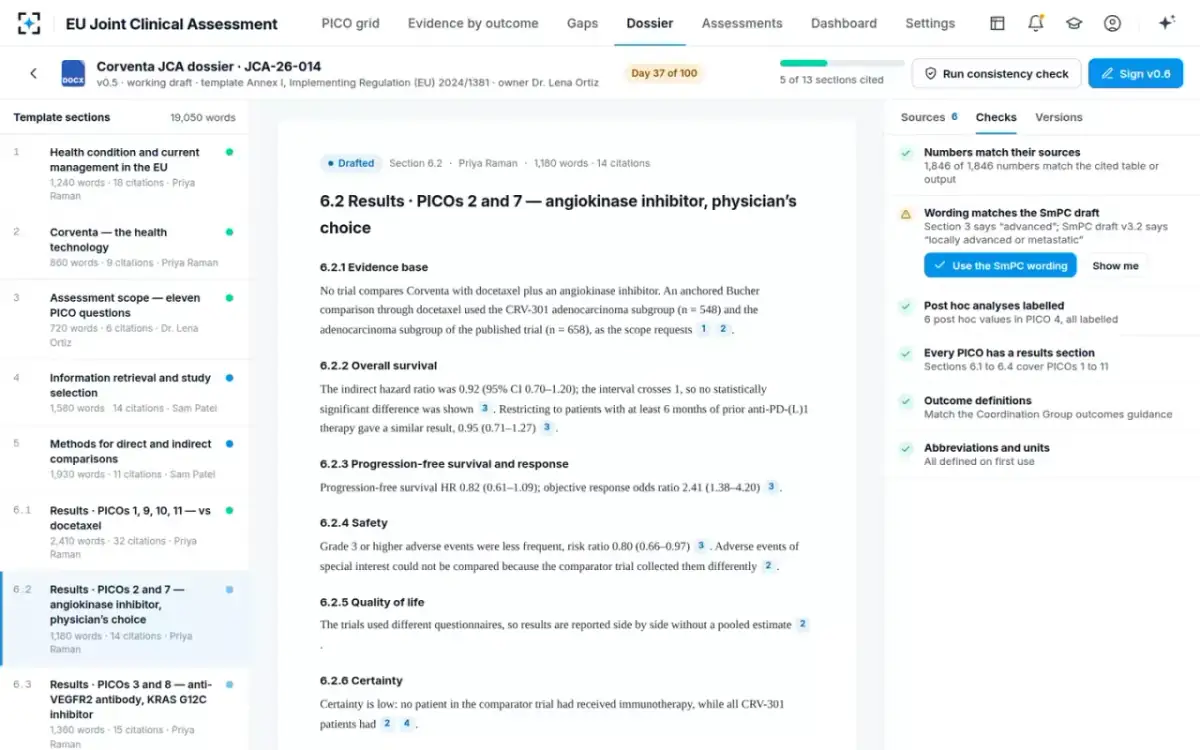
Consistency checkerCompares every number with its cited output, the wording with the latest product-information draft, and confirms every question has a results section.
Never: Never edits silently — it reports the difference
Six agents re-reading the scope, each leaving its source behind
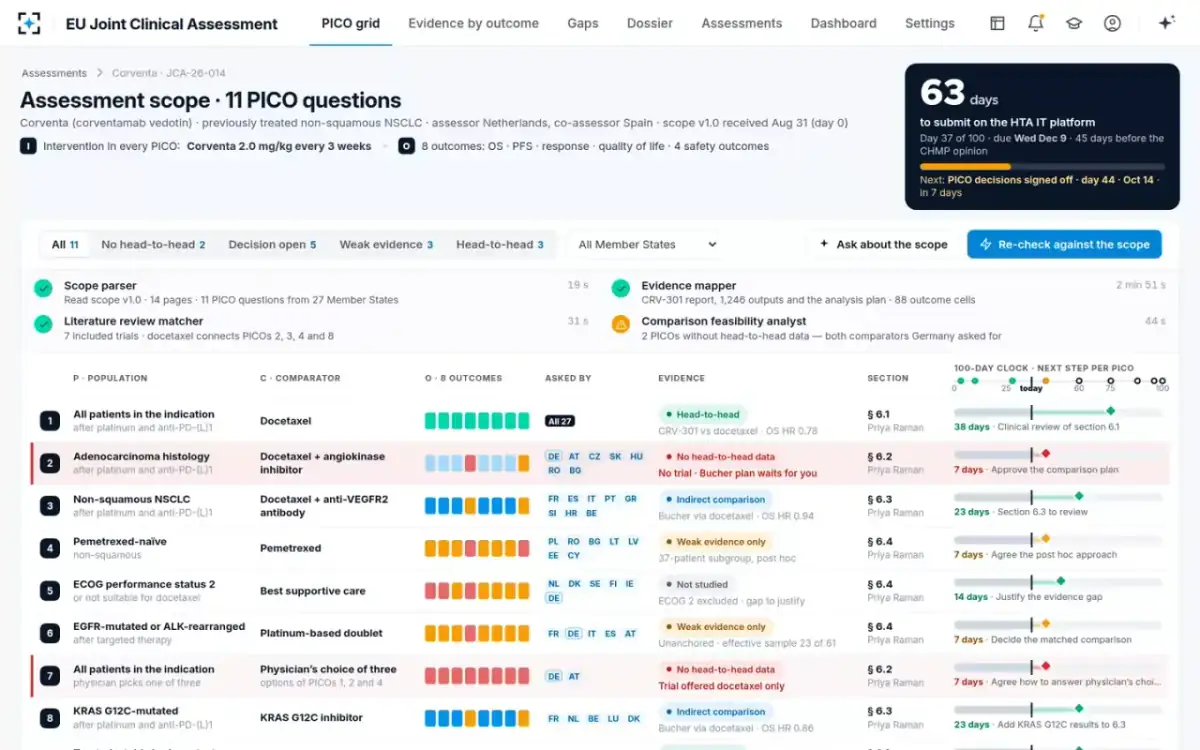
Where they stop is equally specific. An agent does not choose the comparison method, does not approve a plan, does not sign a version, and does not correct a difference it found. The consistency checker reports; a person decides. That last one looks like a limitation until the first time a silent correction has to be explained to an assessor.
A difference found, reported, and fixed by a person
A signed version, and what the signature claims
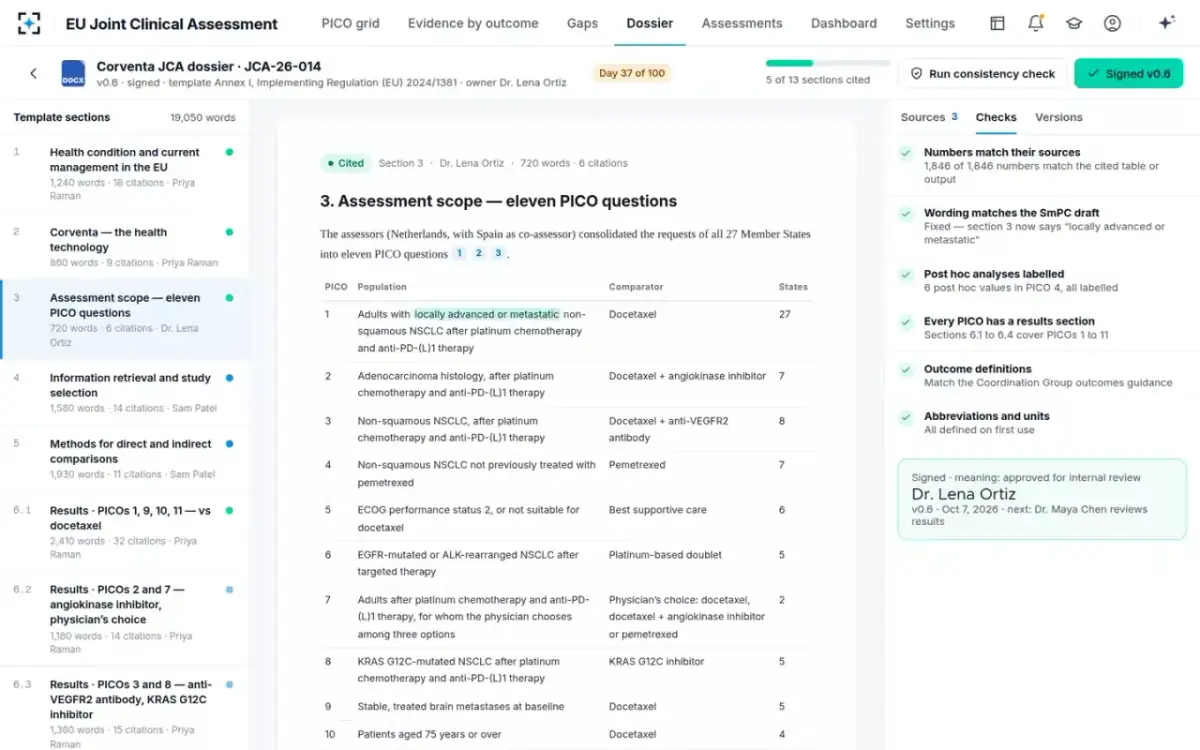
The honest summary of what a product like this is worth is not speed. It is that the disclosure section, the prompt record and the answer to "where did this number come from" exist as a by-product of the work rather than as a reconstruction at the end. Building the capability against buying it in takes the rest of that decision.
Questions people ask
Do you have to disclose AI use in an HTA dossier?
Yes, for a joint clinical assessment dossier. The Coordination Group expects use of AI to be clearly documented, with a specification of all AI-assisted steps — it names information retrieval including study screening, data extraction, risk-of-bias assessment, analysis and reporting as examples — and any output or judgment that is AI-generated or AI-informed to be identified. The only exception is AI used to improve spelling and grammar.
Do you have to keep the prompts?
Yes. The principles state that all prompts used in AI tools are expected to be recorded and made available if requested during the assessment process. Because an assessor's request can carry a deadline as short as seven days, this is only satisfiable by capturing prompts as the work happens — it cannot be reconstructed afterwards.
Can AI screen studies for a systematic review in a JCA?
It can assist. What it cannot do is run the step with nobody responsible: no step in dossier preparation or analysis should be fully automated without a human ultimately responsible for its quality and accuracy. Screening is one of the examples the principles give for disclosure, so if a model screened, the dossier says so, names the tool and version, and says what it was used for.
Who is responsible if an AI tool makes a mistake in a dossier?
The health technology developer. The principles place accountability for content, methods and findings on the developer, and say explicitly that this includes decisions about whether and how AI was used, its impact on the evidence synthesis and the validity of any output it produced. The developer is also responsible for copyright and data-protection compliance, with the dossier's publication in view.
Does the EU AI Act apply to HTA dossiers?
The principles do not perform that analysis, but they point at it: any use of AI systems should be consistent with applicable requirements and guidance under Regulation (EU) 2024/1689, the AI Act. In practice that is a question for your legal team about the systems you deploy, and it sits alongside — not instead of — the Coordination Group's own expectations about disclosure, oversight and prompts.
Can an agent write the results section of a dossier?
It can draft one, and the draft has to be reviewed by a named person and disclosed as an AI-assisted reporting step. Two constraints shape the draft itself: the dossier must report every question the assessment scope asks, including those with no evidence, and the methodological guidance still applies, so an uncertain result has to read as uncertain. Neutral, cited and complete matters more than fluent.