The EU JCA dossier template is Annex I of Implementing Regulation (EU) 2024/1381: six numbered sections, four appendices, and a revision history that runs from V0.1 to a public V1.0. It is not a house style. The Commission checks the dossier against Article 9 of the HTA Regulation within 15 working days of submission, and the assessors read it section by section against the questions the Member States set, so the template is the shape of the completeness test itself. Botminds' EU Joint Clinical Assessment drafts into that shape — each section in template order, each question answered where the scope asks for it, and every number in the draft carrying the table, output or publication it came from.
Everything below is read from the Implementing Regulation and the HTA Regulation themselves, with the Coordination Group's published answers where they clarify a requirement. The product screens are the solution's fictional sample assessment, on a fictional medicine.
The template, in four numbers
6
numbered sections, plus four appendices — nine parts in Appendix D alone
Annex I, Implementing Regulation (EU) 2024/1381
6
source types the information retrieval must systematically cover
sponsored studies, bibliographic databases, trial registries, HTA reports, the EMA file, patient registries
3
months: the maximum age of the literature search at submission
and at least Medline and CENTRAL must be searched
15
working days for the Commission to confirm the dossier is complete
10 working days in the accelerated and new-indication cases
What is in the EU JCA dossier template?
The template runs: overview, background, assessment scope, methods, results, references, appendices. The order is not arbitrary — it moves from what the product is, through what was asked, to how you went looking, to what you found, to the material that lets someone check you.
The EU JCA dossier template, section by section
1
Overview
The medicinal product and the developer; whether it has been assessed under the Regulation before; and an executive summary written against the assessment scope — the results per question, the certainty, and every question left unanswered with its reason.
2
Background
The medical condition, its diagnosis and its clinical management; the product, its mechanism, its administration and dosing, and its regulatory status.
3
Assessment scope
The scope reproduced in the format the Commission sent it, and a clear identification of every question for which no results were submitted, with the reasons.
4
Methods
Study selection criteria per question; information retrieval and study selection; data analysis and synthesis, broken into original studies, direct comparisons, indirect comparisons, sensitivity analyses, subgroups and anything else used.
5
Results
Results of the information retrieval across six named source types; the characteristics of the included studies; then the health outcome results, organised by population and by question.
6
List of references
With the full texts themselves in Appendix D.1.
A–D
Appendices
The line listing of every included study and its methods; the material for judging certainty, including risk of bias; the main studies where they answered no question; and the underlying documentation in nine parts.
Two structural points govern everything else. First, the dossier is written against the assessment scope rather than against the clinical development programme: the executive summary must give the results "for each PICO separately", and the results section is organised by population and question, not by study. Second, the content requirements are set twice over. Annex I of the HTA Regulation lists what a medicinal-product dossier must include — the EMA clinical safety and efficacy data, all published and unpublished evidence from the developer's own studies, HTA reports, registry studies, any deviation from a joint scientific consultation's advice, and the underlying documentation for all of it. Annex I of the Implementing Regulation then says where each of those goes.
Section 3: reproducing the scope, and naming the PICOs you did not answer
Section 3 is the shortest section in the template and the one with the sharpest edge. It asks for two things: the assessment scope "reproduce[d] in the format shared with the HTD in the Commission's first request", and then this.
Clearly identify any PICO(s), for which results were not submitted and explain the reasons for their omission.
Annex I, Implementing Regulation (EU) 2024/1381, section 3
The instruction appears twice in the template — once here and once in the executive summary — which tells you how the assessors read a dossier. An unanswered question is not something to be buried; it is something the document must surface on its own, early, with a reason attached.
The Coordination Group has set out how those reasons are judged: "in general, all data requirements resulting from the assessment scope should be fulfilled. Any items not addressed should be justified. The dossier's completeness will then be assessed, taking into account the appropriateness of the justifications provided for any items not addressed." So the test is not whether every question was answered — the published assessments show that is often impossible — but whether every unanswered one was named and explained well enough.
The published record makes the point. In the tovorafenib assessment the developer informed two of the eight questions and argued that the other six could not be addressed for want of data on the specified comparators. In the onasemnogene abeparvovec assessment, seven of the twelve were informed and five were stated to be unaddressable. Both dossiers were confirmed and both assessments were endorsed. What would have sunk them is leaving the gaps to be discovered.
Section 4: the methods, and why they must be written before the results
Section 4 describes how the dossier was made: the inclusion and exclusion criteria for studies, "provided for each PICO, as appropriate"; the information retrieval; the selection process; and then data analysis and synthesis, broken into seven subsections covering the design and results of the original studies, direct comparisons by pairwise meta-analysis, indirect comparisons, sensitivity analyses, subgroups and effect modifiers, and anything else.
Two requirements inside it do more work than their length suggests. The first is that deviations are allowed but must be declared: the methods "shall follow international standards of evidence-based medicine and take into account, if available, the methodological guidance adopted by the HTACG… Any deviations shall be described and justified." That sentence, or one almost identical to it, appears at the head of nearly every part of the template. The Coordination Group's guidance is not binding in the way an article is; departing from it silently is what fails.
The second is that the evidence synthesis protocols are not optional extras. For both direct and indirect comparisons, "the protocol for evidence syntheses, including the relevant statistical analysis plan, shall be provided in Appendix D.5". A comparison designed in week nine of the hundred days has to produce a protocol and an analysis plan as well as a result, and the seat that writes them is the same one that is running the analysis.
Information retrieval: the named databases and the three-month cut-off
This is the most prescriptive part of the whole template, and the easiest to fall foul of by starting early. Six source types "shall be systematically considered": the developer's own and third-party studies, bibliographic databases, trial registries and results registries, HTA reports, the clinical data in the EMA submission file, and patient registries.
Two of those come with named targets. For the databases: "the search shall at least be conducted in the National Library of Medicine's bibliographic database (Medline) and the Cochrane Central Register of Controlled Trials database." For HTA reports, the net is wider than the Union: reports "from EEA States in which the HTAR is applicable and from Australia, Canada, the United Kingdom and the United States of America". A dossier that cites only European assessments has not met the requirement.
And then the rule that drives the calendar: "the cut-off date for the searches shall be a maximum of 3 months before the submission of the dossier". With a 100-day window, a search run on the day the scope arrives is already at the edge of its life on submission day. In practice the search has to be refreshed inside the window, which means the review team is working while the results sections are being drafted, not before.
The Coordination Group has extended the same discipline to the supporting searches: "any data/information informing the assessment of relative effectiveness and relative safety should be based on an information retrieval with a cut-off date for the searches at maximum 3 months before the submission of the dossier. Other references supporting statements in the dossier should be reasonably timely." And where an indirect comparison needs covariates, a systematic review is required to identify them — "to identify covariates, a systematic literature review is required" — not a targeted one.
The completeness test, as the Commission applies it
- Is the evidence complete?
"The submitted evidence is complete with regard to the available studies and data that could inform the assessment" (Article 9(3)(a)). Held-back data from the developer’s own programme is the clearest way to fail this.
- Were appropriate methods used for every question?
"The data has been analysed using appropriate methods to answer all research questions of the assessment" (Article 9(3)(b)) — all of them, not the ones with trials.
- Can it be assessed inside the time available?
The presentation must be "well structured and transparent, thereby allowing for an appropriate assessment within the limited timeframes available" (Article 9(3)(c)). Structure is a legal requirement here, not a courtesy.
- Can the assessors verify the numbers themselves?
The dossier "includes the underlying documentation in respect of the submitted information, thereby allowing the assessor and co-assessor to verify the accuracy of that information" (Article 9(3)(d)).
- Does it contain what Annex I lists?
The dossier "shall include the information set out in Annex I" of the HTA Regulation (Article 9(4)) — including studies that are ongoing or discontinued, and the explanation of any deviation from a joint scientific consultation’s advice.
- Is every omission named and justified?
Not a separate article, but the way the first five are applied: completeness is assessed "taking into account the appropriateness of the justifications provided for any items not addressed".
Section 5: results presented by PICO, not by study
Section 5 is where most of the pages are, and the reorganisation it demands is the single biggest difference between a joint clinical assessment dossier and the clinical documents a team already has.
Results from the information retrieval come first, transparently, with every study's reference, status, duration, data cut-off and arms — and, for each retrieval step, a list of the studies not used and why. Then the characteristics of the included studies, in tabular form. Then section 5.3, which is organised by the scope: a subsection for each population, and within it a subsection for each question's patient characteristics and each question's health outcome results.
The instruction for those result subsections is precise about the order: "within the given patient population, results on health outcomes describing relative effectiveness and relative safety shall be described by PICO in tabular format. The section shall start from describing and justifying the choice of evidence (type of comparison) submitted to address the given PICO." The justification comes first, then the numbers.
Results written by study, and results written by question
How the evidence already exists: The trial. One chapter per study, with its own population, endpoints and analysis set.
What the template asks for: The question. One subsection per PICO, within a chapter per population.
How the evidence already exists: The enrolled population of each study, as randomised.
What the template asks for: The population the countries asked about — which often means a sub-population of a trial, re-analysed, with its characteristics described and its patient count given.
How the evidence already exists: Whatever the trial randomised against.
What the template asks for: Whatever the scope names, including comparators no trial used — answered by indirect comparison or by a justified gap.
How the evidence already exists: Those prespecified in the protocol and statistical analysis plan.
What the template asks for: Those, plus re-analyses driven by the questions — which must be flagged as deviations from the original study planning.
How the evidence already exists: Not an issue: each study is reported once.
What the template asks for: A live issue: one study can inform several questions, and duplication must be avoided — a cross-reference is allowed, but has to be explained and justified.
How the evidence already exists: That the study is reported faithfully.
What the template asks for: That every question in the scope has a subsection, and every number has documentation behind it.
One consequence deserves spelling out, because it is where the work actually lands. The scoping guidance notes that the available studies often do not match a question — "the specific PICO might comprise only a subpopulation of the population included in a study available for the assessment" — so studies "might need to be re-analysed or evaluated for suitability for indirect comparisons". Those re-analyses "will deviate from the original study planning but [are] required for the JCA by the definition of the PICO", and "any such deviations should be clearly mentioned by the HTD in the submission dossier". The original analyses go in as well.
A section drafted in template order, with every number pointing at its source
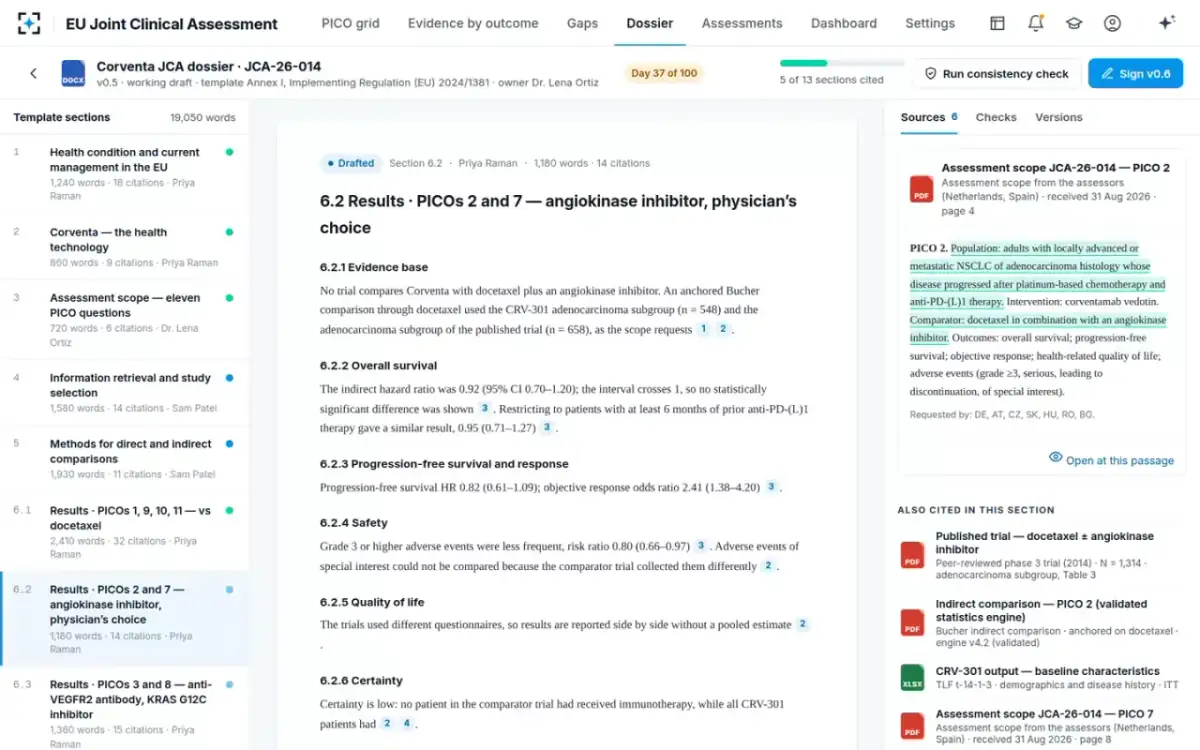
The nine appendices, and the one that carries your programming code
Appendices A to C hold the study-level material: a line listing with methods and a patient flow chart for every included study; the information needed to judge the certainty of the effects, including risk of bias; and the main studies from the clinical development programme where they did not answer any of the questions. Appendix D is the underlying documentation, and it has nine parts.
Appendix D: the nine places the underlying documentation goes
| Part | What goes in it | Why it exists |
|---|---|---|
| D.1 Full texts of references | The full text of everything cited in section 6. | So a claim can be checked without a library. |
| D.2.1 Search strategies | The documented strategy for each information source searched. | So the retrieval can be repeated exactly. |
| D.2.2 Retrieval results | The results of the information retrieval, in standard format. | So the numbers at each screening step add up. |
| D.3 Programming code | Program code and relevant output, where an analysis cannot be described by a specific standard method. | So a non-standard calculation can be reproduced rather than taken on trust. |
| D.4 Study reports | Clinical study reports, with study protocols and statistical analysis plans. | The underlying documentation Annex I of the HTA Regulation requires. |
| D.5 Evidence synthesis reports | Published and unpublished synthesis work, with its protocols and analysis plans. | So an indirect comparison is judged as a study, not as a result. |
| D.6 The EMA file | CTD modules 2.5, 2.7.3 and 2.7.4, and the clinical study reports — each provided once. | So the regulatory and HTA pictures can be compared. |
| D.7 HTA reports | The HTA reports listed in section 5.1.4. | So what other agencies concluded is on the table. |
| D.8 Registry studies | Studies with the product from patient registries, where available. | So real-world sources are visible rather than implied. |
| D.9 Joint scientific consultations | Information on any joint scientific consultation for the product. | So a deviation from earlier advice can be seen in context. |
D.3 is the one that surprises teams. Where an analysis cannot be described by a specific standard method — which covers most matching-adjusted indirect comparisons and most bespoke re-analyses — the code and its output go into the dossier. That has a governance consequence long before submission: the analysis has to be run from a version-controlled program with a readable output, not from an analyst's working session.
Every result cell, with the table it came from
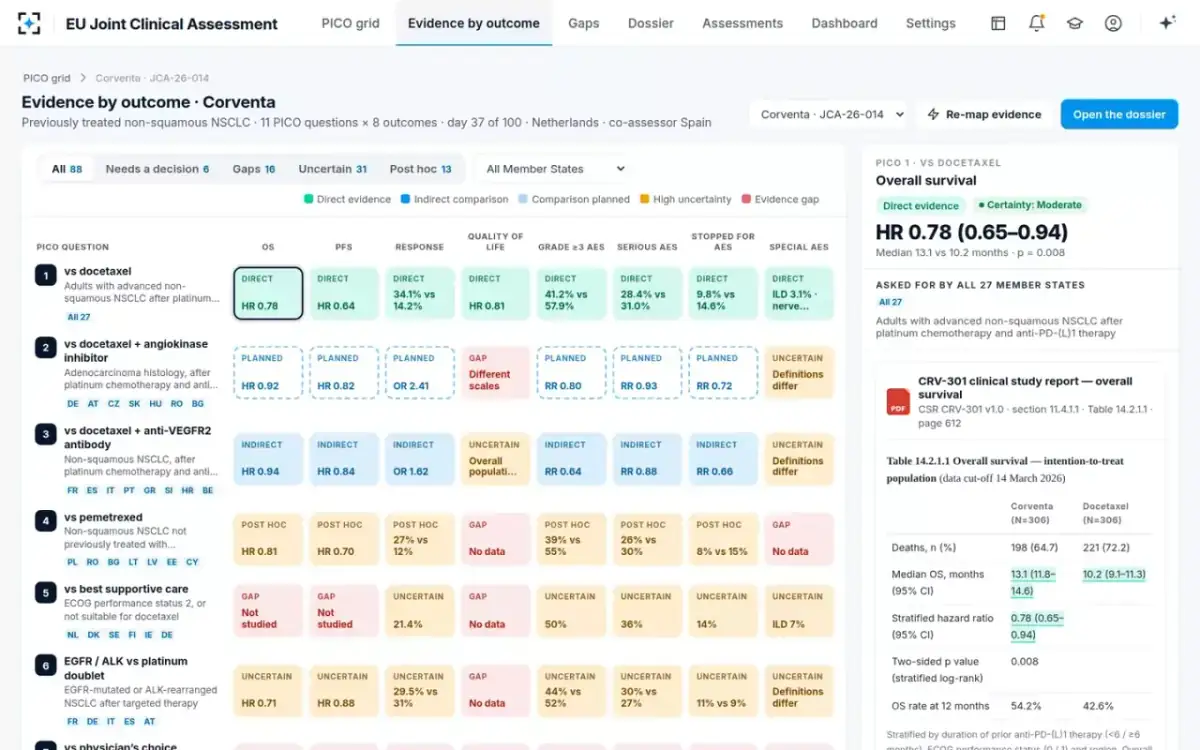
What happens to a dossier the Commission does not confirm?
Nothing dramatic, at first. The Commission issues a second request naming what is missing, and the developer has 15 days to supply it — 10 in the accelerated and new-indication cases, 7 where only minor information is missing. That becomes dossier version 0.2, and the assessment continues.
The cliff is at the end of that road. If, after the second request, the Commission judges the dossier late or still not compliant with Article 9(2) to (4), the Coordination Group has to discontinue the assessment (HTA Regulation, Article 10(6)). A statement of discontinuation is published on the IT platform, and the protection against being asked for the same evidence again at national level stops applying.
Two things make that outcome avoidable. One is answering the completeness test above against your own draft, in week ten rather than after submission. The other is holding the statistical capacity that would answer a second request: fifteen days is enough to supply a missing appendix or a sensitivity analysis that already exists, and is not enough to build an indirect comparison from nothing. The dates around the confirmation make the same point from the calendar's side.
The version ladder: from V0.1 to the V1.0 the world reads
The template opens with a revision history, and it is worth reading as a map of everything that can happen to a dossier. Each row names a version, what it is for, and the article that creates it.
The dossier version ladder, and what creates each rung
| Version | What it is | Legal reference |
|---|---|---|
| V0.1 | The initial dossier — Due 100 days after the first request — 60 in the accelerated and new-indication cases. | Article 10(2) HTAR |
| V0.2 | Updated after the Commission’s second request — 15 days to answer; 10 in the accelerated cases, 7 where only minor information is missing. | Article 10(5) HTAR |
| V0.3 | Updated after the assessors ask for clarification — The assessors set the deadline, between 7 and 30 days. | Article 11(2) HTAR |
| V0.4 | Updated after a change to the therapeutic indication — Follows a revised assessment scope. | Article 16(4) IR |
| V0.5 | Updated after a joint clinical assessment is re-initiated — Only where an assessment was discontinued and restarted. | Article 10(8) HTAR |
| V0.6 | The developer’s confidentiality claims and their justification — Commercial sensitivity has to be demonstrated, not asserted. | Article 11(5) HTAR |
| V1.0 | The dossier for publication, without confidential information — This is the version the world reads. | Article 20 IR |
| V1.0.1 – V1.0.5 | Updates where new evidence appears or an update is initiated — Year-scale work on a product already on the market. | Articles 18(1), 18(2), 18(5), 18(6) IR and Article 11(5) HTAR |
| V2.0 | The dossier for publication after an update is finalised — The public version of the updated assessment. | Article 20 IR |
V1.0 is the one that changes how the earlier versions should be written. It is "the dossier for publication (without confidential information)", and it is published by the Commission alongside the assessment report. Before publishing, the Commission gives the developer the list of information it does not consider confidential, having assessed the justification and taken the subgroup's view, and tells the developer of its right to appeal the refusal to redact.
So confidentiality is adjudicated, not declared, and the adjudication happens late — after the content is fixed. A dossier written on the assumption that sensitive passages can be removed later is a dossier whose structure may not survive the removal.
Where developers lose days, and how the first four assessments show it
The published procedural tables are the only hard evidence of how this template behaves in practice, and three things stand out.
Nobody was confirmed first time. Each of the four published assessments shows at least one dossier version between the initial submission and the Commission's confirmation. Lurbinectedin's table records version 0.1 on 16 December 2025, then versions 0.2 and 0.3 explicitly marked as responses to the second request on 2 and 18 February 2026, with confirmation on 23 February — and then a further version 0.3 on 12 March in response to a request for additional information. Four submissions from one dossier.
The questions outnumber the answers. Six of tovorafenib's eight questions and five of onasemnogene abeparvovec's twelve were not informed by submitted results. Section 3's instruction to identify them and explain the omission is therefore the most-used sentence in the template, not an edge case.
The retrieval has to be refreshed inside the window. A three-month cut-off against a 100-day window leaves no room for a search done before the scope arrives to still be valid at submission — and where an indirect comparison needs covariates, a systematic review has to be in place as well. Teams that treat the literature work as a pre-scope activity find themselves repeating it in the last fortnight.
The check that runs before a version is signed
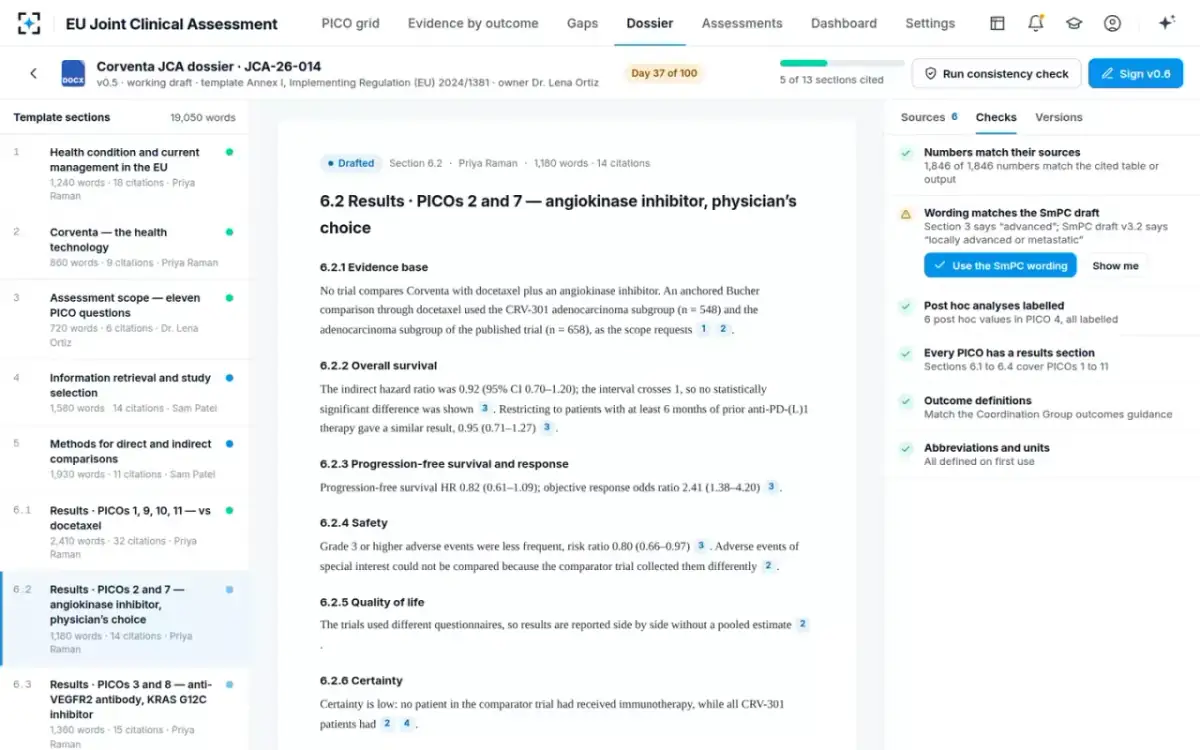
Questions people ask
Where do you put PICOs you cannot answer?
In two places, both near the front. Section 3 must "clearly identify any PICO(s), for which results were not submitted and explain the reasons for their omission", and the executive summary in section 1.3 must do the same. Completeness is then assessed on how appropriate those justifications are, not on whether every question was answered.
Which databases must a JCA literature search cover?
At minimum the National Library of Medicine's Medline and the Cochrane Central Register of Controlled Trials. Beyond bibliographic databases, the retrieval must systematically consider the developer's own and third-party studies, trial and results registries, HTA reports from EEA states applying the Regulation and from Australia, Canada, the United Kingdom and the United States, the clinical data in the EMA submission file, and patient registries.
How old can the literature search be?
Its cut-off date may be at most three months before the dossier is submitted. The Coordination Group applies the same limit to any search informing relative effectiveness or relative safety. Asked about a targeted epidemiology search, it answered that other references supporting statements in the dossier need only be reasonably timely.
Do you have to submit the statistical programming code?
Yes, where the analysis cannot be described by a specific standard method — the code and its relevant output go in Appendix D.3. Section 4.3 is broader still: the underlying documentation for any analysis, including study protocols, statistical analysis plans and details of all software used, belongs in the relevant parts of Appendix D.
Which version of the dossier is published?
V1.0, "the dossier for publication (without confidential information)". Before publishing, the Commission sends the developer the list of information it does not accept as confidential, having assessed the justification and considered the subgroup's view, and informs the developer of its right to appeal that refusal.
How do you present results for each PICO?
By population first, then by question, in tabular format, starting with a description and justification of the type of evidence used for that question. Each subsection must carry the available outcomes per study, the course of the studies, the synthesis method with its strengths and limitations, the results of each study and of the syntheses, the missing data and its reasons, every sensitivity analysis, and anything affecting the certainty of the effect.