HTA dossier development, for a European joint clinical assessment, is the work of turning an assessment scope into a complete, cited, template-shaped submission inside a statutory window — and the hard part is that the window is almost all presentation. The deadline is 100 days from the Commission's first request, 60 days in two named cases, and no part of that is long enough to generate evidence that does not already exist. So the whole discipline is really a readiness question settled before the clock starts, and then an execution question about sequence and sign-off. Botminds' EU Joint Clinical Assessment is built for the second half, and this guide is honest about which problems it does not solve.
The deadlines and obligations below come from the HTA Regulation, its implementing regulation and the Coordination Group's own published answers, each linked where it is used. The screens show the solution on a fictional sample assessment — Corventa (corventamab vedotin), JCA-26-014, with invented studies, people and figures — and none of its numbers is a measured customer result.
Four numbers that shape the plan
3months
the oldest your literature search may be on the day the dossier is submitted
15working days
the Commission’s window to confirm the dossier meets the requirements — 10 in the accelerated and new-indication cases
92%
of the 13 companies surveyed for a 2024 multi-stakeholder workshop expected duplicative submission processes and national requirements
39days
from scope to a full draft dossier, the design target in the solution, against about 70 by hand on our own estimate
What does HTA dossier development involve?
Six things, in roughly this order. Reading the assessment scope into a list of answerable questions, each with its population, comparator and outcomes, and an owner. Finding, for every question and every outcome, the evidence that answers it — in a clinical study report, a statistical output, a published trial — or establishing that none exists. Deciding, for each question with no head-to-head trial, what comparison can be made and getting that decided before anything is run. Drafting each section in the order the template sets, in neutral language, with every number cited to the table it came from. Checking the result: numbers against their outputs, wording against the current product information, a results section for every question. And signing, version by version, with a chain of named approvers ending in the submission.
What makes it different from a national submission is the completeness standard and the publication. The dossier must contain complete and up-to-date evidence to assess every parameter in the scope, analysed with appropriate methods to answer all of the research questions, presented transparently, with the underlying documentation attached so the assessors can verify it. And a version of it is published.
The clock starts before the clock: what has to exist on day zero
Two provisions turn readiness into a deadline of its own. The first is the information-retrieval rule: the searches may be no more than three months old on the day the dossier is submitted (Annex I, section 4.2.1). A review completed last year does not qualify; it has to be refreshed, and the refresh happens inside the window. The second is the Coordination Group's answer on staging evidence: "All available evidence must be included in the initial dossier submitted to address Commission's first request (dossier version V0.1)." There is no first pass and a stronger second pass.
What has to exist before the assessment scope arrives
- A search that can be refreshed, not repeated
A documented strategy over Medline, the Cochrane Central Register, study registries, HTA reports, the Agency submission file and patient registries, built so it can be re-run and the delta reviewed inside the window.
- A current comparator landscape
Which treatments the Member States are likely to name, which of them share a treatment with your trials, and which readouts in the next year would change that.
- Access to the individual patient data you will need
Your own trials, and any agreement you will need with another sponsor. These take months and cannot be started on day 20.
- Programming code written to be read
Appendix D asks for the code and output behind analyses that are not standard methods. Code assembled at the end is where submissions slip.
- Named section owners
A person per section of the template, and a person who approves a comparison plan. Deciding this in week one costs the week.
- A signature chain with meanings
Who signs which version and what the signature claims — internal review, ready to submit, final. The record matters more than the ceremony.
- A rehearsal of the questions
An exercise that has already told you which questions you cannot answer. Without one, the scope tells you, with the clock running: see our guide to the rehearsal itself.
That last line deserves its own sentence. The rehearsal — a PICO simulation — is the only item on the list whose absence cannot be corrected later, because its whole output is the warning you needed earlier.
The first 100 days, phase by phase
The statutory clock is short and it has deadlines stacked behind it. The dossier is due 100 days from the notification of the first request, "However, that deadline shall be 60 days where" the marketing authorisation is being assessed under the accelerated procedure, or where the assessment concerns a new therapeutic indication added by a variation of a type the regulation names. An extension exists but is narrow: the secretariat may grant one only where it is justified and the assessor and co-assessor agree, and never past the regulation's own outer limit.
The statutory clock, and the milestones a team sets inside it
- Dossier window100 d
- Commission confirms15 working days
- Second request15 d
- Questions and comparison plansto day 44
- Comparisons run, full draftto day 75
- Checks, sign-off, submissionto day 100
The shape of the bottom lane is the argument. Comparison plans have to be settled around day 44 not because anything legal happens then, but because a comparison agreed later cannot be run, reproduced, written up and checked before the draft is due. Every milestone in the window is a back-calculation from the one piece of the work that has an irreducible duration.
Where the days actually go is worth looking at as a split, because the intuition is usually wrong: teams expect drafting to dominate and find that evidence mapping and comparison feasibility have quietly eaten the month.
Where the days to a full draft go, by hand and with the solution
By hand — about 70 days, our estimate
- Scope into questions, then evidence per question · 35.7%
- Feasibility and comparison plans · 21.4%
- Drafting with citations · 28.6%
- Checking numbers and wording · 14.3%
With the solution — 39 days, the design target
- Scope into questions, then evidence per question · 23.1%
- Feasibility and comparison plans · 28.2%
- Drafting with citations · 33.3%
- Checking numbers and wording · 15.4%
What happens when the Commission does not confirm your dossier
You get a second request, and a short clock. The Commission has 15 working days from submission to confirm, in consultation with the assessor and co-assessor as appropriate, whether the dossier meets the requirements — 10 working days in the accelerated and new-indication cases. If it finds the dossier short, it asks for the missing material, and the developer "shall submit the missing information, data, analyses and other evidence indicated in the Commission's second request ... within 15 days from the date of notification", 10 days in those same two cases, and 7 days "for cases where only minor information is missing".
Separately, and at any time while the report is being written, the assessors may ask for further specifications, clarifications or additional information. The deadline for those is set by the assessor and co-assessor according to what they are asking for, and the implementing regulation bounds it: "That deadline shall be set at minimum 7 days and maximum 30 days counting from the date of notification of the request." All four published assessments record at least one further dossier version after the Commission's confirmation, and lurbinectedin's table marks its own as a response to a request for additional information; onasemnogene abeparvovec filed two more after the therapeutic indication changed and the scope was revised.
The lesson is about where your evidence lives rather than how fast your writers are. A request for a standardised-difference table or a data cut-off is a seven-day job if the number is traceable to its output and a three-week job if somebody has to find out who ran it.
Can a joint clinical assessment be discontinued?
Yes, and the consequence is sharper than most teams realise. Article 10(6) of the HTA Regulation: "Where, after the second request referred to in paragraph 5 of this Article, the Commission deems that a dossier was not submitted in a timely manner by the health technology developer, or attests that it fails to meet the requirements laid down in Article 9(2), (3) and (4), the Coordination Group shall discontinue the joint clinical assessment." The Commission then publishes a statement on the platform justifying the discontinuation.
The sting is in the last line of that paragraph: where an assessment is discontinued, the protection in Article 13(1), point (d) does not apply. That is the provision stopping national bodies from asking again for evidence already submitted at Union level. Lose the assessment and you lose the one concrete reciprocal benefit the system offers.
A discontinued assessment can be re-initiated within six months of the original deadline, once the Commission has confirmed the requirements are met, and the Coordination Group may also ask for updates of what was submitted before. It is a recovery route, not a plan.
Build it in-house or buy it in?
The question is usually posed as capacity and is really about what survives the first assessment. An agency delivers a dossier; a capability delivers the second one faster than the first. Both are legitimate, and the answer differs by how many assessments you expect.
Building the capability against buying the dossier
Build it in-house: Headcount, and a first assessment that is slower than it should be
Buy the work in: Fee per assessment, predictable, and a team that already knows the template
Build it in-house: A method, a set of owners, and evidence organised the way the scope asks for it
Buy the work in: A dossier, and whatever documentation the contract specified
Build it in-house: Faster: the retrieval, the evidence map and the signature chain are reusable
Buy the work in: About the same, unless you kept the working material
Build it in-house: The first scope, with nobody who has seen one before
Buy the work in: Questions that need your own trial data or your own programming to answer
Build it in-house: Accountability for the completeness and the methods, which the regulation places on the developer
Buy the work in: The same. No supplier can hold it on your behalf
Build it in-house: A portfolio with several assessments a year
Buy the work in: A first or one-off assessment, or a gap in capacity
What you bring, and what a platform brings
A platform brings structure, retrieval, drafting and checking. You bring the evidence and the judgement, and neither is optional.
Six inputs the dossier template demands, against how ready a team usually is
A systematic information retrieval
Medline and the Cochrane Central Register at minimum, plus study registries, HTA reports from the EEA and from Australia, Canada, the UK and the USA, the clinical data in the EMA submission file, and patient registries.
On day zeroUsually a review exists, rarely one that covers all six sources and can be refreshed inside three months.
Study reports, protocols and analysis plans
Clinical study reports with their protocols and statistical analysis plans, for every study that informs a question.
On day zeroHeld, but often across three systems and two vendors.
Programming code and its output
Appendix D asks for the program code and relevant output for any analysis that cannot be described by a standard method.
On day zeroThe least ready item on most programmes, because the code was written to produce a figure, not to be read.
Evidence-synthesis documentation
The protocols and statistical analysis plans behind every synthesis, published and unpublished alike.
On day zeroPartial: the synthesis often postdates the scope, so the plan has to be written inside the window.
The regulatory file
Modules 2.5, 2.7.3 and 2.7.4 of the submission to the Agency, and the current product-information draft.
On day zeroAvailable, but moving — the wording changes during regulatory review.
A named owner per section and a signature chain
Who drafts, who reviews, who approves a comparison plan, who signs the final version.
On day zeroUsually improvised in week one, which is where the first week goes.
The third row is the one that catches programmes out. Appendix D asks for "details on all software used as well as the respective program code and relevant output" behind any analysis that is not a standard method — a requirement that is trivial if the code was written to be handed over and expensive if it was not.
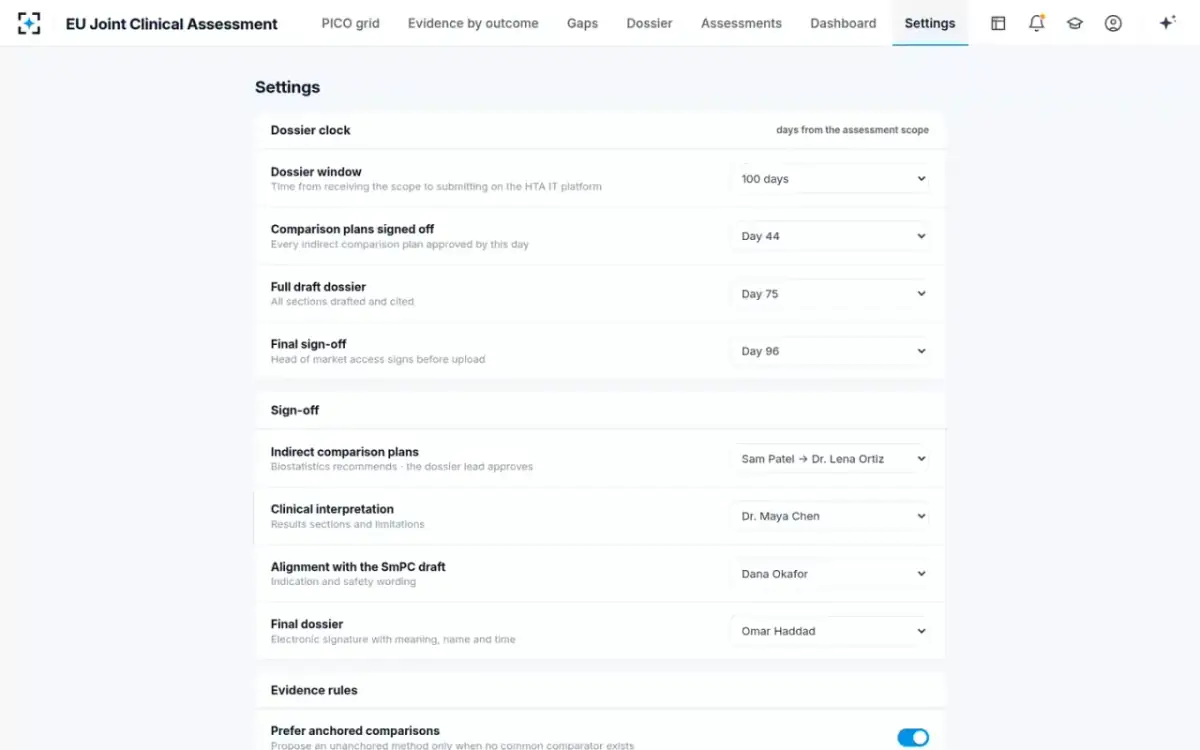
The clock, the milestones and the signature chain as settings
Does the JCA dossier save you work nationally?
In law, yes. Member States may not ask, at national level, for any information, data, analyses or other evidence the developer has already submitted at Union level in answer to the Commission's requests (Article 13(1), point (d)). That is a real protection: the material in your dossier cannot be demanded again by a national body.
In expectation, the industry is sceptical. At the 2024 multi-stakeholder workshop, the challenges companies anticipated included "the potential for inconsistent acceptance of JCA reports among HTA agencies (92% of respondents), duplicative submission processes and national-level requirements (92%), resource constraints within HTA agencies (77%), and the lack of established HTA systems in certain jurisdictions (77%)". The protection covers the evidence you submitted; it does not cover a national economic model, a national comparator nobody asked about at Union level, or a national format.
The planning conclusion is to build the dossier so its parts can be reused rather than re-derived: evidence organised by question, each number traceable to its table, and the comparison plans and their results kept with the reasoning attached. That is also what makes a published assessment report easier to live with afterwards.
How long it takes to go live, and what "live" means
Going live does not mean a dossier is written. It means the structure that holds one is in place: the template, the clock and its milestones, the sign-off chain, the evidence sources connected, and the rules a dossier is held to — a number without a source blocking a signature, post hoc analyses labelled, a warning when a matched sample falls below a threshold you set.
In the solution, that is built and deployed from your own material — your dossier template, study reports, statistical outputs and a past assessment scope — and it is live once the quality checks have passed. A past scope matters more than it sounds: it is what lets the question parsing be tested against something real before an assessment depends on it.
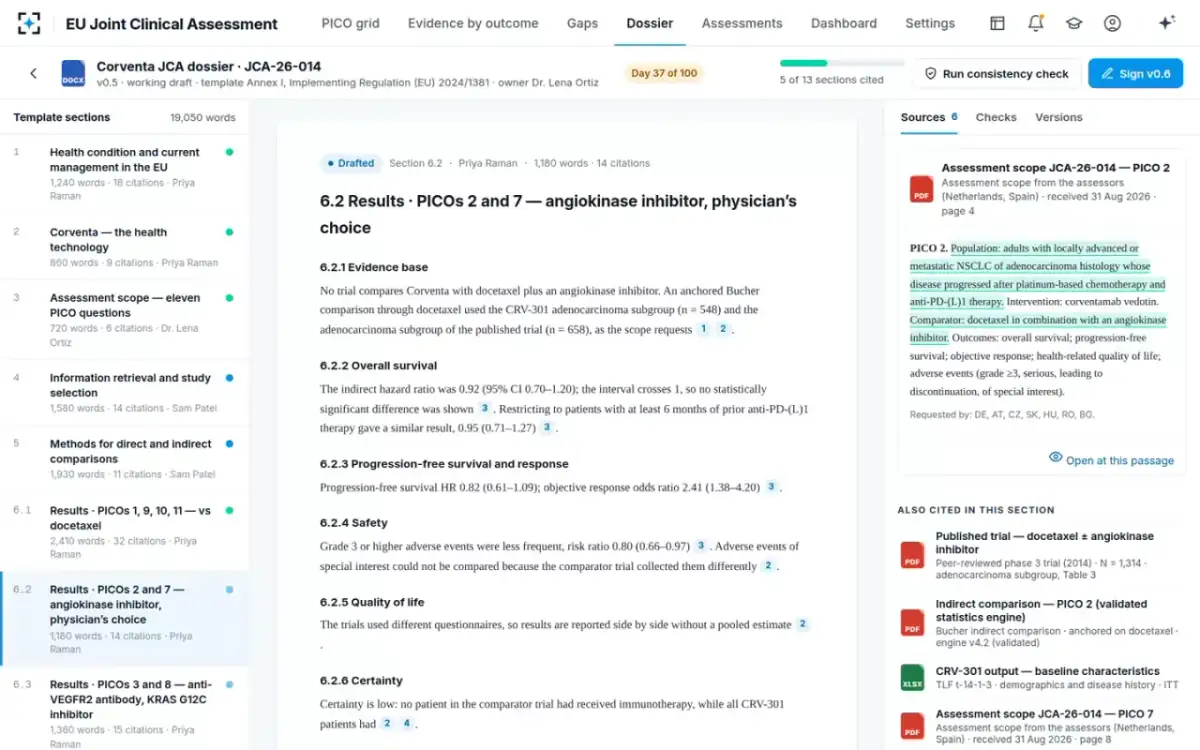
A cited draft section, in template order
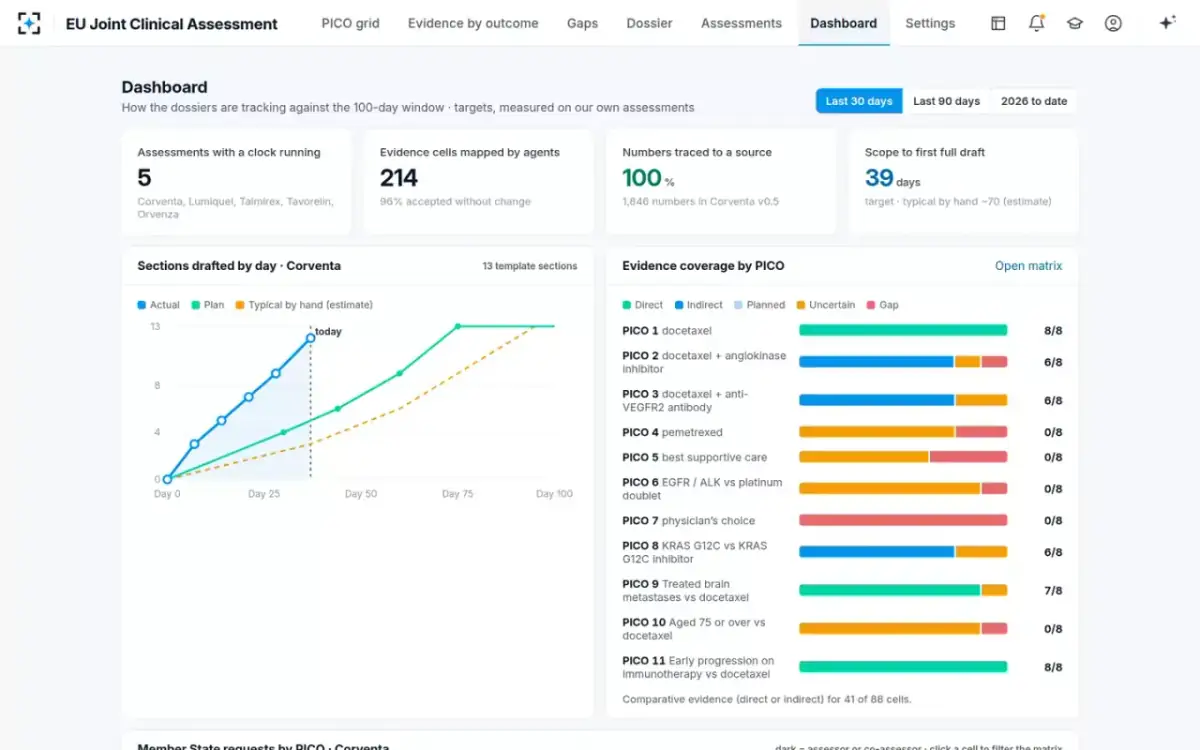
Where every assessment stands, in EU Joint Clinical Assessment
One honest caveat to close on. A platform shortens the mechanical part of the work and makes the record of it defensible. It does not shorten the statutory deadline, it does not create evidence that does not exist, and it does not move the accountability for completeness, which the regulation places on the developer and nowhere else. If the comparator you need was never studied, the plan for that question is a justified gap — written early, argued well, and submitted with everything the assessors need to weigh it.
Questions people ask
What do you need before the JCA assessment scope arrives?
A refreshable systematic search over the six source types the template names; a current comparator landscape; access to the individual patient data you will need, including any agreement with another sponsor; programming code and output written to be handed over; a named owner per template section; and a signature chain. The search is the one with a hard legal edge — its cut-off may be at most three months before submission.
How do you plan the 100 days after the scope?
Backwards from the one task with an irreducible duration, which is usually an indirect comparison: the plan has to be approved early enough for the analysis to be run, reproduced, written up and checked. In the solution the default milestones put comparison plans at day 44, a full draft at day 75 and final sign-off at day 96. Those are internal dates a team sets; the 100 days is not.
What happens if the Commission does not confirm your dossier?
It issues a second request for the missing material, and you have 15 days to answer — 10 in the accelerated and new-indication cases, and 7 where only minor information is missing. The Commission's own window to confirm is 15 working days from submission, or 10 in those same cases.
How many people do you need for a JCA dossier?
There is no published figure, and the honest answer is that it depends on the number of questions in your scope rather than on the medicine. What is fixed is the set of roles: someone who owns the scope and the deadlines, a biostatistician for the comparisons, medical writers for the results sections, regulatory affairs for the product-information wording, and a final approver. The number of questions decides how many of each.
How do you reuse a JCA dossier for national submissions?
Member States may not ask again at national level for evidence you submitted at Union level, so the dossier's content is protected. What is not protected is a national economic model, a comparator nobody raised at Union level, or a national format — and 12 of the 13 companies surveyed for a 2024 workshop expected duplicative national requirements anyway. Organise the dossier so its parts are reusable: evidence by question, every number traceable to its table.
Can a joint clinical assessment be discontinued?
Yes. If, after the second request, the Commission deems the dossier was not submitted in time or still fails the requirements, the Coordination Group discontinues the assessment and the Commission publishes a statement explaining why. The provision stopping national bodies asking again for Union-level evidence then does not apply. A discontinued assessment can be re-initiated within six months of the original deadline, once the Commission confirms the requirements are met.