A joint clinical assessment report is the document the EU Member States' assessors produce at the end of a joint clinical assessment: a description of how your medicine performs against each comparator the assessment scope named, on each outcome it listed, with the certainty of each result. It is not a recommendation and not a price, and by law it reaches no conclusion about the medicine's overall value. Four have been published so far, and reading them together is the fastest way to learn what the new system actually produces. Botminds' EU Joint Clinical Assessment works on the other side of that document — the dossier the report is written from — and the pattern in these four is the reason it exists.
Everything counted on this page comes from the four reports themselves, which the Commission publishes as PDFs; each is linked where it is used. Where the page shows a screen, it is the solution running on a fictional sample assessment — Corventa (corventamab vedotin), JCA-26-014, and the people around it are invented, and none of their numbers is a customer result.
The first four reports, counted
4
joint clinical assessment reports published so far, the first of them on 9 June 2026
14
patient populations defined across their four assessment scopes
28
PICO research questions those populations carry between them
16
of the 28 for which the report carries comparative evidence
What is in a joint clinical assessment report?
Every report follows the same template, set out in Annex II of the implementing regulation, and the four published ones follow it closely enough that you can navigate one having read another. Section 1 gives the general information: who the assessor and co-assessor were, the dates of every procedural step, which patients and clinical experts were involved, and whether the medicine had a joint scientific consultation and whether the developer departed from what it proposed. Section 2 describes the medical condition and the product — characteristics, dosing, regulatory status. Section 3 is the assessment scope: the populations, the PICO questions, the outcomes table and the subgroup table.
Section 4 is the assessment. It opens with information retrieval and the list of included studies by PICO, then the studies' characteristics and risk of bias, then the results on relative effectiveness and relative safety, organised by population, with a subsection per comparator. Section 5 is the references. Then come four appendices that most readers never reach and that repay the trip: input from patients and clinical experts; the assessors' own check of the developer's information retrieval; additional study data; and — the one to read first if you are preparing a dossier — the assessors' requests for further specifications, the developer's answers, and the assessors' brief verdict on each answer.
The reports are long. Counted from the published files, the four run to 154, 211, 257 and 362 pages. A summary report is published beside each one.
The four published so far, side by side
The four differ more than a summary suggests. One has a single question and a randomised trial to answer it; another has twelve questions across six populations. Two national agencies, Ireland's and Germany's, led all four between them.
The four published joint clinical assessment reports
| Report | Assessor · co-assessor | Populations | PICOs | With evidence in the report | Endorsed |
|---|---|---|---|---|---|
| Tovorafenib | Ireland (NCPE) · Germany (IQWiG) | 3 | 8 | 1 | 30 April 2026 |
| Lurbinectedin | Germany (IQWiG) · Portugal (INFARMED) | 1 | 1 | 1 | 22 June 2026 |
| Tarlatamab | Germany (IQWiG) · Hungary (NCPHP) | 4 | 7 | 7 | 22 June 2026 |
| Onasemnogene abeparvovec | Ireland (NCPE) · France (HAS) | 6 | 12 | 7 | 16 July 2026 |
Two observations are worth more than the table. The first is that scope size is not a function of the medicine's importance but of how many ways the Member States wanted to see it tested: a single licensed indication with one standard of care produced one question, while a therapy used across several ages and genotypes produced twelve. The second is that the assessor and co-assessor are two national agencies with their own traditions, and the pairings so far put a German or Irish agency in the lead chair each time. How 27 countries become one assessment scope explains where the questions come from.
How many PICOs does a report actually answer?
Sixteen of twenty-eight, so far. That is the number a team planning its first dossier should sit with, because it is not a measure of how good the four developers were. It is a measure of what a scope built from twenty-seven countries' needs asks for, against what a clinical development programme designed years earlier happens to contain.
Questions set against questions the report carries evidence for
The spread is the lesson. A scope of one question with a randomised trial behind it is answered completely. A scope of seven questions in a disease with several lines of therapy was answered completely too, because the developer had a direct comparison for three of them and built indirect comparisons for the rest. A scope of eight questions, four of them against individualised treatment — a clinician's choice among several options — was answered once.
None of this is a surprise to the people who designed the system. The Coordination Group's guidance on scoping says so in advance: because the scope is driven mainly by policy, it can contain questions for which no evidence exists, and in that case the report identifies the evidence gap for the health systems' decision-making (Guidance on the scoping process). Identifying gaps is an intended output, not a failure state. The question for a developer is whose gaps they are.
What an unanswered PICO looks like in print
It looks like a short, dry sentence in section 3, and then nothing. In the tovorafenib report: "The HTD provides evidence informing PICOs 5 and 7 and argues that PICOs 1 to 4, 6 and 8 could not be addressed due to the unavailability of data for the specified comparators in the target population." In the onasemnogene abeparvovec report: "The health technology developer (HTD) provided evidence informing PICOs 1, 2, 3, 8, 9, 10 and 11, and stated that PICOs 4, 5, 12, 13 and 14 could not be addressed due to unavailability of sufficient data in the target population for the intervention and/or comparator(s)."
There is a second way to be unanswered, and it is worse, because the work was done. The tovorafenib report records under its results table that the results submitted for PICO 7 were left out of the assessment because too little information was available to assess the comparator study (tovorafenib report). An unanchored comparison was built, submitted and then excluded — not because the method was rejected in principle, but because too little was published about the study on the other side for anyone to check it. Which indirect comparison a JCA will accept follows that distinction through the methods.
Either way, the national bodies reading the report get the same thing for that question: nothing comparative, and a justification whose acceptability, as the scoping guidance says, is decided at national level.
The assessors' verdicts: where a developer's reasoning was rejected
The most useful pages in any of the four are the ones where the assessors say, in plain terms, what was wrong. They are specific, and almost all of them are about documentation rather than science.
Six findings the assessors recorded against the first dossier
- A comparator study too thin to assess
“Results submitted by the HTD to inform PICO 7 are not included in the assessment, due to insufficient information available for the assessment of the study on the comparator”.
- A definition of the comparator the assessors did not accept
“The HTD’s approach to include studies with an individualised treatment comparator, only if the comparator included all treatment options, is not adequate.” Four questions turned on that reading.
- A missing data cut-off
“For FIREFLY-1, the analyses use the 2-year data cut-off (10 May 2024); for Bouffet 2023, no information on the data cut-off is available in the dossier.”
- Standardised differences not reported
“Standardised differences for the characteristics were not reported in the dossier and therefore not included in Table 21.” The comparison of baseline characteristics is the evidence that a weighting worked.
- A comparator population that did not match the question
“These patient characteristics do not align with Population 2 or with those of the patients included in the analysis sets for tovorafenib which exclusively include a diagnosis of LGG and prior systemic therapy.”
- Requested analyses not run
The assessors asked for additional analyses pooling two arms of the pivotal study, “but this was not provided by the HTD”, and recorded that “the HTD did not provide sufficient justification for not carrying out the requested analyses themselves”.
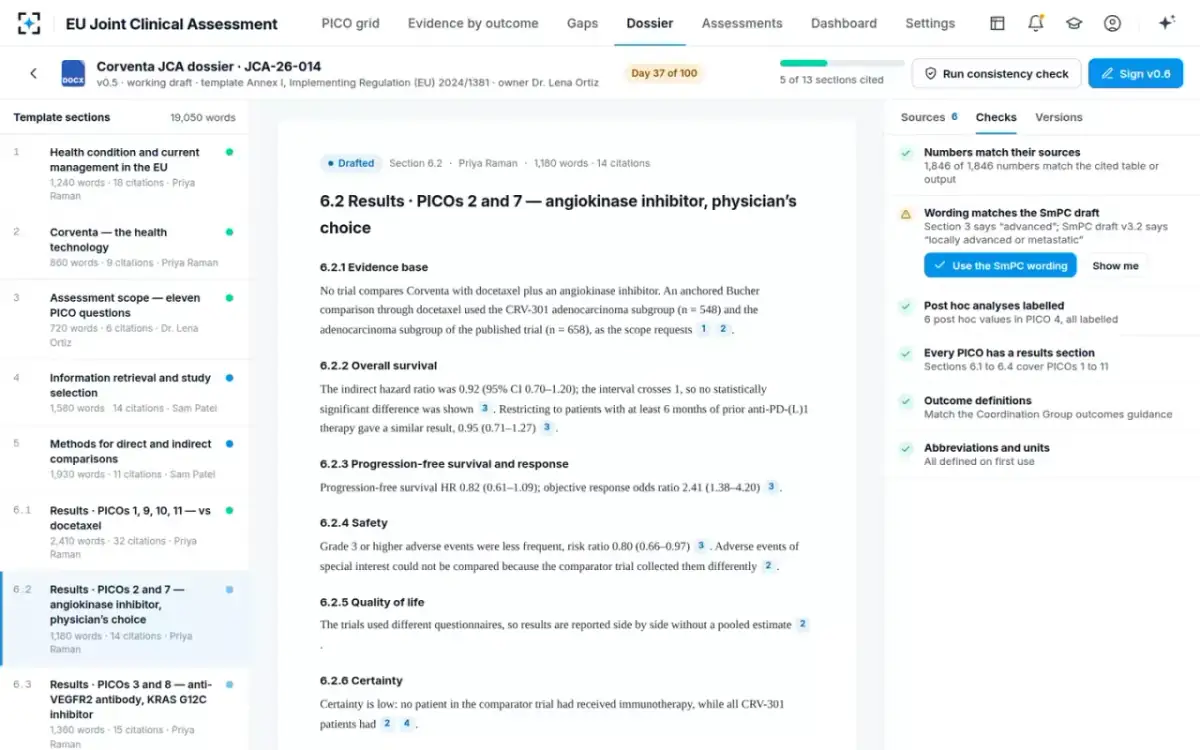
Read as a list, these are the reasons a dossier team keeps a check between the numbers in its text and the outputs they came from, and between its results sections and the questions they are supposed to answer. Four of the six findings are absences, and an absence is exactly the kind of thing a last read-through does not catch.
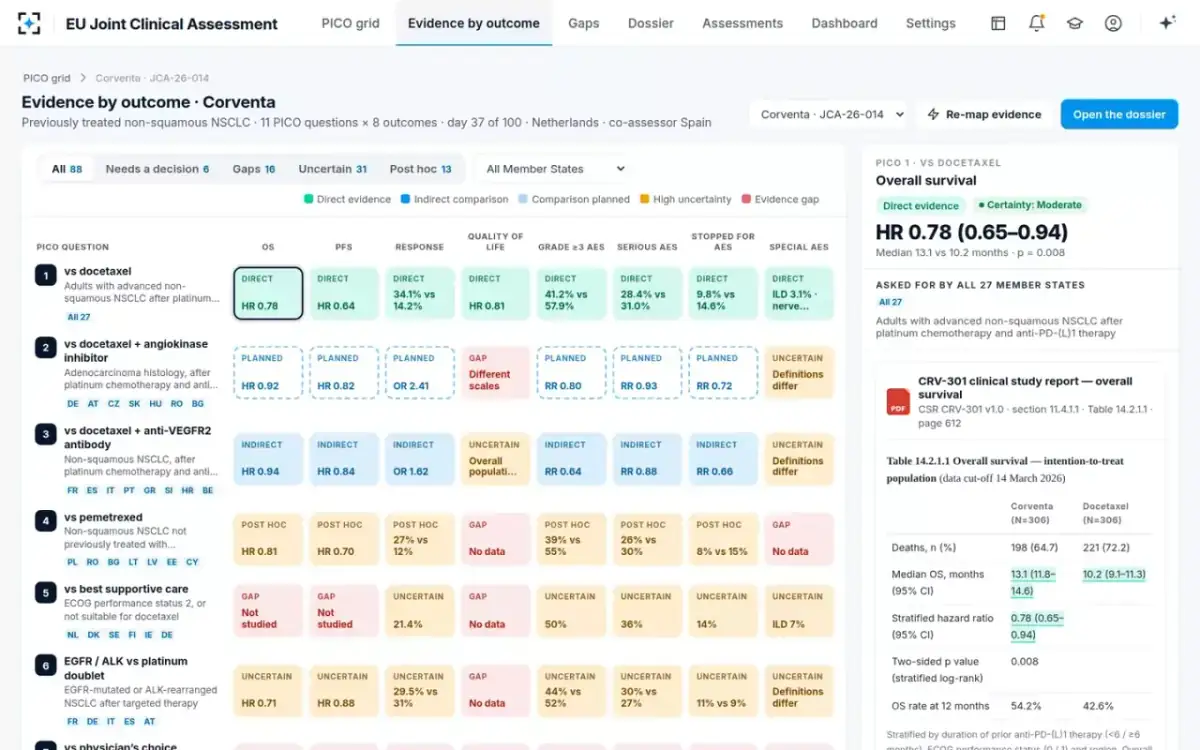
Every question against every outcome, in EU Joint Clinical Assessment
Can a company correct the report before it is published?
It can correct facts, and nothing else. The regulation gives the developer the revised draft to point out purely technical or factual inaccuracies and anything it considers commercially confidential — and then, in the same paragraph: "The health technology developer shall not provide any comments on the results of the draft assessment." The implementing regulation sets the window at 7 days from receipt, or 5 days where the marketing authorisation is on the accelerated procedure or the assessment concerns a new indication added by variation.
The form the developer fills in is published with the report, and it spells out the boundary again: "The health technology developer should not provide any comments affecting the interpretation of data (data presentation, description and summary of the report), and the JCA Subgroup will not consider such comments." It also sets a bar that catches teams out: "All technical and factual accuracy comments must be validated by published sources (full reference) and/or by indication of the documents/page numbers from the submission dossier."
That bar is the quiet reason to know where every number in your dossier came from. A correction you cannot point to a page for will not be considered, and seven days is not long enough to go and find it.
What the report is forbidden to say
A joint clinical assessment report does not say the medicine is better. Article 9(1) of the HTA Regulation is unambiguous: the reports may carry no value judgement and no conclusion on the medicine's overall clinical added value, and are confined to describing the scientific analysis of the relative effects on the health outcomes the scope chose, and the degree of certainty of those effects. Value is a national judgement, made with national prices and national alternatives in view; the report is the shared factual base under it.
What a report must contain, and what it may never contain
Must contain: A description of the relative effects on the outcomes the scope named
May never contain: A value judgement, or any conclusion on overall clinical added value
Must contain: The degree of certainty of each relative effect, with the strengths and limitations behind it
May never contain: A verdict on whether the certainty is good enough to reimburse
Must contain: Every PICO the Member States asked for, answered or recorded as a gap
May never contain: A question the developer preferred, in place of one the scope set
Must contain: Signalled technical and factual inaccuracies, each pointed to a published source or a page of the dossier
May never contain: Comments on the results, or on how the data are interpreted — the subgroup will not consider them
Must contain: National bodies, which must give the report due consideration
May never contain: Any binding effect on a national authority
What gets published besides the report
More than most teams expect, which is the point worth taking away. The Commission publishes the joint clinical assessment report and the summary report together with the other documentation the regulation lists, once it has considered the subgroup's view on what the developer asked to keep confidential — and before publishing, it tells the developer which information it does not regard as confidential and informs it of the right to appeal a refusal to redact.
The dossier itself has a published version. The dossier template's own revision history names V1.0 as the "dossier for publication (without confidential information)", alongside V0.6, the version in which the developer marks and justifies what it considers commercially sensitive. The factual accuracy check is published too: the annex quoted above is the developer's comments and the assessors' response to each, in full, beside the first report.
So the right mental model is not a report about your dossier. It is your dossier, your requests and answers, your corrections and the assessors' replies to them, all public, with the report on top. That changes what "ready" means, and it is the argument running through the 100-day plan.
How long the first report took, from the first information to publication
- Building the scope87 d
- Dossier V0.1101 d
- To confirmation56 d
- First draft42 d
- To endorsement129 d
- Published40 d
What the four reports teach a team preparing its first dossier
Three things, none of them about writing. The first is that the scope decides the shape of your report, and the questions it contains are set before your dossier starts. Twelve questions across six populations is a different document from one question with one trial, and the only moment to influence that is the survey and consolidation that produce the scope.
The second is that the published failures are documentation failures. A missing data cut-off, unreported standardised differences, a comparator study described too thinly for an assessor to assess, an analysis the assessors asked for and did not get: none of these is a disagreement about science. They are things that can be checked before a version is signed, by comparing every number against the output it came from and every question against the section that answers it.
The third is that the clock is not evenly distributed. The developer's window was about a hundred days; the assessors' part took another 167 to 227 days. Work that slips inside the window does not get made up later, because the later time is not yours. The 100-day clock, deadline by deadline sets out where it goes.
Numbers against their sources, before a version is signed
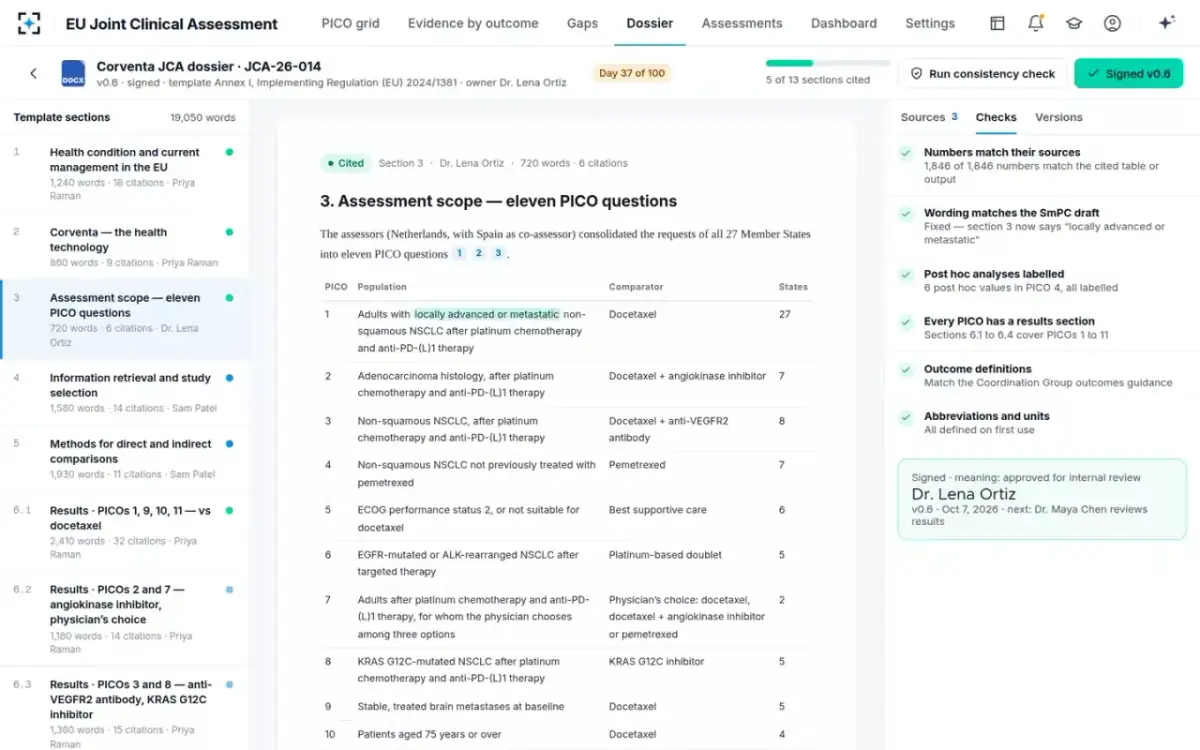
A signed version, with what the signature means
Eighteen joint clinical assessments had been started by the time the first report appeared, the Commission said when it published it, and more reports were expected in the months after. The four on this page are the beginning of a public record that every developer's own report will eventually join.
Questions people ask
Where can I read a joint clinical assessment report?
On the European Commission's health site, as a PDF, free. The four published so far cover tovorafenib, lurbinectedin, tarlatamab and onasemnogene abeparvovec; each is linked from the figures on this page. A summary report is published beside each one, and the first report is accompanied by the developer's factual accuracy comments and the assessors' answers to them.
What happens when a PICO has no evidence?
The report records it. The developer has to justify why no data were submitted, the assessors judge the justification, and the scoping guidance states that a scope can contain questions no evidence answers, and that the report then identifies the evidence gap. The acceptability of the justification is decided nationally, which means the same gap can be treated differently in different countries.
Can a JCA report say a medicine is better?
No. Article 9(1) of the HTA Regulation limits the reports to a description of the scientific analysis of the relative effects and their certainty, and forbids any value judgement or conclusion on overall clinical added value. A result can show a difference, with an interval and a certainty rating; the judgement about what that difference is worth belongs to the national bodies.
Is the JCA dossier published too?
Yes, in a version with confidential information removed. The dossier template names V1.0 as the dossier for publication, and the developer marks and justifies what it regards as commercially sensitive in an earlier version. The Commission tells the developer which information it does not accept as confidential before publishing, and informs it of the right to appeal.
What is a summary joint clinical assessment report?
A shorter companion document, required by the same article that requires the report, published with it and endorsed on the same day. The full report carries the study characteristics, the risk-of-bias assessment, the results tables and the appendices with the assessors' requests; the summary is what a reader goes to first.
Who endorses a joint clinical assessment report?
The Member State Coordination Group, after the joint clinical assessment subgroup finalises the revised draft. The assessor and co-assessor write it, the subgroup comments, patients and clinical experts give input, the developer checks it for factual accuracy, and the Coordination Group endorses the result. The Commission then performs a procedural review and publishes it: for the first report, endorsement on 30 April 2026, review on 19 May, publication on 9 June.