JCA roles and responsibilities have changed what market access means. The role used to be a negotiating one: build the value story, engage payers, win reimbursement country by country. Since 12 January 2025 it is something closer to regulated production. A joint clinical assessment hands the team a question set written by the Member States, gives it 100 days to answer every question, and ends with the European Commission formally confirming whether what was submitted is complete. The judgement has not gone anywhere, but it has moved: it now sits in which comparison method a team proposes for a question nobody has a trial for, and in who signs the version that leaves the building. Botminds' EU Joint Clinical Assessment is built around exactly that split — the agents read, map and draft; the five named people decide and sign.
The people on this page come from the solution's own sample assessment and are fictional, as are the medicine and trials around them. The law, the procedure, the published assessment and the survey figures are real and linked where they appear.
How ready the industry said it was, one year in
13
international pharmaceutical companies answered the survey
CIRS multi-stakeholder workshop, published March 2025
6–7
out of 10, how prepared most of them rated themselves
nobody rated themselves at either extreme
92%
named coordinating EU timelines with local submissions as a top internal hurdle
the same share named aligning findings with each jurisdiction
50%
had run an internal mock joint clinical assessment
against 92% that had assessed their 2025 pipeline products
What does a market access manager do, now that the EU assesses medicines jointly?
The old description still holds for everything downstream of the joint clinical assessment: pricing, reimbursement dossiers, payer engagement, contracting, launch sequencing. What the EU HTA Regulation added above it is a Union-level production step with three fixed points the job now has to hit, none of which existed before.
The questions are given to you. The assessment scope is written by the Member States and consolidated by the assessor and co-assessor, and the developer has no vote in it. The Coordination Group's own answer to a developer who disagrees with a question runs to a single sentence: the questions reflect what the Member States need, and so every one of them has to be addressed appropriately in the dossier (HTACG Q&A, 15 May 2026). The job is no longer to frame the comparison; it is to answer the comparison somebody else framed.
The calendar is statutory. The dossier is due 100 days from the Commission's first request, or 60 days under the accelerated procedure and for a new-indication variation, under Article 12(2) of Implementing Regulation (EU) 2024/1381. Inside that window sit a second request answered in 15 days, and any assessor clarification answered in between 7 and 30 days. Every one of those deadlines, in order, is a planning document, not a background fact.
Completeness is adjudicated. Within 15 working days of submission the Commission confirms whether the dossier meets Article 9(2), (3) and (4) of the HTA Regulation. A dossier that leaves a question unanswered without an adequate justification is not a weak submission; it may be an incomplete one. The job description's old line about "preparing high-quality submissions" now has a formal test behind it.
The five seats around one assessment scope
No single person does this work. In the teams that have run it, and in the way the solution models it, one assessment scope is carried by five seats whose boundaries are set by what each is allowed to decide.
Five seats, and the one decision each of them keeps
Today
Owns several assessments at once and tracks their questions, comparison plans and deadlines in spreadsheets, so the question that will miss its window surfaces late.
With agents
Works from one row per question, sees which rows have no evidence and how many days each decision has left, and approves or refuses each comparison plan.
Still theirs: Approving a comparison plan, and signing each dossier version with its meaning.
Today
Works out by hand which comparisons share a common comparator before any plan can be written.
With agents
Gets the evidence network and the feasibility checks with the source passage behind each, and recommends a method.
Still theirs: The recommendation — including the recommendation not to run a comparison at all.
Today
Copies values out of statistical outputs into the results sections, then hunts for the table each one came from when a reviewer asks.
With agents
Reviews a neutral draft in template order in which every number already links to its table, output or publication.
Still theirs: Whether the wording describes the evidence honestly, especially where an interval crosses 1.
Today
Reads the dossier against the latest label draft before every version goes out, by eye.
With agents
Sees each wording difference against the current summary of product characteristics draft, listed, before a version is signed.
Still theirs: Which wording wins when the dossier and the label disagree.
Today
Signs the final dossier, and has to ask where each assessment in the portfolio stands.
With agents
Sees every assessment’s stage, clock, checked cells and next step on one screen.
Still theirs: The signature on the dossier that is submitted.
What the dossier lead decides, and what only they may decide
The dossier lead is the seat the Regulation creates without naming. Somebody has to hold the whole scope, because the obligations attach to the dossier as a single object: it must be complete against the studies and data that could inform the assessment, analysed with methods fit to answer every research question, and presented so that an assessor can verify every figure in it (Article 9(3)).
Three decisions belong to that seat and nowhere else. The first is what to do with a question that has no head-to-head trial: accept an indirect comparison, accept it with a sensitivity analysis, or declare an evidence gap and justify it. The Coordination Group has been clear that the third is a legitimate answer — where no study allows a valid direct or indirect comparison for a question, that is an evidence gap — but also that whether the justification stands is assessed, and that the Commission's confirmation of the dossier takes it into account.
The second is the trade between completeness and defensibility across the whole scope. A team with eleven questions and finite statistical capacity cannot give every one the same effort; the lead decides which rows get the rigorous treatment and which get an honest gap, and that decision is a portfolio decision, not a per-question one.
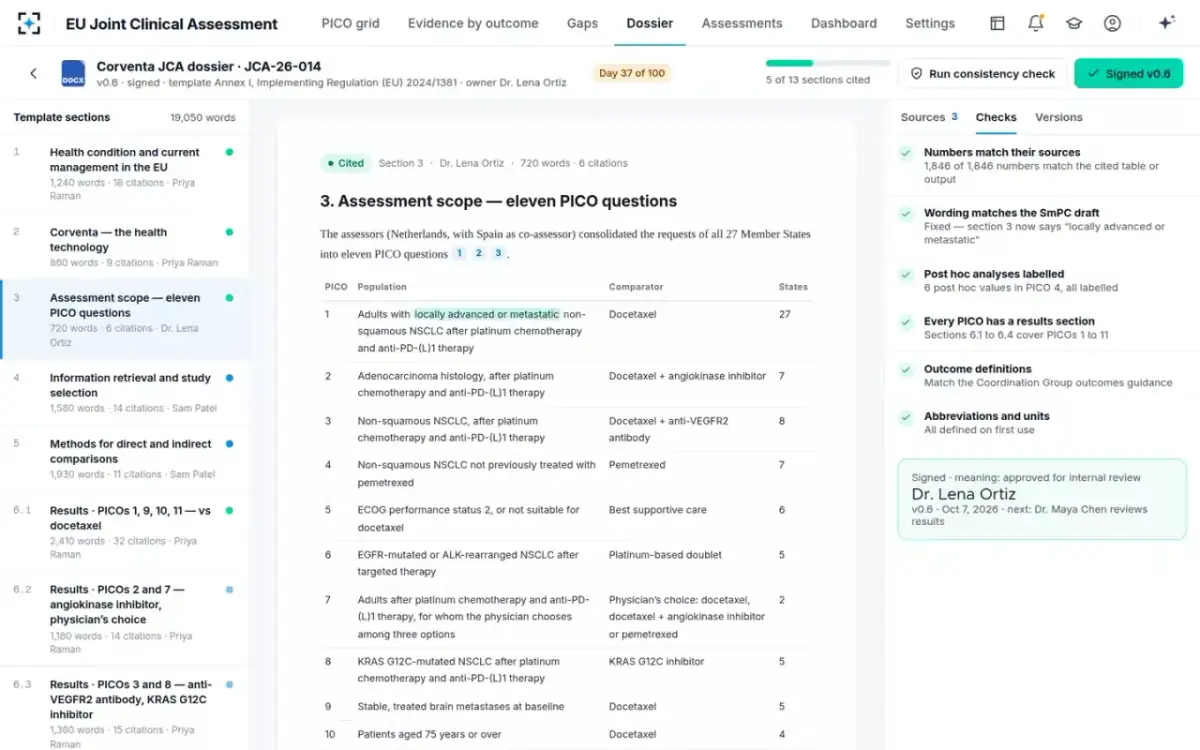
The third is the signature. Each version of the dossier that leaves carries a meaning — approved for internal review, approved for submission — and in the solution that meaning, the name and the time are attached to the version itself, so a later reader can tell what was being claimed when.
The biostatistician's seat: recommending a method, not choosing a result
Every joint clinical assessment of any size runs into a question whose comparator was never in a trial with the medicine. That is not a failure of the development programme; it is a predictable result of letting 27 health systems name the comparators they use. What happens next is the biostatistician's work, and the Coordination Group's methodological guideline is unusually direct about why it must be a specialist's.
The guideline sets the order of preference first: an indirect comparison should be anchored on one or more common comparators wherever possible, because anchoring preserves randomisation, and anchored methods come before unanchored ones every time (methodological guideline). Where no connected network exists, methods for non-randomised evidence apply, with everything that follows for certainty. Which questions a scope is likely to produce decides how often this happens.
Then it says who should be in the room:
"In many cases, the conditions will not be ideal for the use of any of the methods presented in this guideline to produce unbiased estimates of relative effectiveness. Therefore, very careful consideration of the underlying assumptions is required when making inferences. Input from a statistician with specific expertise in this area is advised for a critical assessment of the methodological approach used, assumptions potentially violated, and the corresponding uncertainty of results."
Methodological Guideline for Quantitative Evidence Synthesis: Direct and Indirect Comparisons, adopted by the Coordination Group on 8 March 2024 — read it
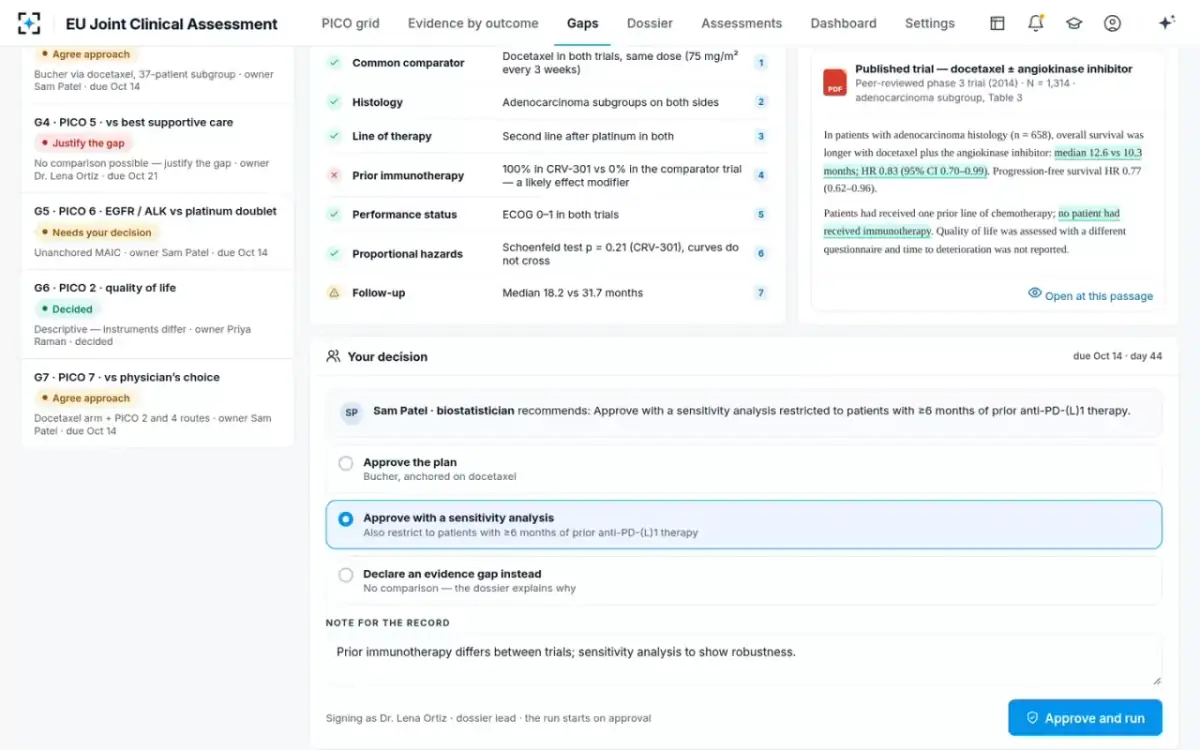
The distinction that keeps this seat clean is between recommending and deciding. The statistician's output is a method with its assumptions and the ones at risk — a named effect modifier that differs between the trials, a proportional-hazards test that did not hold, a matched sample that shrank past the threshold the team set. The lead decides what to do about it, in writing. Collapsing the two seats into one is how a dossier ends up carrying a comparison that nobody was willing to defend in the report's own language. The template section that reports it asks for both the method and its limitations in the same place, which makes the omission visible.
The recommendation and the approval, as two separate acts
The medical writer's seat: every number against its own table
The results sections are the bulk of the dossier and the part with the least room for interpretation. Annex I of the Implementing Regulation prescribes both the shape and the order: within each population, the relative effectiveness and relative safety results are set out question by question in tables, and each question's section opens by describing and justifying the type of comparison chosen to answer it (Implementing Regulation (EU) 2024/1381, Annex I).
So the writer's unit of work is not a chapter but a question, and the first paragraph of each one has to say why this kind of evidence was used at all. The section must then carry the available outcomes per study, the course of each study, the synthesis method with its strengths and limitations, the results of every individual study and of the syntheses, the missing data and its reasons, every sensitivity analysis, and a description of anything affecting the certainty of the effect.
The craft problem is traceability at volume. A scope with eleven questions and eight outcomes is 88 result cells, each of which must match a table in a clinical study report, a statistical output or a publication, to the last decimal. A consistency check that compares every value with its cited source before a version is signed is not a nicety; it is the only way the writer's seat stays a writing seat rather than a reconciliation seat.
Regulatory affairs, and the wording that has to match the label
The fourth seat exists because the joint clinical assessment and the marketing authorisation run in parallel on the same molecule, with different wording and different timetables, and the dossier is written against a label that is not final.
The anchor is fixed and leaves no discretion. Asked whether a developer may frame the assessment around a different therapeutic indication from the one filed at EMA, the Coordination Group answered: "No, the health technology developer cannot propose a different therapeutic indication than the claimed therapeutic indication applied for in the submission file to the European Medicines Agency." The scope follows the claimed indication; the dossier follows the scope.
What regulatory affairs manages is the drift between them. If the indication changes during the centralised procedure, the assessor decides whether the change affects the scope and the subgroup decides whether the assessment continues or a new scope proposal is prepared; where a new scope is finalised, the developer is asked for an updated dossier (Implementing Regulation, Article 16). That happened in practice during the onasemnogene abeparvovec assessment, whose procedural table records a revised assessment scope in March 2026 "following the change to the therapeutic indication initially submitted to the EMA", followed by two further dossier versions within ten days. In the tovorafenib assessment the opposite call was made: the indication changed, and the subgroup decided the existing scope could stand without a new one.
Either way, somebody must be watching the label draft against the dossier text every week. The difference between "advanced" and "locally advanced or metastatic" in a population description is the kind of thing that is invisible in a 400-page document and obvious in a list of differences.
Who owns each part of the dossier, and who signs it off
Section1.3 Executive summary
What it must carryThe scope, every PICO with no results and why, the results per PICO, the certainty
Who writes itDossier lead
Who signs it offDossier lead
Section3 Assessment scope
What it must carryThe scope as the Commission sent it, unaltered
Who writes itDossier lead
Who signs it offDossier lead
Section4 Methods
What it must carrySelection criteria, information retrieval, data analysis and synthesis, sensitivity analyses
Who writes itBiostatistician with the review team
Who signs it offDossier lead
Section5.1 Studies identified
What it must carrySponsored studies, bibliographic databases, registries, HTA reports, EMA submission files, patient registries
Who writes itSystematic review lead
Who signs it offDossier lead
Section5.2 Characteristics of included studies
What it must carryDesign, dates, eligibility, intervention and comparators, endpoints, data cut-off, sample size, analysis methods
Who writes itMedical writer
Who signs it offDossier lead
Section5.3 Results by population and PICO
What it must carryPatient characteristics and health outcome results for each PICO, with the certainty of each effect
Who writes itMedical writer with the biostatistician
Who signs it offClinical reviewer, then dossier lead
SectionAppendix D Underlying documentation
What it must carryFull texts, search documentation, programming code, study reports
Who writes itBiostatistician and review team
Who signs it offDossier lead
SectionThe version that is submitted
What it must carryEverything above, consistent with the label and with itself
Who writes itDossier lead
Who signs it offHead of market access
Who is on the other side of the desk: the assessor and the co-assessor
It helps to know exactly who reads what you send. The subgroup on joint clinical assessments appoints an assessor and a co-assessor from among its own members, from two different Member States, chosen for the scientific expertise the assessment needs (Article 8(4)). They are named in the published report. The first one lists them plainly: assessor Emer Fogarty of Ireland's NCPE, co-assessor Beate Wieseler of Germany's IQWiG.
Two named people in two national agencies, supported by an HTA secretariat and answerable to a subgroup of all Member States, write the scope proposal and the draft report. They may ask for clarifications at any point during drafting, with a deadline between 7 and 30 days depending on what is asked. They are not a negotiating counterparty, and the Regulation makes that explicit in the one place a developer most wants to argue: on receiving the revised draft report, the developer may not comment on the results of the draft assessment (Article 11(5)). Seven days, technical and factual inaccuracies and confidentiality claims only.
What each side may decide, and what neither side may do
The developer’s five seats: No. The scope arrives written, and every question in it must be addressed.
The assessor and the co-assessor: They draft the proposal and consolidate the Member States’ answers, but the subgroup finalises the scope by consensus.
The developer’s five seats: Yes — which studies, which analyses, which comparison method, and where to declare a gap.
The assessor and the co-assessor: No. They assess what was submitted, and record what was not.
The developer’s five seats: Proposes and justifies it, in the dossier.
The assessor and the co-assessor: Yes. The methodology of an indirect comparison is assessed, and the assessment appears in the report.
The developer’s five seats: No. Seven days for technical and factual inaccuracies and confidentiality, and nothing on the results.
The assessor and the co-assessor: They write the results section; the subgroup and the Member States comment on the draft.
The developer’s five seats: Not in this document. The dossier reports; the value case is national.
The assessor and the co-assessor: Forbidden. Article 9(1) confines the report to the scientific analysis and its certainty.
Which parts of the week can an agent take, and which may it never?
The mechanical half of this work is large, repetitive and checkable: reading a scope into structured questions, finding the table behind every value, matching the included studies to the comparators, testing whether a network connects, drafting a section in a fixed order with a citation on every number. The judgement half is small, consequential and named: which method, which gap, which wording, which signature.
One question, from the scope landing to a signed version
Agent
Read the scope into questionsTurns the assessment scope into one row per PICO — population, comparators, outcomes — each element keeping the page and sentence it came from.
Never: merges or drops a question; the scope is the assessors’ document
Agent
Map the evidenceFills every outcome of every row from study reports, analysis plans and outputs, head-to-head first, with the interval, the population, the data cut-off and the table.
Never: takes a number from anywhere but a cited table, or computes a comparison itself
Agent
Build the networkLinks the studies the review team included to the comparators in the scope and finds which trials share a common comparator.
Never: uses a study the review team did not include
Agent
Check feasibilityFor each gap, proposes a method and checks the common comparator, the effect modifiers, proportional hazards and sample size, citing the source passage for each check.
Never: runs a plan that was not approved
A person decides
The biostatistician recommendsReads the checks, names the assumption most at risk and recommends a method — or recommends declaring a gap.
A person decides
The dossier lead approvesChooses between the plan, the plan with a sensitivity analysis, and a justified gap, and writes the reason down.
Agent
Draft the sectionWrites the results section in template order from the matrix and the comparison output, with every number carrying its source.
Never: claims superiority where the interval crosses 1
A person decides
Review, then sign the versionThe medical writer and the clinical reviewer read the section; the dossier lead signs the version with its meaning, and the head of market access signs the one that is submitted.
The useful test for any tool in this seat is not what it can draft but what it refuses to do without a person. An agent that will compute a comparison on its own, or quietly edit a number to match, has taken a decision the report will later be read against.
Where teams are short-staffed, and what the first-year surveys found
The published evidence on staffing is thin, and the honest thing to say is that there is no published figure for how many people a joint clinical assessment takes. The nearest thing is the 2024 CIRS multi-stakeholder survey of thirteen international pharmaceutical companies, published in March 2025, and its findings are about coordination rather than headcount.
Companies rated their own readiness at 6 or 7 out of 10 — "none of the surveyed companies rated themselves at either extreme". They had done the obvious preparation: 92% had assessed the pipeline products expected to go through a joint clinical assessment in 2025, 92% had been to the conferences and training, 85% had stood up an internal task force. The gap was in rehearsal: "only half of the surveyed companies had conducted internal mock JCAs to identify potential challenges".
And when asked what was actually hard, they did not name the science. "Internally, the primary hurdles identified were difficulties in coordinating EU-level JCA processes with local HTA submission timelines (92% of respondents) and the complexity of aligning JCA findings with the specific requirements of individual jurisdictions (92%)." Both of those are handoff problems — between the Union-level team and the national teams, between a question written in Brussels and a submission made in Warsaw or Madrid.
That is the practical argument for writing the handoffs into the job description rather than leaving them to goodwill. Thirteen self-selected companies is a small sample and the figures are self-reported; treat them as a direction, not a measurement.
The eight lines a market access role now needs to cover
- Owns a named assessment from the scope landing to submission
Not "supports EU HTA activities". One person holds one assessment scope, its questions, its clock and its versions.
- Approves the comparison method for every question without a head-to-head trial
With a written reason. The biostatistician recommends; this seat decides, including deciding to declare an evidence gap.
- Plans against statutory dates, not internal milestones
100 days for the dossier, 60 in the accelerated and new-indication cases, 15 days for the second request, 7 to 30 for a clarification, 7 days on the revised draft report.
- Keeps the dossier aligned with the claimed indication
The scope follows what was filed at EMA. A change in the indication during the procedure can reopen the scope and the sections it touches.
- Can defend every number to its source table
Article 9(3) requires the underlying documentation that lets an assessor verify the figures. Build that in, do not reconstruct it in week fourteen.
- Knows which questions have no evidence, by week two and not week ten
A question with no connected network needs a method agreed with biostatistics before any result can exist, so finding it late costs the result and the section together.
- Hands over to the national teams in the scope’s own words
The countries that wrote the questions are the countries that will appraise the answers, and the same evidence may not be requested again nationally.
- Signs, with a meaning
Each version carries who approved it and what the approval meant; the final submission carries the head of market access.
Several assessments, and who owes what next
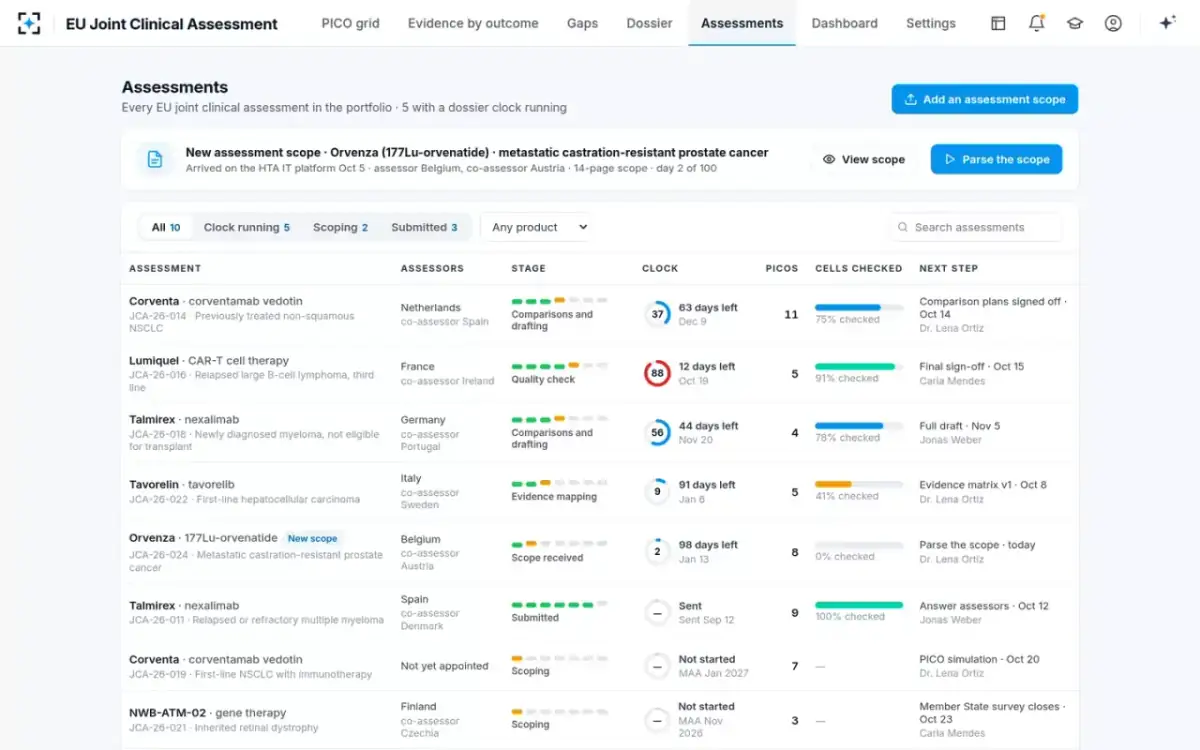
A version, and what signing it meant
Questions people ask
What expertise does a JCA team need?
There is no licence. The seats on the developer's side are typically filled from epidemiology, biostatistics, health economics, medical writing and regulatory affairs; the one that has hardened under the EU HTA Regulation is statistics, because indirect comparisons now sit on the critical path of most assessments and the Coordination Group's guideline advises specific expertise in that method before the assumptions are relied on. On the assessor side, the people named in the published reports come from national HTA bodies such as IQWiG, NCPE, HAS and INFARMED.
Who prepares a JCA dossier?
The health technology developer, which submits it to the HTA secretariat in response to the Commission's first request. Internally it is a team effort: a lead who owns the scope and signs, a biostatistician for the comparisons, a medical writer for the results sections, regulatory affairs for the label alignment, and a systematic review team for the information retrieval.
Does a JCA team need a biostatistician?
In practice, yes, as soon as any question lacks a head-to-head trial — which is most assessments with more than one or two questions. The Coordination Group's methodological guideline says that input from a statistician with specific expertise is advised for a critical assessment of the approach, the assumptions potentially violated and the resulting uncertainty, because the conditions are often not ideal for any of the methods to produce unbiased estimates.
Who signs off an HTA dossier?
The Regulation is silent on internal sign-off: it obliges the developer, as a legal person, to submit a dossier meeting Article 9(2), (3) and (4). Most teams split it, with the dossier lead signing each working version and the head of market access signing the version that is submitted. What matters is that the signature records what was being approved, since the dossier is later annexed to national HTA documentation.
What does an HTA assessor do?
An assessor, with a co-assessor from a different Member State, prepares the assessment scope proposal, consolidates the Member States' PICO requests into the lowest workable number of questions, assesses the submitted dossier and drafts the joint clinical assessment and summary reports. They may request clarifications from the developer during drafting. They do not negotiate, and they may not write a conclusion about the medicine's value.
How big is a JCA dossier team?
There is no published headcount, and anyone quoting one is estimating. What the law fixes is the set of distinct decisions — the comparison method per question, the justification for each gap, the label alignment, the submission signature — and those are what a team has to cover. The 2024 CIRS survey of thirteen companies found the hardest internal problems were coordination ones, which is a staffing answer of a kind.