Anchored and unanchored are the two shapes an indirect treatment comparison (ITC) can take, and in a European joint clinical assessment only one of them is treated as evidence by default. An anchored ITC links your medicine to a comparator through a treatment that both trials contained — the anchor — so the randomisation inside each trial survives the comparison. An unanchored ITC has no such link: it sets one trial's arm beside another study's arm and adjusts for whatever differences it can measure. The Coordination Group that runs the EU assessments has now written the preference down twice, and the published assessment reports show what happens to an unanchored result in practice. Botminds' EU Joint Clinical Assessment builds the evidence network for every question in the assessment scope, shows which networks are connected and which are not, and turns the choice of method into a dated decision a biostatistician recommends and a dossier lead approves.
Two kinds of figure appear below. The published ones come from the Coordination Group's own guideline, its questions-and-answers document and the assessment reports the Commission has published, each linked where it appears. The worked ones come from a fictional sample assessment inside the solution — Corventa (corventamab vedotin), assessment JCA-26-014, the studies CRV-301 and CRV-201, and the people who run it — invented for the product and never a customer's measured result.
What the first published assessments did about missing head-to-head data
2of 8
PICO questions in the tovorafenib assessment for which the developer submitted an unanchored matching-adjusted comparison
1
of those two whose results the report then left out, for want of information on the comparator study
1
anchored matching-adjusted comparison carried as the primary analysis for the first question of the onasemnogene abeparvovec assessment
What is the difference between an anchored and an unanchored ITC?
The difference is one treatment. In an anchored comparison, the trial of your medicine and the trial of the comparator both contain a third treatment — docetaxel, say, or a standard chemotherapy backbone. Each trial's own randomisation produced an unbiased estimate against that shared treatment, and the indirect estimate is built by subtracting one from the other. Nothing is compared across trials except two within-trial contrasts, which is why the method can claim to respect randomisation at all.
In an unanchored comparison there is no shared treatment. The arms themselves are compared: patients who took your medicine in your trial against patients who took something else in someone else's study. Every difference between the two populations, measured or not, now sits inside the estimate alongside the treatment effect. Weighting or regression can remove the imbalances you measured; it can do nothing about the ones nobody recorded.
Anchored against unanchored, row by row
Anchored: A common comparator present in both, at a comparable dose and in a comparable population
Unanchored: Nothing. The arms are set side by side
Anchored: Randomisation within each trial; only two within-trial contrasts are combined
Unanchored: Nothing. The comparison is between groups that were never randomised against each other
Anchored: Exchangeability — similarity, homogeneity and, where closed loops exist, consistency. With population adjustment, conditional constancy of relative effects
Unanchored: Conditional constancy of absolute effects: the outcome itself is assumed constant at any given level of the prognostic variables and effect modifiers
Anchored: Aggregate data for Bucher and network meta-analysis; individual patient data for at least one trial once you adjust the population
Unanchored: Individual patient data from your own trial and published aggregate data from the other
Anchored: On the usual interval, with the feasibility assessment reported alongside it
Unanchored: Against a threshold shifted away from no effect, because a small effect could be bias alone
Anchored: “… in general only anchored indirect comparisons respecting randomisation are appropriate, which requires that the evidence network is connected”
Unanchored: “STC and MAIC without a common comparator are highly problematic”
The anchor, and why randomisation is the thing it preserves
The guideline is explicit that randomised trials with low risk of bias "are the gold standard for informing estimates of treatment effectiveness and should be used for evidence synthesis when possible", and that indirect comparisons are a fallback when no direct trial exists. The reason an anchored comparison is the acceptable fallback is narrow and technical: it never compares two groups of patients who were not randomised against each other. It compares two treatment effects, each of which was randomised.
That is also why connectedness, not sophistication, is the first question. The guideline defines a network as connected when "any two comparators are linked by at least one path of RCTs", and describes a disconnected network as one where the evidence comes from single-arm studies, or where the standard treatment simply differed between the studies and no head-to-head comparison exists. Both situations end in the same place: there is no path of randomised evidence from your medicine to the comparator the Member States asked about.
A dossier team that treats this as a statistical question discovers it late. It is a data question, and it has an answer on the day the assessment scope arrives — which is the argument of how 27 countries become one assessment scope and the reason the comparison deadline sits so early in the 100-day clock.
The method decision, as five questions in order
1. Is there a randomised trial comparing your medicine with this comparator?
Direct comparison. A pairwise meta-analysis if there is more than one trial.
2. Do your trial and the comparator trial share a treatment, at a comparable dose, in a comparable population?
Anchored. Bucher for a three-treatment star; network meta-analysis for anything larger or with closed loops.
3. Is the shared treatment there, but the populations too different for the effect to carry across?
Anchored with population adjustment: matching-adjusted comparison, simulated comparison or multilevel network meta-regression — and individual patient data for at least one trial.
4. No shared treatment at all — a disconnected network?
No method the guideline endorses. It asks for methods for non-randomised data with full individual patient data from every study, and says unanchored matching-adjusted and simulated comparisons here are highly problematic.
5. And where nothing of the above is possible?
A documented evidence gap, with the information retrieval that proves the search was done and a justification the assessors will weigh.
Bucher: the simplest anchored comparison, and the assumption it cannot test
Bucher's method is the plainest anchored comparison there is, and the guideline limits it to the plainest network: a star with three treatments, your medicine and the comparator each tried against one shared treatment. It is "intended for situations in which there is no direct comparative evidence for treatments A and B and the only evidence is through comparison with treatment C", and it works with odds ratios, risk ratios, risk differences, standardised mean differences and hazard ratios alike.
What it cannot do is check itself. Because the only evidence for the comparison of interest is indirect, there is no closed loop, and so "the consistency assumptions cannot be assessed in applications of the Bucher method". The guideline draws the consequence in one sentence: "In this case, a thorough assessment of similarity is even more important." The arithmetic is trivial; the defensible part of the work is the feasibility assessment that comes before it, and the honest description of what remained unequal.
Two practical limits follow. Where several trials exist for one pairwise comparison they must be pooled first, before Bucher is applied. And where random-effects models were used for the direct comparisons, the guideline says using Bucher "is problematic and should be avoided", and points to network meta-analysis instead.
When a network meta-analysis earns its complexity
A network meta-analysis combines direct and indirect evidence across a whole network, and the guideline says it is needed as soon as the network is more than a simple star — more than three treatments, or a closed loop where both direct and indirect evidence exist for the same pair. Its advantage is real: where a loop exists, inconsistency can be measured, and a direct and an indirect estimate that disagree are a finding rather than a silence.
Its cost is also real, and the guideline is unusually blunt about it. The chance of violating the exchangeability assumption grows with the number of treatments, and there is "a power trade-off between the number of pairwise comparisons and the number of studies included": too many comparisons on too few studies and the analysis cannot detect a true difference. The conclusion is a rule most dossiers would benefit from reading before they draw the network: "the inclusion of additional comparators and studies beyond those required to connect the network should generally be avoided, unless there is strong evidence to suggest that their inclusion improves certainty of evidence". Add the trials you need to reach the comparator, and stop.
Time-to-event outcomes carry their own warning. Pooled hazard ratios rest on proportional hazards, which the guideline calls "often implausible" — the obvious case being survival curves that cross — and where the violation is severe the hazard ratio stops being interpretable at all. Parametric survival curves or fractional polynomials are the alternatives it names, with the caveat that the effect measure then stops being one number.
Population adjustment: MAIC, STC and multilevel network meta-regression
Population-adjusted methods exist for one situation: the network is connected, but the populations are too different for the similarity assumption to hold. All three require individual patient data for at least one study, which for a developer usually means its own trial and nobody else's.
A matching-adjusted indirect comparison reweights your patients so their measured characteristics match the published averages of the other trial. The guideline notes two limits that get skipped in slide decks: the method "is only valid where there is sufficient overlap between the patient populations in both trials", and the result it produces is adjusted to the population of the trial you only have summary data for — "which may not match the target population for the decision". A simulated treatment comparison fits an outcome model instead of reweighting, and the guideline warns that with a non-identity link the usual implementation mixes conditional and marginal effects and biases both. Multilevel network meta-regression generalises the whole framework, targets a population you choose rather than one you inherit, and — as currently proposed — cannot be applied to time-to-event data at all.
All three rest on conditional constancy of relative effects: the model contains every relevant effect modifier. The guideline's own verdict on that is the sentence to quote in a plan: "In practice, however, one can never be sure that all the relevant effect modifiers are included. Therefore, population-adjusted methods have to be applied with the utmost care." A simulation study it cites confirmed that no weighting scheme recovers the true effect when an effect modifier was never measured.
Does EU HTA accept an unanchored MAIC?
Not as a first choice, and the record now shows what that means in practice. The Coordination Group's questions-and-answers document of 15 May 2026 answers the question directly: "Anchored indirect comparisons preserve randomisation and should always be used in preference to unanchored methods." Where the network is disconnected, it points to methods for non-randomised evidence rather than to an unanchored comparison, and it names the outcome where nothing works: "If no studies allowing for a valid direct or indirect comparison are available for a given PICO, this would constitute an evidence gap."
Therefore, STC and MAIC without a common comparator are highly problematic. When treatment effects are estimated from disconnected evidence networks, methods for the analysis of non-randomised data with access to full IPD from all studies should generally be used instead.
Methodological Guideline for Quantitative Evidence Synthesis: Direct and Indirect Comparisons, section 6.1 — Coordination Group, 8 March 2024
So an unanchored comparison is not forbidden. It is a route a developer may have to take when the alternative is nothing at all, and it arrives carrying a description of its own weakness. The guideline's section on disconnected networks goes further than the reservations it expresses elsewhere: "Currently, there is no gold-standard method that addresses the issue of disconnectedness of evidence networks. The use of such evidence in JCA is highly problematic as it carries a high risk of not providing valid and reliable estimates of the relative treatment effects of interest."
The practical reading for a dossier team is that an unanchored comparison should be submitted with the full individual-patient-data analysis the guideline prefers where that is possible, with the overlap and the effective sample size stated plainly, and with the certainty rated at the bottom of the scale by the team itself rather than by the assessors.
The shifted hypothesis: why an unanchored result has to be bigger to count
The guideline attaches an unusual arithmetic condition to every population-adjusted or non-randomised estimate, and it is the part practitioners most often have not met before. Because the estimate may carry bias from effect modifiers nobody measured, a conclusion may be drawn "only if the confidence interval lies completely above or below a certain pre-specified threshold shifted away from the zero effect". A hazard ratio whose interval excludes 1.0 is not enough; the interval has to clear a margin set in advance.
Three consequences follow for a plan written before the data are seen. The threshold has to be pre-specified, so it belongs in the statistical analysis plan and not in the discussion section. The covariate selection strategy has to be prespecified too, and clinically justified. And the sample arithmetic matters more than it does in an anchored comparison, because reweighting shrinks the effective sample and widens the interval exactly when the interval has further to travel. A team that discovers at the comparison deadline that its weighted analysis has an effective sample of a third of the patients has already lost the question, whatever the point estimate says.
A worked example from a published assessment: tovorafenib's PICO 5 and PICO 7
The first published joint clinical assessment report is the clearest teaching case available, because the developer submitted unanchored comparisons for two questions and the two ended differently. For PICO 5 — the subpopulation of patients over one year of age with a BRAF V600E mutation — the report records that "the HTD provides an unanchored matching-adjusted indirect comparison (MAIC) of tovorafenib with the combination of dabrafenib and trametinib". Those results are in the report, assessed, with the assessors' reservations beside them.
For PICO 7 the same approach did not survive. The report's own footnote records that the results submitted for PICO 7 were left out of the assessment, because too little information was available to assess the study on the comparator side. An unanchored comparison depends entirely on what is known about the other study, because every adjustment is made against its published characteristics; where that description is thin, there is nothing for an assessor to check, and the analysis drops out of the report rather than being argued over.
The contrast worth holding beside it comes from the onasemnogene abeparvovec assessment, where for the first question "the HTD provided an anchored matching adjusted indirect comparison (MAIC) comparing OA IT with nusinersen as the primary analysis, and a multilevel-network meta-regression (ML-NMR) between OA IT, nusinersen and risdiplam in DMT-naive patients, as supportive analysis". Same family of method, anchor present, a second method offered as support. That is what a strong submission looks like when the network holds together, and what the first four published reports actually say sets out the rest of the pattern.
How to find out, early, whether your network is connected
Connectedness is knowable long before anyone writes a statistical analysis plan. It needs the comparators the Member States asked for, the trials your systematic review included, and the question of whether any treatment appears on both sides. Everything after that is feasibility, and the guideline names the checks.
The feasibility checks the guideline expects before a method is chosen
- Connectedness
Is there a path of randomised trials from the intervention to this comparator? Without one, no anchored method exists and the honest options are a full individual-patient-data analysis or a documented gap.
- Similarity
No substantial differences in the distribution of effect modifiers between trials. Unknown modifiers cannot be assessed, which is why the guideline asks for a thorough feasibility assessment of design and patient characteristics instead.
- Homogeneity
Relative effects sufficiently alike across the studies of each pair. A non-significant heterogeneity test does not prove it — the test may simply lack power.
- Consistency
Direct and indirect estimates agree where both exist. In a Bucher comparison there is no closed loop, so this cannot be tested at all and similarity carries the whole weight.
- Effect modifiers identified and justified
Named before the analysis, clinically justified, and written into the statistical analysis plan — not chosen after seeing which ones improve the result.
- Overlap
Enough common ground between the two populations for a weighted comparison to mean anything, with the effective sample size after weighting reported next to the estimate.
- Proportional hazards
Tested for every time-to-event outcome. Where it fails badly the hazard ratio is not interpretable, and the guideline points to parametric survival curves or fractional polynomials.
The evidence network for one unanswered question, in EU Joint Clinical Assessment

Having the network in front of you changes who decides and when. The method is a recommendation a biostatistician makes against the checks, not a preference a medical writer discovers in a results table, and the solution keeps it that way: the agents propose a route for every gap and never compute a comparison themselves.
One unanswered question, from gap to approved plan in EU Joint Clinical Assessment
Agent
Literature review matcherLinks the included studies to the comparators the assessment scope names and draws the evidence network, showing which trials share a treatment.
Never: Never uses a study the review team did not include
Agent
Comparison feasibility analystRuns the feasibility checks against the sources — common comparator, effect modifiers, proportional hazards, sample size — and proposes a method, citing the passage behind each check.
Never: Never computes a comparison itself; proposes only
A person decides
BiostatisticianReads the checks and the failing one, and recommends: the anchored comparison, the anchored comparison with a sensitivity analysis, or an evidence gap with its justification.
Never: Never approves the plan — the recommendation goes to the dossier lead
A person decides
Dossier leadChooses between the three, writes the reason, and signs. The plan is locked with the recommendation attached to it.
Never: Never leaves the reason unwritten: the note travels with the plan
Agent
Validated statistics engineRuns the approved plan and its sensitivity analysis, and a second program reproduces every estimate before any number reaches the evidence matrix.
Never: Never runs a plan that was not approved
The recommendation, the three choices and the note that travels with them

What an approved anchored comparison looks like when it comes back
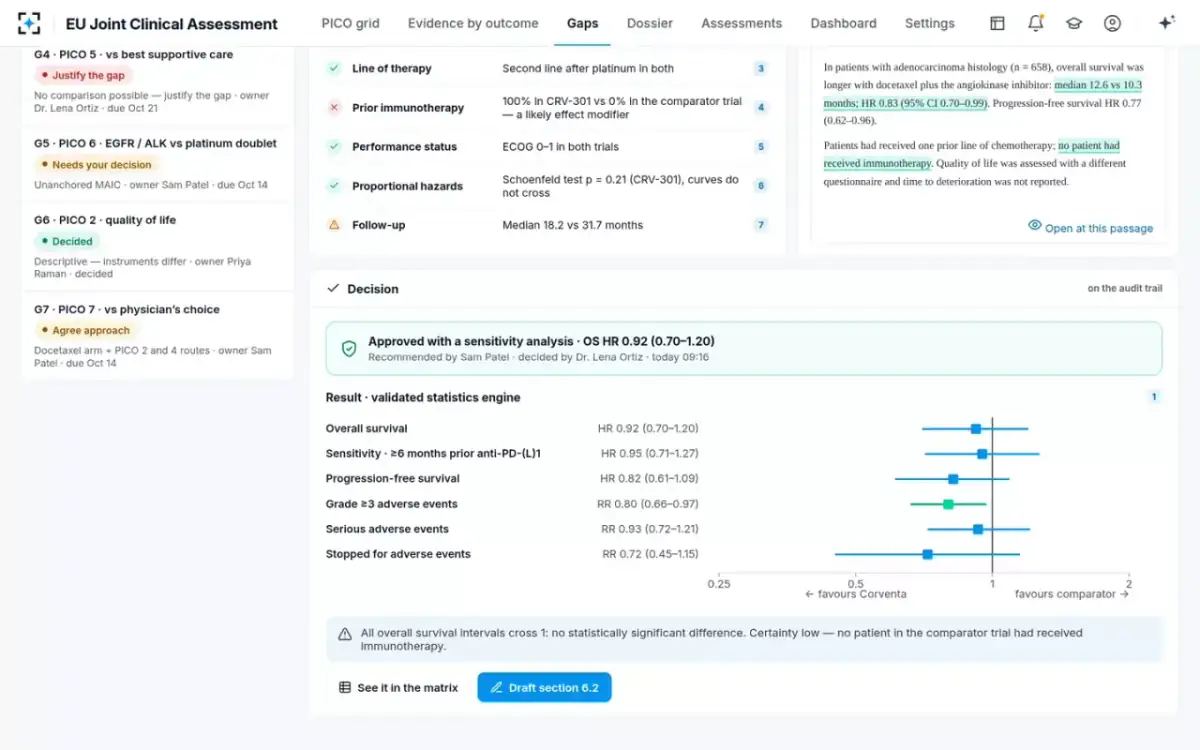
Where no anchor exists at all, the solution will propose a matching-adjusted comparison and report the effective sample size after weighting, rating the result very low certainty. That is a route of last resort, not a recommended method: the guideline's position is that comparisons without a common comparator are highly problematic and that full individual-patient-data methods should generally be used instead. A team taking the route should know it is taking it, and say so in the dossier — which is also the spirit of the rules on what a JCA dossier allows an AI tool to do.
Questions people ask
What is the difference between an anchored and an unanchored indirect treatment comparison?
An anchored comparison connects two trials through a treatment both of them contained, so only two within-trial randomised contrasts are combined. An unanchored comparison has no shared treatment and compares arms from different studies directly, which means every unmeasured difference between the two populations sits inside the estimate. The Coordination Group's guideline says that, in general, only anchored comparisons respecting randomisation are appropriate, and that this requires a connected evidence network.
When can you use an unanchored MAIC?
When the network is disconnected and there is no alternative — and knowing that the guideline calls comparisons without a common comparator highly problematic, and would rather see methods for non-randomised data with full individual patient data from every study. If you do submit one, the overlap, the effective sample size after weighting and a certainty rating at the bottom of the scale belong in the dossier with it. The first published assessment report shows the risk: of two unanchored comparisons submitted, one was left out of the report because too little was known about the comparator study.
What is the Bucher method?
An anchored indirect comparison for the simplest possible network: your medicine against a shared treatment in one trial, the comparator against the same shared treatment in another, with the two effects subtracted. It works with odds ratios, risk ratios, risk differences, standardised mean differences and hazard ratios. Because there is no closed loop, consistency cannot be tested, so the guideline asks for an especially thorough assessment of similarity instead.
When do you use network meta-analysis instead of Bucher?
As soon as the network stops being a simple three-treatment star — more treatments, or a closed loop where direct and indirect evidence both exist for the same pair. Network meta-analysis also handles multi-arm trials and random effects properly, which Bucher does not. The guideline's caution is to add only the comparators needed to connect the network: more comparisons on the same number of studies cost power.
What is a disconnected evidence network?
One where no path of randomised trials links your medicine to the comparator — typically because your evidence is a single-arm study, or because the trials used different standard treatments and never met. The guideline states that there is currently no gold-standard method for it, and that using such evidence in a joint clinical assessment carries a high risk of not giving valid estimates of the treatment effect.
Who decides the indirect comparison method in a JCA?
The developer chooses the method and has to justify it; the assessors judge it in the report, and the methodology of a specific indirect comparison is assessed in the joint clinical assessment itself. Inside a dossier team the choice should have a named owner and a date, because it determines which results exist in time for the submission. In the solution a biostatistician recommends, the dossier lead approves with a written reason, and only approved plans are run.