TMF roles and responsibilities start with a seat that is not a filing clerk’s: the TMF specialist. The seat exists because a trial master file is a statutory object that four people write into and nobody owns by default: the sponsor is responsible for the trial, the investigator must control the records their own site generates, and on a large Phase 3 study a contract research organisation generates most of the paper. The specialist holds that file to a standard every day: where a document belongs, whether it arrived on time, what is missing and who will get it. The work is hard because the answer to “what is missing?” changes every time a site activates, amends, enrols or changes staff, and because an inspector asks who was accountable for each part of the file long before asking what is in it. Botminds’ eTMF Quality Check scores every zone at every site each morning against what that site should have filed by today, and hands each gap to a named person with the passage that made it due.
The people, sites and the study VLT-302 named on this page are fictional characters and sample data in the solution. The rules and inspection findings come from regulators and standards bodies, linked where they appear.
Four seats around one trial master file, and the decision that stays with each
Today
Learns what was missing at the last quarterly review; works a backlog by hand.
With agents
Sees what is missing today, zone by zone, and confirms only the doubtful filings.
Still theirs: The signature that files a document, and its meaning
Today
Chases from a list that does not say why a document is needed, or by when.
With agents
Gets each gap with the passage that made it due, a due date and a drafted request.
Still theirs: Pressing Send on anything that goes to a site
Today
Must answer, before an inspection, what would be found at one named site tomorrow.
With agents
Sees the weakest cells every morning, and approves what leaves the file.
Still theirs: Approving a “not required” decision, and every inspection export
Today
Works through whole batches when only a few filings are doubtful.
With agents
Gets the few held below the confidence setting, with their candidates and reasons, plus a weekly sample.
Still theirs: Whether a filing is right, and whether to re-file it
What does a TMF specialist do?
A TMF specialist keeps the trial master file complete, current and navigable: classifying each incoming document to the file’s index, checking its metadata and signatures, working out what each site still owes, raising and chasing the gaps, and preparing the file for inspection. In many organisations the seat also owns the TMF plan (which artifacts this trial expects, who files each one and how quickly) and runs the quality control review that samples what has been filed.
No occupational standard describes the seat on its own. The closest public description is the clinical research coordinator’s, which the US Department of Labor’s O*NET lists with the task “Maintain required records of study activity including case report forms, drug dispensation records, or regulatory forms” (O*NET 11-9121.01). That is the site-side half of the same job. The sponsor-side specialist does it for every site at once, and that changes the unit of attention: not a document but a difference: between what a site should have filed by today and what it has.
That difference cannot be worked from an inbox. It has to be derived, site by site, from milestones and from events buried inside documents, and kept derived as the study moves. How a site’s documents fall due is the mechanics of it; this page is about who owns the answer.
Four seats around one file
Many trials distribute the file across four seats, whatever the titles say. The TMF lead owns the plan, the index and the quality standard. The TMF specialist or coordinator does the daily filing, indexing and chasing. The clinical research associate, the monitor, is the only one regularly at the site, and so collects what the site owes. The clinical trial manager approves the decisions that change what the file is expected to contain.
The difference between a specialist and a manager is not seniority on a document count; it is which decisions sit in the seat. A specialist decides where a document goes and whether it is usable. A manager decides what the file should contain, what counts as critical, who may take something off the expected list, and whether the study is ready to be inspected. A job description that gives a specialist the first set and silently expects the second is the one that produces the finding.
Accountability by zone: who files, who confirms, who may take a document off the list
04 IRB/IEC and Approvals
Who filesSite or sponsor, by country
Who confirmsQC reviewer, always
Who may mark “not required”Clinical trial manager
Why it sits thereCritical: a person confirms every ethics approval
05 Site Management
Who filesSite portal; monitor by email
Who confirmsQC reviewer, always for the delegation record
Who may mark “not required”Clinical trial manager
Why it sits thereThe investigator generates it and must control it
06 IP and Trial Supplies
Who filesSite pharmacy and supply vendor
Who confirmsQC reviewer, always for accountability logs
Who may mark “not required”Clinical trial manager
Why it sits thereAccountability is an inspection staple
08 Central and Local Testing
Who filesSite and central laboratory
Who confirmsTMF lead
Who may mark “not required”Clinical trial manager
Why it sits thereRanges and certifications expire on their own calendar
Two of those columns are the ones an inspector tests. The confirming column has to name a person, not a team; and the right to decide a document is not required has to sit above the person who benefits from the decision, because that is the one action which makes a gap disappear without a document arriving.
Who is responsible for the trial master file?
Responsibility is split by design, and the split is written into the guidance rather than into any job description. The sponsor is responsible for the trial and for its part of the file. The investigator and institution are responsible for theirs, and ICH E6(R3) is specific that this is a control duty rather than a filing one: they “should have control of all essential records generated by the investigator/institution before and during the conduct of the trial” (section 2.12.11). Where work is delegated, the delegating party keeps the answer.
The investigator retains the ultimate responsibility and should maintain appropriate oversight of the persons or parties undertaking the activities delegated to ensure the rights, safety and well-being of the trial participants and the reliability of data.
ICH E6(R3), Guideline for Good Clinical Practice, section 2.3.1 (Step 4 final guideline, 6 January 2025)
So the question has three true answers at once, and an inspection tests whether they were reconciled in advance. The reconciliation is the TMF plan: one document naming, for each part of the file, which party holds it, who files into it, who checks it and who may change what it is expected to hold. Where that is thin, the finding is rarely “the file was incomplete” on its own; it is that nobody could say whose incompleteness it was.
And this is where inspections land. Writing for the MHRA’s GCP Inspectorate in July 2015, Gail Francis noted that “the next significant issue is that for commercial sponsors, the most frequent major finding is in relation to record keeping and essential documents” (MHRA Inspectorate blog). The documents are the finding; the seats are why.
The investigator’s half, and why they must control it
The site’s part of the file is not a copy of the sponsor’s. It holds what the site generated (consent forms, source agreements, the delegation record, staff qualifications, local laboratory certifications, the accountability log), and the investigator must be able to produce it without asking the sponsor. So when a monitor collects a document, two files need it, and the one more often neglected is the site’s: a specialist who chases a document into the sponsor file without asking whether the site kept its copy has closed a gap and created one.
The staff-qualification corner of this is often misremembered, so state it precisely. Under the US rules, what the Form FDA 1572 requires about sub-investigators is a list of their names (21 CFR 312.53(c)(1)(viii)). FDA’s own guidance is explicit on the rest: asked whether a statement of qualifications is required for sub-investigators, it answers “No. The regulations at 21 CFR 312.53(c)(1)(viii) require only that subinvestigators’ names be listed in Section #6 of the 1572” (FDA, Frequently Asked Questions — Statement of Investigator, May 2010, question 34). A sub-investigator’s curriculum vitae and training certificate are usually expected all the same, not because that regulation demands them but because the sponsor’s TMF plan does, and because the investigator must be able to show that whoever performed a trial activity was qualified to. Financial disclosure is a separate obligation under its own part of the US rules. Write the three into the job description as what the plan requires, and the specialist can defend each on its own footing.
What changes when a CRO holds most of the documents
Outsourcing moves the work and leaves the answer where it was. The EMA’s TMF guideline puts it in one passage: “The sponsor remains responsible for the trial and will need to maintain oversight. Therefore, access to the CRO-maintained part of the sponsor TMF (e.g. by remote access to an eTMF) or at least regular access to relevant documents from it will be necessary to fulfil these responsibilities effectively” (EMA/INS/GCP/856758/2018, section 3.2).
Read as a staffing instruction, that is uncomfortable: a sponsor that has outsourced the filing still needs a seat that can look at the file, at its own initiative, at the documents rather than at the vendor’s monthly metric. It is the most useful line in an outsourced trial’s job description.
Sponsor, investigator and CRO: what each holds, what each controls, and what the contract must settle first
| Party | What it holds | What it must be able to control | What the contract has to settle in advance |
|---|---|---|---|
| Sponsor | The sponsor part of the file for the whole study, including what a CRO generates for it. | Oversight of the whole file, with access to the documents a vendor holds, not only its reports. | Which party holds which part; how the sponsor reaches the CRO-held part; who archives, and for how long. |
| Investigator and institution | The site part: what the site generated, before and during the trial. | Those records: the guidance asks for control, not merely a copy. | Whether the site uses the sponsor’s system or its own, and how it keeps a copy it can produce alone. |
| Contract research organisation | Whatever the contract delegates; on a Phase 3 study, often most documents by volume. | Its own quality control, its filing timelines, and a transfer process that loses nothing. | The index both sides file to; timelines; the quality standard; how documents move between systems. |
Delegation: the record that has to exist before the work does
Delegation is where the four seats are tested, and a regular subject of inspection findings. ICH E6(R3) asks the investigator to maintain a record of the persons and parties to whom trial-related activities have been delegated, with a sizing rule that is easy to miss: “Documentation of delegation should be proportionate to the significance of the trial-related activities” (section 2.3.3). That cuts both ways: a record logging every incidental task becomes unmaintainable and therefore untrue, while one that omits who performed an efficacy assessment is missing what the inspector came for.
The EMA’s GCP Inspectors Working Group publishes what it finds. Under Organisation and Personnel, its 2023 report lists among the deficiencies in delegation “Persons not delegated to perform trial related tasks involved in the trial” and “Access to trial related systems given to persons not authorised to be involved in the trial” (EMA/INS/GCP/164938/2024). Both describe people working on the trial, or inside its systems, without the delegation that should have authorised them; the same list also names delegation “documented retrospectively”. That is why the record is written when the work is handed over, so that the file shows the order of events.
What a delegation record has to say before the work starts
- The person, by name, and the role they are taking
A role title alone cannot be matched to a signature on a case report form or an assessment.
- The specific activities delegated, not a category
Documentation proportionate to the significance of the activity: an efficacy assessment is named; a routine administrative task need not be.
- The date the delegation starts, and the date it ends
An inspector compares those dates with the first assessment the person performed.
- The investigator’s signature, and the date they signed
Delegation is the investigator’s act, and the oversight duty under ICH E6(R3) 2.3.1 stays with them.
- Evidence the person was qualified for what they were given
Curriculum vitae and training for the activity, required by the sponsor’s TMF plan rather than by the Form FDA 1572.
- Matching system access, granted and removed on the same dates
Inspectors read the access list as part of the delegation evidence.
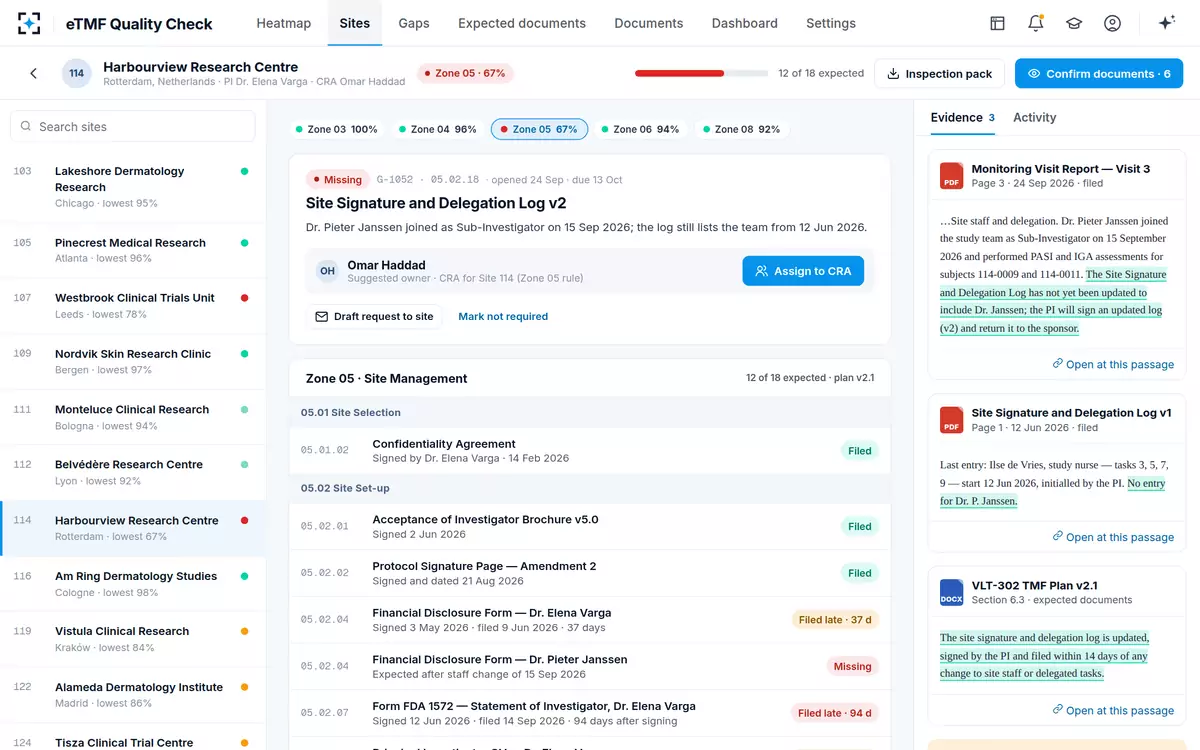
One worked example. A monitoring visit report filed in late September records, on page 3, that a sub-investigator joined Site 114 on 15 September and has already performed two assessments; version 1 of the delegation record still lists the June team. Nothing in that is a missing document on anybody’s list until somebody reads the report.
A staff change found inside a visit report, with the three passages behind it
Will AI replace TMF specialists?
No, and the reason is structural rather than reassuring. Each of the four things an agent can usefully do to a trial document (classify it, read its details, work out what is missing, draft the chase) produces a proposal, not a decision. The decisions here are a signature with a meaning attached, an approval to remove something from an expected list, and the choice to send something to a site; all three have to belong to a person, because the file must show who made them.
What changes is the shape of the day: the seat stops being a queue and becomes a set of exceptions to judge: the filings the agents were unsure of, the gaps that are not moving, the sites whose milestones have outrun their paperwork. What regulators have and have not said about letting software touch this file is in may an agent file your TMF?
One gap, from the sentence that created it to the moment it closes
Agent
The completeness checker reads the eventPage 3 of the Visit 3 monitoring report records a sub-investigator joining on 15 September. The checker sets that against the delegation record and the trial’s filing rule.
Agent
It opens the gaps with their evidenceFour documents become due (the delegation record, and the new sub-investigator’s CV, training certificate and financial disclosure), each carrying the passage that made it due and a deadline from the plan.
Never: an agent decides a document is not required
A person decides
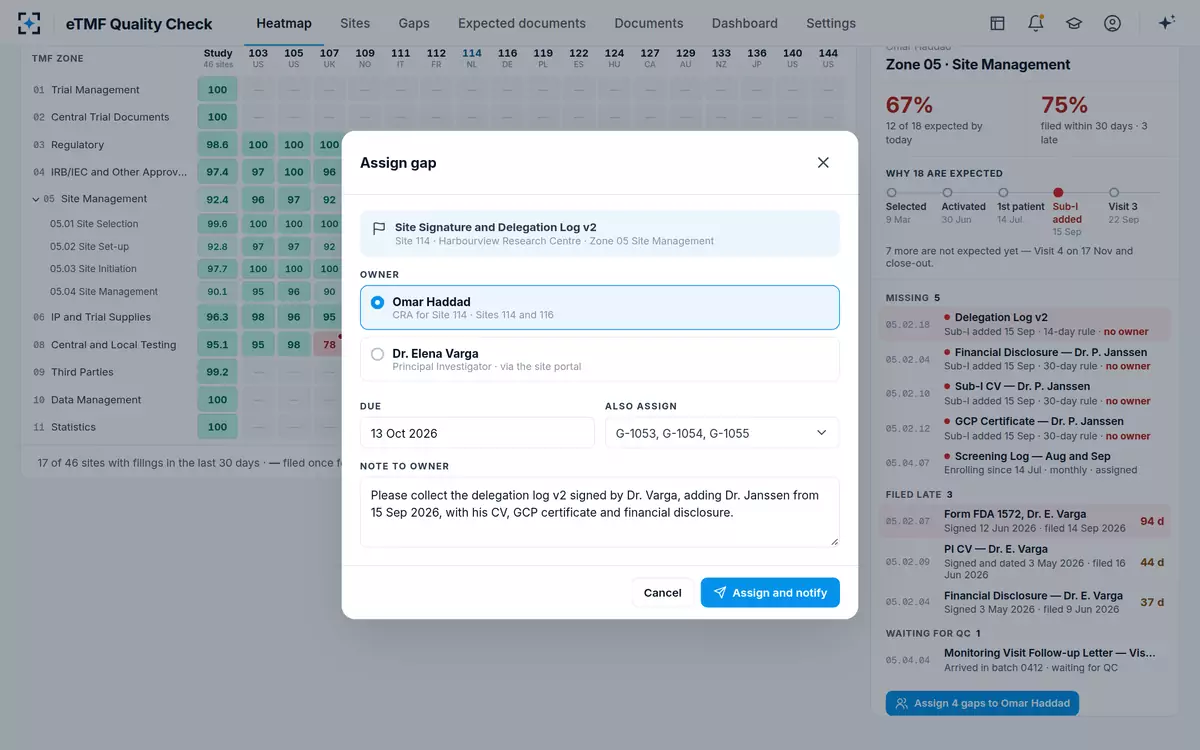
The TMF lead assigns, and edits the requestThe zone’s owner rule suggests the site’s monitor. She accepts it, assigns the four related gaps together, and rewrites the drafted request in plainer words.
A person decides
The monitor presses SendNothing reaches a site until a person does this. The owner is reminded before the due date and on the day.
Never: an agent sends anything to a site on its own
A person decides
A QC reviewer confirms the arriving document and signsA delegation record is critical, so a person confirms it every time. Only then does the gap close and the score move.
Never: an agent closes a gap on its own
The seat nobody staffs: the person who finds the event
Every job description around a trial master file assumes the list of what is expected already exists. Somebody has to keep that list true, and on most studies no seat owns it: it is a spreadsheet maintained by whoever has time, and it goes stale the day a site changes staff, exactly the day it most needed to change. The gap that follows is invisible, because a site cannot look red for a document nobody has added to its list.
Write that seat in explicitly, under whatever name: the person accountable for the expected-document rules (what makes a document due, from which milestone, within how many days) and for re-deriving them as the study moves. Where that is named, the completeness score means something; where it is not, the score measures the spreadsheet.
Assigning four related gaps to one owner, with the due date and the note
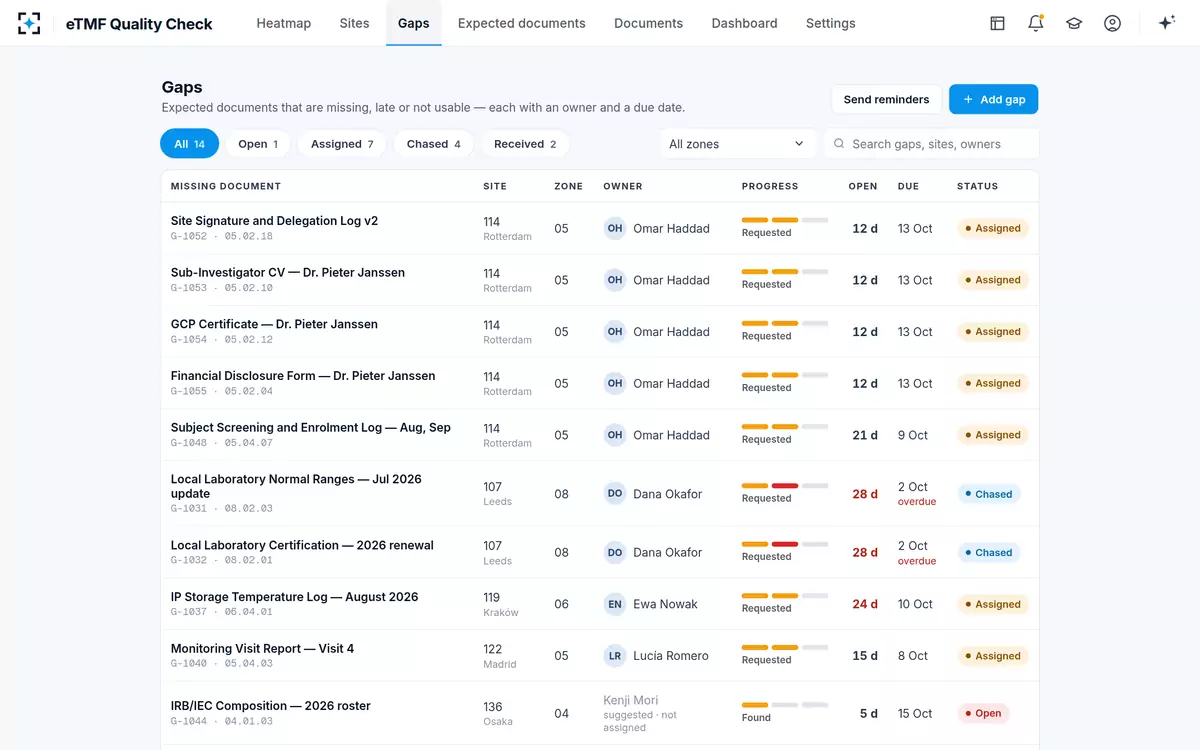
The register below is what the four seats look like on an ordinary morning: the fourteen most urgent of the study’s thirty-seven open gaps, each with a person, a stage and a clock. One is still unassigned: the item the TMF lead picks up first, because an unowned gap is the one likeliest to be still open at the inspection.
Every gap with an owner, a stage, days open and a due date
What the four seats produce between them is a file that can be handed over. How to run a TMF QC review that would survive an inspection is the quality half of the same job, and eTMF Quality Check is where the heatmap, the register and the signatures sit together.
Questions people ask
What is the difference between a TMF specialist and a TMF manager?
Decisions, not document counts. A specialist decides where a document belongs and whether it is usable; a manager decides what the file should contain, what counts as critical, who may remove something from an expected list, and whether the study is inspection-ready. On small trials one person holds both, and the job description should say so.
Does the CRA file documents in the trial master file?
Usually not directly, but the monitor is the person who gets them: a clinical research associate collects what the site owes, checks it is signed and dated and sends it in, often by email, which is why a sponsor-side seat has to treat email as a real intake channel. On the sample study the monitor is the suggested owner of every Site Management gap at their own sites.
Who signs off trial master file quality at a sponsor?
Whoever the TMF plan names; it should name a person, not a function. Two signatures matter most: the quality control confirmation on a filing, and the approval of an inspection export, which says the file may be shown outside the organisation. In the sample configuration those are two different people.
Can the trial master file be outsourced to a CRO?
The work can; the responsibility cannot. The EMA’s guideline says the sponsor remains responsible and will need access to the CRO-maintained part of the file (remote access, or at least regular access to the documents) to maintain oversight. A sponsor with no seat capable of looking at the outsourced file has outsourced the oversight too.
What skills does a TMF specialist need?
Three testable ones: reading a clinical document for what it implies rather than what it is titled, because the events that create gaps are buried in reports about something else; discipline about the expected list, since a score is only as honest as its denominator; and the willingness to leave an item open and owned rather than close it tidily.
Will AI replace TMF specialists?
It replaces the queue, not the seat. Agents can classify a document, read its details, derive what is missing and draft the chase; they cannot hold the signature that says a filing is correct, approve the removal of an expected document, or decide what to send a site. The day becomes exceptions and judgement rather than throughput, which asks more of the job description, not less.