FDA has not published a rule about AI in clinical trials that governs how you file a trial master file, and the honest starting point for anyone evaluating this is that no AI-specific requirement for a TMF exists yet. What exists is a draft guidance whose own scope section excludes operational uses, a European guideline that names eTMFs as in scope and then defers artificial intelligence to a future annex, and a reflection paper that leaves the whole burden with the sponsor. So the constraints that bind an agent filing a trial document are the ordinary ones: validate the system, keep an audit trail, record a signature that carries a meaning, and be able to name the person who decided. Botminds’ eTMF Quality Check is built to that reading — every agent output is a proposal with the passage it relied on attached, and a filing becomes part of the file when a person confirms it.
No regulator has approved, cleared or qualified this system for trial master file work, and this page does not claim otherwise. The figures tagged demo come from the solution running on a fictional sample study. The regulatory documents are linked where they appear.
What each agent does to a trial document, what it must cite, and the one thing it may never do
Classifier
What it doesMatches a document to one artifact in the index, with its top three candidates, a confidence and the reasons.
What it must citeA passage of the document behind every reason it gives.
NeverFiles a critical document, or anything below the study’s confidence setting, without a person confirming it.
Metadata extractor
What it doesReads study, site, document date, version, language, the people named and every signature with its date.
What it must citeThe place on the page each value came from, with a confidence per value.
NeverGuesses a date. A missing date is reported as missing.
Completeness checker
What it doesDerives what each site should have by today from its milestones and from events it reads inside documents, and scores each zone.
What it must citeThe passage and the plan rule that made each document due.
NeverDecides a document is not required — only a person can, with a reason and an approval.
Gap follow-up agent
What it doesDrafts the request to the site and the note to file, and sends reminders on the owner rules.
What it must citeThe gap, its evidence and its due date, inside the draft.
NeverSends anything to a site. A person presses Send.
Does the FDA allow AI in clinical trials?
FDA has not prohibited it, and has not authorised it either; there is no permission to obtain. In January 2025 the agency published a draft guidance, Considerations for the Use of Artificial Intelligence To Support Regulatory Decision-Making for Drug and Biological Products, which sets out a risk-based credibility assessment framework for AI models whose output is used as evidence in a regulatory decision. A draft guidance is not binding on anyone, including FDA, and this one is still a draft.
More useful than the question of permission is the question of applicability, and the draft answers it in its own scope section (section II). It sets two kinds of use aside altogether: AI in drug discovery, and AI used for operational efficiencies — its examples are internal workflows, resource allocation and drafting or writing a regulatory submission — so long as that use has no impact on patient safety, drug quality or the reliability of a nonclinical or clinical study’s results.
Why FDA’s draft AI guidance may not cover filing your trial master file
Read the exclusion carefully, because it has two limbs and the second one carries a condition. Internal workflows are out of scope where they do not impact patient safety, drug quality or the reliability of a study’s results. Classifying an incoming monitoring visit follow-up letter to the right place in an index is an internal workflow by any ordinary reading. Deriving which documents a site owes, and therefore what an inspector is told is complete, sits closer to the line — not because the filing changes the trial, but because the file is the evidence that the trial was conducted as described.
The practical conclusion is not that the draft guidance is irrelevant. It is that you should not pretend it is the applicable rulebook, and should instead write down, in your own assessment, which of your uses you consider operational and why. The draft itself gives the vocabulary for that argument, and it is worth borrowing even where the document does not apply.
FDA’s two risk factors, applied to two very different uses of the same kind of model
Classifying a monitoring visit follow-up letter: Low where a person confirms the filing, and where every reason the model gives is tied to a passage a reviewer can read.
Deciding a participant’s eligibility: High: the model’s output is often the decisive evidence for the decision.
Classifying a monitoring visit follow-up letter: A document in the wrong place, found by the checking that samples automatic filings, and correctable.
Deciding a participant’s eligibility: An unsuitable participant exposed to an investigational product.
Classifying a monitoring visit follow-up letter: An operational use, in our reading. Document the reading, the controls and the checking.
Deciding a participant’s eligibility: Inside the draft guidance’s territory, and inside the EMA’s named list of AI uses in trials.
What the EMA has said, and what it has deliberately not said yet
Europe is further along in one respect and deliberately silent in another. The EMA’s guideline on computerised systems and electronic data in clinical trials puts the trial master file inside its scope by name, listing “eTMFs, which are used to maintain and archive the clinical trial essential documentation” among the systems it covers. In the same scope section it lists AI used in clinical trials — participant recruitment, eligibility, coding of events and medication, data clarification, query processes, event adjudication — and then says this: “Requirements to AI beyond the generally applicable expectations to all systems will not be covered in this guideline initially. This may be covered in a future Annex” (EMA/INS/GCP/112288/2023).
That sentence is the whole European position in miniature. The expectations that apply to all computerised systems apply to one with a model inside it, and nothing more has been written down yet. The EMA’s reflection paper on artificial intelligence in the medicinal product lifecycle then places the responsibility: it is for the sponsor, applicant or manufacturer to make sure every algorithm, model, dataset and data-processing pipeline it uses is fit for purpose and meets the legal, ethical, technical, scientific and regulatory standards set by EU law, good-practice standards and the EMA’s current guidelines (EMA/CHMP/CVMP/83833/2023, section 2.2). It also asks for a system risk management plan setting out how the algorithm is likely to fail — for every model, and above all for those that run with no person in the loop — which is a strong argument for keeping a person in the loop where the record is statutory.
Three rulebooks, what each covers, and what therefore still governs a trial master file
| Document | What it covers | What it says it does not cover | What that leaves governing a TMF |
|---|---|---|---|
| FDA draft guidance on AI to support regulatory decision-making, January 2025 | A risk-based credibility assessment for AI models producing evidence for a regulatory decision about safety, effectiveness or quality. | Drug discovery, and operational efficiencies such as internal workflows that do not impact patient safety, drug quality or the reliability of study results. | Nothing specific to AI. The record-keeping requirements and, where records are electronic, 21 CFR Part 11. |
| EMA guideline on computerised systems and electronic data in clinical trials, 2023 | Every computerised system in a trial, naming eTMFs in its scope: validation, access, audit trail, data integrity. | Requirements for AI beyond those that apply to all systems — deferred to a possible future annex. | The full weight of the ordinary computerised-system expectations, applied to a system with a model in it. |
| EMA reflection paper on AI in the medicinal product lifecycle, 2024 | Principles across the lifecycle, and the sponsor’s responsibility for models, data and pipelines being fit for purpose. | It is a reflection paper: it sets expectations and invites dialogue rather than imposing requirements. | An explicit instruction that AI used in a trial still has to meet ICH E6 good clinical practice. |
The four jobs an agent can honestly do on a trial document
Strip away the vocabulary and there are only four, and each one produces a proposal rather than a result. An agent can say where a document probably belongs, and how sure it is. It can read the facts off the page and say where on the page each came from. It can work out what a site should have by today and what is missing. And it can draft the request that chases what is missing.
None of those is a decision. The decisions on a trial master file are narrower and older than the technology: a signature confirming a filing, with a meaning attached; an approval that removes a document from a site’s expected list; and the choice to send something to a site. Keep those three with people and the question “is this allowed?” becomes a question you can answer from the existing rules rather than from a rulebook nobody has written. Who holds each of those decisions is a separate design problem, and worth settling first.
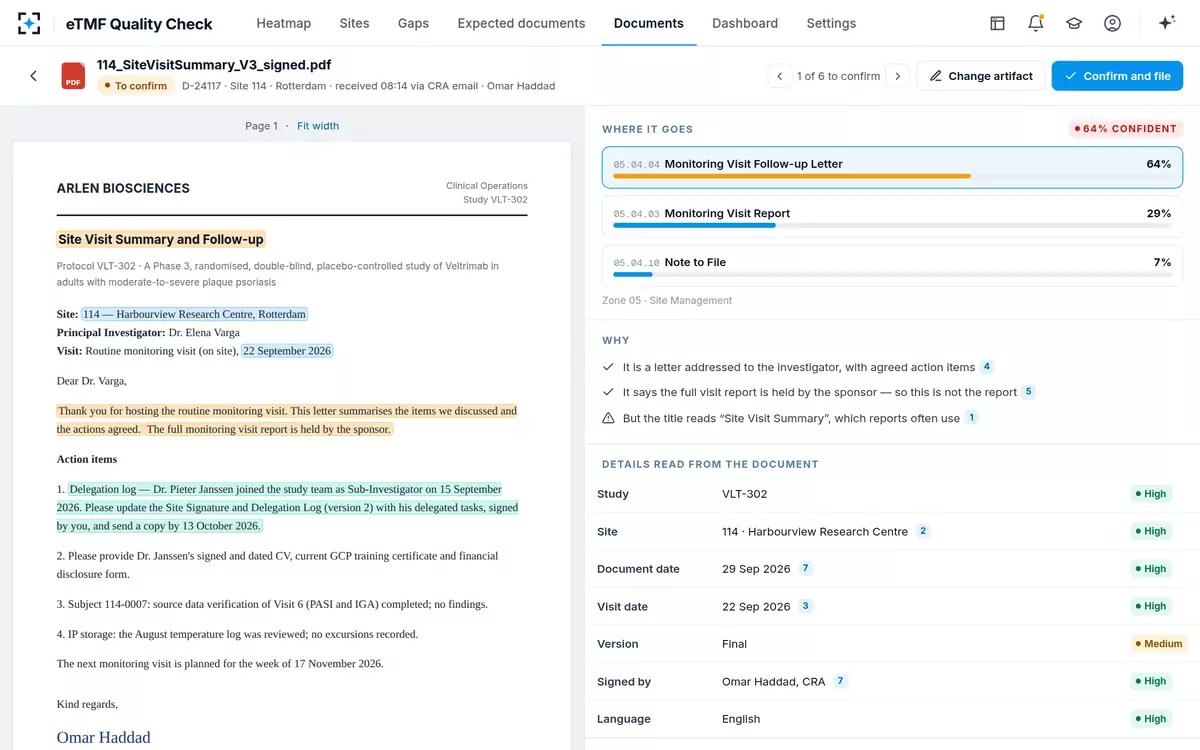
A proposal, not a filing: candidates, a confidence, and the passage behind each reason
What an agent may never do to a trial master file
The list is short, and each item has a rule behind it rather than a preference. It may not file a document the study has defined as critical without a person confirming it — consent forms, delegation records, ethics approvals, accountability logs. It may not file below the confidence the sponsor has set, which on the sample study is 90%. It may not decide a document is not required, because that changes what the file is expected to contain and is the one action that makes a gap vanish without a document arriving. It may not close a gap on its own. And it may not send anything to a site.
Two of those are worth defending explicitly, because they are the ones a buyer is likeliest to be offered as conveniences. “Not required” has to be a person’s decision with a written reason, or the completeness figure becomes self-certifying. And nothing should reach a site without somebody pressing Send, because the request a site receives is itself part of the conduct of the trial.
One document through four agents and one person
Agent
Classified, with candidates and a confidenceThree candidate artifacts, a confidence, and reasons each tied to a passage — including the reason against the leading candidate.
Agent
Details read, each with its source on the pageStudy, site, document date, version, signatures and people named. A date that is not on the page is reported missing.
Never: a date is guessed
Agent
Scored against what the site should have todayThe filing changes a zone’s completeness; any event inside the document, such as a staff change, opens its own gaps with their evidence.
Never: a document is marked not required
A person decides
A reviewer confirms, or re-files itEverything below the confidence setting, and every critical artifact, arrives here with its candidates and reasons rather than as a fait accompli.
A person decides
They sign, and choose what the signature meansThe name, the time and the meaning go onto the trail with what was signed. Only now is the document part of the file.
Never: an agent signs
Confidence, and the line where a person takes over
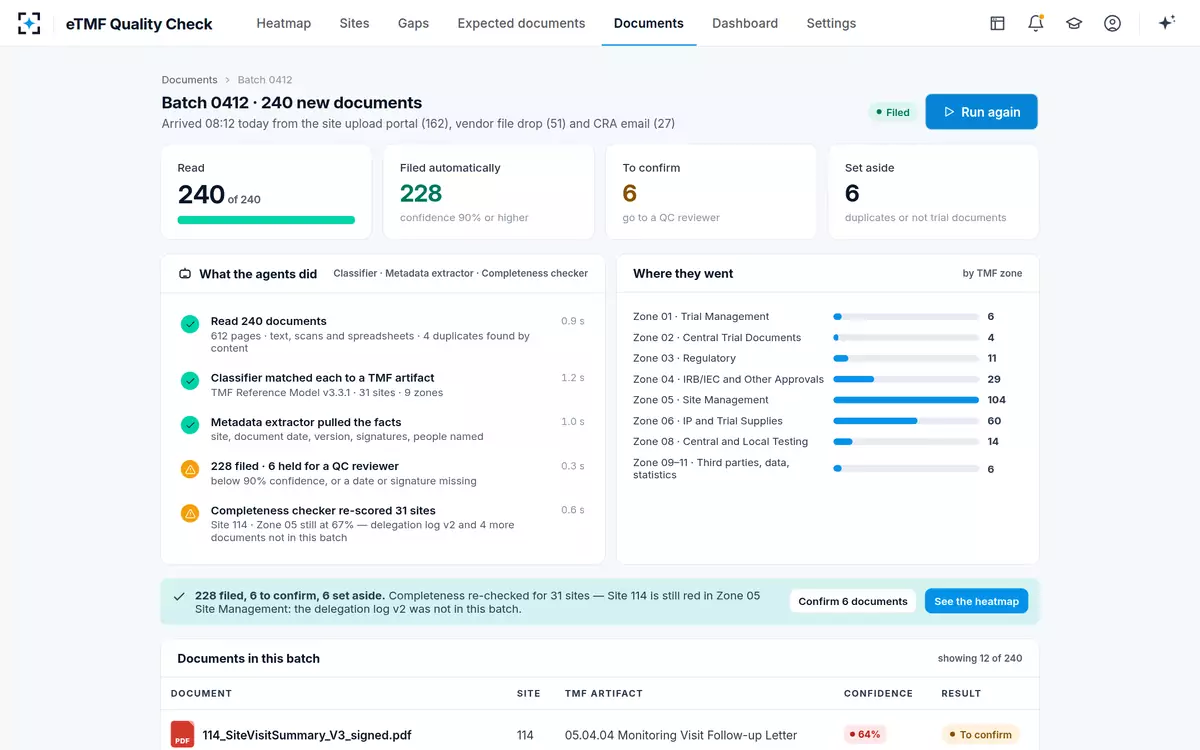
A confidence threshold is a control, not a claim. On the sample study it is set at 90%: above it, and with the date and signature checks passing, a document is filed; below it the document waits for a person. In one batch of 240 documents, 228 were filed that way, 6 were held for a reviewer and 6 were set aside as duplicates or not trial documents at all. None of those numbers is an accuracy figure, and a supplier quoting a threshold as though it were one is quoting the wrong thing.
What makes the threshold defensible is what sits around it: a sample of the automatic filings checked every week, every critical artifact confirmed by a person regardless of confidence, and a trail that shows which route each document took. Set the threshold where your own checking says it belongs, and move it on evidence from your own file. How to run the review that produces that evidence is the other half of this decision.
A batch, with each agent’s step, its time, and what it found
Does 21 CFR Part 11 apply to a document an agent filed?
The question is wrongly framed, and the framing is the answer. Part 11 applies to electronic records kept under agency records requirements and to the signatures executed on them — not to the method by which a draft of the metadata was produced. Whether a human typed the artifact code or a model proposed it, the record and the signature are held to the same standard, and the signature has to record what it means — review, approval, responsibility or authorship are the regulation’s own examples (21 CFR 11.50).
ICH E6(R3) asks for the same thing in the language of records: they “should be identifiable and version controlled (when appropriate) and should include authors, reviewers and approvers as appropriate, along with date and signature (electronic or physical), where necessary” (Appendix C.2.1). Notice what both require: a named human role. Neither names a model as an author, reviewer or approver, and the clean design is not to try — the agent’s work is evidence attached to the record, and the person who signs is the reviewer.
Who is accountable for an AI classification?
The sponsor, with no distribution of the liability to a supplier and none to a model. The EMA’s reflection paper is unambiguous that it is the sponsor’s responsibility to ensure the algorithms, models, datasets and pipelines used are fit for purpose, and its good clinical practice section says plainly that AI used in a trial “should meet applicable requirements in the ICH E6 guideline for good clinical practice”.
In practice that collapses to a question an inspector can ask on a single document: who decided this is a monitoring visit follow-up letter, and what did they see when they decided? If the answer is a person, a time, a meaning and the passages they read, the use of a model upstream is a detail of how the proposal was prepared. If the answer is that a system decided and nobody looked, the sponsor has no answer at all — which is the same failure as an unreviewed filing by a temporary member of staff, and has always been one.
What to write down before an agent files anything
- Which uses you consider operational, and why
The FDA draft guidance excludes operational efficiencies that do not impact safety, quality or the reliability of results. Make the argument yourself, in writing, use by use.
- The validation of the system, as a system
The EMA’s computerised-systems guideline names eTMFs in scope and defers AI-specific requirements; the ordinary expectations apply in full, on your configured installation.
- The failure modes you expect, and what catches each
The reflection paper asks for a risk management plan defining likely failure modes, especially where no person is in the loop. Keeping a person in the loop is itself a control, and should be recorded as one.
- Where the line between proposal and decision falls
The confidence threshold, the critical artifacts always confirmed, who signs, who may approve a “not required”, and who presses Send.
- How you check what was filed without a person
A sample size, a frequency, who reviews it, and what happens to the threshold when the sample disagrees.
- What the audit trail will show an inspector
Each agent step, each filing, each assignment and each signature with who, what and when. The EMA’s guideline expects audit trail review to use technology as well as manual reading.
What you would have to show an inspector
Three things, and none of them is a model card. First, the assessment above: what the software does, which uses you judged operational, and how the system was validated on your installation. Second, the division between proposal and decision, as configured — and the ability to demonstrate it by picking a document and showing who confirmed it, when, and what the confirmation meant. Third, the trail, with the checking that samples automatic filings and what you did the last time it disagreed.
The EMA’s guideline on computerised systems also expects that audit trail review itself be approached seriously, noting that “manual review as well as review by the use of technologies to facilitate the review of larger datasets should be considered”. That cuts in an interesting direction: the regulator contemplates software helping a human review a trail, which is the same shape as software helping a human file a document. The principle that unites them is that the technology narrows what a person looks at, and the person still looks.
Where it becomes a record: a person, a time, and a meaning
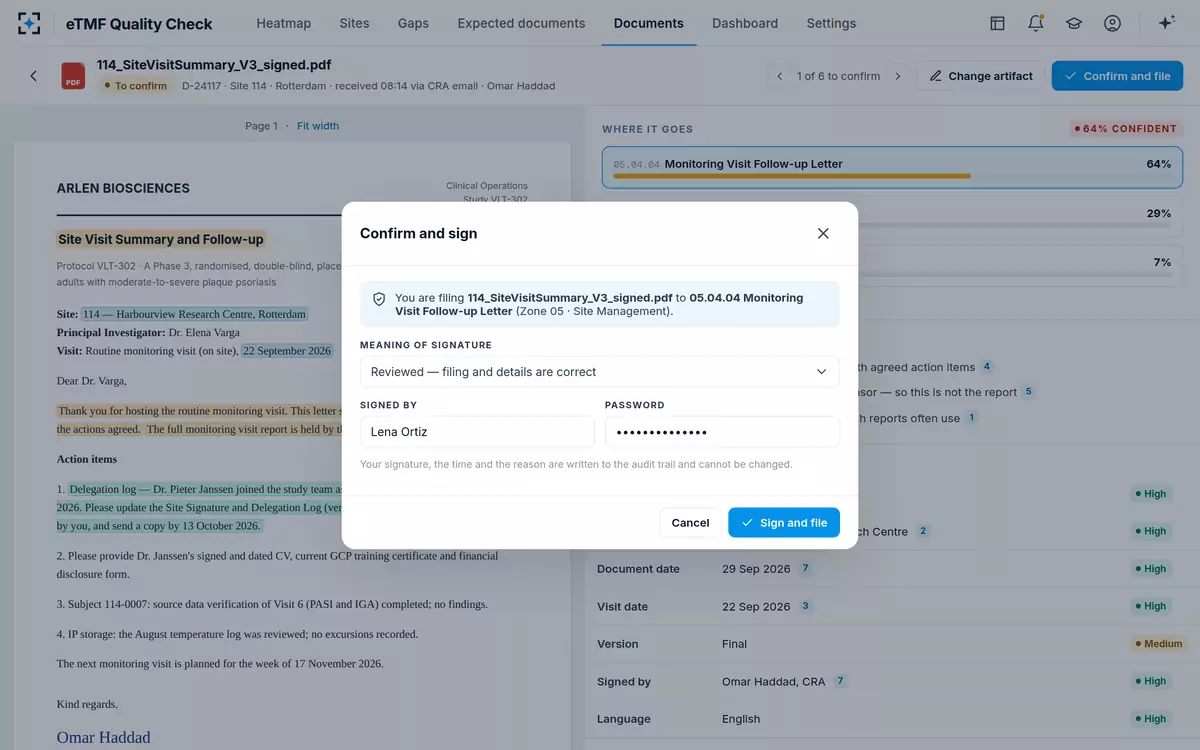
Read together, the three documents point at one design rather than at a permission. The agent’s output is a proposal with its evidence attached; the person decides and signs; the trail shows both. The controls an inspector will test are the same controls whether or not a model is involved, and eTMF Quality Check shows the whole chain on one study.
Questions people ask
Does the FDA allow AI in clinical trials?
There is no permission to obtain and no prohibition to breach. FDA’s January 2025 document on AI supporting regulatory decision-making is a draft guidance, not a rule, and its scope section excludes AI used for operational efficiencies that do not impact patient safety, drug quality or the reliability of study results. For trial master file work the binding obligations are the ordinary ones about records, signatures and validated systems.
Does the EMA allow AI in clinical trials?
The EMA has named AI uses in clinical trials inside the scope of its computerised-systems guideline and then said that requirements for AI beyond those applying to all systems are not covered initially and may appear in a future annex. Its reflection paper puts responsibility for models, data and pipelines being fit for purpose on the sponsor, and states that AI used in a trial must still meet ICH E6 good clinical practice.
Can AI classify and file trial documents?
Classifying and proposing is uncontroversial; filing without a person is a choice you make and have to defend. The defensible configuration sets a confidence below which a person confirms, always requires confirmation for critical artifacts such as consent forms and delegation records, samples what was filed automatically, and records every step. The threshold is a setting, not an accuracy figure.
Do you have to tell a regulator you used AI?
None of the documents above sets a general duty to disclose operational use on a trial master file, though FDA’s draft encourages sponsors who are unsure whether a use falls within its scope to engage with the agency early. What does exist is the expectation that your validation, your risk assessment and your audit trail describe the system you actually run, and an inspector reading them will see what the software does. Writing the assessment as though it will be read is the practical version of disclosure.
Who is accountable for an AI classification in a trial?
The sponsor. The EMA’s reflection paper assigns responsibility for algorithms, models and pipelines being fit for purpose to the sponsor, applicant or manufacturer, and neither 21 CFR Part 11 nor ICH E6(R3) names a model as an author, reviewer or approver. On any individual document the accountable party is the person whose signature carries the meaning recorded beside it.
What must a person still do when agents file documents?
Confirm and sign the filings the configuration holds back, decide anything that removes a document from a site’s expected list, press Send on whatever goes to a site, and review the sample of automatic filings. Those four are the whole of the human role, and they are the part of the work that makes the rest defensible.