An eTMF system implementation fails on the mapping, not on the software. Nothing in a trial master file can be scored until somebody has written down, artifact by artifact and milestone by milestone, what each site owes and by when — and that is a cross-functional exercise with a named stakeholder for every part of the file, which the TMF Reference Model’s own implementation guide sets out in detail and many programme plans treat as a formality. So the order that works is the opposite of the intuitive one: map the index and write the rules first, prove them on a study that is already closed and whose answer is therefore already known, go live on the live studies, and migrate the old file last — because migration is the only step whose cost you can still choose not to pay. Botminds’ eTMF Quality Check is built and deployed from your own requirements and documents, and goes live once every quality check has passed; what follows is the sequence of decisions that gets it there, on anyone’s software.
Figures tagged demo come from the solution running on a fictional sample study; typical figures are published. This page gives no durations in weeks or months, because the honest answer to “how long?” is a sequence of decisions, and the decisions are what move.
What an implementation is actually sizing
11zones
to map, with 48 sections beneath them, if you build on the published reference model
typical
249
artifacts, and 607 sub-artifacts, to decide about one at a time, with an owner for each
typical
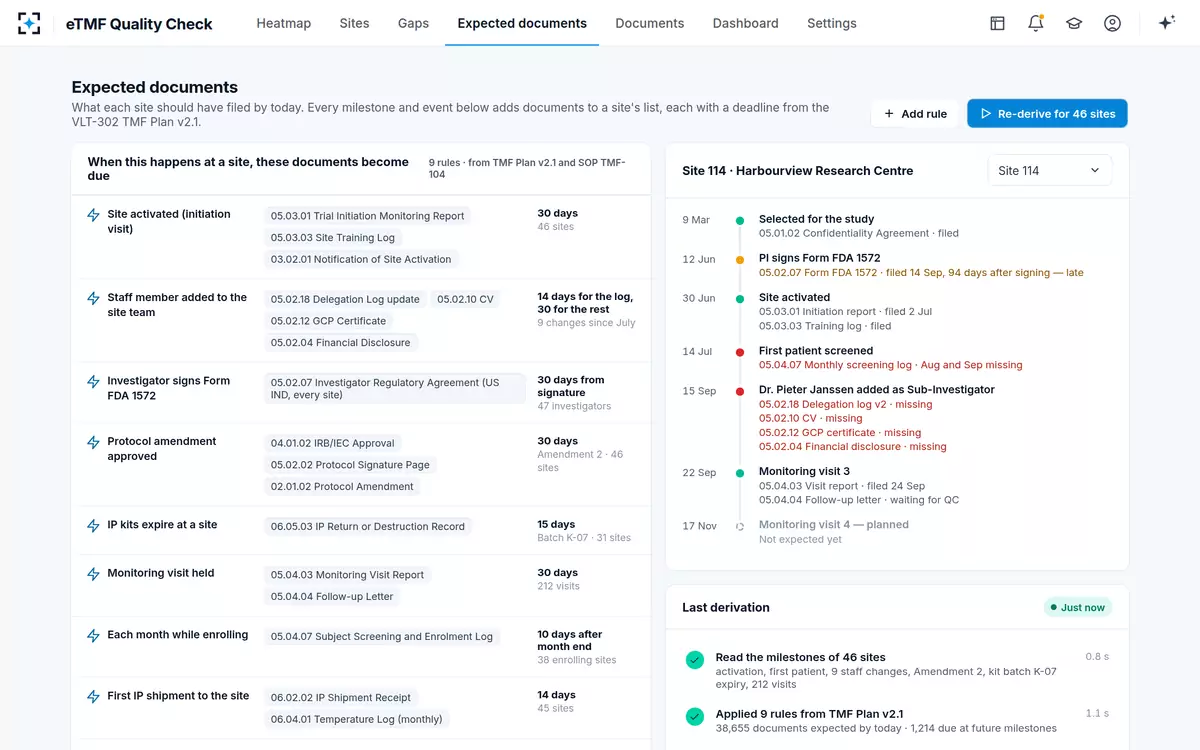
9rules
from the trial’s own plan and procedures that make documents due on the sample study
demo
46sites
re-derived in one run, reading each site’s milestones and comparing the result with the filed file
demo
How do you implement an eTMF system?
In six moves, and only one of them is installation. Agree what the file is: which index, which version, which local adaptations, and who owns each part of it. Write the rules that make a document due. Configure the thresholds, the owners and the approvals. Prove the whole thing on a study whose answer you already know. Validate the configured installation. Then go live, and decide separately — later — what happens to the old file.
The order matters more than the speed. Every step after the first consumes the mapping, so a programme that starts configuring before the index is agreed will configure twice. And the step most often brought forward, migration, is the one that should go last: until the mapping is signed, every document you move is a document you may have to move again.
The order of the work, drawn to relative effort — and what arrives whether you are ready or not
- Index and mappingthe long pole
- Expected-document rulesneeds the mapping
- Configuration
- Replay test
- Validation
- Go live
- Decide, then verify a sample, then moveafter the mapping is signed
- The first inspection window
- The archiving obligation
- Study milestones, still arriving
What you bring: five inputs, and which of them does not exist yet
An implementation consumes five things from your organisation, and often the fourth is thinner than anyone admits and the fifth does not exist in writing at all.
The five inputs, and the rule or practice that makes each necessary
- The index: a published reference model version, or your own company index
Everything downstream is a position in this structure. The guidance asks for a suitable overall index enabling the location of essential documents to be traced.
- The TMF plan and procedures, with their filing timelines
Where the expected-document rules and the timeliness target come from. Without the timelines written down, nothing can be called late.
- Site milestones and the staff directory
Activation, first patient, visits, amendments, shipments, staff changes. A rule is only as good as the source the milestone is read from.
- A sample of real trial documents
Not specimens. Real ones, including the badly titled and the badly scanned, because those are the documents that decide whether the mapping holds.
- The names of the zone owners
The implementation guide asks that a stakeholder be identified for each part of the file; one person may own several zones, but every zone has one.
Map the index before you touch the system
The mapping is the exercise where an organisation decides what its trial master file is. The implementation guide is explicit about how it should be staffed: “A stakeholder should be identified for each department creating TMF content and/or for each part of the TMF (called Zones in the TMF RM). (Note: A stakeholder could very well be responsible for multiple TMF Zones)” (TMF Reference Model Implementation Guide, version 2, section 5.1.4). That sentence is the whole reason mapping takes time: it is not a document exercise, it is a sequence of decisions by people who do not usually sit in the same meeting.
Two rules from the same guide save weeks later. With the exception of artifacts the model repeats deliberately, each artifact should appear only once in the file, so that filing procedures are unambiguous and accountability for placement is clear. And before inventing an artifact your index does not have, check whether the published model already has somewhere for it — a local invention is a local invention for twenty-five years. Give the extended team your current procedures and your existing expected-document list at the start, so the mapping is a comparison rather than a blank page.
Record a decision for each artifact, not only a position: who owns it, whether it is electronic or paper, which system holds it, whether it needs a wet-ink signature, what quality checking applies, and whether a blinded user may see it. That list is also the configuration specification, which is why doing it properly makes the next three steps short.
Writing the rules that make a document due
A completeness score is a fraction, and the mapping only gives you the numerator. The denominator comes from rules of the form when this happens at a site, these documents become due, within this many days — and the implementation guide asks the question that generates most of them: “Is the Artifact necessary to achieve a milestone (eg: Site Activation)?”
Write each rule with three parts and it will survive contact with the study: the trigger, the documents, and the deadline. Then add the part most rules omit, which is where the trigger will be read from. A rule triggered by “a staff change” is useless until somebody says whether staff changes are read from the staff directory, from the delegation record, or from the text of monitoring visit reports — and the answer on many studies is all three, at different times. On the sample study nine rules from the trial’s own plan and procedures cover activation, staff changes, a signed Form FDA 1572, an approved amendment, kit expiry, visits, monthly enrolment, shipments and close-out.
Nine rules, the milestones they read, and the latest re-derivation
How do you validate an eTMF before go-live?
Validation is the sponsor’s exercise, on the sponsor’s configured installation, and it cannot be bought. The EMA’s TMF guideline asks that eTMF systems be validated to demonstrate the functionality is fit for purpose, with formal procedures managing the process; a supplier can hand over its development and release evidence, and should, but fitness for purpose means fitness for your index, your rules and your roles. Nothing arrives validated.
Two parts of this are easy to under-scope. The first is any link between systems: where documents move from one party’s file into another’s, the guidance asks that the transfer process be robust and validated to prevent any loss, and a single-system validation that ignores the inbound channels has validated half the file. The second is the archiving behaviour, which is rarely exercised before go-live and is hard to change afterwards. ICH E6(R3) is worth reading alongside, because it sets the functional bar plainly: the storage systems used during the trial and for archiving “should provide for appropriate identification, version history, search and retrieval of trial records” (Appendix C.2.4). The controls an inspector will test is the fuller list.
Prove it on a study you have already closed
The most informative test available to an implementation costs almost nothing: take a study that is finished, re-derive what should have been expected at each site, re-score it, and compare the result with the gaps that were actually found at the time. You already know the answer, which is what makes the disagreements readable.
The replay test, and what each kind of disagreement tells you
A person decides
Choose a closed study with a known historyIdeally one that was inspected or audited, so there is an independent view of what the file was missing.
Agent
Re-derive the expected list from its milestonesApply the new rules to the study’s real activations, visits, amendments and staff changes, as of a date in the past.
Agent
Re-score the file as it stood on that dateCompleteness and timeliness per zone, per site, against the re-derived list rather than the list used at the time.
A person decides
Read the disagreements, both waysGaps the replay finds and nobody found then: either a real miss, or a rule that is too strict. Gaps found then that the replay misses: a rule or a trigger source that is wrong, and the more urgent of the two.
A person decides
Change the rules, not the scoreEach disagreement ends as an edit to a rule, a trigger source or the index — recorded, so the reason survives the people who were in the room.
Migrate the old trial master file, or leave it where it is?
This is a real choice, and treating it as a given is how implementations lose a quarter. The guidance governs the how rather than the whether: “Any migration of data and documents to new media or a new format should be verified to ensure long-term readability and to maintain integrity.” Verified means a sample checked against the originals, with criteria agreed before the move — which is the cost people forget when they budget a migration as a data transfer.
Migrate, leave in place, or hybrid
What it costs you: The largest of the three, and the cost is verification rather than transfer: a sample checked against originals, with criteria set first.
What it costs an inspection: Least: one file, one index, one place to look. The migration itself becomes something to evidence.
What it costs you: Least now. You keep the old system, its access and its archiving obligation, for as long as the retention period runs.
What it costs an inspection: Manageable, if the TMF plan says plainly where each study lives and the old system can still be read.
What it costs you: Middle, but the ongoing cost is attention: two indexes, two sets of procedures, two places a document might be.
What it costs an inspection: Highest risk, unless the mapping document is unambiguous about which study is where.
Whichever you choose, the MHRA’s advice applies to all three: “A simple way to achieve this is to have an overarching mapping document that lists all the essential documents and where they are located” (MHRA Inspectorate blog). A hybrid estate with that document is defensible. A migrated estate without one is not.
How long does an eTMF implementation take?
Long enough to make the decisions, and no amount of software shortens that. The variables are how many artifacts your organisation adapts away from the published model, how many stakeholders have to agree each adaptation, whether the milestone data is where you were told it was, and whether a migration is in scope. A plan that assumes the first and third are easy is the plan that slips.
Two things do compress it. Deciding the index before the project starts removes a large source of elapsed time. And running the replay test early, on a closed study, moves the arguments about rules to the beginning, where they are cheap. In this solution the build and deployment are done from your own requirements and documents — your plan, your index, your milestones and a sample of real trial documents — and it goes live once every quality check has passed; the time that takes is mostly the time your organisation needs to settle the five decisions below.
Who decides what, before anything goes live
The index owner
What it coversWhich index the file is built on, which version, and every local adaptation to it.
How to tellCan they name the one person who signs off adding an artifact that the published model does not have?
The rule owner
What it coversWhat makes a document due, from which milestone or event, and within how many days.
How to tellDoes every rule name the source the milestone will be read from, before anyone writes it?
The quality owner
What it coversWhich artifacts a person always confirms, what sample of the rest is reviewed, and how often.
How to tellIs the sample a number, with a name attached to doing it every week?
The approver of a “not required”
What it coversRemoving an expected document from a site’s list, with a written reason.
How to tellDoes this sit above the person whose score improves when it happens?
The person who signs the validation
What it coversThat the configured installation is fit for its purpose on your study.
How to tellHave they seen the configuration specification, not only the supplier’s evidence?
Five things that slip, and the week each one shows up
The five slips, what causes each, and when it surfaces
| What slips | What causes it | When it shows up |
|---|---|---|
| An index nobody owns | Mapping run as a workshop rather than as a decision with a named owner per zone. | Immediately, as an unresolved artifact list that stays open while everything else waits on it. |
| Rules written without a source for the trigger | A rule says “when a staff member is added” and nobody has said where that is read from. | At the first re-derivation, when sites that changed staff look unchanged. |
| Milestone data that is not where you were told | Activation and visit dates live in a different system, or in a spreadsheet, or in three places that disagree. | During the replay test, as a block of sites whose expected list is obviously wrong. |
| A vendor system outside the TMF definition | Essential documents in an ancillary system nobody listed as part of the file. | At the first audit or inspection. The MHRA has recorded exactly this among the observations behind a critical finding. |
| A migration started before the mapping was signed | Pressure to show progress on something visible. | When the index changes and the migrated documents have to be moved again. |
Four of those five are decisions rather than tasks, which is the pattern. The one genuinely technical risk — milestone data not being where you were told — is also the one the replay test finds earliest, which is the strongest argument for running the replay before go-live rather than as a reassurance afterwards.
The first inspection after go-live
Expect to be asked three questions, and build the answers during the implementation rather than after it. What is your index, and who owns it? How do you know what should be in the file, and where did those rules come from? And what is missing today, with its evidence? The first two are the mapping and the rules; the third is the thing that distinguishes a scored file from a stored one.
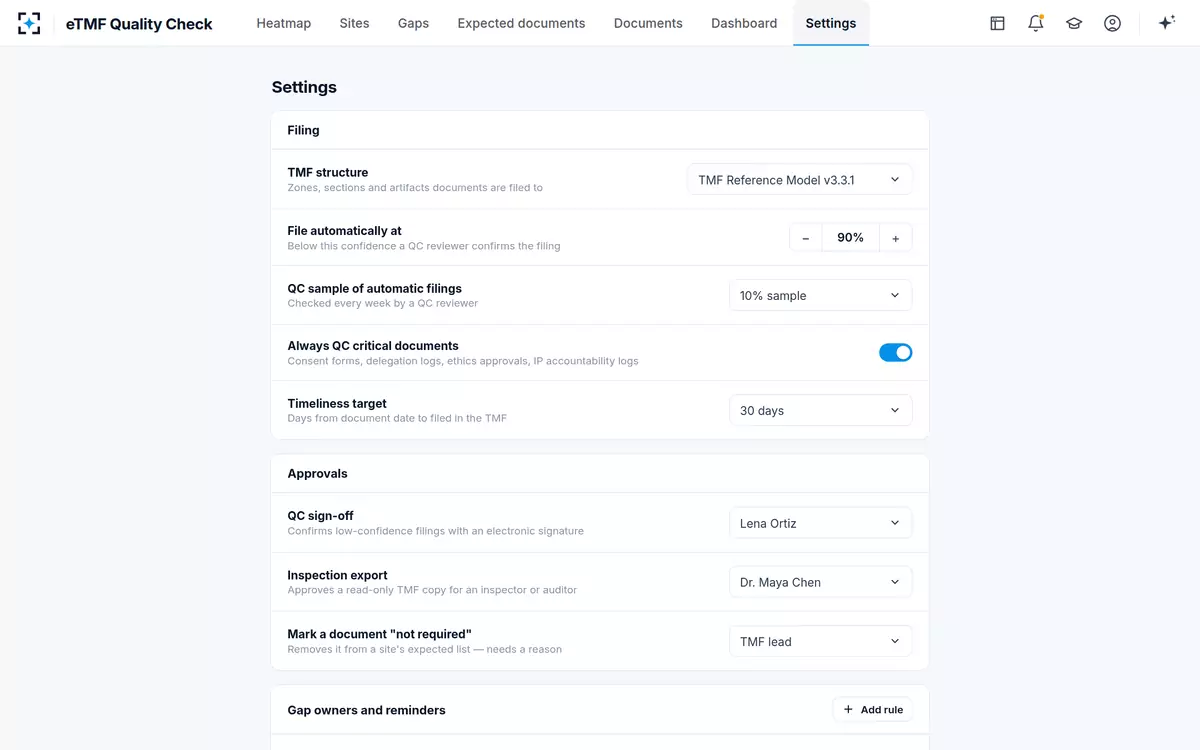
Keep the configuration where the TMF plan can reach it, too. The index version, the confidence at which a document is filed without a person, the sample of automatic filings that is reviewed, the critical-artifact list, the timeliness target and the two approvers should all be settings with an owner — because the first inspection will ask who chose each value, and “it came that way” is not an answer.
The configuration as settings, each with an owner
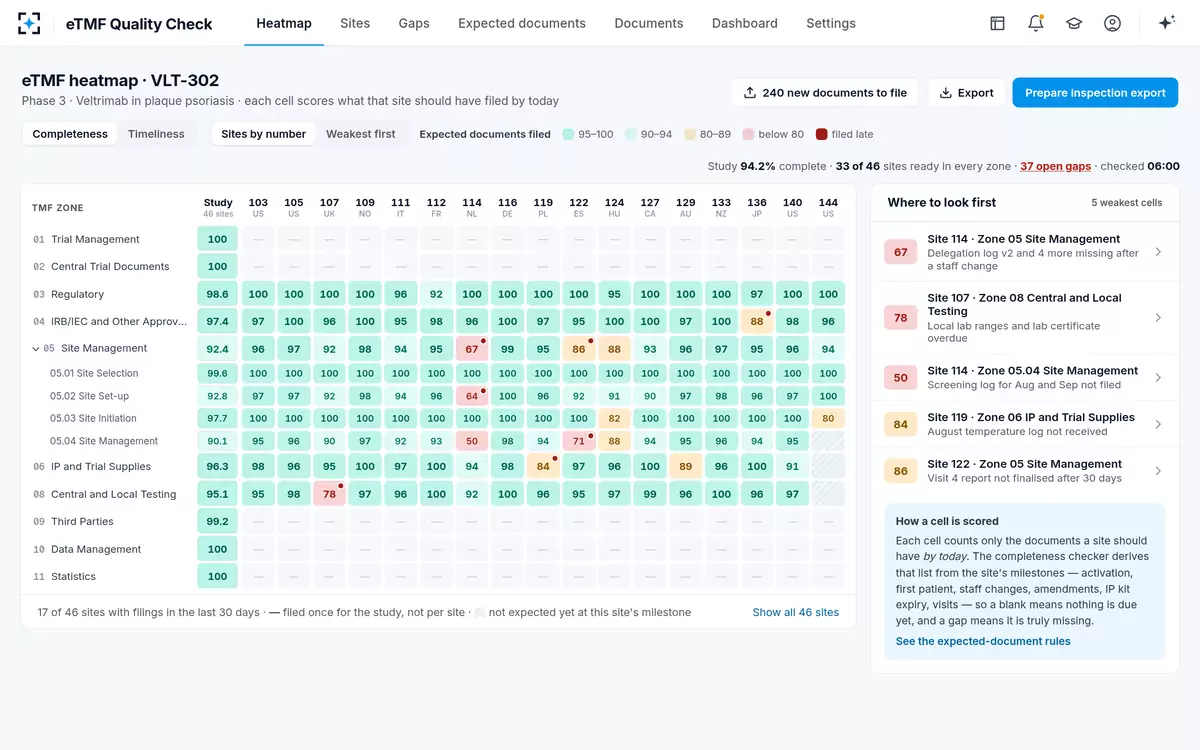
What go-live looks like, on the day it works, is unremarkable: a score for every zone at every site, derived from your own rules, with the weakest cells listed and each gap owned. That is the test of the whole implementation — not that documents can be uploaded, but that the file can say what is missing.
What go-live looks like: every zone at every site, scored against today
For the evaluation that comes before this one, the three cost lines of a trial master file sets out the business case, and eTMF Quality Check shows the heatmap, the rules and the gap register on one study.
Questions people ask
How do you implement an eTMF system?
Agree the index and who owns each part of it, write the rules that make a document due, configure the thresholds and approvals, prove the result on a study you have already closed, validate the configured installation, then go live — and treat migrating the old file as a separate decision taken afterwards. Only one of those six steps is installation, and it is not the long one.
How do you map your TMF to the TMF Reference Model?
Artifact by artifact, with a named stakeholder for each zone, as the Reference Model’s implementation guide sets out. Give the extended team your current procedures and existing expected-document list so the exercise is a comparison. Keep each artifact in one place unless the model deliberately repeats it, and check the published model before inventing anything local.
Do you migrate the old trial master file or leave it?
It is a choice, and all three answers are defensible. What is not optional is verification: any migration to new media or a new format has to be verified for long-term readability and integrity, which means a sample checked against originals with criteria agreed first. Whatever you decide, keep one mapping document that lists the essential documents and where they are located.
How do you validate an eTMF before go-live?
On your own configured installation, against your own intended use. The EMA’s guideline asks that eTMF systems be validated to demonstrate the functionality is fit for purpose with formal procedures managing it. Include the inbound channels — transfers between systems have to be robust and validated to prevent loss — and exercise the archiving behaviour, which is the part nobody tests until it is too late to change.
How do you pilot a TMF quality check on one study?
Use a closed one. Re-derive what should have been expected, re-score the file as it stood, and compare with the gaps found at the time. Disagreements in one direction suggest rules that are too strict; disagreements in the other mean a rule or a trigger source is wrong, which is the more urgent finding. Every disagreement should end as a recorded edit to a rule or the index.
What goes wrong in an eTMF implementation?
Five things, and four are decisions rather than technology: an index nobody owns, rules whose triggers have no named source, milestone data that is not where you were told, essential documents in a system nobody defined as part of the file, and a migration started before the mapping was signed. The replay test finds the third early, which is the best reason to run it before go-live.