TMF timeliness metrics measure how long each document took to reach the trial master file: the days between the document’s own date and the day it was filed, compared with a target. The first surprise for most people writing one is that the European, United Kingdom and United States rules name no number of days. What they require is that the file contain the essential documents “at all times”, and the EMA guideline asks you to define your own filing timelines in your plan — so a timeliness target is a promise the sponsor makes to itself. That makes the honest part of the metric not the target but the date you start the clock from, and the most telling timeliness observation an inspectorate has published is about shape rather than average: a flat filing rate across a trial is evidence of a contemporaneous file, and a surge in the fortnight before an inspection is evidence against one. eTMF Quality Check, the Botminds agentic solution for trial master file quality, scores timeliness as a second number beside completeness, per zone and per site, and lists every late filing with the days it took rather than averaging it away.
Figures tagged demo below are from a fictional sample study, VLT-302 — forty-six sites, invented sponsor, sites and people. Figures tagged target are design goals and estimated marks our own estimate; none of the three is a customer’s measured result.
One document, one backlog, two medians
38days
median from document date to filed, working the sample study by hand
estimated
1.6days
median against the 30-day target the sample study sets
target
94days
from signature to filed for one investigator’s Form FDA 1572
demo
4,820
documents waiting to be filed in mid-August, by hand
demo
What are TMF timeliness metrics?
They are the second of the three questions an inspection asks of a trial master file — is it complete, was it filed on time, is it right. A timeliness metric has four parts, and many published ones leave two of them unstated: a start date, an end date, a target, and a population of documents the metric covers.
The usual pair of headline figures is the median days to file and the share of documents filed within target. Both are worth having and neither is sufficient, because they answer different questions: the median says what a typical document experiences, the share within target says how often the promise was kept. A file can have an excellent median and a long, ugly tail of documents that took months — and the tail is where the inspection findings live.
Timeliness is also not completeness. A site that has filed one document, quickly, scores perfectly on timeliness and disastrously on completeness; the two must be reported as separate numbers, which is the subject of the completeness guide.
Which date starts the clock?
This single decision moves the metric more than any target does, and it is the one the EMA guideline explicitly tells you to make rather than assume: “Consideration should be given to defining the dates used for document filing; for example, the date of receipt, the date of filing into the (e)TMF, the date of approval or the date of expiration.”
Four candidates, with very different behaviour. The document date — when it was signed or issued — is the honest one, because it is the date the file is supposed to reflect; it also produces the worst-looking numbers, since it includes the time the document spent at the site before anyone sent it. The date of receipt measures only your own organisation’s handling, which is useful for managing a filing team and useless as an assurance of contemporaneousness. The date of approval suits documents that are not valid until signed. And the date a document was first uploaded anywhere measures the system, not the file.
The test to apply is simple: if a document sat at a site for sixty days before anyone sent it, does your metric show sixty days? If not, your metric is measuring your inbox. On the sample study the clock runs from the document’s own date, which is why one investigator’s Form FDA 1572 appears as ninety-four days rather than as the fortnight it spent in the filing queue.
One Form FDA 1572, from signature to findable
- Inside the study’s own 30-day target30 days
- Beyond it — the document existed, and the file did not know64 days
Is there a legal deadline for filing a trial master file document?
Not in the European Union, the United Kingdom or United States rules quoted here — none names a number of days. What there is instead is a continuous duty and an instruction to set your own deadlines. Article 57 of Regulation (EU) No 536/2014 requires the file to contain the essential documents “at all times”; regulation 31A of the United Kingdom regulations uses the same phrase; and the EMA guideline turns the obligation into a planning requirement: “The timelines for submission and filing of all documents to the TMF in procedural documents or TMF plans should be defined.”
That is a stronger position than a fixed number of days would be, and sponsors sometimes miss why. A deadline written in law would be a safe harbour: meet it and you are compliant. “At all times” offers no safe harbour. It means the question can be asked about any moment in the trial’s past, and the answer has to come from the file’s own record of when things arrived.
What “at all times” and contemporaneous actually require
The EMA’s inspectors have written down what the phrase means in practice, and it is the sentence a timeliness policy should be built on.
“The requirement ‘at all times’ within Article 57 of the Regulation means that the TMF should have all documentation added in a timely manner during the trial, as this greatly assists the successful management of a trial by the investigator/institution, the sponsor and CROs to whom the sponsor has delegated its duties.”
EMA guideline on the TMF, section 3.5.4, Contemporariness of trial master file
Two things follow. During the trial: the obligation is continuous, so a file completed after database lock has not met it, however complete it ends up. And the justification given is operational rather than bureaucratic — a current file helps run the trial — which is also the argument that persuades sites, because it is true.
ICH E6(R3) says the same thing in its Appendix C.2.5, in the language of essential records collected and filed in a timely manner, and adds that some records should generally be in place before the trial starts. Taken together the two give a timeliness policy its two halves: a filing speed during the trial, and a set of documents that must exist before anything happens at all.
The thirty-day clocks that are not yours to set
Under the filing targets sit a small number of genuine regulatory clocks. They are not filing deadlines, and treating them as such produces procedures that chase the wrong date — but they do constrain a trial, and a timeliness policy that ignores them will be surprised.
Four clocks on the same document, and who owns each one
| Clock | What it governs | Who sets it | What it does not do |
|---|---|---|---|
| Your TMF plan’s filing target | How many days a document may take from its own date to reach the file. 30 days on the sample study, with 14 and 60 as alternatives. | You. It is a setting, not a rule. | It creates no regulatory exposure of its own — but failing your own published target is evidence about your quality system. |
| “At all times” — Article 57, and the United Kingdom’s regulation 31A | The continuous duty for the file to contain the essential documents. | The legislature. | It names no number of days, so it can never be satisfied by hitting a target. It is tested by what the file shows at a moment. |
| FDA notification of a new investigator — 21 CFR 312.30(c) | Telling FDA, within 30 days, that an investigator has been added to a protocol. | FDA. | It is not a deadline for filing a signed Form FDA 1572, or anything else, into the trial master file. The coincidence of “30 days” with a common filing target is exactly that. |
| Document-specific validity dates | Expiry of investigational product kits, laboratory accreditation periods, consent document versions in force. | The document or the issuing body. | They do not start a filing clock, but they end one: a document filed after it has been superseded answers a question nobody is asking. |
The filing curve: why the shape matters more than the median
The most telling thing an inspectorate has published about timeliness is not a number. It is an observation about shape, recorded by the MHRA’s inspectorate as part of a critical finding: “There were several examples of documents/data not being uploaded in a timely manner. alongside evidence of the eTMF having been updated substantially just prior to the inspection.”
That sentence turns the filing history into evidence. A file whose documents arrive steadily looks like a file that was kept; a file that fills up in the weeks before an inspection looks like a file that was assembled, and the audit trail of an electronic file records which of the two happened. A good median is no defence against it, because a late surge can coexist with a respectable average.
Two files, both complete on inspection day, with different histories
Kept contemporaneously — documents arriving as the trial produced them
- First quarter · 24%
- Second · 26%
- Third · 25%
- Fourth · 25%
Assembled before the inspection — the same documents, the same final count
- First quarter · 9%
- Second · 12%
- Third · 14%
- Fourth — most of it in the last fortnight · 65%
The same inspection recorded the underlying cause in a second sentence worth quoting, because it is about design rather than effort: “Essential documents were not defined in the SOP nor was there any clear policy and process to ensure the accurate completeness of the TMF contemporaneously.” No definition, no process — so no shape.
There is a related finding that shows up on the other side of the inspection. The EMA’s Good Clinical Practice Inspectors Working Group lists among its recurring deficiencies in delegation: “Lack of documented delegation of trial related tasks. Delegation of tasks documented retrospectively.” Retrospective documentation is a timeliness failure that completeness scoring cannot see at all — the document is present, properly filed, and dated after the activity it authorises.
Late, missing and unusable are three different problems
Lumping them together is a common fault in a gap register, and they need different work from different people.
A missing document has to be collected: someone contacts the site, and the fix takes days or weeks. A late document is already in the file, so there is nothing to collect — what it needs is a note to file explaining the delay, and a look upstream at why the route was slow. An unusable document is the quiet one: present, on time, and wrong — an unsigned signature page, a scan with a cut-off margin, a version that was superseded before it arrived. It will be counted as complete and timely by any metric that does not look inside the document.
Where a document’s 38 days went, working the sample study by hand
Measuring timeliness in a file half-held by a CRO
A sponsor reporting a timeliness figure for a file a provider holds is reporting a number the provider produced, about work the provider did, using a clock the provider chose. Three questions settle whether it means anything.
Whose date starts the clock? If the provider counts from the date it received a document from a site, the metric excludes the longest leg of the journey. What is the population? A figure covering only documents the provider was asked to file omits those nobody sent. Can the sponsor see the audit trail? Without it, the pre-inspection shape cannot be checked by the party who carries the responsibility for it.
The remedy belongs in the agreement rather than in a system: one definition of the start date, one population, a right to the underlying filing dates rather than a monthly summary, and reconciliation at a fixed interval. The sponsor remains responsible for the whole file, and a timeliness report it cannot verify does not discharge that.
Timeliness as a second score on the same cell
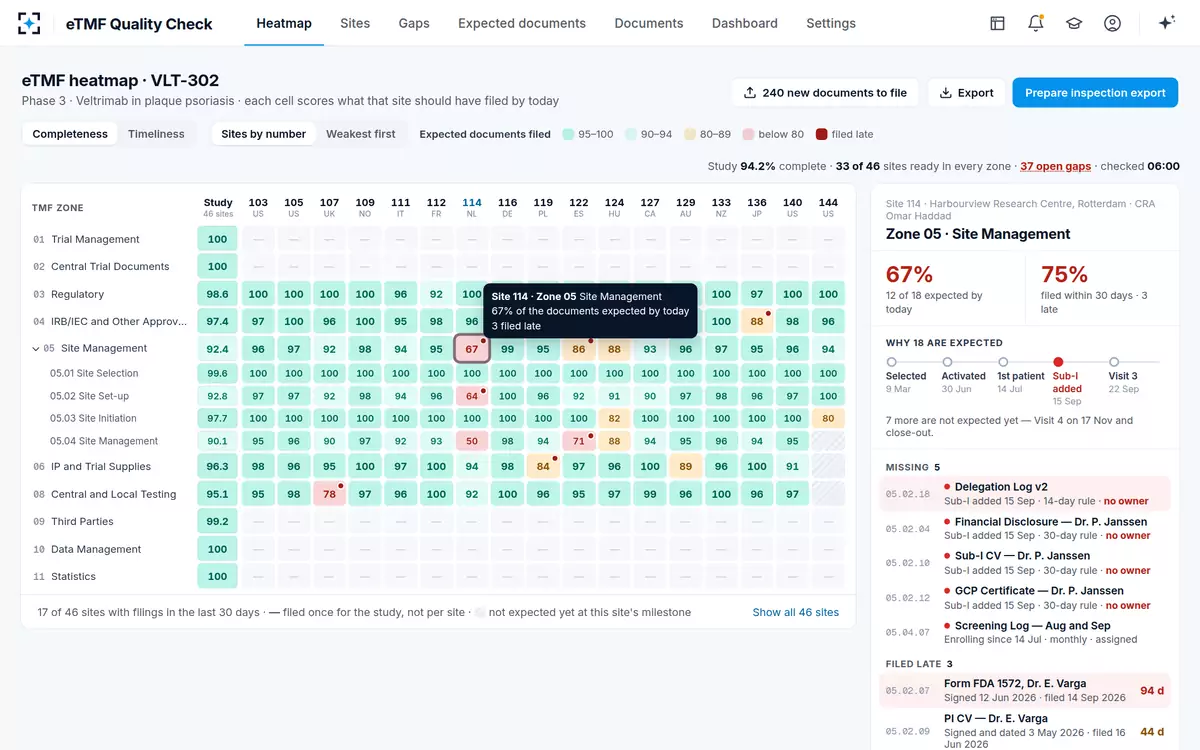
Three filings late on this cell; the worst is on the screen, not in a tail.
What a timeliness target should say, and who signs it
A target is a sentence, not a number, and the number is the least important part of it. Ours is this shape: Documents of class X, measured from the document’s own date to the date the filing passed its quality check, will reach the file within N days in P per cent of cases; exceptions are recorded with a note to file; the target is reviewed by [role] and changed only with [role]’s approval.
Median days against share within target: the same month, two conclusions
Median days to file: What a typical document experienced.
Share filed within target: How often the promise in your plan was kept.
Median days to file: The tail. Half the documents are slower than the median, and the slowest are the interesting ones.
Share filed within target: How bad the misses were. A document at 31 days and one at 194 days both count once.
Median days to file: Improves when a large batch of easy documents is filed quickly, even as hard ones sit.
Share filed within target: Improves by raising the target, which costs nothing and is invisible unless the setting is versioned.
Median days to file: The 90th percentile, and the single worst filing with its day count.
Share filed within target: The count of misses and the list, not just the percentage.
Median days to file: Whether the document that arrived quickly was the right one.
Share filed within target: Whether the file filled up evenly or in a surge before an inspection.
What a defensible timeliness definition has to state before you publish a number
- The start date, by name
Document date, receipt, approval or upload — one of them, written down. If two teams would answer differently, the metric is not comparable with itself month to month.
- The end date
Arrival in the file, or arrival plus a passed quality check. The second is harder and is what an inspector is testing, because an unconfirmed filing is not yet a filing.
- The population
Which documents are in scope, including those the sponsor never received. A metric over what arrived cannot detect what did not.
- The target, and that it is yours
A number of days and a share of documents, stated as the sponsor’s own commitment and not as a regulatory requirement.
- What happens on a miss
A note to file, an owner, and whether the miss is reportable upward. A target with no consequence is a decoration.
- Who may change it
A versioned setting with a named approver. A target that can be moved quietly is the easiest metric in this discipline to game.
The backlog, the days and the gaps on one screen
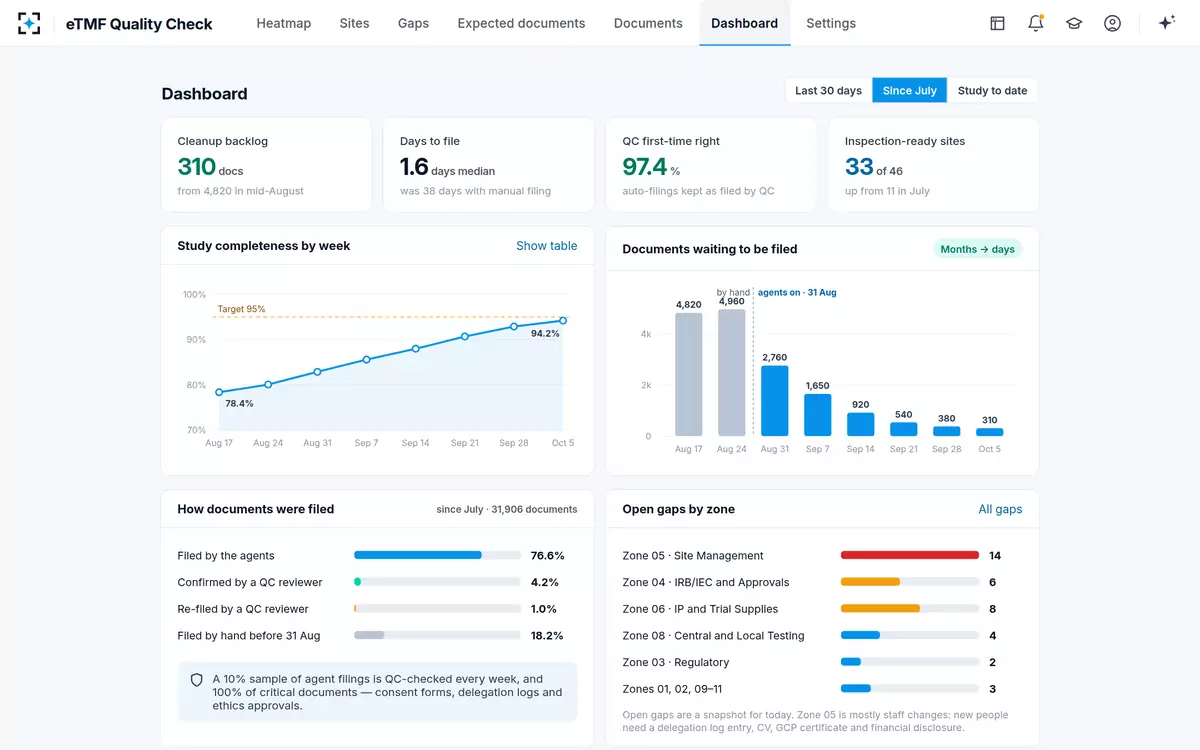
A last point about where the time actually goes. The sample study’s by-hand median of thirty-eight days is, by our estimate, more than half queue — documents waiting in an inbox before anyone looks at them. Filing speed is therefore mostly a question of how quickly a document is read and routed, not of how fast people type; which is why the open gaps and their owners, rather than the filing team’s throughput, are the thing to watch.
Every gap with an owner, a stage and a due date
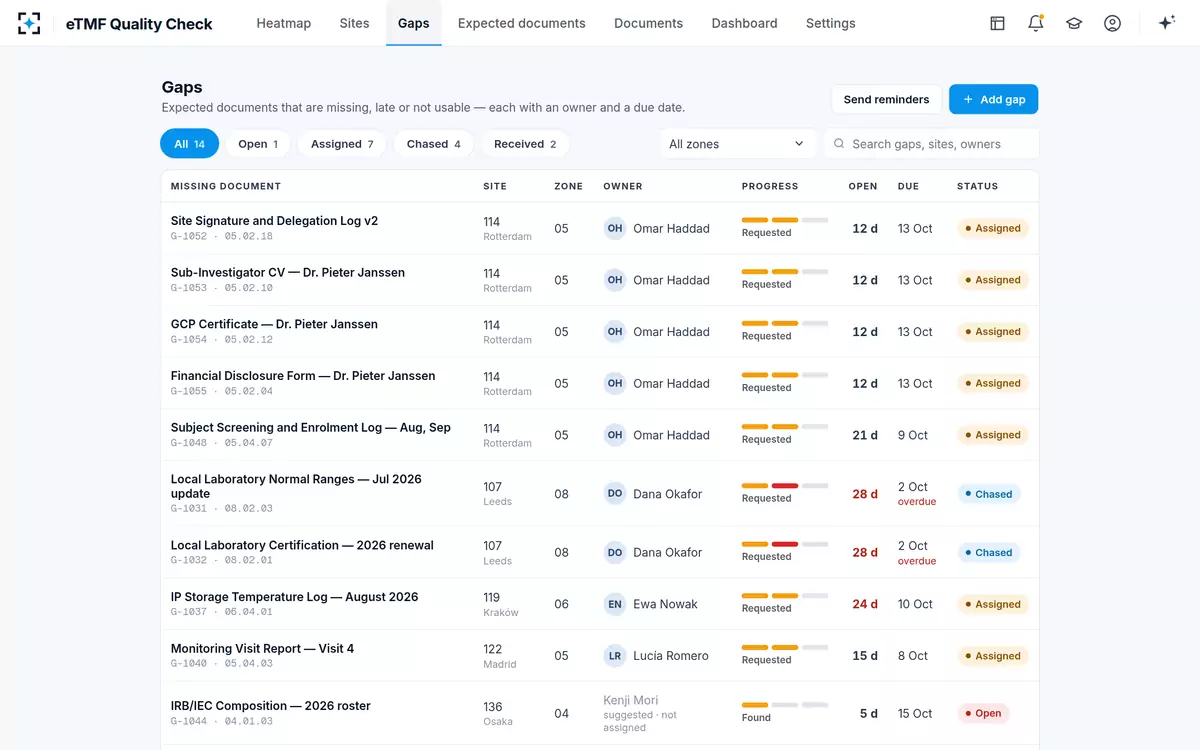
Timeliness is the score that is hardest to improve and easiest to misreport, and both facts come from the same place: nobody outside your organisation set the deadline. Define the clock, publish the tail beside the median, keep the shape of the filing history visible, and the number starts carrying the meaning its readers assume it has. What makes a document due in the first place is the subject of the expected document list guide, and what “right” means is the QC review guide. To see both scores on one grid, start from eTMF Quality Check.
Questions people ask
How many days do you have to file a document in the TMF?
As many as your own TMF plan allows — the EU, UK and US rules set no number. The sample study uses thirty days, with fourteen and sixty as the alternatives its settings offer, and a plan can sensibly set shorter periods for documents that authorise activity, such as delegation records and ethics approvals. What the rules require is that the file contain the essential documents at all times and that your filing timelines be defined in your procedures or plan, so the enforceable fact is the existence of the target, not its value.
What does contemporaneous mean for a trial master file?
That documentation was added during the trial, as the trial produced it, rather than assembled afterwards. The EMA guideline reads Article 57’s “at all times” that way in terms. The practical test is not a number of days but the shape of the file’s own history: an audit trail showing steady arrival supports it, and one showing a surge before an inspection undermines it, which inspectors have recorded as part of a critical finding.
What happens if documents are filed late in the TMF?
Nothing automatically — there is no penalty attached to a day count. What happens is evidential: the file could not answer questions during the period the document was missing, and the delay is visible in the audit trail. Where the late document authorises activity, such as a delegation record signed after the work, the finding is about the activity rather than the filing. Record late filings with a note to file explaining the delay, rather than quietly closing them.
How do inspectors detect late filing in an eTMF?
From the system’s own audit trail, which records when each document was uploaded, and from the dates on the documents themselves. Comparing the two gives a day count for every document in the file, and plotting the uploads over time gives the shape. Neither needs your metric, which is the point: a sponsor’s timeliness report is a convenience for the sponsor, while the audit trail is the evidence.
What is a good TMF filing target?
One you set by document class, publish, and meet. A single number across every document type is easy to report and hard to defend, because an ethics approval and a courier note have very different consequences when they are late. Start from the documents that permit something to happen — delegation records, approvals, consent versions — give them the shortest period, and accept a longer one for documents that record rather than authorise.
How do you measure TMF timeliness when a CRO holds the file?
Agree the start date, the end date and the population in the agreement, before the first document moves, and require the underlying filing dates rather than a monthly percentage. A provider counting from its own date of receipt will report a good number while the longest leg of the journey — the document sitting at a site — goes unmeasured. The sponsor remains responsible for the file as a whole, so a figure it cannot check does not discharge the duty.