TMF completeness is the share of the documents a trial master file should hold that it actually holds — and the whole argument lives in the word “should”. Completeness is a fraction, and four different denominators are in everyday use: documents filed over documents filed, which tells you nothing; documents filed over everything the trial will ever need, which punishes a site that opened last week; documents filed over a list kept by hand, which measures the list; and documents filed over what is due by today at this site, which is the only one you can defend to an inspector. eTMF Quality Check, the Botminds agentic solution for trial master file quality, is built on the fourth: it derives what each site owes by today from that site’s milestones, scores every zone at every site against it, and shows the denominator beside the percentage so nobody has to guess.
The screens and figures tagged demo are from a fictional sample study, VLT-302 — forty-six sites, invented sponsor, sites and people. Figures tagged target are design goals, not a customer’s measured result. The research below is published and linked where it appears.
TMF completeness, written out — and the denominators to refuse
The numerator
documents filed and passed QC
Filed to the right artifact and confirmed. A document sitting unclassified in an inbox is not in the file, and a filing nobody has checked is a claim rather than a fact.
TMF lead
The denominator
documents due by today at this site
Derived from this site’s milestones through the TMF plan’s rules. Documents whose triggering milestone has not happened are outside the fraction, not inside it as gaps.
The TMF plan
Not: documents in the file
filed ÷ filed = 100%
A surprising number of reports do this. It measures how well the filing system filed what it was given, and says nothing about what was never given to it.
Nobody, usefully
Not: everything the trial will ever need
filed ÷ full lifetime list
Honest in intent and useless in practice: a site activated last week scores near zero and stays red until close-out, so the colour stops carrying information.
Nobody, usefully
What is TMF completeness?
It is one of the three questions an inspection asks of a trial master file — is it complete, was it filed on time, is it right — and the only one that can be reduced to a single number without immediately lying. The EMA guideline is where the duty comes from: the sponsor and investigator “should implement risk-based quality checks (QC) or review processes to ensure the TMF is being maintained up-to-date and that all essential documents are appropriately filed in the TMF.” Up-to-date and appropriately filed: completeness and quality, named together.
Three things are commonly bundled into the word and should not be. Completeness is whether the document is there. Timeliness is whether it arrived while it still meant something — a separate score with a separate clock, worked through in the timeliness guide. Quality is whether the document that is there is the right one, in the right place, with the right details on it. A file can be complete, late and wrong all at once, and a single blended percentage hides which.
How do you calculate TMF completeness?
Take one site and one zone. Count the documents that site owes in that zone by today, from the milestones it has actually reached. Count how many of those are filed and have passed their quality check. Divide. Then publish the bottom number next to the top one, because without it the percentage cannot be interpreted or challenged.
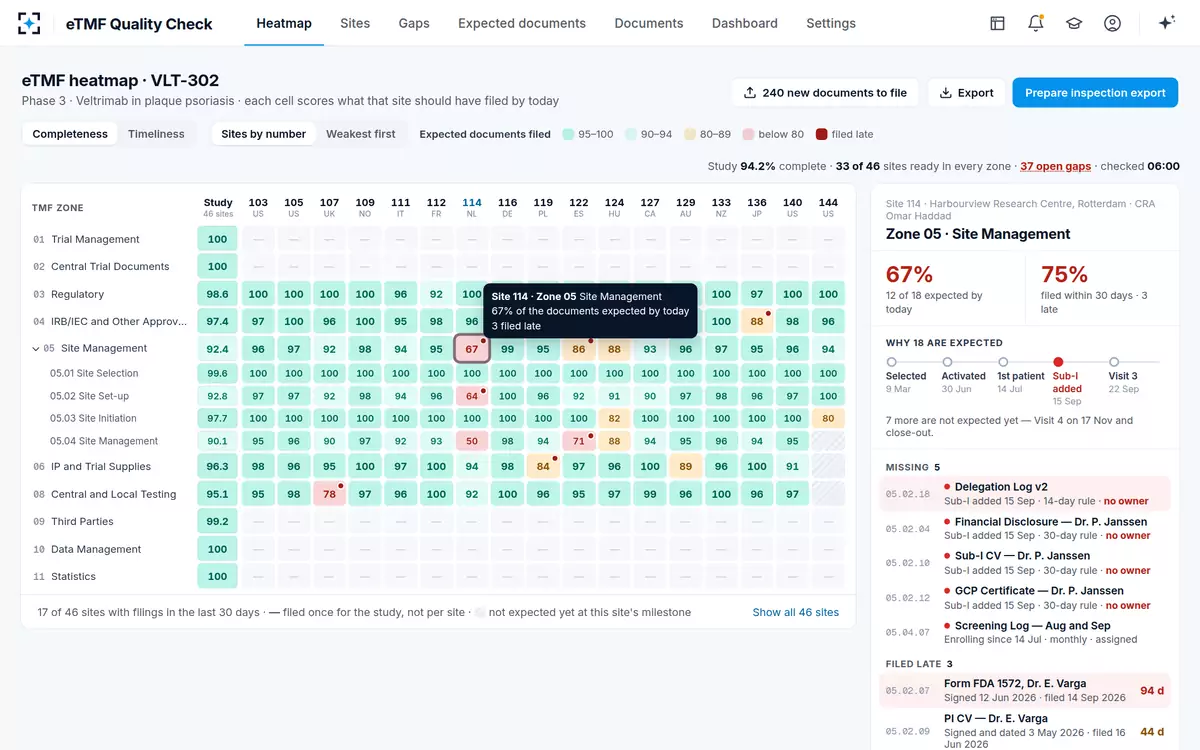
On the sample study, Site 114 in Rotterdam has eighteen documents expected by today in Zone 05, Site Management — eighteen rather than a round number because the site was selected on 9 March, activated on 30 June, enrolled its first participant on 14 July, added a sub-investigator on 15 September and held its third monitoring visit on 22 September. Twelve of the eighteen are filed. Five gaps are open, four of them created by the staff change alone. Seven further documents are not expected yet and sit outside the fraction entirely. The cell reads 67% complete, and the number is legible because the eighteen is on the screen beside it.
Aggregating upward is where care is needed. A study-level figure should be the sum of the site-level numerators over the sum of the site-level denominators, not the average of the site percentages — averaging percentages gives a site with four expected documents the same weight as a site with four hundred. On the sample study the file reads 94.2% complete, with 37 gaps open across forty-six sites.
Completeness as a grid: every zone at every site, scored this morning
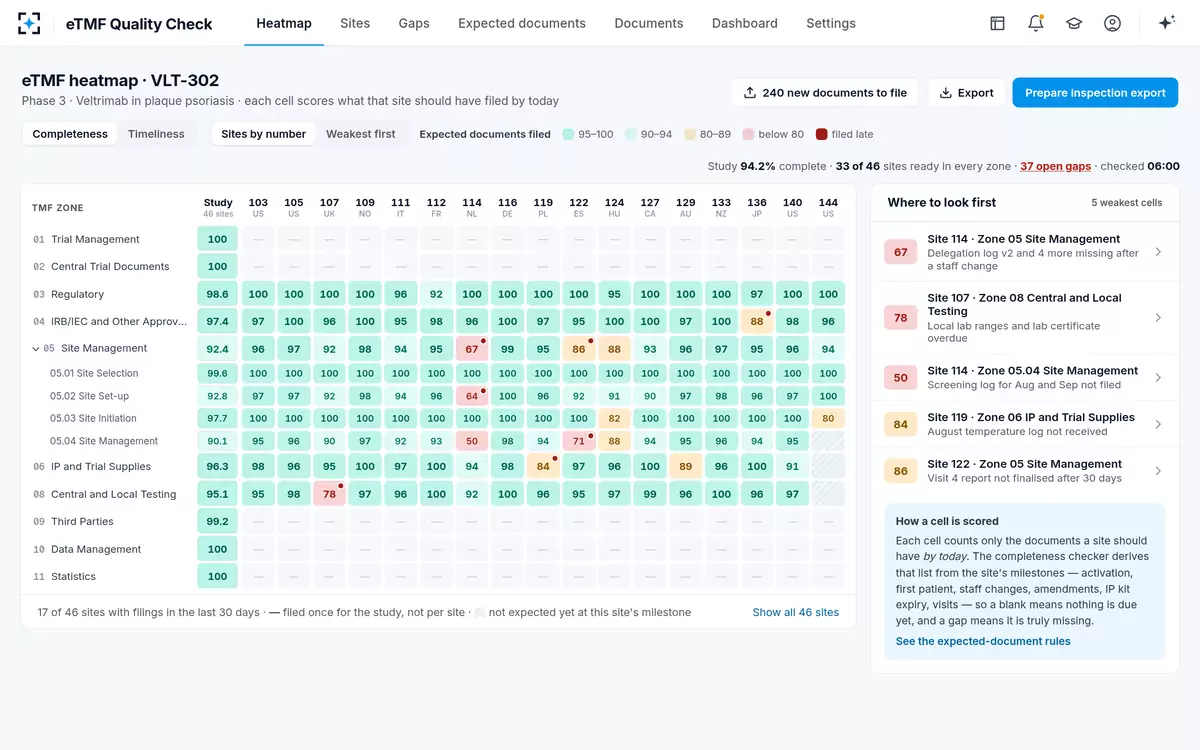
Each cell is a fraction whose denominator is that site's own milestones.
Four denominators, four different answers for the same file
The clearest way to see why the denominator matters is to score one site four ways on the same morning, with the same documents in the file, and read what each number would make a manager do next.
One site, one zone, one morning: four completeness figures
| Denominator | What it actually measures | Site 114, Zone 05 | What it makes you do next |
|---|---|---|---|
| Documents in the file | How well the filing step performed on what it received. | 100% — twelve filed, twelve classified | Nothing. The cell is green and the four documents the staff change created have never been counted. |
| Everything the trial will ever need | Distance from the end of the trial, mostly. | Low, and low for every site until close-out | Nothing useful. Every site is red, so nobody reads the colour. |
| A list kept by hand | The age of the list. | Whatever the list says — here it still shows the pre-September roster | Chase whatever the list happens to name. The delegation log is not on it. |
| Documents due by today at this site | The file, against the trial’s own events. | 67% — twelve of eighteen, five gaps open | Assign four documents to the site’s monitor with the passage that made each one due, and a date. |
The first row is common, and the most dangerous, because it produces a green file that nobody distrusts. It is also the easiest to spot in a report: if the completeness figure never moves when a site changes staff, it is counting the file against itself.
Not all missing documents are equal
A score that counts documents treats a missing delegation log and a missing courier receipt as the same event. The published work does not. One peer-reviewed study — Hecht and colleagues, in German Medical Science in 2015 — had a cross-company working party of quality-assurance specialists assess the 148 required core document types in version 2 of the Reference Model (2012) by the impact their absence would have on participants’ rights and safety and on data integrity.
How 148 core document types divide by the impact of losing them
Nearly half the document types assessed are in the group whose loss matters most. The same group sorted a second way — by overall risk, combining impact with how hard a document would be to replace — came out far more concentrated: 8% of document types in the very high category and 14% in the high one, against 38% in the medium one and 40% in the low one. The authors’ conclusion is the sentence every completeness report ought to carry: “when considering how to assure an adequate-quality TMF, it is important to assess the importance of the individual documents rather than to simply consider the overall number of documents filed.”
The practical consequence is a weighted view alongside the plain one. A site at 97% with a missing delegation log is in worse shape than a site at 88% whose five gaps are visit follow-up letters, and any scoring design that cannot express that will send people to the wrong site.
What tolerance is acceptable for missing TMF documents?
No regulatory guidance sets one — the 2015 working party said as much, finding no detailed regulatory guidance on tolerance limits. What exists is that working party’s own proposal, and it should be read as a proposal rather than as a standard — it has no regulatory status, and quoting it as a requirement is a misuse of it.
What the published proposal actually says about tolerance, and what it does not
| Question | What the 2015 paper states | What that means for a report |
|---|---|---|
| What is a tolerance limit for? | “The tolerance limit indicated what level of completeness is necessary to ensure acceptable quality of a TMF.” | It is a threshold on a score, applied per document class — not a single number for a whole file. |
| What is the limit for the most important documents? | “The tolerance limit for ‘stand alone documents’ (for instance, the clinical trial protocol) was 0%.” | For a document that exists once and anchors the trial, one missing is a failure. There is nothing to average it against. |
| How does a per-cent limit behave on a real trial? | The authors worked it: with 100 sites supplied with investigational material three times each — 300 documents — an expectation of under 1% is still met if 2 are missing. | Tolerance arithmetic only works where a document type recurs often enough to have a meaningful denominator. On a 46-site study most classes are far smaller than 300. |
| How was importance decided? | By a risk priority number: “(impact of missing process)² × effort to replace the document”, the impact squared because patient rights and safety were judged far more important than the effort of replacement. | Impact dominates, so a document that is easy to replace still ranks high if its absence matters. A tolerance scheme that ignores impact inverts this. |
| Is any of this a regulatory requirement? | No. It is one working party’s proposal, published in a peer-reviewed journal. | Cite it as a method you adopted, in your own plan, with your own numbers — never as a rule you are obeying. |
There is a regulatory idea in the neighbourhood, and it is worth getting right because it is often confused with the above. ICH E6(R3) asks sponsors to set ranges in advance for the things that matter to the trial’s quality.
“Where relevant, the sponsor should set pre-specified acceptable ranges (e.g., quality tolerance limits at the trial level) to support the control of risks to critical to quality factors. These pre-specified ranges reflect limits that when exceeded have the potential to impact participant safety or the reliability of trial results.”
ICH E6(R3), section 3.10.1.3, Risk Control
Note what that does and does not say. It tells you to set the limits in advance and to tie them to participant safety and the reliability of results. It does not give you a number, and it does not say that a trial master file needs one at all — the guideline’s own example is a quality tolerance limit at the trial level, tied to critical-to-quality factors rather than to filing. If you adopt a filing tolerance, it is yours, and your plan has to say what happens when it is exceeded.
Completeness by zone, by site, by day
One number for a trial is a board figure. The number that changes behaviour is the smallest one with an owner: this zone, at this site, today. Forty-six sites across eleven zones is five hundred and six cells, which sounds unmanageable and is not, because most of them do not move on a given day.
Four states a cell can be in, and why only one of them is a gap
Scored, and high
Every document due at this site in this zone by today is filed and has passed its quality check. The number is a fraction with a known bottom.
Scored, and low
Documents that should be here by today are not. This is the only state that is a gap, and each one names the rule and the passage that made it due.
Hatched — not due yet
The milestone that makes these documents due has not happened. Counting this as a gap would punish a site for being new; counting it as complete would flatter it. It is neither, so it is not scored.
A dash — not scored here
A zone filed once for the whole trial, not per site. Spreading a trial-level document across forty-six site columns would count it forty-six times.
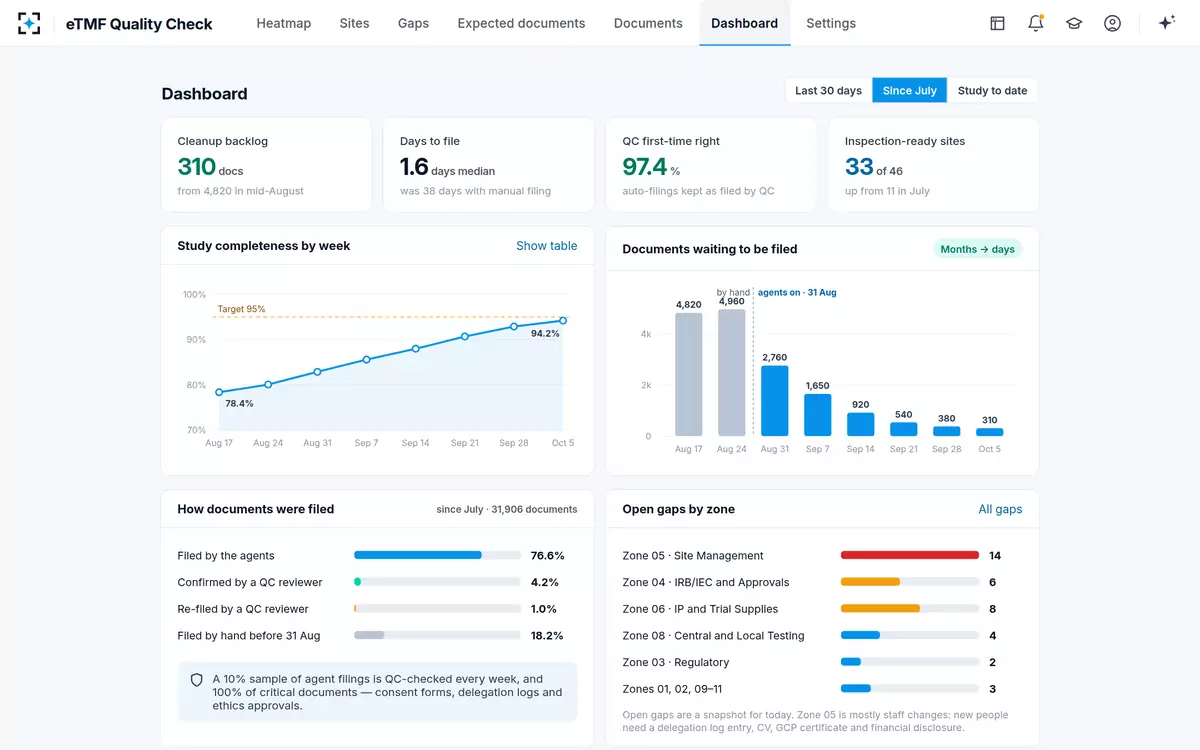
Scoring daily also changes what the number is for. A quarterly figure is a report on the past; a daily one is a work queue, because the difference between this morning and yesterday morning is a short list of sites where something happened. On the sample study the design target is 33 of 46 sites inspection-ready in every zone, up from 11 — a goal for the solution rather than a measured outcome, and the kind of figure that should always be labelled as such.
Completeness and timeliness are two scores, and eTMF Quality Check keeps them apart
Completeness: Documents due by today that are filed and confirmed.
Timeliness: Days from each filed document’s own date to the day it reached the file.
Completeness: What this site owes today, derived from its milestones.
Timeliness: The target in your TMF plan — 30 days on the sample study, and a setting, not a rule.
Completeness: Something that should be here is not. Somebody has to go and get it.
Timeliness: What is here arrived late. The document cannot be un-filed, so the fix is upstream.
Completeness: Whether the documents that are filed are the right ones, correctly indexed.
Timeliness: Whether anything is missing at all — a site with one document, filed fast, scores perfectly.
Completeness: A single average of the two lets a good filing speed cancel a missing delegation log.
Timeliness: And lets a complete file hide the fact that half of it arrived in the fortnight before an inspection.
What a green trial master file can still be hiding
Four things, all of them common, and none of them visible in a completeness percentage.
The first is a stale denominator. If the expected document list has not been re-derived since the last staff change, the score is a statement about an older trial. The second is equal weighting: ninety-seven per cent with a missing delegation log reads better than it is. The third is filing that nobody checked — a document counted as filed because it reached a folder, not because anyone confirmed it belongs there, which is what the QC review exists to catch. The fourth is a file assembled late: a trial master file can be complete this morning and still have been empty for most of the trial, which is a finding in itself.
The deficiency data shows the shape of the problem. In the European Medicines Agency’s 2023 inspection figures, essential documents produced 74 findings across the year’s 67 CHMP-requested inspections — 42 minor and 32 major, and none classed as critical. In that year, at least, essential-document problems were not single catastrophic absences but many smaller ones, which is the kind of problem a score with a correct denominator catches early and a quarterly sample can miss.
One cell, and the five documents behind the percentage
Reporting completeness when a CRO holds half the file
Most sponsors do not hold their whole file. The sponsor part may sit with a contract research organisation, sometimes in that organisation’s own system, and the investigator part sits at the sites. The EMA guideline is unambiguous that this is still one file in two parts — and the sponsor’s responsibility does not divide with it.
Three things go wrong when the score crosses an organisational boundary. The denominators differ, because each party derived its own expected document list from its own reading of the plan. The clocks differ, because one party counts from receipt and the other from the document’s date. And the reporting is self-assessed: a provider’s completeness figure is a statement by the party being measured.
The fixes are unglamorous and all belong in the plan rather than in a system. Agree one expected document list and one definition of the denominator, in writing, before the first document moves. Require the gap list rather than the percentage, because a list can be checked and a percentage cannot. Reconcile counts at a fixed interval and investigate differences instead of averaging them. And make sure the sponsor can see the underlying file, not a monthly extract of it — an oversight finding against a sponsor who could only see a report is a finding against the sponsor.
The completeness an inspector will actually test
An inspector does not recompute your percentage. They pick a thread — a participant, a visit, a staff member, an amendment — and ask the file to account for it, and the finding is written in terms of what the file could not do. The MHRA’s own metrics report records a critical finding in exactly those words: “The TMFs presented to inspectors being incomplete or inaccurate, which resulted in an inability to reconstruct the trial or procedural conduct to enable the verification of GCP compliance.”
Read that sentence as a test specification and it tells you what to measure. Incomplete or inaccurate: a document filed to the wrong artifact fails the same test as a document that is absent. Reconstruct procedural conduct: the thread includes who was permitted to do what, which is why delegation documents matter so much to it. And presented to inspectors: a file that cannot be shown is a file that is not complete, whatever the score says.
Six questions to ask of any TMF completeness number before you report it
- What is the denominator, exactly?
Documents due by today at this site, or something else? If the answer takes more than a sentence, the number is not reportable.
- When was it last re-derived?
A denominator computed before the last staff change, amendment or activation is describing a trial that no longer exists.
- Are the documents weighted by impact?
If not, say so, and publish the critical-document gaps separately. A single percentage cannot carry both messages.
- What happened to documents that are not due yet?
They should be outside the fraction. Counted as gaps they flood the red; counted as complete they flatter every new site.
- Does “filed” mean confirmed?
A document that arrived in a folder and was never checked is a claim. State whether the numerator counts filings that have passed quality control.
- Who produced it, and can you see underneath it?
A figure reported by the party being measured needs the gap list behind it, not a summary of the gap list.
Completeness as a trend, beside the backlog that drives it
Completeness is the easiest of the three inspection questions to measure and the easiest to measure dishonestly, and the difference is entirely in the denominator. Fix that, publish it beside the percentage, and the rest of the discipline — the expected document list it rests on, the timeliness score beside it, the quality check underneath it — becomes arguable rather than asserted. The list itself is built in the expected document list guide. To see the grid, the cells and the gaps together, start from eTMF Quality Check.
Questions people ask
What is a good TMF completeness score?
There is no published figure, and a number quoted without its denominator means nothing — ninety-seven per cent against a hand-kept list can be worse than eighty-eight against a derived one. The useful targets are per class rather than overall: no critical document missing at any site, no gap older than its due date, and a denominator re-derived within the last day. If you must report one headline number, report the gap count beside it.
Should a trial master file be 100% complete?
Against what is due today, yes, that is the only defensible goal — and some document classes admit no tolerance at all. The 2015 risk-based proposal by Hecht and colleagues put the tolerance for stand-alone documents such as the protocol at 0%. Against everything the trial will ever need, no: a trial in progress is legitimately incomplete, and a score that says otherwise is measuring the wrong thing.
What is a TMF heatmap?
A grid with the file’s zones on one axis and the sites on the other, each cell coloured by that site’s score in that zone. It works because it localises: a single trial-level percentage tells you to worry, while a grid tells you which site and which zone, which is the smallest unit anyone can act on. The useful ones distinguish at least four states — scored high, scored low, not due yet, and not scored at this level.
Can a TMF be complete and still fail an inspection?
Yes, in three ways. The documents can be present but misfiled or missing their metadata, which fails the same accuracy test. They can have been filed late, or all at once shortly before the inspection, which is itself evidence against a contemporaneous file. Or the file can be complete and inaccessible — findings about limitations in access appear in the EMA’s inspection reports independently of whether anything was missing.
How do you report TMF completeness to a sponsor?
With the denominator, the date it was derived, the gap list and the critical gaps called out separately. A sponsor receiving a percentage alone cannot discharge its oversight duty, because it cannot tell whether the number fell because the file got worse or rose because the list got shorter. Where a provider holds part of the file, agree the expected document list and the definition of “filed” in writing before the first document moves.
How do you measure the quality of a trial master file?
Completeness alone does not do it. The EMA guideline’s own list for a trial master file review covers whether all essential documents generated are available, whether they are filed in the right locations, whether they were added in a timely manner, whether they are correctly indexed, whether access matches the assigned roles, and whether the audit trail has been reviewed. Only the first of those six is completeness; the others are the subject of a quality check.